
Atlantic West Europe (676–819): From Merovingian Fragmentation …
Years: 676 - 819
Atlantic West Europe (676–819): From Merovingian Fragmentation to Carolingian Unity
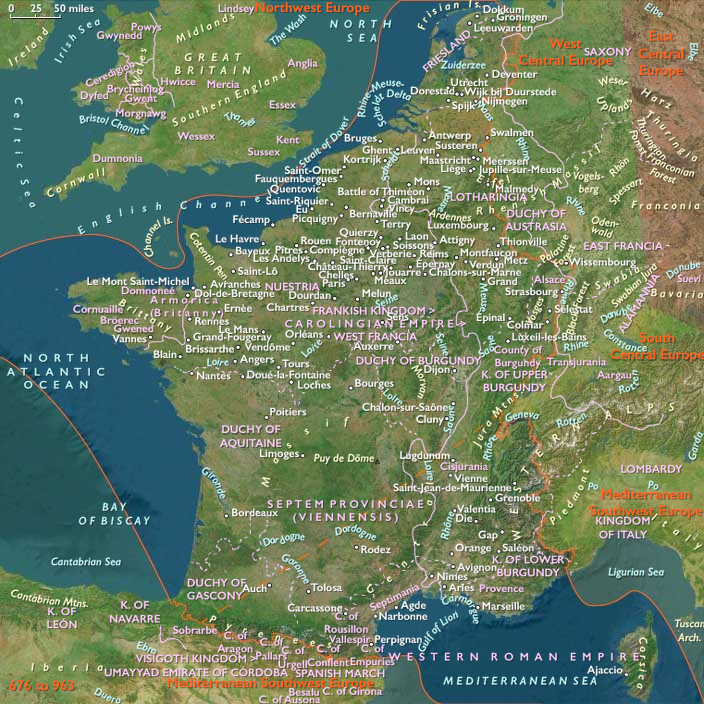
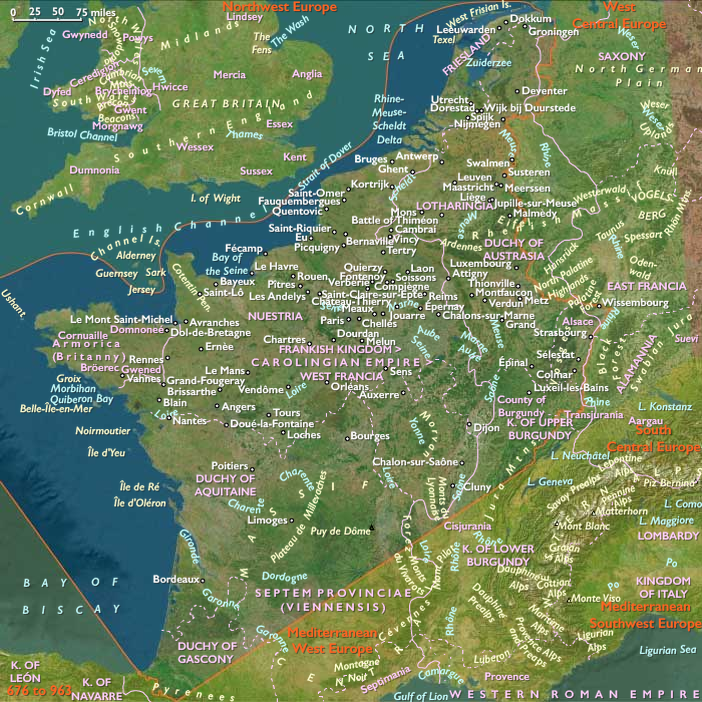
Between 676 and 819, Atlantic West Europe—including regions corresponding to modern-day France (Neustria, Austrasia, Aquitaine, Brittany, Burgundy) and the Low Countries—underwent profound political restructuring, evolving from fragmented Merovingian rule into the unified, culturally vibrant Carolingian Empire. This age witnessed the pivotal transition from declining royal authority to the consolidation of power under influential mayors of the palace, culminating in the ascendance of Charlemagne and the flowering of the Carolingian Renaissance.
Political and Military Developments
Merovingian Fragmentation and Austrasian Dominance (676–714)
- Following the assassination of Childeric II (675), the Frankish kingdoms—Neustria, Austrasia, and Burgundy—descended into rivalry and weakened royal power.
- Pepin of Herstal, Austrasian mayor of the palace, established dominance after the decisive Battle of Tertry (687), consolidating power over Neustria and Burgundy, thereby shifting control away from Merovingian kings to the mayors of the palace.
Carolingian Rise (715–751)
- Charles Martel (r. 718–741), son of Pepin of Herstal, fortified the Carolingian position by defeating Neustrian rivals and asserting authority over Aquitaine, Burgundy, and the Low Countries.
- His victory at Tours-Poitiers (732) halted the northward expansion of Umayyad forces, significantly shaping the future of Atlantic West Europe and earning him legendary status.
Carolingian Consolidation and Expansion (752–819)
- Pepin the Short (r. 751–768), Charles Martel's son, deposed the last Merovingian king (751), becoming king himself with papal sanction. His reign legitimized Carolingian rule, strengthened royal authority, and subdued Aquitaine.
- Charlemagne (r. 768–814) dramatically expanded Frankish territory through wars against Saxons, Lombards, Avars, and Muslim Spain, solidifying control over Aquitaine, Brittany, and parts of Burgundy.
- Charlemagne’s imperial coronation in 800 by Pope Leo III established the Carolingian Empire, a cultural and political unity unprecedented since Rome.
- Louis the Pious (r. 814–840) inherited a vast, culturally vibrant empire, though internal tensions foreshadowed future divisions.
Economic and Social Developments
Agricultural Revival and Feudal Foundations
- Improved stability under the Carolingians spurred agricultural expansion and economic recovery. Monastic estates spearheaded land clearance, technological innovations, and improved farming practices, laying groundwork for medieval manorialism.
- Proto-feudal relationships emerged as local aristocrats and monasteries provided peasants protection in exchange for labor, reinforcing hierarchical rural societies.
Urban Development and Commercial Renewal
- Trade gradually revived as towns such as Paris, Lyon, Nantes, Tours, and Utrecht benefited from increased political stability, becoming regional market centers.
- The Carolingian monetary reforms, especially the introduction of the silver denier, standardized and facilitated trade throughout Atlantic West Europe.
Religious and Cultural Developments
Expansion of Christianity and Ecclesiastical Reforms
- Carolingian rulers promoted Christianity vigorously, supporting missionary work in Saxony and among neighboring peoples.
- St. Boniface (d. 754), supported by Charles Martel and Pepin the Short, reorganized the Frankish church, strengthened papal ties, and founded key bishoprics throughout Atlantic West Europe.
Carolingian Renaissance
- Charlemagne’s court at Aachen became the heart of an intellectual revival, attracting scholars like Alcuin of York, Paul the Deacon, and Einhard.
- The establishment of cathedral and monastic schools, along with manuscript production centers in monasteries such as Corbie, Tours, and Fulda, significantly advanced literacy, education, and classical scholarship.
- Revival and standardization of Latin, script reforms (Caroline minuscule), and illuminated manuscripts marked cultural achievements.
Intellectual and Artistic Developments
Artistic and Architectural Innovations
- The period saw an evolution from Merovingian artistic traditions to Carolingian art, blending Classical Roman, Byzantine, and Germanic elements.
- Notable architectural projects included Charlemagne’s palace chapel at Aachen, Abbey of Saint-Denis, and monasteries throughout the empire.
Legacy and Significance
The era from 676 to 819 in Atlantic West Europe transformed a fragmented post-Roman landscape into a unified, culturally dynamic Carolingian Empire. The rise of the Carolingian dynasty established a powerful political order, revitalized economic life, and fostered a vibrant intellectual and artistic culture, laying the critical foundations for medieval European civilization.
People
- Alcuin of York
- Charlemagne
- Charles Martel
- Einhard
- Lothair I
- Louis the German
- Louis the Pious
- Paul the Deacon
- Pepin of Herstal
- Pepin the Short
- Pope Leo III
- Saint Boniface
Groups
- Franks
- Breton people
- Christianity, Chalcedonian
- Frisians
- Aquitaine, (Frankish) Duchy of
- Frisian Kingdom
- Austrasia, Frankish Kingdom of
- Burgundy, Frankish Kingdom of
- Francia (mayors of the palaces of Austrasia and Neustria)
- Austrasia, Frankish Kingdom of
- Aquitaine, (Carolingian) Kingdom of
- Vikings
- Brittany, Kingdom of
Topics
- Frisian–Frankish wars
- Tertry, Battle of
- Islamic invasion of Gaul
- Tours (Poitiers), Battle of
- Renaissance, Carolingian
- Viking Raids in France, Early
Commodoties
Subjects
Regions
Subregions
Related Events
Showing 10 events out of 56205 total
Years: 676 - 819
People
- Alcuin of York
- Charlemagne
- Charles Martel
- Einhard
- Lothair I
- Louis the German
- Louis the Pious
- Paul the Deacon
- Pepin of Herstal
- Pepin the Short
- Pope Leo III
- Saint Boniface
Groups
- Franks
- Breton people
- Christianity, Chalcedonian
- Frisians
- Aquitaine, (Frankish) Duchy of
- Frisian Kingdom
- Austrasia, Frankish Kingdom of
- Burgundy, Frankish Kingdom of
- Francia (mayors of the palaces of Austrasia and Neustria)
- Austrasia, Frankish Kingdom of
- Aquitaine, (Carolingian) Kingdom of
- Vikings
- Brittany, Kingdom of
Topics
- Frisian–Frankish wars
- Tertry, Battle of
- Islamic invasion of Gaul
- Tours (Poitiers), Battle of
- Renaissance, Carolingian
- Viking Raids in France, Early
Commodoties
Subjects
Regions
Subregions