
The Qara'unas in Transoxiana had meanwhile lost …
Years: 1360 - 1371
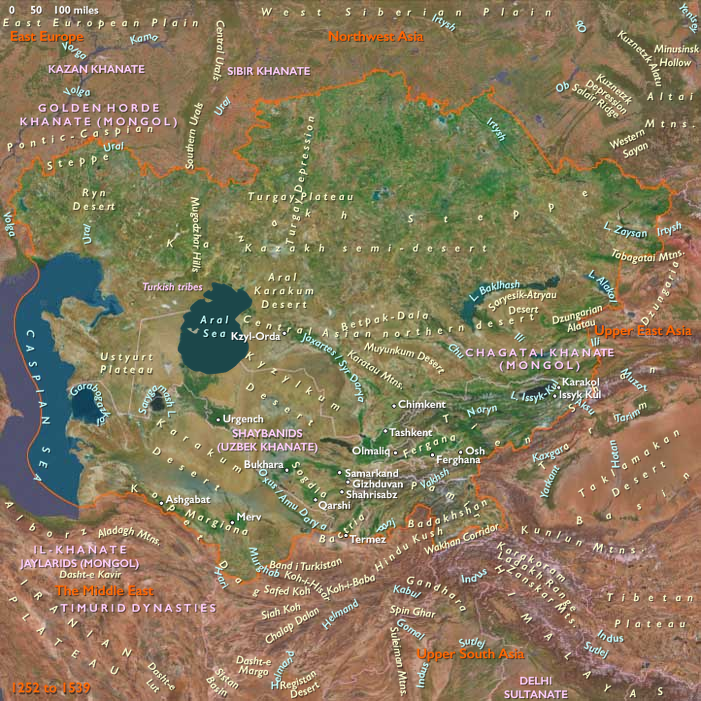
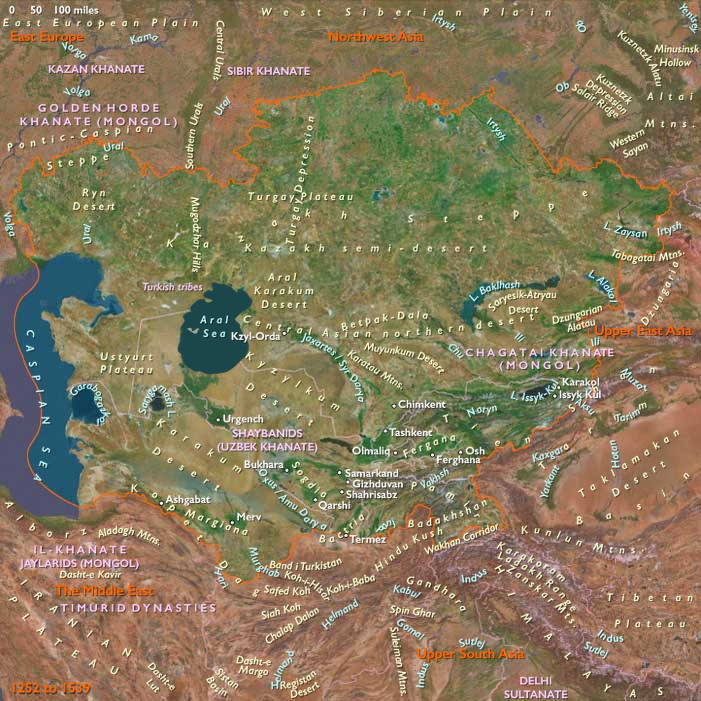
The Qara'unas in Transoxiana had meanwhile lost their status as de facto leaders of the Chagatai ulus; they have been replaced by Buyan Suldus, an easygoing and ineffective amir.
Tughlugh Timur judges that he will face little resistance in Transoxiana and invades in March 1360.
As predicted, most of the tribal amirs declare their support for him; those that don't (notably Hajji Beg of the Barlas tribe) decide to flee.
The Moghuls decide to find someone else to administer Hajji Beg's former territories; they agree on Hajji Beg's young nephew Timur, who has submitted to them.
This, incidentally, is the first step in Timur's rise to power as amir of the Timurid Empire.
The Moghuls soon leave Transoxiana after a dispute ensues among their amirs.
In 1361, however, Tughlugh Timur and his army ride into the region for the second time.
This time the khan seems to have decided to depose the Transoxianan amirs and centralize power in his own hands.
He executes several amirs, including Amir Bayazid and Buyan Suldus, while Hajji Beg, who had returned following the departure of the Moghuls in 1360, again retreats.
When the Qara'unas Amir Husayn opposes him, Tughlugh Timur invades his extensive territories located south of the Amu Darya and defeats him in battle.
Amir Husayn flees; the Moghul army advances as far south as Kunduz in pursuit of him and plunders the region.
Having destroyed the power of the Transoxianan amirs and reunified the Chagatai Khanate, Tughlugh Timur appoint his son Ilyas Khoja as viceroy of Transoxiana and departs for Moghulistan.
Locations
People
Groups
- Buddhism
- Transoxiana
- Islam
- Mongols
- Chagatai Khanate, Western
- Moghulistan, or Eastern Chagatai Khanate
Topics
Commodoties
Subjects
Regions
Subregions
Years: 1360 - 1371
Locations
People
Groups
- Buddhism
- Transoxiana
- Islam
- Mongols
- Chagatai Khanate, Western
- Moghulistan, or Eastern Chagatai Khanate
Topics
Commodoties
Subjects
Regions
Subregions