
Timur
founder of the Timurid dynasty
1329 CE to 1405 CE
Timur, Tarmashirin Khan, Emir Timur (late 1320s to April 9, 1336 – February 18, 1405), historically known as Tamerlane (from Persian: Timūr-e Lang, Aksak Timur "Timur the Lame" in Turkish), is a Turkic ruler.
He conquers West, South and Central Asia and founds the Timurid dynasty.
He is the grandfather of Ulugh Beg, who rules Central Asia from 1411 to 1449, and the great-great-great-grandfather of Babur Beg, founder of the Mughal Empire, which rules South Asia for centuries.
Timur is considered the last of the great nomadic conquerors of the Eurasian Steppe, and his empire sets the stage for the rise of the more structured and lasting Ottoman, Safavid and Mughal empires in the 1500s and 1600s.
Born into the Barlas confederation in Transoxiana during the 1320s or 1330s, Timur gains control of the Western Chagatai Khanate by 1370.
From this base, he leads military campaigns across Western, South and Central Asia and emerges as the most powerful ruler in the Muslim world after defeating the Mamluks of Egypt and Syria, the emerging Ottoman Empire and the declining Delhi Sultanate.
From these conquests he founds the Timurid Empire, although it will fragment shortly after his death.
Timur envisions the restoration of the Mongol Empire of Genghis Khan.
Unlike his predecessors Timur is also a devout Muslim who refers to himself as the Sword of Islam, converting nearly all the Borjigin leaders to Islam during his lifetime.
His armies are inclusively multiethnic.
During his lifetime Timur emerges as the most powerful ruler in the Muslim world after defeating the Mamluks of Egypt and Syria, the emerging Ottoman Empire and the declining Sultanate of Delhi.
Timur has also decisively defeated the Christian Knights Hospitaller at Smyrna; styling himself a Ghazi.
Timur's armies, which are inclusively multiethnic, are feared throughout Asia, Africa, and Europe, sizable parts of which are laid to ruin by his campaigns.
Scholars estimate that his military campaigns caused the deaths of seventeen million people, amounting to about 5% of the world population.
On the other hand, Timur is also recognized as a great patron of art and architecture, as he interacts with Muslim intellectuals such as Ibn Khaldun and Hafiz-i Abru.
Later Timurid dynastic histories claim that he was born on April 8, 1336, but most sources from his lifetime give ages that are consistent with a birthdate in the late 1320s.
Historian Beatrice Forbes Manz suspects the 1336 date was an invention designed to tie Timur to the legacy of Abu Sa'id Bahadur Khan, the last ruler of the Ilkhanate descended from Hulagu Khan, who died in that year.
World
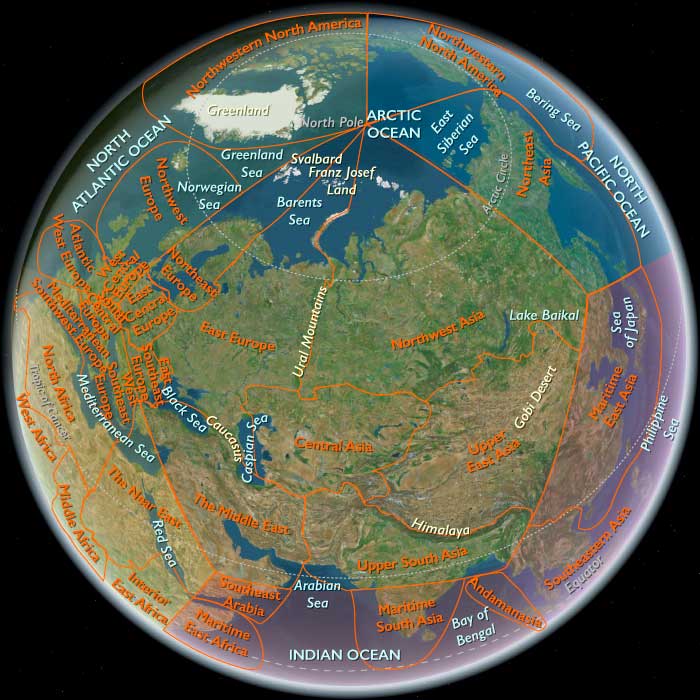
The Great Crossroads
View →Related Events
Showing 10 events out of 126 total
Central Asia (1252 – 1395 CE): Chaghatay Fragmentation, Moghulistan, and Timur’s Transoxiana
Geographic and Environmental Context
Central Asia includes the Syr Darya and Amu Darya basins (Transoxiana), Khwarazm and the Aral–Caspian lowlands, the Ferghana Valley, the Merv oasis and Kopet Dag piedmont, the Kazakh steppe to the Aral littoral, and the Tian Shan–Pamir margins.
-
Oasis belts (Bukhara–Samarkand, Khwarazm/Urgench, Ferghana, Merv) alternated with steppe and desert corridors (Kyzylkum, Karakum, Jetysu).
Climate and Environmental Shifts
-
Late Medieval Warm Period conditions yielded to the early Little Ice Age after c. 1300: cooler winters and episodic droughts stressed marginal pastures and canals.
-
Oases remained productive when canals were maintained; pasture shocks widened transhumance ranges on the steppe.
Societies and Political Developments
-
Mongol–Chaghatay framework (13th–14th c.):
-
After the Mongol conquest (early 1200s), Transoxiana lay within the Chaghatay ulus.
-
Islamization of the ruling elite advanced in the 14th century (e.g., Tarmashirin), but the ulus fractured into western Transoxiana vs. eastern Moghulistan (Jetysu–eastern Turkestan).
-
-
Moghulistan (mid-14th c. onward):
-
Consolidated under Tughluq Temür (r. 1347–1363), promoting Islam while steppe clans (Dughlat amirs) dominated Tarim oases (Kashgar, Yarkand).
-
-
Transoxiana’s city–amirs and Sufi networks:
-
Urban amirs and tribal commanders contested Bukhara–Samarkand; Sufi lineages (Yasawiyya; emergent Naqshbandiyya) gained social authority.
-
-
Timur (Tamerlane) and the Timurid ascendancy (from 1370):
-
Timur seized Samarkand (1370), unifying Transoxiana via alliances and campaigns.
-
He defeated the western and eastern Chaghatay rivals and intervened across Khwarazm, Khurasan, and the steppe (notably against Tokhtamysh at Kondurcha, 1391, and the Terek, 1395).
-
By the mid-1390s Samarkand stood as Timur’s capital and a revived caravan metropolis.
-
Economy and Trade
-
Oasis agriculture: wheat, barley, cotton, melons, orchards (apricot, pomegranate); irrigation via canal revetments and qanat galleries.
-
Pastoral production: horses, sheep, felt, hides, and remounts from steppe confederations.
-
Caravan commerce:
-
Transoxiana–Khwarazm linked to Volga–Caspian routes (furs, slaves, metals) and to Khurasan–Iran (textiles, dyes).
-
Ferghana–Kashgar–Turfan tied Moghulistan to China’s oases; jade, cotton, and raisins moved east–west.
-
-
Monies & markets: silver and copper coinages circulated alongside barter; late-Yuan collapse shifted some silk traffic south, while Timurid security restored Transoxiana’s bazars.
Subsistence and Technology
-
Canal maintenance and barrage repairs under strong amirs (and Timur later) sustained yields; abandonment under weak rule led to salinization and field loss.
-
Textiles & crafts: silk and cotton weaving, leatherwork, inlayed metalware, paper mills (Samarkand tradition).
-
Military tech: composite bows, heavy cavalry, lamellar armor; siege craft and early gunpowder bombards employed in late-14th-century campaigns.
Movement and Interaction Corridors
-
Oxus–Jaxartes (Amu/Syr) corridors funneled caravans between Khwarazm, Bukhara–Samarkand, and the Ferghana gates.
-
Hexi/Tarim rim road connected Kashgar–Yarkand to Turfan–Hami and onward to China; when conflict rose, traffic detoured via Khurasan–Persian Gulf lanes.
-
Steppe arcs (Ustyurt, Betpak-Dala, Ili) moved herds and armies between the Aral littoral, Moghulistan, and the Volga.
Belief and Symbolism
-
Islamic scholarship & Sufism: madrasas and khānqāhs flourished; Naqshband (1318–1389) catalyzed a sober, urban-rooted Sufism influential among merchants and elites.
-
Court patronage: Qurʾanic schools, endowments, and shrine complexes reinforced legitimacy; saints’ cults knit town and countryside.
Adaptation and Resilience
-
Twin economies: oasis farming + steppe herding provided ecological complementarity; caravans stitched the two.
-
Political redundancy: when the Chaghatay framework fractured, city-amirs, Sufi networks, and caravan guilds maintained local order; later Timurid consolidation restored regional security.
-
Route flexibility: merchants shifted between Caspian–Volga, Tarim–Gansu, and Khurasan–Gulf corridors as wars or epidemics (e.g., Black Death, 1340s) disrupted one path.
Long-Term Significance
By 1395, Central Asia had reconfigured under Timurid leadership:
-
Transoxiana regained primacy as a caravan heartland centered on Samarkand.
-
Moghulistan stabilized the eastern steppe–oasis zone under Islamizing elites.
-
Sufi orders, urban crafts, and restored irrigation prepared the ground for the Timurid cultural boom of the 15th century and renewed Silk Road vitality between the Caspian, Tarim, and Indian worlds.
The lands that will eventually become Tajikistan are part of Turkic or Mongol states during the centuries following the Mongol Conquests.
The Persian language remains in use in government, scholarship, and literature.
Among the dynasties that rule all or part of the future Tajikistan between the eleventh and fifteenth centuries are the Seljuk Turks, the Mongols, and the Timurids (Timur, or Tamerlane, and his heirs and their subjects).
Repeated power struggles among claimants to these realms take their toll on Central Asia.
The Mongol conquest in particular had dealt a serious blow to sedentary life and destroyed several important cities in the region.
The Timurids, although they had come in conquest, also patronize scholarship, the arts, and letters.
Despite the potential for serious fragmentation, Mongol law maintains orderly succession for several more generations, and control of most of Mawarannahr stays in the hands of direct descendants of Chaghatai, the second son of Genghis.
Orderly succession, prosperity, and internal peace prevail in the Chaghatai lands, and the Mongol Empire as a whole remains strong and united.
As the empire begins to break up into its constituent parts in the early fourteenth century, however, the Chaghatai territory also is disrupted as the princes of various tribal groups compete for influence.
One tribal chieftain, Timur (Tamerlane), emerges from these struggles in the 1380s as the dominant force in Mawarannahr.
Although he is not a descendant of Genghis, Timur becomes the de facto ruler of Mawarannahr and proceeds to conquer all of western Central Asia, Iran, Asia Minor, and the southern steppe region north of the Aral Sea.
East Europe (1252 – 1395 CE): Mongol Suzerainty, Novgorod’s Fur Republic, and Lithuania’s Expansion
Geographic and Environmental Context
East Europe includes Belarus, Ukraine, and the European portion of Russia (including the sixteen Russian republics west of the Urals).
-
Anchors: the forest and forest-steppe zones of the Dnieper, Volga–Oka, and Upper Dvina basins; the steppe corridor north of the Black Sea; and the Novgorod–Pskov lakelands tied to the Baltic.
-
Strategic axes: Dnieper–Desna, Volga–Oka, Western Dvina, and Don; Baltic connectors through Novgorod and Pskov.
Climate and Environmental Shifts
-
Late Medieval Warm Period yielded to the early Little Ice Age after c. 1300: longer winters, more frequent spring floods, and shorter growing seasons on the northern fringe.
-
River freezes lengthened the winter over-ice transport season, facilitating fur and grain movement to urban markets.
Societies and Political Developments
-
Mongol conquest and the Golden Horde (Jochid ulus):
-
The Mongol campaigns (1237–1240) dismantled the Kievan Rus’ commonwealth. Principalities survived under Horde suzerainty—paying tribute (yasak), hosting basqaq agents, and using the Horde courier system (yam).
-
The Horde’s capitals at Sarai (lower Volga) coordinated levies and trade; steppe raids remained a constant frontier pressure.
-
-
Vladimir–Suzdal’, Tver’, and Moscow:
-
On the Volga–Oka, rival knyaz lines competed for the Horde’s patent (yarlik) to the grand princely title of Vladimir.
-
Moscow rose from a junior appanage: Ivan I “Kalita” (1325–1341) secured the tribute-collector role, attracting boyars and clergy; Dmitry Donskoy defeated Mamai’s army at Kulikovo Field (1380), a landmark of resistance, though Toqtamish burned Moscow (1382).
-
-
Novgorod and Pskov (veche republics):
-
The Novgorod Republic remained autonomous under Horde suzerainty by avoiding direct confrontation, governed by a popular assembly (veche) and posadniks.
-
It dominated the fur–wax–honey trades and dealt with the Hanseatic League via the kontor in Toruń/Visby; Pskov emerged as a semi-independent sister republic.
-
-
Galicia–Volhynia and the rise of Lithuania:
-
King Danylo (Daniel) of Galicia (crowned 1253) revived the southwestern Rus’ realm, but by the 14th c. the Grand Duchy of Lithuania absorbed most Rus’ lands.
-
Under Gediminas (1316–1341) and Algirdas (victory at Blue Waters, 1362), Lithuania took Kiev and the Dnieper marches; after the Union of Krewo (1385) and Christianization of Lithuania (1387), a Polish-Lithuanian dynastic bloc formed, ruling much of Belarus and Ukraine.
-
-
Steppe frontier:
-
Rus’ principalities, Lithuanian border castles, and later Moldavian and Wallachian states contested the Black Sea approaches amid shifting Horde factions.
-
Economy and Trade
-
Agrarian base: rye, oats, and barley dominated the forest zone; wheat and millet in the forest-steppe. Three-field rotation spread on the more southerly soils.
-
Fur economy: sable, marten, squirrel, and fox from taiga and mixed forests remained the premier export through Novgorod–Hanse channels and via Volga routes to Sarai.
-
Long-distance routes:
-
Volga corridor: grain, salt, fish, and crafted goods moved to the Horde markets and the Caspian.
-
Baltic corridor: Novgorod and Pskov exported furs, wax, and flax; imported silver, cloth, and salt through Hanseatic towns.
-
Dnieper–Black Sea traffic declined after the Mongol shock but partially revived under Lithuanian protection in the later 14th c.
-
-
Urban crafts & coinage: smithing, tanning, and milling flourished in river towns; silver grivna bars and later fractional pennies circulated alongside foreign denars and Prague groschen.
Subsistence and Technology
-
Agriculture & stock: ard and heavy plough on loams; horse and ox traction; beekeeping (forest apiculture) supplied wax and honey.
-
Fortifications: timber-earth ramparts and later stone kremlins (e.g., Moscow’s white-stone walls from 1367) secured capitals and river nodes.
-
Transport: river barges in ice-free seasons; winter sled-trains along frozen rivers and packed snow routes; Horde yam way-stations accelerated couriers and tribute convoys.
Movement and Interaction Corridors
-
Volga–Oka–Klyazma triangle: heartland of northeast Rus’ power (Vladimir, Moscow, Tver’).
-
Upper Dnieper–Pripet–Western Dvina: Lithuanian–Rus’ arteries binding Kiev, Smolensk, Polotsk, and Vilnius.
-
Novgorod–Ladoga–Neva: gateway to the Baltic and Hanse.
-
Steppe roads from Sarai to the Don/Lower Dnieper: conduits for tribute, trade, and raids.
Belief and Symbolism
-
Orthodox Christianity: the Metropolitan’s seat shifted from Kiev to Vladimir (1299) and effectively to Moscow (1325); monastic renewal under Sergius of Radonezh (d. 1392) anchored spiritual and agrarian colonization of the northeast.
-
Latin Christianity: strong in Galicia–Volhynia and later within Lithuanian–Polish spheres; cathedral foundations and mendicant houses appeared in frontier towns.
-
Mission & frontier faiths: St Stephen of Perm (d. 1396) evangelized among the Komi; in steppe zones, Islam advanced within the Horde elite while popular Tengrism persisted.
-
Cult and memory: chronicles, saints’ lives, and battle legends (e.g., Kulikovo) forged shared identities across fragmented polities.
Adaptation and Resilience
-
Political layering: veche republics, appanage principalities, Horde suzerainty, and Lithuanian grand-ducal rule coexisted—allowing trade and church life to continue despite warfare.
-
Route redundancy: when Dnieper routes faltered, Volga and Baltic corridors carried exchange; winter travel compensated for summer insecurity.
-
Monastic colonization: cleared forests, drained bogs, and created agricultural oases that stabilized settlement and provided safe havens.
-
Fiscal pragmatism: tribute arrangements with the Horde and yarlik politics bought breathing room for rising centers (notably Moscow).
Long-Term Significance
By 1395, East Europe had reconfigured its political geography:
-
The Golden Horde still dominated the steppe; yet its internal strife and Timur’s blows (1380s–1395) weakened control.
-
Lithuania ruled most southwestern Rus’ lands, while Moscow emerged as the chief collector and defender in the northeast.
-
Novgorod remained a Baltic fur-empire under veche rule.
-
The Orthodox Church and monastic networks provided cohesion—laying the spiritual and institutional groundwork for Muscovy’s 15th-century ascent and for a durable Lithuanian-Rus’ commonwealth across the Dnieper and Dvina.
The Near and Middle East (1252–1395 CE): Mamluk Power, Ilkhanid Persia, and the Gulf Thalassocracy
From the valleys of the Tigris and Euphrates to the incense ports of Dhofar and the high walls of Cairo, the Near and Middle East in the Lower Late Medieval Age was a region of simultaneous devastation and renewal. Mongol armies and Black Death epidemics reshaped cities and frontiers, yet new centers of learning, commerce, and maritime enterprise rose from the wreckage, linking Iran, Syria, and Arabia in an intricate web of faith and exchange.
The Ilkhanate, founded in 1256, drew together Iran, Iraq, Armenia, and Azerbaijan under Mongol sovereignty. Its rulers—Ghazan (r. 1295–1304) and Öljeitü (r. 1304–1316)—converted to Islam and built monumental capitals at Tabriz and Sultaniyya, where Persianate administration and Mongol military discipline fused into a new imperial synthesis. Agrarian restoration followed: tax reforms, irrigation repairs, and standardized coinage encouraged recovery from the Mongol onslaughts of the previous century. When the dynasty collapsed after 1335, its fragments—the Jalayirids of Baghdad and Tabriz, the Chobanids of Azerbaijan, and the Muzaffarids of Fars and Isfahan—carried forward the artistic and bureaucratic legacy of the Ilkhans until Timur’s armies swept across the plateau in the 1380s and 1390s, subduing both Jalayirid Baghdad and Muzaffarid Shiraz by 1395.
In Syria, Egypt, and the Levant, the Mamluks—a military elite of Turkic, Circassian, and Kurdish origin—repelled the Mongols at ʿAyn Jālūt in 1260 CE and built an empire that stretched from Nubia to Anatolia. Under Sultan Baybars I (r. 1260–1277), a chain of fortresses secured the desert marches; the Crusader states fell one by one—Antioch in 1268, Tripoli in 1289, Acre in 1291—ending two centuries of Latin presence on the Syrian coast. Cairo, revitalized under the Qalawunid and later Circassian lines, became the pivot of a Sunni revival. Its madrasas, hospices, and waqf foundations endowed a new urban piety, while the Qalawun complex and the minarets of al-Nasir Muhammad defined the city’s skyline. In Jerusalem and Damascus, restoration of shrines and caravanserais followed, binding pilgrimage, scholarship, and trade into a single sacred geography.
Beyond the northern frontier, Cilician Armenia, long a crusader ally, succumbed to the Mamluks in 1375; Georgia and Armenia endured Mongol and later Timurid incursions but maintained resilient ecclesiastical traditions. On northeastern Cyprus, the Lusignan dynasty preserved a Latin outpost. Its ports of Famagusta and Kyrenia sustained Mediterranean commerce even as crusader dreams faded. There, Venetian and Genoese merchants turned to sugar cultivation, importing enslaved labor from the Black Sea and Africa—a precursor to Europe’s later plantation economies.
To the east, the Persian Gulf and Arabian Peninsula entered a maritime renaissance. Along the coast of Fars, the island kingdom of Hormuz relocated its capital offshore about 1301, evolving into the dominant Gulf thalassocracy. From its island fortress, Hormuz taxed all shipping between India, Iran, and Arabia, exporting horses, pearls, and dates while importing Indian cottons, pepper, and spices. The Nabhani dynasty held the interior of Oman, while the Mahra sultans ruled the eastern Yemeni littoral and Socotra, policing the monsoon routes. In Hadhramaut, the oases of Shibam and Tarim prospered under Rasulid overlordship from Taʿizz and Zabīd, producing dates and jurists alike; the Bā ʿAlawī families of Tarim fused Sufi sanctity with mercantile enterprise, laying the foundation of the later Hadhrami diaspora that would link Arabia, India, and the Malay world. In Dhofar, frankincense groves continued to yield the aromatic resin that had perfumed temples since antiquity, while Socotra’s dragon’s-blood and aloe maintained niche trades to Gujarat and Calicut. The dhow fleets of al-Shihr and Mirbat rode the monsoons between Hormuz, Malabar, and the Swahili coast, tying the Gulf to the wider Indian Ocean.
Meanwhile, on the Nile’s southern frontier, the Mamluk intervention in Nubia after 1276 CE ended the independence of Christian Dongola. Arab tribes—Beja, Jaʿalin, and Juhayna—migrated southward, intermarrying with Nubian nobles and spreading Islam through commerce rather than conquest. By the fourteenth century, Arab-Nubian Muslim dynasties ruled the valley, while the nomadic Juhayna ranged between the Nile and the Red Sea hills. Conversion, commerce, and intermarriage rather than war defined this gradual Arabization of the Sudanese corridor. Southward migrations of Luo and other Nilotic peoples followed, diversifying the upper Nile’s cultural landscape.
Throughout the region, plague and climate tested resilience. The Black Death (1347–1351) decimated populations from Tabriz to Cairo, emptying markets and caravanserais, yet irrigation and trade revived quickly where canal and qanāt systems endured. In Iran and Mesopotamia, the Tigris–Euphrates canal tracts and Fars orchards continued to yield grain, dates, and cotton. Syrian iqṭāʿ-holders restored orchards and olive groves; artisans in Aleppo and Damascus revived the glass, textile, and metal industries that made them famous from Genoa to Samarkand. The overlapping networks of merchants, Sufi orders, and urban guilds maintained a measure of stability when dynasties faltered.
Religiously, Islam’s geographic breadth encouraged plural expression. The Ilkhanids’ conversion sanctioned a synthesis of Persian bureaucratic culture and Mongol political forms. The Mamluks enshrined Sunni orthodoxy through law colleges and endowments; the Suhrawardi and Kubrawi Sufi orders crossed linguistic frontiers, linking Khurasan to Cairo. Christian and Jewish communities—Armenian, Georgian, Nestorian, Coptic, and Rabbanite—remained active in manuscript art, translation, and trade. The multicultural workshops of Tabriz and Damascus produced illuminated Qurʾans and Gospel codices alike, hallmarks of a cosmopolitan Middle East.
By 1395 CE, the region had re-formed into a constellation of complementary powers. Mamluk Syria and Egypt stood as guardians of Sunni learning and Mediterranean commerce; Jalayirid Baghdad and Muzaffarid Shiraz sustained Persianate art until Timur’s armies imposed a new imperial order. Hormuz ruled the Gulf as an island empire of merchants, while the Hadhrami and Dhofari coasts linked Arabia to India and Africa. Cyprus remained Latin and commercially vibrant, the last echo of crusader Christendom. Along the Nile, Arab-Nubian fusion gave rise to new societies that would shape the Sudan for centuries.
The fourteenth century thus closed not in decline but in transformation—a world of rebuilt capitals, re-channeled rivers, and re-charted seas, where Persian administrators, Egyptian Mamluks, Gulf mariners, and Hadhrami saints together forged the polycentric Middle East that would carry its traditions into the early modern age.
Middle East (1252 – 1395 CE): Ilkhanid Persia, Mamluk Syria, Caucasian Frontiers, and the Persian Gulf Thalassocracy
Geographic and Environmental Context
The Middle East includes Iraq, Iran, Syria, Armenia, Georgia, Azerbaijan, eastern Jordan, most of Turkey’s central and eastern uplands (including Cilicia), eastern Saudi Arabia, northern Oman, Qatar, Bahrain, the UAE, northeastern Cyprus, and all but southernmost Lebanon.
-
Anchors: the Tigris–Euphrates basin, the Iranian plateau with Azerbaijan–Tabriz, the Caucasus (Armenia–Georgia–Azerbaijan), the Cilician uplands and Syrian plains, the Persian Gulf rim (Hormuz, al-Ahsa, Bahrain, Oman), and northeastern Cyprus as a crusader–Mamluk frontier node.
Climate and Environmental Shifts
-
Transition from the Medieval Warm Period to the Little Ice Age (~1300) brought more variable rainfall: steppe margins and uplands suffered droughts, but irrigated zones (Khuzestan, Tigris–Euphrates alluvium, northern Syria, Fars) remained productive with careful canal upkeep.
-
Plagues, especially the Black Death (1347–1351), devastated urban populations in Tabriz, Baghdad, Aleppo, and Damascus, undermining tax bases and military manpower.
Societies and Political Developments
-
Ilkhanate and Successor States:
-
Founded in 1256, the Ilkhanate encompassed Iran, Iraq, Azerbaijan, Armenia, and eastern Anatolia.
-
Under Ghazan (r. 1295–1304) and Öljeitü (r. 1304–1316), Islam became the state religion, reforms standardized taxes, and monumental capitals rose at Tabriz and Sultaniyya.
-
Collapse after 1335 led to regional successor dynasties: the Jalayirids (Baghdad–Tabriz), Chobanids (Azerbaijan), and Muzaffarids (Fars–Isfahan). By the 1380s–1390s, Timur’s invasions shattered them, culminating in victories over Jalayirids and Muzaffarids by 1395.
-
-
Mamluk Syria and Cilicia:
-
Mamluks defeated Mongols at ʿAyn Jālūt (1260) and absorbed the Syrian coast, toppling the Crusader states: Antioch (1268), Tripoli (1289), and Acre (1291).
-
Cilician Armenia, long allied with crusaders, fell to the Mamluks in 1375, ending the kingdom.
-
Northeastern Cyprus remained in Latin hands under the Lusignan dynasty, serving as a crusader–commercial outpost until Ottoman advance.
-
-
Caucasus (Armenia, Georgia, Azerbaijan):
-
Georgia endured Mongol suzerainty and fragmentation; Timurid raids (from 1386) devastated Kartli and Kakheti but church culture persisted.
-
Armenia was divided between Ilkhanid and Turkmen spheres, later overrun by Timur.
-
-
Eastern Jordan and Eastern Arabia:
-
Bedouin and tribal emirates balanced between Ilkhanid, Mamluk, and local suzerainty.
-
In al-Ahsa and Qatif, the Jarwanids (14th c.) controlled pearls and trade.
-
-
Oman and Hormuz:
-
The Nabhani dynasty held the Omani interior; coastal ports came under Hormuz, which relocated to an island base c. 1301.
-
By the 14th century Hormuz had become the preeminent Persian Gulf thalassocracy, taxing Gulf trade and controlling routes between India, Iran, and Arabia.
-
Economy and Trade
-
Agriculture:
-
Mesopotamia’s canals supported dates, wheat, and flax when maintained.
-
Fars, Isfahan, and Azerbaijan produced cotton, silk, and fruit.
-
Syrian plains yielded grain, olives, and fruits under iqṭāʿ assignments.
-
-
Maritime trade:
-
Hormuz dominated Gulf tolls, channeling Indian pepper, cottons, and spices northward, and exporting Arabian horses, pearls, and dates.
-
Omani and Bahraini ports linked fisheries and pearl-beds to wider circuits.
-
-
Overland caravans:
-
Tabriz–Sultaniyya–Rayy–Khurasan remained Silk Road arteries, routing Chinese silks and Central Asian horses westward.
-
Aleppo and Damascus linked the Indian Ocean–Persian Gulf circuits with Mediterranean trade (Genoese, Venetian).
-
-
Currency: Ilkhanid monetary reforms under Ghazan stabilized coinage; Mamluks minted dīnārs and dirhams; Hormuz issued its own copper and silver for Gulf trade.
Subsistence and Technology
-
Hydraulics: canal dredging on the Tigris–Euphrates, qanāt networks in Iran, water-lifting wheels in Syria and Fars.
-
Military: steppe cavalry and mamluk armies; siege artillery and early gunpowder bombs appeared in late-14th-century warfare.
-
Craft industries: Syrian glass and textiles, Persian inlaid metalwork and miniature painting, Armenian manuscript arts.
Movement and Interaction Corridors
-
Silk Road trunks: Tabriz ⇄ Baghdad ⇄ Aleppo ⇄ Damascus; branches to Sultaniyya and Khurasan.
-
Persian Gulf: Hormuz ⇄ Basra ⇄ Wasit and Hormuz ⇄ Oman ⇄ India, timed to the monsoon.
-
Caucasus passes: Darial and Derbent funneled steppe nomads and caravans.
-
Cilicia–Levant routes: Sis ⇄ Aleppo–Damascus for trade and crusader/Mamluk conflicts.
-
Northeastern Cyprus: Lusignan harbors (Famagusta, Kyrenia) tied to Genoese and Venetian networks.
Belief and Symbolism
-
Islam:
-
Ilkhanid Islamization fused Persianate culture with Mongol rulership; Sufi orders (Suhrawardiyya, Kubrawiyya) proliferated.
-
Mamluks institutionalized Sunni madrasas and waqf endowments in Damascus, Aleppo, and Jerusalem.
-
-
Christianity:
-
Armenian and Georgian churches endured under Mongol, Mamluk, and Timurid pressures.
-
Northeastern Cyprus and Cilician Armenia hosted Latin cathedrals and monasteries.
-
-
Judaism: thriving communities in Baghdad, Damascus, and Tabriz engaged in scholarship and commerce.
Adaptation and Resilience
-
Political layering: successor dynasties (Jalayirids, Muzaffarids) maintained irrigation and caravan routes after Ilkhanid collapse.
-
Route redundancy: if Levantine ports faltered, trade diverted via Hormuz–Tabriz or the Black Sea (Trebizond).
-
Urban–Sufi–guild networks: mediated crisis during plague years, sustaining social cohesion.
-
Maritime resilience: Hormuz’s dominance ensured Gulf commerce continued despite upheavals inland.
Long-Term Significance
By 1395, the Middle East had reconfigured into polycentric powers:
-
Mamluk Syria consolidated Sunni legitimacy and Mediterranean trade.
-
Jalayirids and Muzaffarids carried Ilkhanid legacies until Timur’s conquests.
-
Hormuz anchored the Persian Gulf as a global maritime crossroad.
-
Armenia, Georgia, and Cilicia suffered fragmentation and invasion but preserved ecclesiastical traditions.
-
Northeastern Cyprus remained Latin, a final outpost of crusader Christendom.
This constellation — Persianate successor courts, Mamluk Levant, Gulf thalassocracy, and Caucasian frontier polities — defined the region’s transition into the 15th century under Timurid shockwaves and the oncoming Ottoman challenge.
A brief resurgence of Georgian power in the fourteenth century ends when the Turkic conquerer Timur (Tamerlane) destroys Tbilisi in 1386.
Tamerlane, variously described as of Mongol or Turkic origin, is the next ruler to achieve emperor status.
He conquer Transoxiana proper and by 1381 establishes himself as sovereign.
He does not have the huge forces of earlier Mongol leaders, so his conquests are slower and less savage than those of Genghis Khan or Hulagu Khan.
Nevertheless, Shiraz and ...
South Asia (1252–1395 CE): Sultanates, Temples, and Oceanic Gateways
From the passes of Afghanistan to the lagoons of Kerala and the island atolls of the Maldives, South Asia in the Lower Late Medieval Age was a world of shifting capitals, converging faiths, and expanding sea routes. The monsoon remained the great architect of life, its alternating abundance and scarcity driving hydraulic ingenuity, agricultural diversity, and mercantile enterprise. By the fourteenth century, the subcontinent was knit together by caravan and sea, by shared institutions of devotion and trade, and by the political duality of the Delhi Sultanate in the north and the twin powers of Bahmani and Vijayanagara in the south.
The Delhi Sultanate, centered on the Punjab–Doab, inherited a century of consolidation. Under Alauddin Khalji (r. 1296–1316), frontier raids were repelled, revenue reforms rationalized, and the Sultan’s authority pressed deep into the Deccan. His successor, Muhammad bin Tughluq (r. 1325–1351), extended campaigns from Gujarat to Madurai but overreached; famines, revolts, and failed experiments in currency and administration frayed the realm. Firoz Shah Tughluq (r. 1351–1388) restored order through canal works, madrasas, and endowments that linked state and faith, but within a decade of his death the empire disintegrated. Timur’s invasion of 1398 CE devastated Delhi and the upper Ganga plain, closing a cycle of central dominance.
To the northwest, Afghan and Khurasani frontiers remained gateways of exchange. The Karts of Herat and later Timurid commanders dominated the trans-Hindu Kush approaches; horse caravans, falcons, and precious textiles passed through Kabul and Ghazni toward Lahore and Delhi. In Kashmir, the establishment of the Shah Mir sultans(from 1339) introduced Islam to the court without extinguishing the valley’s Sanskrit learning and artistry.
Eastward, Bengal broke decisively from Delhi’s control. The Ilyas Shahi dynasty (from 1352) ruled from Gauda and Pandua, maintaining fleets on the deltaic channels and embanking the rivers for rice, jute, and cane cultivation. Prosperous and cosmopolitan, Bengal’s silver tanka coinage and river ports connected it to Chittagong, Arakan, and the eastern seas. Along the Naf–Kaladan corridor, the Launggyet kingdom of northern Arakan mediated between Bengal and Upper Myanmar, its rice, salt fish, and elephants moving with the tides toward the Chindwin gateway and the rising Burmese capital of Ava.
In the Himalayan crescent, Nepal’s Malla era flowered. The city-states of Kathmandu, Patan, and Bhaktapur built tiered pagodas and brick–timber palaces; artisans forged gilt copper images and repoussé ornaments that blended Vajrayana and Hindu devotion. To the east, the valleys of Bhutan coalesced around monastic estates of the Drukpaorder; dzong-like fortresses presided over a landscape where pastoral and agrarian life merged with Himalayan Buddhism. The passes of Kuti, Kerung, and Nathu carried salt, wool, and paper between Tibet, Nepal, and the plains, sustaining a centuries-old vertical trade.
Across this vast northern arc, canals, embankments, and riverboats underwrote resilience. The Tughluq canals linked Yamuna and Ganga tracts; Bengal’s earthen polders contained the floods of the Brahmaputra–Meghna; and Newar stone spouts (hiti) distributed water through urban courtyards. Even amid invasion and rebellion, agrarian cycles and market towns endured. Sufi hospices offered refuge and credit; temple endowments and monastic networks stabilized rural life. The Chishti and Suhrawardi orders spread devotional Islam across towns and villages, while Bhakti poets in Maharashtra and the north began to reinterpret older Hindu spirituality in the vernacular.
South of the Narmada, a new political balance emerged. Delhi’s Deccan campaigns shattered older dynasties—the Yadavas, Hoysalas, and Kakatiyas—but opened space for regional power. In 1347, Ala-ud-Din Bahman Shahestablished the Bahmani Sultanate at Gulbarga (later Bidar), claiming the mantle of Persianate Islam in the Deccan. Within a decade, the brothers Harihara I and Bukka Raya I founded the Vijayanagara Empire on the Tungabhadra, creating a Hindu imperial center whose granite walls, tank-fed gardens, and towering temples at Hampi proclaimed resilience against northern invasion. Between these two great states stretched a frontier of forts, irrigation tanks, and shifting alliances that defined peninsular politics for the next two centuries.
The southern littoral remained the meeting ground of oceans. The Pandya realm of Madurai collapsed under Khalji and Tughluq incursions; a brief Madurai Sultanate (1335–1378) yielded to Vijayanagara. Along the western coast, Calicut rose under the Zamorin as a premier Indian Ocean port. The Malabar backwaters and Kerala pepper gardens fed demand from the Red Sea to the South China Sea, while Quilon, Goa, and Nagapattinam thrived as multiethnic harbors. Chinese junks arrived in Yuan and early Ming decades, exchanging silks and copper for spices, pearls, and cottons.
In Sri Lanka, irrigation in the northern plains declined with the fall of Polonnaruwa. Highland and coastal polities at Gampola and Kotte shared the island with the Tamil Jaffna kingdom, its rulers mediating between South Indian and Sri Lankan trade. Buddhism persisted but lost its royal patronage, while Tamil Saivism and mercantile guilds dominated the northern coast. Across the open sea, the Maldives flourished as an Islamic sultanate and hub of cowrie export. Cowries served as small currency from Bengal to East Africa, while tuna, coir, and coral jewelry reached every shore of the Indian Ocean. The Lakshadweep islands integrated into Malabar’s spice circuits, and the distant Chagos atolls, still uninhabited, served as navigational markers for Arab and Indian seafarers.
Despite climatic cooling and intermittent famine, South Asia’s ingenuity endured. Canal and tank systems buffered monsoon irregularities; double-cropping spread across Bengal and the Deccan; and horse trade through the Afghan passes and maritime networks through Hormuz and Aden kept markets supplied. Islamic and Hindu institutions coexisted—mosques, madrasas, and khanqāhs beside temples, monasteries, and shrines—forming a dense spiritual landscape that bridged rural and urban life.
By 1395 CE, the subcontinent had become a mosaic of sultanates, temple kingdoms, and oceanic polities. Delhi remained a wounded but symbolic capital; Bengal flourished as an independent deltaic power; Kashmir and Nepal perfected their courtly arts; Bhutan and Arakan linked the Himalayas to the Bay; and in the south, the twin empires of Bahmani and Vijayanagara defined the political frontier. The Maldives exported currency to half the known world, while Calicut and Quilon stood as the new hinge between the Indian Ocean and the China seas.
Amid transition and turbulence, South Asia preserved its rhythms of irrigation, devotion, and exchange—a civilization resilient in its regional diversity and poised to enter the early modern age as one of the great centers of global commerce and culture.