
The Near and Middle East (1252–1395 CE): …
Years: 1252 - 1395
The Near and Middle East (1252–1395 CE): Mamluk Power, Ilkhanid Persia, and the Gulf Thalassocracy
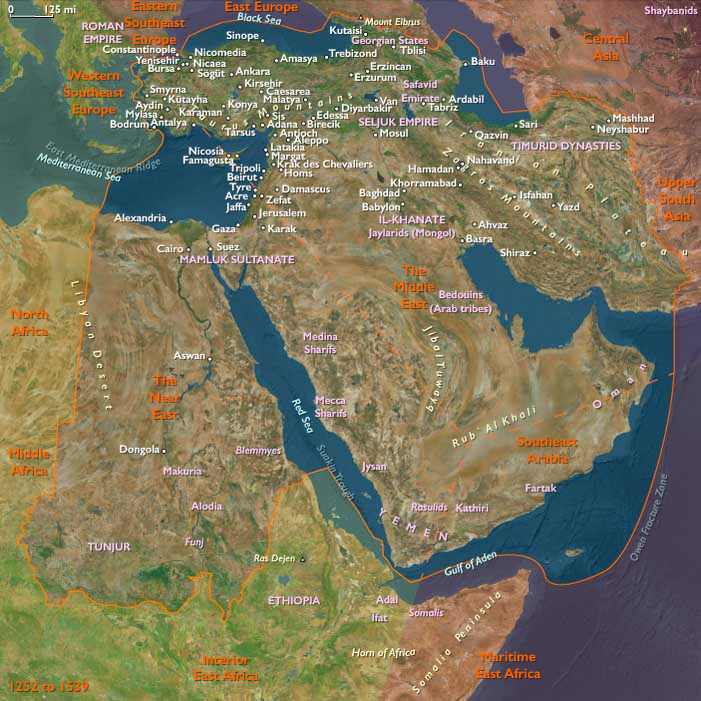
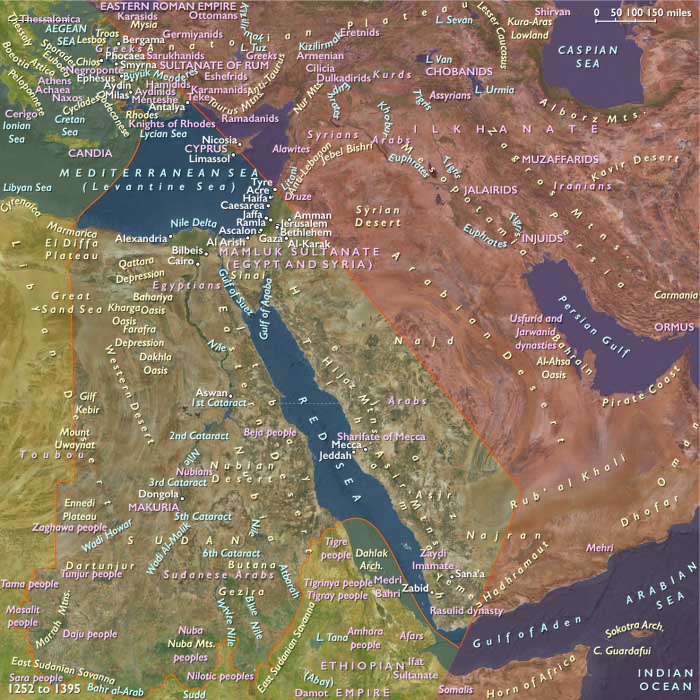
From the valleys of the Tigris and Euphrates to the incense ports of Dhofar and the high walls of Cairo, the Near and Middle East in the Lower Late Medieval Age was a region of simultaneous devastation and renewal. Mongol armies and Black Death epidemics reshaped cities and frontiers, yet new centers of learning, commerce, and maritime enterprise rose from the wreckage, linking Iran, Syria, and Arabia in an intricate web of faith and exchange.
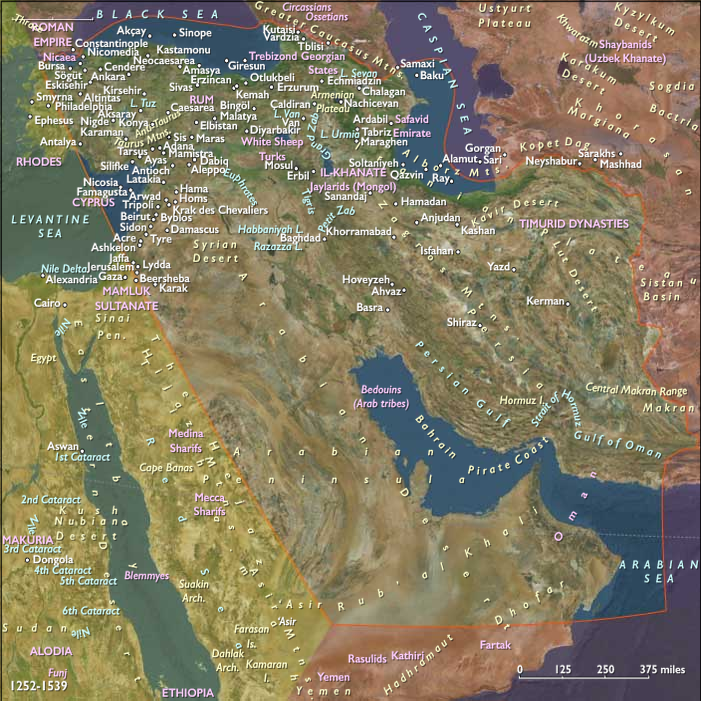
The Ilkhanate, founded in 1256, drew together Iran, Iraq, Armenia, and Azerbaijan under Mongol sovereignty. Its rulers—Ghazan (r. 1295–1304) and Öljeitü (r. 1304–1316)—converted to Islam and built monumental capitals at Tabriz and Sultaniyya, where Persianate administration and Mongol military discipline fused into a new imperial synthesis. Agrarian restoration followed: tax reforms, irrigation repairs, and standardized coinage encouraged recovery from the Mongol onslaughts of the previous century. When the dynasty collapsed after 1335, its fragments—the Jalayirids of Baghdad and Tabriz, the Chobanids of Azerbaijan, and the Muzaffarids of Fars and Isfahan—carried forward the artistic and bureaucratic legacy of the Ilkhans until Timur’s armies swept across the plateau in the 1380s and 1390s, subduing both Jalayirid Baghdad and Muzaffarid Shiraz by 1395.
In Syria, Egypt, and the Levant, the Mamluks—a military elite of Turkic, Circassian, and Kurdish origin—repelled the Mongols at ʿAyn Jālūt in 1260 CE and built an empire that stretched from Nubia to Anatolia. Under Sultan Baybars I (r. 1260–1277), a chain of fortresses secured the desert marches; the Crusader states fell one by one—Antioch in 1268, Tripoli in 1289, Acre in 1291—ending two centuries of Latin presence on the Syrian coast. Cairo, revitalized under the Qalawunid and later Circassian lines, became the pivot of a Sunni revival. Its madrasas, hospices, and waqf foundations endowed a new urban piety, while the Qalawun complex and the minarets of al-Nasir Muhammad defined the city’s skyline. In Jerusalem and Damascus, restoration of shrines and caravanserais followed, binding pilgrimage, scholarship, and trade into a single sacred geography.
Beyond the northern frontier, Cilician Armenia, long a crusader ally, succumbed to the Mamluks in 1375; Georgia and Armenia endured Mongol and later Timurid incursions but maintained resilient ecclesiastical traditions. On northeastern Cyprus, the Lusignan dynasty preserved a Latin outpost. Its ports of Famagusta and Kyrenia sustained Mediterranean commerce even as crusader dreams faded. There, Venetian and Genoese merchants turned to sugar cultivation, importing enslaved labor from the Black Sea and Africa—a precursor to Europe’s later plantation economies.
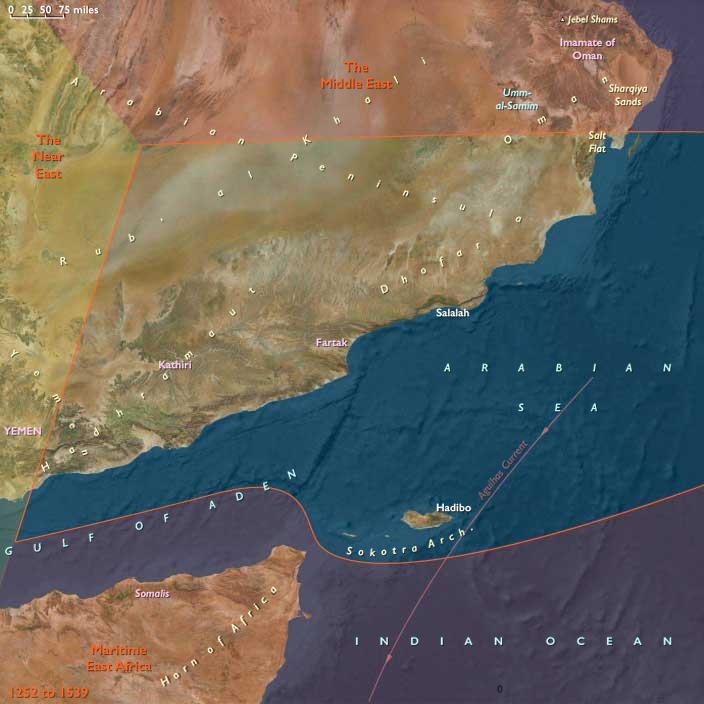
To the east, the Persian Gulf and Arabian Peninsula entered a maritime renaissance. Along the coast of Fars, the island kingdom of Hormuz relocated its capital offshore about 1301, evolving into the dominant Gulf thalassocracy. From its island fortress, Hormuz taxed all shipping between India, Iran, and Arabia, exporting horses, pearls, and dates while importing Indian cottons, pepper, and spices. The Nabhani dynasty held the interior of Oman, while the Mahra sultans ruled the eastern Yemeni littoral and Socotra, policing the monsoon routes. In Hadhramaut, the oases of Shibam and Tarim prospered under Rasulid overlordship from Taʿizz and Zabīd, producing dates and jurists alike; the Bā ʿAlawī families of Tarim fused Sufi sanctity with mercantile enterprise, laying the foundation of the later Hadhrami diaspora that would link Arabia, India, and the Malay world. In Dhofar, frankincense groves continued to yield the aromatic resin that had perfumed temples since antiquity, while Socotra’s dragon’s-blood and aloe maintained niche trades to Gujarat and Calicut. The dhow fleets of al-Shihr and Mirbat rode the monsoons between Hormuz, Malabar, and the Swahili coast, tying the Gulf to the wider Indian Ocean.
Meanwhile, on the Nile’s southern frontier, the Mamluk intervention in Nubia after 1276 CE ended the independence of Christian Dongola. Arab tribes—Beja, Jaʿalin, and Juhayna—migrated southward, intermarrying with Nubian nobles and spreading Islam through commerce rather than conquest. By the fourteenth century, Arab-Nubian Muslim dynasties ruled the valley, while the nomadic Juhayna ranged between the Nile and the Red Sea hills. Conversion, commerce, and intermarriage rather than war defined this gradual Arabization of the Sudanese corridor. Southward migrations of Luo and other Nilotic peoples followed, diversifying the upper Nile’s cultural landscape.
Throughout the region, plague and climate tested resilience. The Black Death (1347–1351) decimated populations from Tabriz to Cairo, emptying markets and caravanserais, yet irrigation and trade revived quickly where canal and qanāt systems endured. In Iran and Mesopotamia, the Tigris–Euphrates canal tracts and Fars orchards continued to yield grain, dates, and cotton. Syrian iqṭāʿ-holders restored orchards and olive groves; artisans in Aleppo and Damascus revived the glass, textile, and metal industries that made them famous from Genoa to Samarkand. The overlapping networks of merchants, Sufi orders, and urban guilds maintained a measure of stability when dynasties faltered.
Religiously, Islam’s geographic breadth encouraged plural expression. The Ilkhanids’ conversion sanctioned a synthesis of Persian bureaucratic culture and Mongol political forms. The Mamluks enshrined Sunni orthodoxy through law colleges and endowments; the Suhrawardi and Kubrawi Sufi orders crossed linguistic frontiers, linking Khurasan to Cairo. Christian and Jewish communities—Armenian, Georgian, Nestorian, Coptic, and Rabbanite—remained active in manuscript art, translation, and trade. The multicultural workshops of Tabriz and Damascus produced illuminated Qurʾans and Gospel codices alike, hallmarks of a cosmopolitan Middle East.
By 1395 CE, the region had re-formed into a constellation of complementary powers. Mamluk Syria and Egypt stood as guardians of Sunni learning and Mediterranean commerce; Jalayirid Baghdad and Muzaffarid Shiraz sustained Persianate art until Timur’s armies imposed a new imperial order. Hormuz ruled the Gulf as an island empire of merchants, while the Hadhrami and Dhofari coasts linked Arabia to India and Africa. Cyprus remained Latin and commercially vibrant, the last echo of crusader Christendom. Along the Nile, Arab-Nubian fusion gave rise to new societies that would shape the Sudan for centuries.
The fourteenth century thus closed not in decline but in transformation—a world of rebuilt capitals, re-channeled rivers, and re-charted seas, where Persian administrators, Egyptian Mamluks, Gulf mariners, and Hadhrami saints together forged the polycentric Middle East that would carry its traditions into the early modern age.
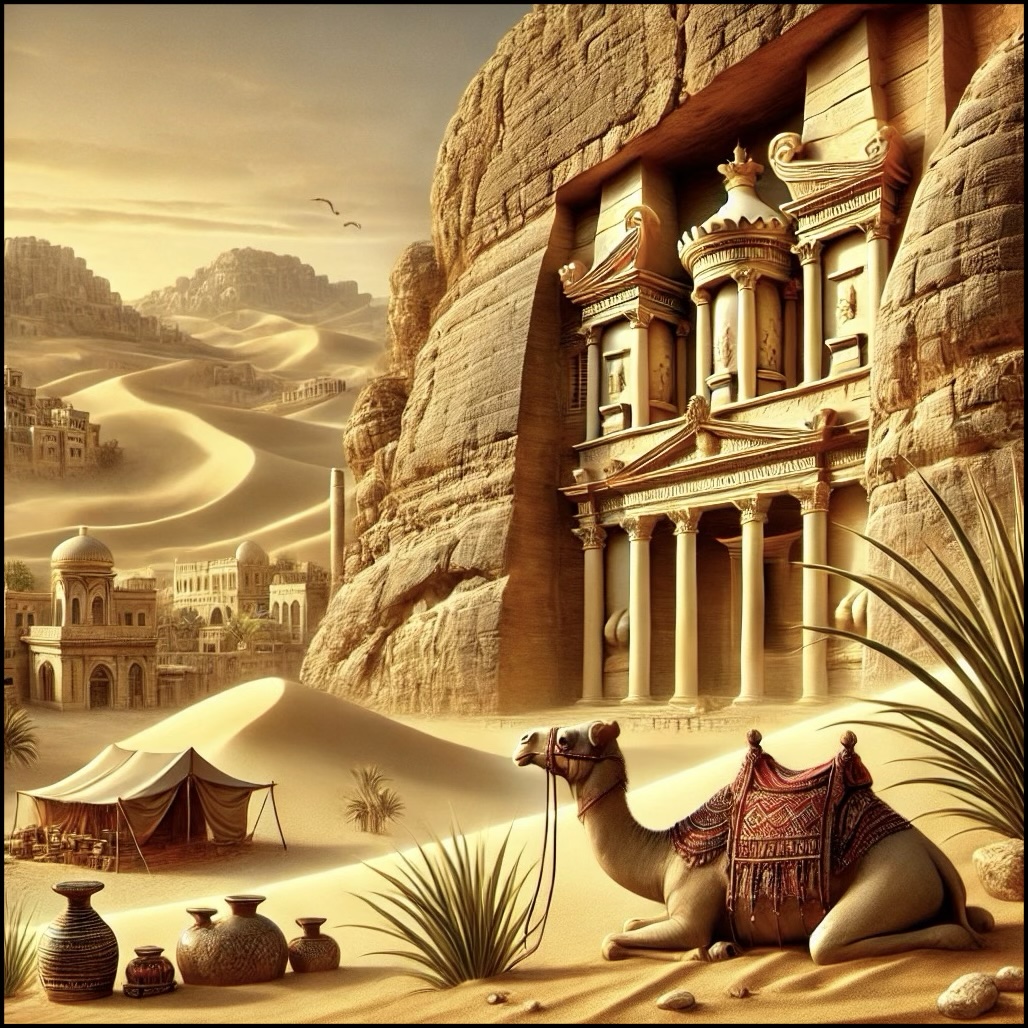
Middle East (with civilization) ©2024-25 Electric Prism, Inc. All rights reserved.
People
Groups
- Armenian people
- Jews
- Christians, Armenian Apostolic Orthodox
- Christians, Maronite
- Islam
- Muslims, Sunni
- Muslims, Shi'a
- Sufism
- Abbasid Caliphate (Baghdad)
- Turkmen people
- Christians, Roman Catholic
- Roman Empire, Eastern: Komnenos dynasty, restored
- Rûm, Sultanate of
- Antioch, Principality of
- Tripoli, County of
- Georgia, (Bagratid) Kingdom of
- Nabhani dynasty
- Damascus, Ayyubid Dynasty of
- Aleppo, Ayyubid Emirate of
- Teutonic Knights of Acre (House of the Hospitalers of Saint Mary of the Teutons in Jerusalem)
- Cyprus, Kingdom of
- Armenian Kingdom of Cilicia, or Little Armenia
- Golden Horde, Khanate of the (Mongol Khanate)
- Egypt and Syria, Mamluk Bahri Sultanate of
- Il-khanate
- Jarwanid dynasty
- Muzaffarids (Iran)
- Jalayirid Sultanate
- Golden Horde, Khanate of the (Kipchak Khanate)
- Egypt and Syria, Mamluk Burji Sultanate of
Topics
- Crusades, The
- Mongol Invasion of the Abbasid Caliphate
- Baghdad, Siege of
- Mongol invasions of the Levant
- Ain Jalut, Battle of
- Acre, Siege of
- Little Ice Age (LIA)
- Little Ice Age, Warm Phase I
- Black Death, or Great Plague
- Timur (Tamerlane), Conquests of
- Timur's invasions of Georgia
Commodoties
- Weapons
- Gem materials
- Glass
- Domestic animals
- Grains and produce
- Fibers
- Textiles
- Strategic metals
- Money
- Spices
Subjects
- Commerce
- Writing
- Architecture
- Painting and Drawing
- Environment
- Conflict
- Mayhem
- Faith
- Government
- Scholarship
- Custom and Law
- Human Migration
Regions
Subregions
Related Events
Showing 6 events out of 6 total
Years: 1252 - 1395
Middle East (with civilization) ©2024-25 Electric Prism, Inc. All rights reserved.
People
Groups
- Armenian people
- Jews
- Christians, Armenian Apostolic Orthodox
- Christians, Maronite
- Islam
- Muslims, Sunni
- Muslims, Shi'a
- Sufism
- Abbasid Caliphate (Baghdad)
- Turkmen people
- Christians, Roman Catholic
- Roman Empire, Eastern: Komnenos dynasty, restored
- Rûm, Sultanate of
- Antioch, Principality of
- Tripoli, County of
- Georgia, (Bagratid) Kingdom of
- Nabhani dynasty
- Damascus, Ayyubid Dynasty of
- Aleppo, Ayyubid Emirate of
- Teutonic Knights of Acre (House of the Hospitalers of Saint Mary of the Teutons in Jerusalem)
- Cyprus, Kingdom of
- Armenian Kingdom of Cilicia, or Little Armenia
- Golden Horde, Khanate of the (Mongol Khanate)
- Egypt and Syria, Mamluk Bahri Sultanate of
- Il-khanate
- Jarwanid dynasty
- Muzaffarids (Iran)
- Jalayirid Sultanate
- Golden Horde, Khanate of the (Kipchak Khanate)
- Egypt and Syria, Mamluk Burji Sultanate of
Topics
- Crusades, The
- Mongol Invasion of the Abbasid Caliphate
- Baghdad, Siege of
- Mongol invasions of the Levant
- Ain Jalut, Battle of
- Acre, Siege of
- Little Ice Age (LIA)
- Little Ice Age, Warm Phase I
- Black Death, or Great Plague
- Timur (Tamerlane), Conquests of
- Timur's invasions of Georgia
Commodoties
- Weapons
- Gem materials
- Glass
- Domestic animals
- Grains and produce
- Fibers
- Textiles
- Strategic metals
- Money
- Spices
Subjects
- Commerce
- Writing
- Architecture
- Painting and Drawing
- Environment
- Conflict
- Mayhem
- Faith
- Government
- Scholarship
- Custom and Law
- Human Migration
Regions
Subregions