
The armies of Sultan Suleiman the Magnificent …
Years: 1538 - 1538
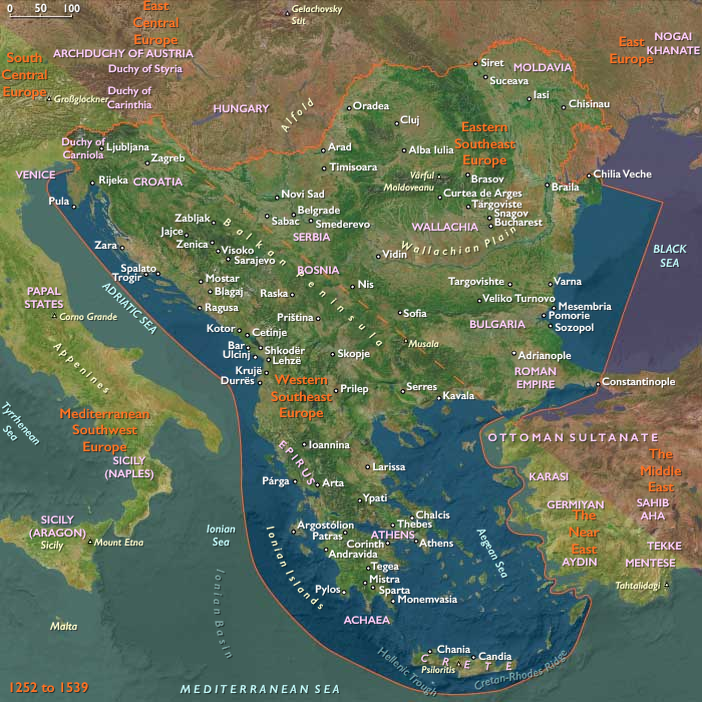
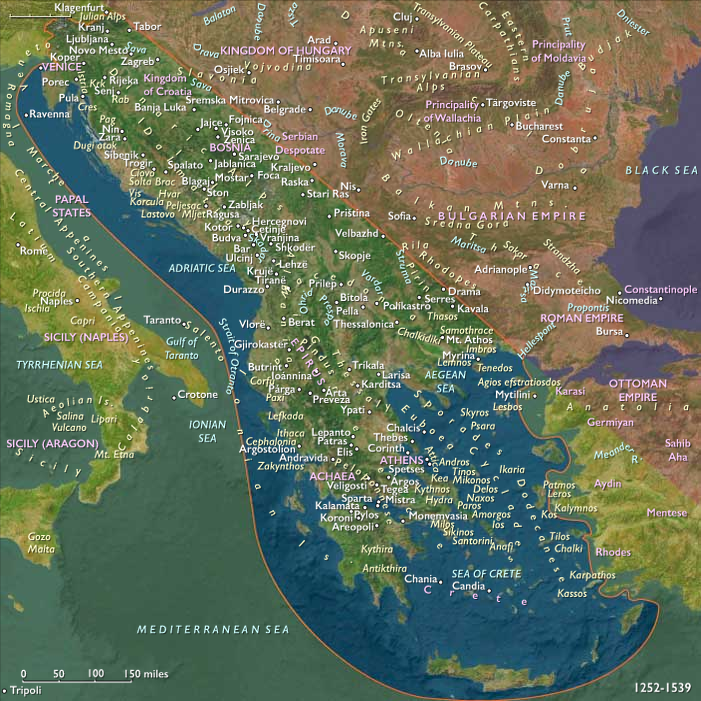
The armies of Sultan Suleiman the Magnificent had been stopped at Vienna in 1529, but the expansion of the Ottoman Empire is the main danger to Christianity in Europe in 1538.
A Christian offensive in the Mediterranean had attempted to eliminate the danger of the great Turkish fleet in 1535, when a strong armada under Don Álvaro de Bazán and Andrea Doria captured the port of Tunis, expelling Ottoman admiral Hayreddin Barbarossa from the waters of the Western Mediterranean.
The Ottoman admiral was then required to return to Constantinople, where he had been appointed commander of a great fleet to conduct a campaign against the Republic of Venice's possessions in the Aegean and Ionian Seas.
Barbarossa has captured almost all the remaining Christian outposts in the Ionian and Aegean Seas, including the islands of Syros, Aegina, Ios, Paros, Tinos, Karpathos, Kasos, Naxos, and besieged Corfu.
The Italian cities of Otranto and Ugento and the fortress of Castro, in the province of Lecce, are also looted.
The Republic of Venice, frightened by the loss of their possessions and the ruin of their trade, conduct a vigorous campaign for the creation of a "Holy League" to recover the lost territories and expel the Ottomans from the sea.
Pope Paul III succeeds in creating a league that in February 1538, unites the Papacy itself, the Republic of Venice, the Empire of Charles V, the Archduchy of Austria and the Knights of Malta.
The Allied fleet for the campaign is supposed to consist of two hundred galleys and another one hundred auxiliary ships, and the army of about fifty thousand infantry and forty-five hundred cavalry, all that can be gathered are are only one hundred and thirty galleys and an army of around fifteen thousand infantry, mostly Spaniards.
The command of the fleet is given nominally to the Genoese Andrea Doria, but Vicenzo Capello and Marco Grimaldi, commanding officers of the Papal and Venetian fleets respectively, have almost twice as many ships as Doria.
The commander of the army is unquestionably Hernando Gonzaga, Viceroy of Sicily.
Differences among the commanders of the fleet diminish its effectiveness against an experienced opponent like Barbarossa.
Locations
People
Groups
- Muslims, Sunni
- Christians, Roman Catholic
- Christians, Eastern Orthodox
- Venice, (Most Serene) Republic of
- Austria, Archduchy of
- Bohemia, Kingdom of
- France, (Valois) Kingdom of
- Moldavia, Principality of
- Venetian Albania
- Holy Roman Empire
- Ottoman Empire
- Greece, Ottoman
- Avlona, Sanjak of
- Spain, Habsburg Kingdom of
- Ottoman Algeria
- Habsburg Monarchy, or Empire
- Knights of Malta, Sovereign and Military Order of the
Topics
Commodoties
Subjects
Regions
Subregions
Years: 1538 - 1538
Locations
People
Groups
- Muslims, Sunni
- Christians, Roman Catholic
- Christians, Eastern Orthodox
- Venice, (Most Serene) Republic of
- Austria, Archduchy of
- Bohemia, Kingdom of
- France, (Valois) Kingdom of
- Moldavia, Principality of
- Venetian Albania
- Holy Roman Empire
- Ottoman Empire
- Greece, Ottoman
- Avlona, Sanjak of
- Spain, Habsburg Kingdom of
- Ottoman Algeria
- Habsburg Monarchy, or Empire
- Knights of Malta, Sovereign and Military Order of the
Topics
Commodoties
Subjects
Regions
Subregions