
Descendants of the Mongol, Turkish, Iranian, and …
Years: 1396 - 1539
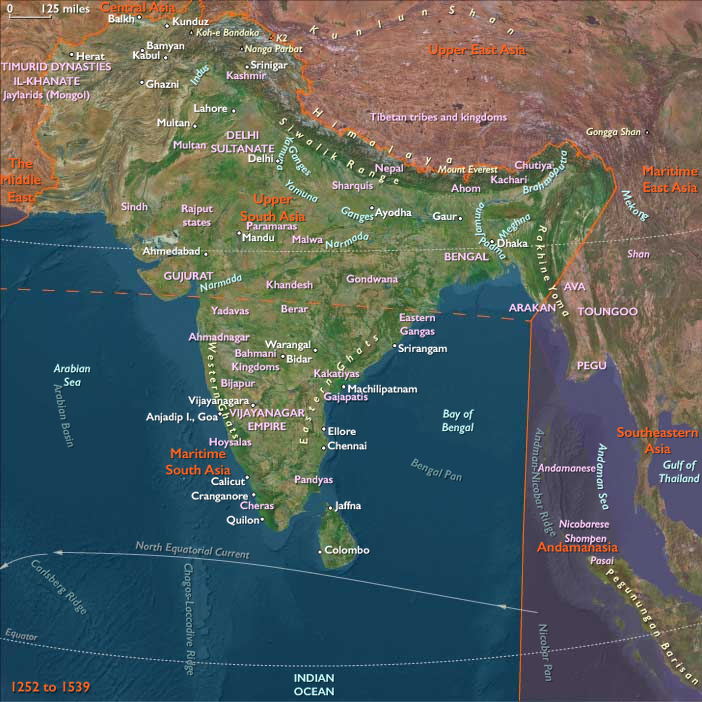
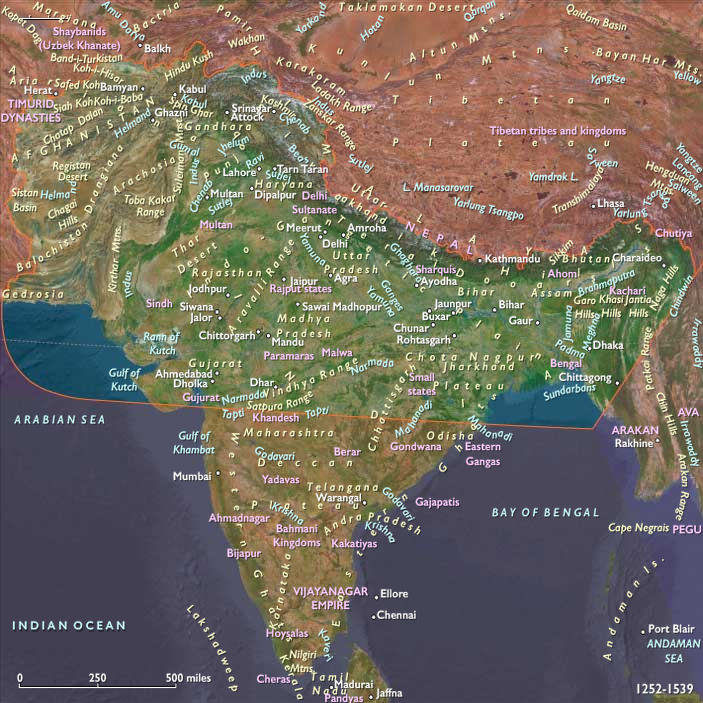
Descendants of the Mongol, Turkish, Iranian, and Afghan invaders of South Asia—the Mughals— invade India in the early sixteenth century under the leadership of Zahir-ud-Din Babur.
Babur is the great-grandson of Timur Lenk (Timur the Lame, from which the Western name Tamerlane is derived), who had invaded India and plundered Delhi in 1398 and then led a short-lived empire based in Samarkand (in modern-day Uzbekistan) that had united Persian-based Mongols (Babur's maternal ancestors) and other West Asian peoples.
Babur had been driven from Samarkand and initially established his rule in Kabul in 1504; he later becomes the first Mughal ruler (1526-30).
His determination is to expand eastward into Punjab, where he has made a number of forays; then, an invitation from an opportunistic Afghan chief in Punjab brings him to the very heart of the Delhi Sultanate, ruled by Ibrahim Lodi (1517-26).
Babur, a seasoned military commander, enters India in 1526 with his well-trained veteran army of twelve thousand to meet the sultan's huge but unwieldy and disunited force of more than one hundred thousand men.
Babur defeats the Lodi sultan decisively at Panipat (in modern-day Haryana, about ninety kilometers north of Delhi).
Employing gun carts, moveable artillery, and superior cavalry tactics, Babur achieves a resounding victory.
A year later, he decisively defeats a Rajput confederacy led by Rana Sangha.
In 1529 Babur routs the joint forces of Afghans and the sultan of Bengal but dies in 1530 before he can consolidate his military gains.
He leaves behind as legacies his memoirs (Babur Namah) , several beautiful gardens in Kabul, Lahore, and Agra, and descendants who will fulfill his dream of establishing an empire in Hindustan.
Locations
People
Groups
- Hinduism
- Pashtun people (Pushtuns, Pakhtuns, or Pathans)
- Rajputs
- Islam
- Delhi, Sultanate of (Lodi, or Afghan, Dynasty)
- Mughal Empire (Agra)
Topics
Commodoties
Subjects
Regions
Subregions
Years: 1396 - 1539
Locations
People
Groups
- Hinduism
- Pashtun people (Pushtuns, Pakhtuns, or Pathans)
- Rajputs
- Islam
- Delhi, Sultanate of (Lodi, or Afghan, Dynasty)
- Mughal Empire (Agra)
Topics
Commodoties
Subjects
Regions
Subregions