
The Division of the Carolingian Empire and …
Years: 820 - 975
The Division of the Carolingian Empire and the Rise of Feudal France (843–10th Century)
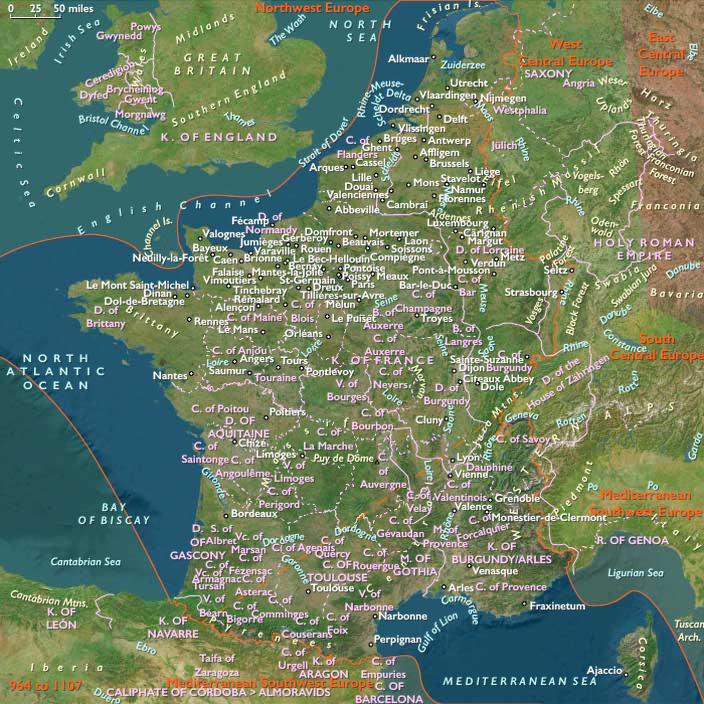
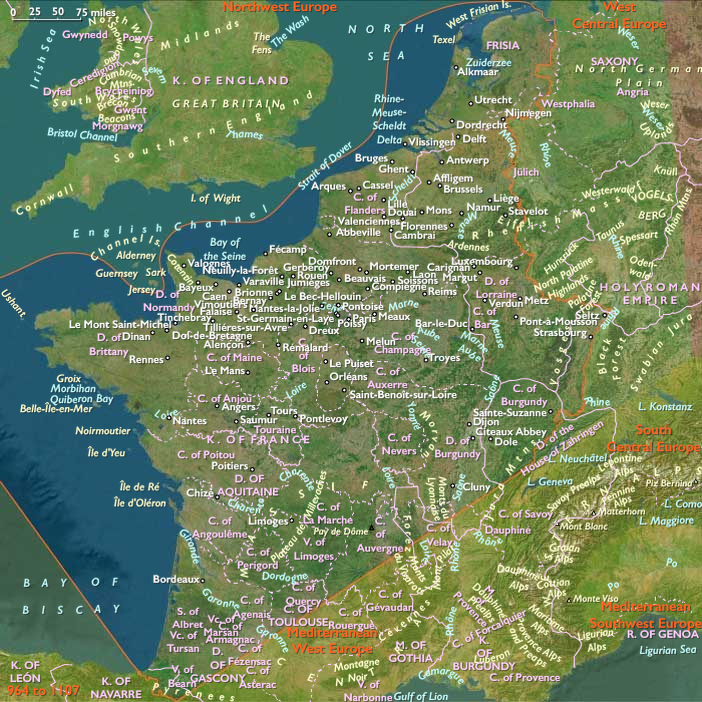
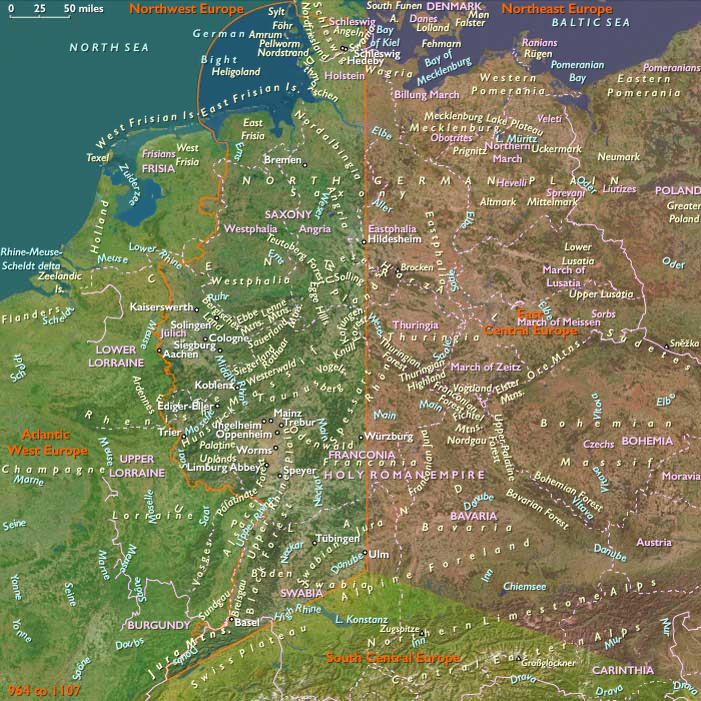
Though Louis the Pious (814–840) successfully maintains the unity of Charlemagne’s empire during his lifetime, his death leads to a power struggle among his sons. This results in the Treaty of Verdun (843), which formally divides the Carolingian Empire into three separate kingdoms:
- East Francia → Louis the German (precursor to the Holy Roman Empire/Germany)
- Middle Francia → Lothair I (including the imperial title and lands stretching from the North Sea to Italy)
- West Francia → Charles the Bald (the forerunner of modern France)
Of these, West Francia, which roughly corresponds to modern France, will experience increasing decentralizationand internal fragmentation, setting the stage for the rise of feudalism.
The Viking Threat and the Decline of Royal Power
Throughout the 9th and 10th centuries, Viking raiders devastate the coasts and river valleys of France, frequently sacking towns, monasteries, and trade centers. With the Carolingian monarchy weakened by internal division, local nobles take increasing responsibility for defense and governance.
This period witnesses a major shift in power:
- Titles and lands become hereditary, rather than being granted or revoked by the king.
- Local lords build castles and raise private armies, exerting more control over their regions.
- The French king’s authority weakens, becoming more religious and ceremonial rather than military and administrative.
This process leads to the emergence of feudalism, where the king’s power is increasingly challenged by powerful noblemen who act as semi-independent rulers within their own domains.
The Rise of Overmighty Vassals: The Norman Challenge
Over time, some of the king’s vassals become so powerful that they rival or even surpass royal authority. One of the most notable examples is the Duke of Normandy:
- In 1066, William the Conqueror, Duke of Normandy, invades England and claims the English crown after his victory at the Battle of Hastings.
- As both King of England and Duke of Normandy, William remains a vassal of the French king in Normandy but also a sovereign ruler in England, creating recurring tensions between the two realms.
- This dual status will lead to centuries of conflict, culminating in the Hundred Years’ War (1337–1453) between England and France.
The Legacy of the Treaty of Verdun
The Treaty of Verdun (843) marks the beginning of medieval Europe’s political landscape, dividing Charlemagne’s empire into the roots of modern France, Germany, and Italy. However, the weakening of royal power in West Francia ensures that France will take centuries to reassert central authority, with feudal lords ruling their lands like independent princes until the emergence of stronger monarchs in the 12th and 13th centuries.
People
Groups
- Franks
- Vikings
- Frankish, or Carolingian (Roman) Empire
- Francia Occidentalis (West Francia, or France), Kingdom of
- Francia Orientalis (East Francia), Kingdom of
- Francia Media (Middle Francia), Kingdom of
- French people (Latins)
Topics
Subjects
Regions
Subregions
Years: 820 - 975
People
Groups
- Franks
- Vikings
- Frankish, or Carolingian (Roman) Empire
- Francia Occidentalis (West Francia, or France), Kingdom of
- Francia Orientalis (East Francia), Kingdom of
- Francia Media (Middle Francia), Kingdom of
- French people (Latins)
Topics
Subjects
Regions
Subregions