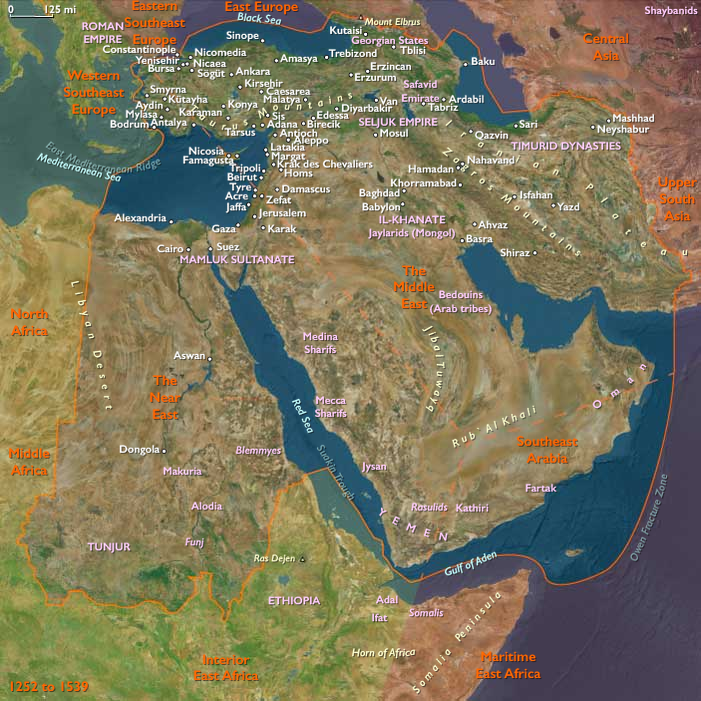
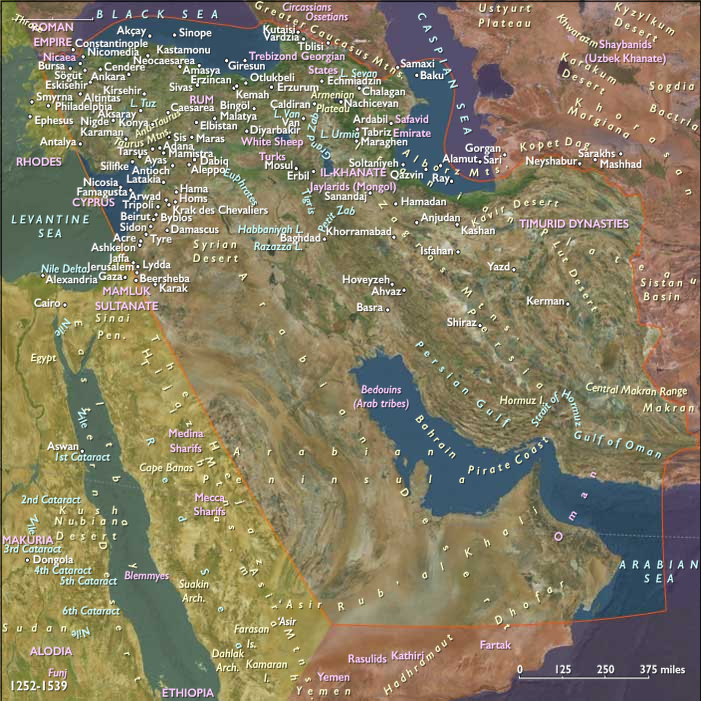
Jalayirid rule is abruptly checked by the …
Years: 1396 - 1539
Jalayirid rule is abruptly checked by the rising power of a Mongol, Tamerlane (or Timur the Lame, 1336-1405), who had been atabeg of the reigning prince of Samarkand.
Timur sacks Baghdad in 1401 and massacres many of its inhabitants.
He kills thousands of Iraqis and devastates hundreds of towns.
Like Hulagu, Tamerlane has a penchant for building pyramids of skulls.
Despite his showy display of Sunni piety, Tamerlane's rule virtually extinguishes Islamic scholarship and Islamic arts everywhere except in his capital, Samarkand.
In Iraq, political chaos, severe economic depression, and social disintegration had followed in the wake of the Mongol invasions.
Baghdad, long a center of trade, had rapidly lost its commercial importance.
Basra, which has been a key transit point for seaborne commerce, is circumvented after the Portuguese discover a shorter route around the Cape of Good Hope.
In agriculture, Iraq's once- extensive irrigation system has fallen into disrepair, creating swamps and marshes at the edge of the delta and dry, uncultivated steppes farther out.
The rapid deterioration of settled agriculture leads to the growth of tribally based pastoral nomadism.
The focus of Iraqi history has shifted by the end of the Mongol period from the urban-based Abbasid culture to the tribes of the river valleys, where it will remain until well into the twentieth century.
Locations
People
Groups
- Iranian peoples
- Arab people
- Persian people
- Oghuz Turks
- Muslims, Sunni
- Muslims, Shi'a
- Turkmen, Iraqi
- Mongols
- Jalairid Sultanate
- Timurid Empire
- Portuguese Empire
Topics
Subjects
Regions
Subregions
Related Events
Filter results
Showing 10 events out of 625 total
The state assumes administrative responsibility—funding expenditures and selecting personnel—for the new ecclesiastical establishments.
Responsibility for conversion of the indigenous population to Christianity is assigned to several religious orders: the Dominicans, Franciscans, and Augustinians, known collectively as the friars—and to the Jesuits.
At the lower levels of colonial administration, the Spanish build on traditional village organization by co-opting the traditional local leaders, thereby ruling indirectly.
The Chinese, in addition to managing trade transactions, are the source of some necessary provisions and services for the capital.
The Spanish regard them with a mixture of distrust and acknowledgment of their indispensable role.
During the first decades of Spanish rule, the Chinese in Manila become more numerous than the Spanish, who try to control them with residence restrictions, periodic deportations, and actual or threatened violence that sometimes degenerates into riots and massacres of Chinese during the period between 1603 and 1762.
There is no direct trade with Spain.
Failure to exploit indigenous natural resources and investment of virtually all official, private, and church capital in the galleon trade are mutually reinforcing tendencies.
Loss or capture of the galleons or Chinese junks en route to Manila represents a financial disaster for the colony.
The ecology of the islands is little changed by Spanish importations and technical innovations, with the exception of corn cultivation and some extension of irrigation in order to increase rice supplies for the growing urban population.
The colony is not profitable, and a long war with the Dutch in the seventeenth century and intermittent conflict with the Moros nearly bankrupts the colonial treasury.
Annual deficits are made up by a subsidy from Mexico.
The missionaries have their greatest success among women and children, although the pageantry of the church has a wide appeal, reinforced by the incorporation of Filipino social customs into religious observances, for example, in the fiestas celebrating the patron saint of a local community
The eventual outcome is a new cultural community of the main Malay lowland population, from which the Muslims (known by the Spanish as Moros, or Moors) and the upland tribal peoples of Luzon remain detached and alienated.
The Spaniards consider conversion through baptism to be a symbol of allegiance to their authority.
Although they are interested in gaining a profit from the colony, the Spanish also recognize a responsibility to protect the property and personal rights of these new Christians.
This group has local wealth; high status and prestige; and certain privileges, such as exemption from taxes, lesser roles in the parish church, and appointment to local offices.
The principalia is larger and more influential than the preconquest nobility, and it creates and perpetuates an oligarchic system of local control.
Among the most significant and enduring changes that occurs under Spanish rule is that the Filipino idea of communal use and ownership of land is replaced with the concept of private, individual ownership and the conferring of titles on members of the principalia.
European missionaries had occasionally visited Vietnam for short periods of time, with little impact, beginning in the early sixteenth century.
The best known of the early missionaries is Alexandre de Rhodes, a French Jesuit who is sent to Hanoi in 1627, where he quickly learns the language and begins preaching in Vietnamese.
Initially, Rhodes is well-received by the Trinh court, and he reportedly baptizes more than six thousand converts; however, his success probably leads to his expulsion in 1630.
He is credited with perfecting a romanized system of writing the Vietnamese language (quoc ngu), which is probably developed as the joint effort of several missionaries, including Rhodes.
He writes the first catechism in Vietnamese and publishes a Vietnamese-Latin-Portuguese dictionary; these works are the first books printed in quoc ngu.
Romanized Vietnamese, or quoc ngu, is used initially only by missionaries; classical Chinese, or chu nom, continues to be used by the court and the bureaucracy.
The French later support the use of quoc ngu, which, because of its simplicity, leads to a high degree of literacy and a flourishing of Vietnamese literature.
After being expelled from Vietnam, Rhodes spends the next thirty years seeking support for his missionary work from the Vatican and the French Roman Catholic hierarchy as well as making several more trips to Vietnam.
East Asia (1540–1683 CE)
Silver Flows, Shogunal Power, and Steppe Revivals
Geography & Environmental Context
East Asia, encompassing both Lower and Upper East Asia, stretched from the Pacific coasts of China, Korea, and Japan to the Tibetan Plateau and the steppes of Mongolia and Xinjiang. Anchors included the Yangtze and Yellow River basins, Beijing and Edo (Tokyo), the Sichuan Basin, Korea’s Han River valley, and the plateaus and mountain systems of Tibet, the Altai, and the Tianshan. The region united fertile monsoon-fed lowlands and densely settled deltas with highland deserts, alpine grasslands, and frontier oases—together forming one of the world’s largest continuous zones of agricultural, pastoral, and imperial interaction.
Climate & Environmental Shifts
The Little Ice Age deepened its impact, bringing colder winters, shorter growing seasons, and erratic monsoons.
-
In northern China and Korea, frost and drought stressed harvests.
-
Across Japan and the Ryukyus, typhoons and volcanic eruptions (e.g., Mount Asama) caused periodic famine.
-
On the Tibetan Plateau and Inner Asia, intensified winter storms—dzud—decimated herds and fueled migrations.
Despite volatility, agricultural innovation, new crops from the Americas, and redistributive institutions helped mitigate disaster.
Subsistence & Settlement
-
China (Ming → Qing): Rice, wheat, tea, silk, and cotton underpinned one of the world’s largest agrarian economies. Urban centers—Suzhou, Hangzhou, Guangzhou, Nanjing, and Beijing—were hubs of manufacturing and finance.
-
Korea (Joseon): Rice paddies expanded southward; Confucian bureaucracy governed agrarian life, even as the Imjin Wars (1592–1598) brought devastation and subsequent recovery.
-
Japan: Civil wars ended with Tokugawa unification (1600). Stable rice taxation and castle-town growth transformed the country into an urbanizing polity centered on Edo.
-
Taiwan and the Ryukyus: Austronesian farming and fishing persisted alongside growing Chinese settlement and maritime trade; Ryukyu balanced dual vassalage to China and Satsuma (after 1609).
-
Mongolia and the Steppe: Nomadic pastoralism centered on horses, sheep, and camels; Oirat/Zunghar confederations consolidated power across western Mongolia.
-
Tibet and Xinjiang: Monasteries and oasis towns—Lhasa, Yarkand, Turpan—served as agricultural and spiritual nodes linking plateau and desert.
Technology & Material Culture
-
Agriculture: Adoption of maize, sweet potato, and peanuts increased food security. Advanced irrigation, terracing, and hydraulic control spread from China into Korea and Japan.
-
Trade goods:
-
China: Exported porcelain, silk, and tea on a global scale.
-
Japan: Renowned for swordsmithing, lacquerware, and castle construction; ukiyo-e art and kabuki theater emerged late in the period.
-
Korea: Perfected Hangul printing and ceramic artistry (white porcelain and celadon).
-
-
Architecture & religion: Ming palaces, Joseon Confucian academies, Tokugawa castles, and Tibetan monasteries reflected political order and spiritual aspiration.
-
Weaponry: Firearms proliferated; Japanese matchlocks influenced Korean and Chinese arsenals; steppe cavalry adopted muskets and cannon via Central Asia.
Movement & Interaction Corridors
East Asia became a central participant in global and regional trade networks:
-
Maritime routes: Chinese ports—Fujian, Guangdong—channeled trade to Southeast Asia, Japan, and the Philippines.
-
The Silver Circuit: Silver from Spanish America reached China via the Manila Galleons; Japanese silver from Iwami Ginzan flowed through East Asian markets. China became the world’s silver sink, fueling its monetary economy.
-
Continental routes: The Silk Road and Tea-Horse Road linked China with Central Asia and Tibet; caravans carried silk, horses, tea, and jade between Kashgar, Lhasa, and Xi’an.
-
Diplomatic and tributary relations: The Ming and Qing empires maintained tributary ties with Korea, Ryukyu, Vietnam, and—via Peking embassies—Tibet and the Mongols.
-
Frontier integration: Manchu expansion in the 1640s–1680s unified Manchuria, Inner Mongolia, and northern China, culminating in Qing consolidation.
Cultural & Symbolic Expressions
-
China: Late Ming intellectual ferment—individualist Confucianism, vernacular fiction (Journey to the West, Dream of the Red Chamber)—gave way under the Qing to state orthodoxy and artistic refinement in porcelain and painting.
-
Japan: The Tokugawa era fostered Neo-Confucian ethics, kabuki, and the first modern urban culture; Edo became a center of literacy and leisure.
-
Korea: Neo-Confucian scholars such as Yi Hwang and Yi I codified moral philosophy; pansori song cycles blended elite and folk performance.
-
Tibet: The Fifth Dalai Lama unified church and state under the Gelugpa school, constructing the Potala Palace as a monumental symbol.
-
Steppe and oasis cultures: Mongol and Turkic elites patronized Tibetan Buddhism and Sufi Islam respectively, blending pastoral and agrarian worldviews.
-
Ryukyu: Maintained hybrid rituals blending Chinese investiture and local traditions.
Environmental Adaptation & Resilience
-
China & Japan: Diversified cropping with American imports mitigated famine; reforestation and granary systems improved ecological stability.
-
Korea: State granaries and irrigation recovery stabilized after war losses.
-
Tibet: Monasteries managed surplus and redistributed barley during lean years.
-
Steppe regions: Herd diversification and mobile camps buffered nomads against drought and dzud; oasis cities relied on karez irrigation to sustain farming.
-
Maritime peripheries: Island polities (Taiwan, Ryukyu) adapted through fishing, trading, and tribute relations.
Political and Military Transformations
-
China: The Ming dynasty’s collapse (1644) and Qing ascendancy reshaped the empire; Manchu rulers consolidated multiethnic governance.
-
Japan: The Tokugawa shogunate imposed peace (Pax Tokugawa), restricting foreign contact under sakokuwhile encouraging internal commerce.
-
Korea: Survived invasions and reaffirmed Joseon Confucian orthodoxy.
-
Mongolia and Inner Asia: The Oirat/Zunghars rose to regional dominance; Tibet entered a new theocratic era under Mongol protection; Russia advanced into Siberia, meeting Qing forces by century’s end.
Transition
Between 1540 and 1683, East Asia became both a regional order of stability and a key node of the world economy.
-
In Lower East Asia, global silver flows bound China, Japan, and the Philippines into an unprecedented network of trade. The Tokugawa and Qing consolidations fostered domestic peace and population growth.
-
In Upper East Asia, new powers—the Zunghars and the Fifth Dalai Lama’s Tibet—reshaped the inner Asian frontier even as the Qing Empire prepared to extend its reach westward.
By 1683, the region’s great civilizations—Qing China, Tokugawa Japan, Joseon Korea, Tibet, and the Zunghar steppe—stood in relative balance, united by commerce and ideology, yet divided by geography and guarded frontiers. The foundations of early modern East Asia—bureaucratic states, tributary diplomacy, and maritime exchange—were firmly in place, linking the ancient continental empires to an increasingly global age.

Maritime East Asia (1540–1683 CE): Silver Flows, Shogunal Power, and Tributary Worlds
Geography & Environmental Context
Maritime East Asia includes southern and eastern China (Yunnan to Shandong, Guangdong to Beijing, Liaoning to southern Heilongjiang), Taiwan, the Korean Peninsula, southern Primorsky Krai, the Japanese islands of Kyushu, Shikoku, Honshu, southwestern Hokkaidō, and the Ryukyu and Izu islands. Anchors include the Yangtze and Yellow basins, the Pearl River Delta, the Beijing court, the Sichuan Basin, Korea’s Han River valley, and Japan’s Kantō and Kansai regions.
Climate & Environmental Shifts
The Little Ice Age produced shorter growing seasons in northern China and Korea, occasional droughts in the Yangtze basin, and harsher winters across Honshu. Typhoons struck the Ryukyus and Fujian coast. Volcanic eruptions in Japan disrupted harvests. Yet agricultural intensification and American crop introductions (maize, sweet potatoes) helped buffer crises.
Subsistence & Settlement
-
China (Ming → Qing transition): Rice and wheat harvests sustained vast populations. Commercial crops like tea, silk, and cotton spread in Jiangnan. Southern cities (Suzhou, Hangzhou, Guangzhou) flourished as trade hubs.
-
Korea: Rice paddies expanded in the south; yangban elites maintained dominance. Villages were devastated by Japanese invasions (1592–1598) but recovered slowly.
-
Japan: Civil war ended with Tokugawa unification (1600). Rice remained staple; castle towns expanded. Edo grew into a major metropolis.
-
Taiwan: Settled by Austronesians but increasingly contested by Europeans (Dutch and Spanish), Chinese migrants, and later Zheng Chenggong (Koxinga), who expelled Europeans in 1662.
-
Ryukyu Kingdom: Continued tribute to China, but after 1609, subordinated to Satsuma domain, creating dual vassalage.
Technology & Material Culture
-
Agriculture: New World crops stabilized food supply. Irrigation and terracing expanded.
-
China: Jingdezhen porcelain, silk, and tea became global exports.
-
Japan: Swordsmithing, castle construction, and Noh theater thrived; ukiyo-e woodblock printing emerged late in the period.
-
Korea: Hangul script, metal type printing, and Confucian texts flourished.
-
Ryukyu: Hybrid material culture blended Chinese, Japanese, and Austronesian elements.
Movement & Interaction Corridors
-
China: Became the sink for global silver, receiving flows from Spanish America via Manila and from Japan via trade. Smuggling and piracy grew as maritime bans faltered.
-
Japan: Silver exports financed imports of silk from China. After 1639, the Tokugawa shogunate instituted sakoku, limiting Europeans to Dutch traders at Nagasaki.
-
Korea: Recovered from devastation of Imjin Wars, maintained tribute to Ming and later Qing.
-
Taiwan: Dutch and Spanish enclaves contested by Chinese settlers; later integrated into Ming loyalist regime of Zheng Chenggong.
-
Ryukyu: Functioned as a diplomatic intermediary, sending tribute to both China and Satsuma.
Cultural & Symbolic Expressions
-
China: Late Ming literati culture produced classics of painting, poetry, and drama; transition to Qing saw reaffirmation of Confucian orthodoxy.
-
Japan: Tokugawa period nurtured Neo-Confucianism, kabuki theater, and castle-town culture.
-
Korea: Neo-Confucian scholarship flourished, with scholars like Yi Hwang. Popular pansori performance emerged.
-
Taiwan: Indigenous Austronesians maintained oral and ritual traditions; Chinese settlers introduced Mazu temples.
-
Ryukyu: Maintained court rituals blending Chinese investiture practices with native traditions.
Environmental Adaptation & Resilience
-
China: Diversification with maize and sweet potatoes reduced famine risk.
-
Japan: Granaries, forestry management, and rice taxation stabilized resources.
-
Korea: Terracing and irrigation spread; state granaries aided recovery post-invasions.
-
Taiwan: Austronesian strategies of mobility and inter-island exchange persisted alongside Chinese agricultural intensification.
-
Ryukyu: Tribute networks ensured food security during typhoon years.
Transition
From 1540 to 1683, Maritime East Asia became a fulcrum of global exchange: Chinese silk and porcelain flowed west in return for silver, Japan stabilized under Tokugawa rule, and Korea recovered from invasion. Taiwan and Ryukyu emerged as contested zones of maritime empire. By the end of the era, Qing consolidation, Tokugawa closure, and Joseon orthodoxy set the stage for a new phase of stability—yet also deeper entanglement with the global economy.
Years: 1396 - 1539
Locations
People
Groups
- Iranian peoples
- Arab people
- Persian people
- Oghuz Turks
- Muslims, Sunni
- Muslims, Shi'a
- Turkmen, Iraqi
- Mongols
- Jalairid Sultanate
- Timurid Empire
- Portuguese Empire