Peace continues in the Frankish realms until …
Years: 827 - 827
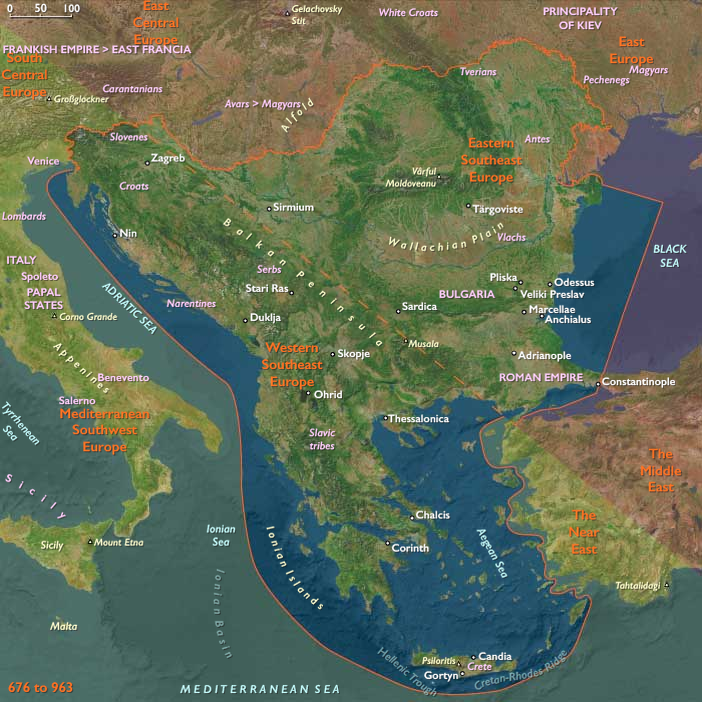
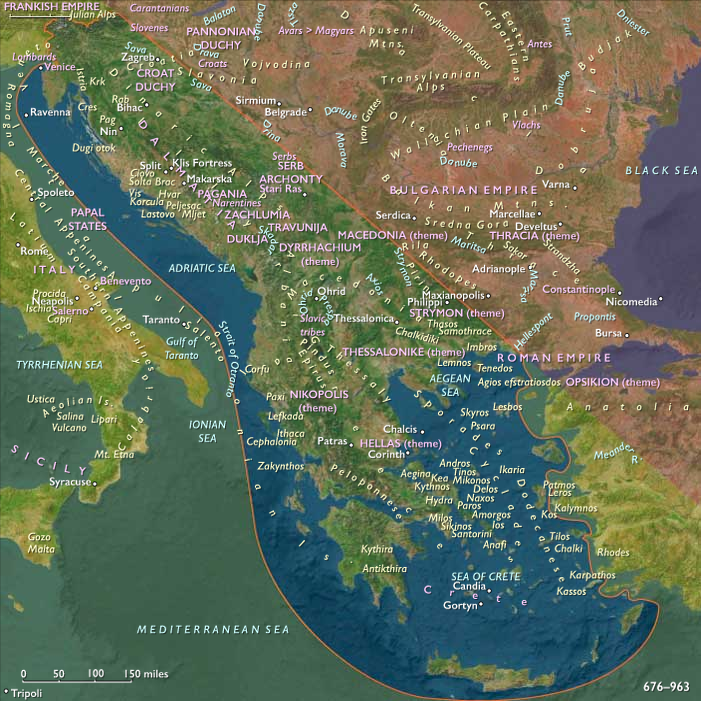
Peace continues in the Frankish realms until 827, when the younger Louis, who had received Bavaria and the neighboring marches, the former realm of Lothair, has to deal with a Bulgarian horde descending on Pannonia.
Locations
People
Groups
- Franks
- Bulgarian Empire (First)
- Bulgarians (South Slavs)
- Bavaria, Carolingian Duchy of
- Frankish, or Carolingian (Roman) Empire
Commodoties
Subjects
Regions
Subregions
Related Events
Filter results
Showing 10 events out of 54392 total
Omurtag, failing to gain Frankish cooperation, had issued an ultimatum in 826 and the following year sends a fleet along the Danube, which restores Bulgarian control over portions of southeastern Pannonia.
Emperor Michael II, immediately upon learning of the Arab landing and before the Andalusians have secured their control over the entire island, reacts decisively and sends successive expeditions to recover the island.
Losses suffered during the revolt of Thomas the Slav have hampered Constantinople's ability to respond, however, and if the landing occurred in 827/828, the diversion of ships and men to counter the gradual conquest of Sicily by the Tunisian Aghlabids also interfered.
The first expedition, under Photeinos, strategos of the Anatolic Theme, and Damian, Count of the Stable, had been defeated in open battle, in which Damian had been killed.
The next expedition had been sent a year later and comprised seventy ships under the strategos of the Cibyrrhaeots Krateros.
It is initially victorious, but the overconfident imperial navy is then routed in a night attack.
Krateros manages to flee to Kos, but here he is captured by the Arabs and crucified.
Makrypoulias suggests that these campaigns must have taken place before the Andalusians completed their construction of Chandax, where they transfer the capital from the inland site of Gortyn.
Euphemius is an imperial admiral, probably born in Messina.
In about 826, according to Michele Amari, the Emperor had appointed a new governor of Sicily called either Constantine or Photinus, who in turn had entrusted a naval command to Euphemius, a landowner with a large following; accused on a perhaps trumped-up charge of abducting a young nun from a convent, he organized an uprising against the Emperor, Michael II and, after some military successes, proclaims himself emperor in Syracuse, independent from Constantinople.
In practice, he is a charismatic chief, and, respected as a king, the title of emperor means that he dominates the whole territory of the island.
Realizing that he would be defeated by imperial troops when reinforcements are sent from the East, he appeals to the Muslim leaders of Ifriqiya, where he asks the help of Arabs to take Sicily and Malta from the Empire.
Joining his forces with a large fleet commanded by the jurist Asad ibn al-Furat in the high summer of 827, he dies later this year, killed by members of the imperial garrison at Castrogiovanni, modern day Enna.
He is considered to be the man who initiated the Arab invasion of Sicily and Malta and the beginning of the two-century Islamic domination on the island as the Emirate of Sicily.
The origins of Venice are not directly dealt with in historical records, but the available evidence has led several historians to agree that the original population of Venice comprised refugees from Roman cities such as Padua, Aquileia, Altino and Concordia (modern Portogruaro) who were fleeing successive waves of barbarian invasions.
The first was in 166-168, when the Quadi and Marcomanni destroyed the main center in the area, the current Oderzo.
The Roman defenses were again overthrown in the early fifth century by the Visigoths and, some fifty years later, by the Huns under Attila.
The last and most enduring was that of the Lombards in 568.
This left Constantinople a small strip of coast in current Veneto, and the main administrative and religious entities, were therefore transferred to this remaining dominion.
New ports were built, including those at Malamocco and Torcello in the Venetian lagoon.
Imperial domination of central and northern Italy had been largely eliminated by the conquest of the Exarchate of Ravenna in 751 by Aistulf.
During this period, the seat of the local imperial governor (the "duke", or “dux”, later "doge") had been situated in Malamocco.
Settlement across the islands in the lagoon had probably increased in correspondence with the Lombard conquest of the imperial territories.
The bishopric seat of Olivolo (Helipolis) had been created In 775-776.
The ducal seat had been moved under Agnello Particiaco, doge from 811, from Malamocco to the highly protected Rialto (Rivoalto, "High Shore") island, the current location of Venice.
The monastery of St. Zachary and the first ducal palace and basilica of St. Mark, as well as a walled defense (civitatis murus) between Olivolo and Rialto will subsequently be built here.
Agnello had undertaken the building of many bridges connecting the islands.
A merchant as well as a statesman, he had obtained important commercial privileges from the emperors Leo V the Armenian and Michael II.
Agnello’s son Giustiniano had been away in Constantinople when his father, the then-reigning Doge Agnello, had appointed his younger brother Giovanni as co-doge.
When Giustiniano returned, he had flown into a fury.
Agnello appointed his third son, also Agnello, co-doge and began to oppose Giustiniano, even besieging him in the church of San Severo.
Giustiniano gained the upper hand, however, and exiled his younger brother and succeeded his father as doge in 827.
The emperor Michael II offered military support to Venice in return for a contingent of Venetians in his expedition to Aghlabid Sicily.
The success of the expedition increases the prestige of the city.

Asad had landed in 827 with a force of Arabs in Sicily and following a defeat of imperial troops proceeds to besiege Syracuse.
However, the city cannot be taken and Asad soon dies of plague.
The Emperor, learning of Aisso’s raids in Barcelona, orders his second son, Pepin, King of Aquitaine, to take action.
A Frankish assembly at Quierzy-sur-Oise decides to send an expedition against the Córdoban caliphate but the counts in charge of the army—the brothers-in-law Hugh of Tours and Matfrid of Orléans—are slow to act.
The young count Bernard having requested and received some help from the Emperor, as well as that of some local hispani (probably Gothic noblemen), Aisso, to counter these reinforcements, had sent his brother to request help from Abd ar-Rahman II, Emir of Córdoba, the only potential ally powerful enough to threaten the Franks.
Abd ar-Rahman had sent the general Ubayd Allah Abu Marwan to Zaragoza in May 827, from whence he invades the territory of Barcelona, reaching the city itself in the summer.
He besieges it and ransacks its environs, but fails to take it.
By the time the Frankish army arrives, in late 827, Abu Marwan has already returned to Muslim territory, taking Aisso and his followers with him.
This reprieve, seen as a victory, greatly increases Bernard's prestige.
The ravaged county of Ausona, a dependency of Barcelona, is to remain depopulated into the mid-ninth century, its ruin attributed to the late arrival of Hugh and Matfrid.
Both counts will be dispossessed of their counties at at the Assembly of Aachen in 828.
Nitra, under Avar rule for more than two hundred years until their defeat by Charlemagne in the early ninth century, has become the capital of the Principality of Nitra, the oldest known independent Slavic state in the present-day Slovakia.
The first known Christian church built by the Western Slavs is consecrated around 828 by Archbishop Adalram of Salzburg at the seat of the ruling prince, Pribina, and in the same year the town is first mentioned as Nitrawa.
Candia (Chandax, modern Heraklion), a city built by the transplanted Iberians, is made the new capital of the island.
They build a moat around the city for protection, and name the city rabḍ al-ḫandaq ("Castle of the Moat").
The Saracens allow the port to be used as a safe haven for pirates who operate against Imperial shipping and raid Imperial territory around the Aegean.
Abu Hafs has repulsed the early attacks by the imperial navy and slowly consolidated control of the entire island.
He recognizes the suzerainty of the Abbasid Caliphate, but he rules as a de facto independent prince.
The conquest of the island is of major importance as it transforms the naval balance of power in the Eastern Mediterranean and opens the hitherto secure Aegean Sea littoral to frequent and devastating raids.
The Andalusians also occupy several of the Cyclades during these early years, but Michael II organizes another large-scale expedition, recruiting an entire new marine corps, the Tessarakontarioi, and building new ships.
Under the admiral Ooryphas, this fleet manages to evict the Arabs from the Aegean islands but fails to retake Crete, which will survive as a piratical emirate until its reconquest in 961 by Constantinople.
Years: 827 - 827
Locations
People
Groups
- Franks
- Bulgarian Empire (First)
- Bulgarians (South Slavs)
- Bavaria, Carolingian Duchy of
- Frankish, or Carolingian (Roman) Empire