
Northwest Europe (1828–1971 CE) Industrial Maturity, …
Years: 1828 - 1971
Northwest Europe (1828–1971 CE)
Industrial Maturity, World Wars, and Atlantic Integration
Geography & Environmental Context
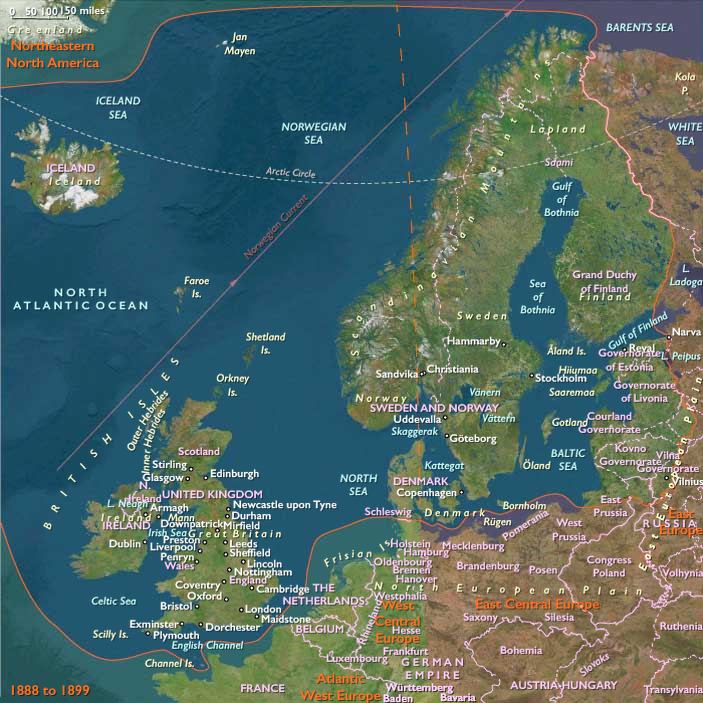
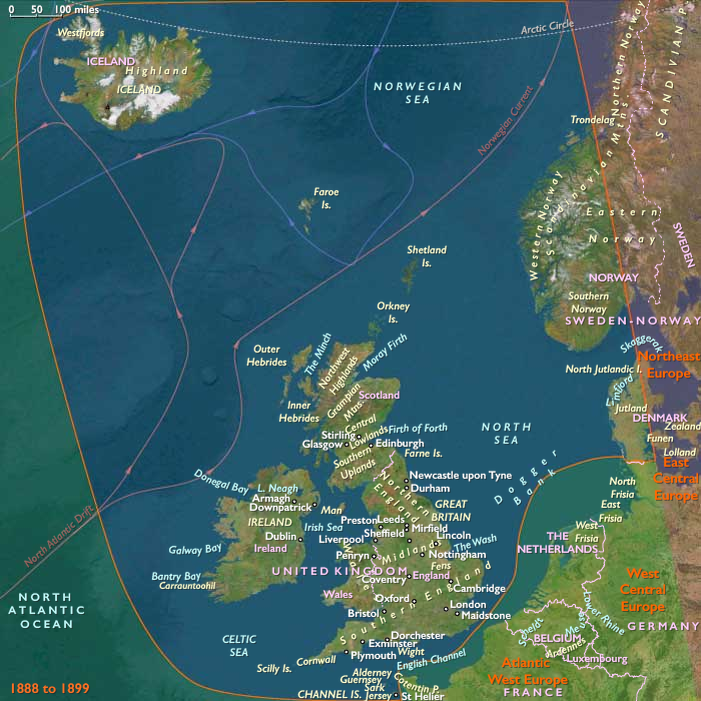
Northwest Europe includes Iceland, Ireland, the United Kingdom, western Norway, and western Denmark. Anchors include the North Sea basin, the Norwegian fjords, the Irish Sea, and the Atlantic approaches from the Channel to Iceland. Capitals such as London, Dublin, Edinburgh, Copenhagen, Oslo, and Reykjavik shaped political and cultural life, while industrial cities like Manchester, Glasgow, Belfast, and Bergen tied the region to global markets.
Climate & Environmental Shifts
The region endured a cool, wet temperate climate with pronounced variability. Iceland faced volcanic eruptions (e.g., Askja 1875) and glacial flooding, while Ireland suffered devastating crop failures in the 1840s during the Great Famine. North Sea storm surges threatened Danish and English coasts (notably 1953’s catastrophic flood). Fisheries fluctuated with changes in North Atlantic stocks, while hydroelectric development in Norway harnessed glacial rivers for modern energy.
Subsistence & Settlement
-
Ireland: The Great Famine (1845–1852), caused by potato blight, killed over a million and drove mass emigration. Afterwards, agriculture reoriented toward cattle and dairy for export to Britain.
-
Britain: The Agricultural Revolution matured; estates and tenant farming fed growing cities. Enclosure and mechanization intensified productivity.
-
Norway & Denmark: Small farms and fisheries combined with forestry; by the 20th century, dairying and cooperative movements modernized rural economies.
-
Iceland: Sheep, fishing, and later mechanized trawlers sustained settlement; urbanization gathered around Reykjavik.
Urbanization accelerated: Britain’s industrial cities boomed, Dublin and Belfast industrialized unevenly, Copenhagen became a northern hub, and Oslo grew as Norway’s capital after independence (1905).
Technology & Material Culture
-
Industry: Britain pioneered steam power, coal mining, iron and steel, and later textiles, shipbuilding, and railways. By the 20th century, heavy industry dominated Belfast, Glasgow, and the English Midlands.
-
Transport: Railways knit Britain and Ireland in the 19th century; steamships shrank Atlantic distances. By the mid-20th century, motorways and civil aviation transformed mobility.
-
Energy: Coal underpinned industry until the mid-20th century; Norway’s hydroelectric resources powered industry. Denmark mechanized agriculture and later pioneered wind technology.
-
Everyday life: Workers’ housing, printed newspapers, gramophones, radios, and later televisions reshaped material culture.
Movement & Interaction Corridors
-
Emigration: Millions left Ireland, Scotland, and Scandinavia for North America in the 19th century, reshaping Atlantic diasporas.
-
Imperial routes: Britain commanded vast maritime networks linking Northwest Europe to India, Africa, and the Pacific.
-
Fisheries & shipping: Cod and herring fleets from Iceland, Norway, and Scotland supplied Europe. North Sea ports (Liverpool, Bergen, Copenhagen) became gateways for trade and migration.
-
Wars: The North Sea and Atlantic were battlegrounds during the First and Second World Wars, with U-boat campaigns devastating shipping. Air bases in Iceland and Britain became strategic nodes.
-
Postwar integration: NATO bases, Marshall Plan aid, and later the EEC (Denmark 1973) tied the region tightly into Western Europe and the United States.
Cultural & Symbolic Expressions
-
Britain & Ireland: The Victorian era produced literature (Dickens, Brontë, Yeats), Romantic poetry, and later modernist innovation (Joyce, Woolf). The Industrial Revolution fueled class consciousness, expressed in labor movements and socialist parties.
-
Norway & Denmark: National romanticism flourished in art and music (Grieg, Ibsen, Kierkegaard). Cooperative movements and Lutheran traditions shaped civic life.
-
Iceland: Preserved sagas and oral traditions; nationalist poetry underpinned independence (achieved 1944).
-
Mass culture: Football, music halls, cinema, and later pop culture (the Beatles, British Invasion) projected regional influence worldwide.
Environmental Adaptation & Resilience
-
Agriculture: Shifts from subsistence to market-oriented systems, supported by cooperatives in Denmark and state subsidies in Britain and Norway.
-
Fisheries: Mechanized trawlers and state quotas modernized fishing; conflicts like the Cod Wars (Iceland vs. Britain, 1958–1976) reflected changing resource management.
-
Urban resilience: After WWII bombing, cities like London, Coventry, and Belfast rebuilt with modern planning. Flood defenses were expanded after the 1953 surge.
-
Social safety nets: Welfare reforms (Britain’s post-1945 system, Scandinavian social democracy) provided resilience against poverty and economic shocks.
Transition
Between 1828 and 1971, Northwest Europe evolved from a rural, maritime frontier into an industrial and geopolitical core. Britain drove global industrialization, but also suffered famine, emigration, and urban upheaval. Ireland endured catastrophe and revolution, moving toward independence (1922). Norway and Iceland emerged from Danish control into independence (1905, 1944), while Denmark rebuilt as a modern agricultural and industrial power. Two world wars and Cold War alignments made the North Atlantic a strategic corridor. By 1971, the region was a hub of welfare states, NATO defenses, and cultural exports, firmly tied into Western Europe’s integration and the Atlantic alliance.
People
Groups
- Christians, Roman Catholic
- Iceland (Danish dependency)
- Protestantism
- Anglicans (Episcopal Church of England)
- Presbyterians
- British Empire
- United States of America (US, USA) (Washington DC)
- Britain (United Kingdom of Great Britain and Ireland)
- Denmark, Kingdom of
- Norway, dependent Swedish kingdom of
- Irish Republic
- Iceland, Commonwealth of
- Ireland, Northern (constituent country of the United Kingdom)
- Irish Free State
- Iceland (Icelandic Republic)
- The Beatles
Topics
- Great Irish Famine of 1845-49
- World War, First (World War I)
- Easter Rising (Easter Rebellion)
- Irish War of Independence, or Anglo-Irish Civil War of 1916-21
- Irish Civil War
- World War, Second (World War II)
- Britain, Battle of
- Normandy, Invasion of
Subjects
- Writing
- Performing Arts
- Environment
- Conflict
- Mayhem
- Government
- Custom and Law
- political movement
- social movements
Regions
Subregions
Years: 1828 - 1971
People
Groups
- Christians, Roman Catholic
- Iceland (Danish dependency)
- Protestantism
- Anglicans (Episcopal Church of England)
- Presbyterians
- British Empire
- United States of America (US, USA) (Washington DC)
- Britain (United Kingdom of Great Britain and Ireland)
- Denmark, Kingdom of
- Norway, dependent Swedish kingdom of
- Irish Republic
- Iceland, Commonwealth of
- Ireland, Northern (constituent country of the United Kingdom)
- Irish Free State
- Iceland (Icelandic Republic)
- The Beatles
Topics
- Great Irish Famine of 1845-49
- World War, First (World War I)
- Easter Rising (Easter Rebellion)
- Irish War of Independence, or Anglo-Irish Civil War of 1916-21
- Irish Civil War
- World War, Second (World War II)
- Britain, Battle of
- Normandy, Invasion of
Subjects
- Writing
- Performing Arts
- Environment
- Conflict
- Mayhem
- Government
- Custom and Law
- political movement
- social movements
Regions
Subregions