
North Africa (1828–1971 CE): Colonial Rule, Anticolonial …
Years: 1828 - 1971
North Africa (1828–1971 CE): Colonial Rule, Anticolonial Resistance, and National Independence
Geographic & Environmental Context
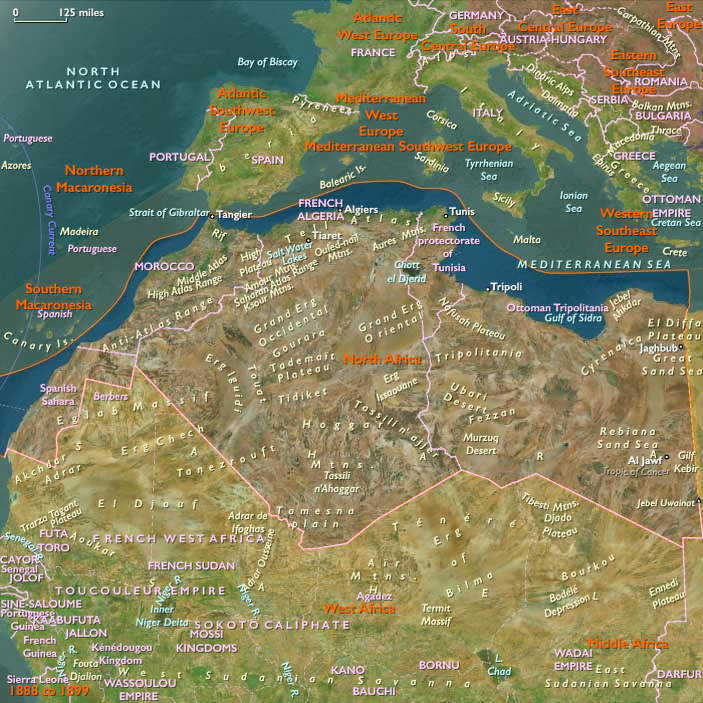
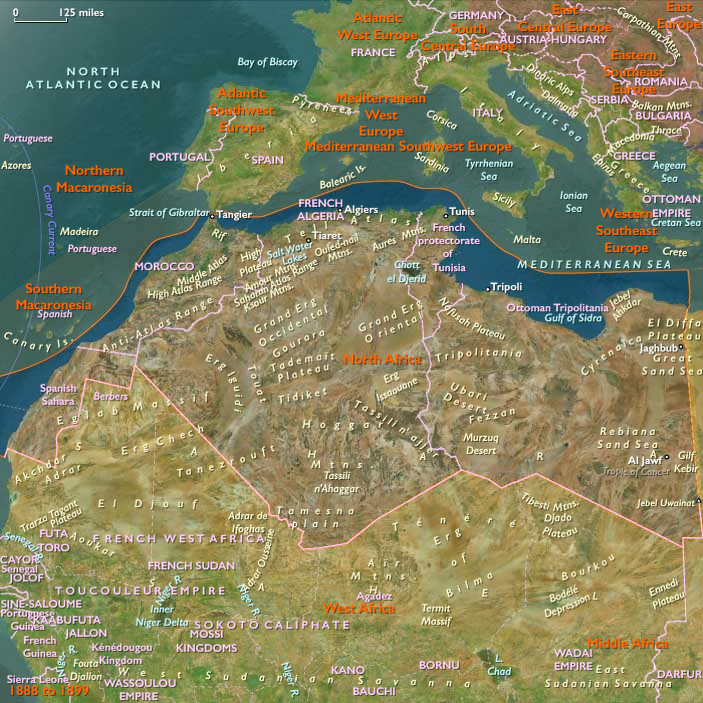
The subregion of North Africa includes Morocco (with the Western Sahara), Algeria, Tunisia, and Libya. Anchors included the Atlas Mountains, the Tell plains, the Western Sahara desert corridor (later Spanish Sahara, with Río de Oro and Saguia el-Hamra), the Saharan oases, and the Mediterranean ports of Algiers, Tunis, Tripoli, Casablanca, and Tangier. From fertile valleys to arid desert, the region’s environments were reshaped by European conquest, settler colonization, and the struggles for independence.
Climate & Environmental Shifts
The 19th century saw cycles of drought and famine across the Maghreb, devastating rural populations in Algeria and Morocco. Locust swarms exacerbated hardship. In the 20th century, irrigation projects and colonial plantations transformed the Tell and oases, while mechanized drilling extended wells into the Western Sahara. By mid-century, desertification intensified, placing stress on nomadic pastoralists.
Subsistence & Settlement
-
Algeria: Invaded by France in 1830, Algeria became a settler colony. Vineyards, wheat fields, and citrus groves expanded, while Indigenous communities lost land through confiscation. Rural revolts erupted, most famously under Abdelkader (1832–1847).
-
Tunisia: Declared a French protectorate in 1881. Olive cultivation and grain exports were commercialized; Tunis and Sfax grew as administrative and commercial centers.
-
Morocco: The Alaouite dynasty endured until the French and Spanish protectorates were imposed in 1912, with Tangier as an international zone. Rural tribes and the Rif War (1921–1926) challenged European control.
-
Libya: Conquered by Italy in 1911 from the Ottomans. Settlers colonized Cyrenaica and Tripolitania, facing fierce resistance from the Sanusi order under Omar Mukhtar (1923–1931) until his capture and execution.
-
Western Sahara: Formally annexed as Spanish Sahara (1884), divided into Río de Oro and Saguia el-Hamra.Spanish rule was consolidated in the 20th century with coastal outposts at Villa Cisneros (Dakhla) and La Güera. Phosphate deposits at Bou Craa (discovered 1947) became central to Spain’s colonial interests.
Technology & Material Culture
Colonial regimes built railways, ports, and roads to export grain, oil, wine, phosphates, and petroleum. European-style cities rose alongside Indigenous medinas. Mosques, zawiyas, and Sufi shrines remained cultural anchors. In Libya and Algeria, resistance fighters wielded rifles and guerrilla tactics. In Morocco and the Western Sahara, nomads sustained camel caravans, tents, and oral poetry while gradually adapting to modern arms and vehicles introduced in mid-century.
Movement & Interaction Corridors
-
Saharan caravans dwindled as steamships and railroads dominated trade, though camel routes persisted into the 20th century.
-
Colonial export networks: Algeria’s wine and wheat fed French markets; Tunisia exported olives and phosphates; Morocco exported citrus, leather, and phosphates.
-
Western Sahara: Connected to the Canary Islands and Spain by shipping routes; nomadic Sahrawis crossed borders with Mauritania and Morocco.
-
Migration: Thousands of Algerians, Moroccans, and Tunisians migrated to France as laborers during both World Wars and afterward.
Cultural & Symbolic Expressions
Islam remained the core of identity, reinforced through the Sanusi order in Libya, reformist ulama in Algeria, and Sufi brotherhoods across Morocco and Tunisia. Oral poetry and tribal traditions preserved Saharan identity. Colonial regimes sponsored European schools, churches, and cultural institutions, but local resistance emphasized Arabic language, Islamic law, and national symbols. Postwar nationalism produced flags, anthems, and revolutionary heroes, linking independence to cultural revival.
Environmental Adaptation & Resilience
Villages intercropped cereals and legumes to survive drought. Nomadic tribes in the Sahara adjusted grazing routes and relied on kinship networks. During famines, zawiyas and religious waqf lands distributed food aid. Resistance fighters exploited deserts and mountains as refuges against colonial armies. In the 20th century, conservation of oases and state irrigation schemes aimed to stabilize fragile ecosystems, though often at high social cost.
Transition
By 1971 CE, North Africa had undergone sweeping transformation:
-
Algeria achieved independence in 1962 after a bloody war led by the FLN.
-
Tunisia became independent in 1956 under Habib Bourguiba.
-
Morocco regained independence in 1956 under Mohammed V and Hassan II.
-
Libya became independent in 1951 under King Idris; a 1969 coup brought Muammar Gaddafi to power.
-
Western Sahara remained under Spanish control as Spanish Sahara, its Sahrawi population marginalized even as Bou Craa phosphate mines and fisheries drew colonial investment.
North Africa, long a crossroads of Saharan caravans and Mediterranean seaports, entered the modern era with its states independent and assertive—except for the Western Sahara, where the unfinished struggle for decolonization would soon ignite.
People
- Abd al-Hafid of Morocco
- Ahmed Ben Bella
- Emir Abdelkader
- Habib Bourguiba
- Houari Boumédiène
- Hussein Dey
- Idris of Libya
- Mohammed V of Morocco
- Muammar Gaddafi
- Omar al-Mukhtar
Groups
- Arab people
- Berber people (also called Amazigh people or Imazighen, "free men", singular Amazigh)
- Islam
- Ottoman Algeria
- Tripolitania (Regency of Tripoli, Tripoli-in-the-West), Ottoman eyalet of
- Alawi dynasty
- Morocco, 'Alawi (Filali) Sultanate of
- Tunis, Beylik of
- United States of America (US, USA) (Washington DC)
- France, constitutional monarchy of
- Algeria, French Colony of
- Tripolitania, Ottoman Vilayet of
- Senussi, or Sanussi
- Tunis, French protectorate of
- Morocco, (French) Protectorate of
- Italian Cyrenaica
- Italian Tripolitania
- Libya, Italian
- Libya, Allied Occupied
- Libya, Kingdom of
- Tunisia, Republic of
- Algeria
- Libya (Libyan Arab Republic)
Topics
- Secession of Constantine (Algeria)
- Abd el-Kader, First War of (Algerian French Wars of 1832-1847)
- Pacification of Algeria
- Abd al-Qadir, or Abd el-Kader, Second War of (Algerian French Wars of 1832-1847)
- Abd el-Kader, Third War of
- Italo-Turkish War of 1911-12
- World War, Second (World War II)
- Libyan Revolt
- Algerian War of 1954-62
Subjects
Regions
Subregions
Related Events
Showing 10 events out of 19829 total
Years: 1828 - 1971
People
- Abd al-Hafid of Morocco
- Ahmed Ben Bella
- Emir Abdelkader
- Habib Bourguiba
- Houari Boumédiène
- Hussein Dey
- Idris of Libya
- Mohammed V of Morocco
- Muammar Gaddafi
- Omar al-Mukhtar
Groups
- Arab people
- Berber people (also called Amazigh people or Imazighen, "free men", singular Amazigh)
- Islam
- Ottoman Algeria
- Tripolitania (Regency of Tripoli, Tripoli-in-the-West), Ottoman eyalet of
- Alawi dynasty
- Morocco, 'Alawi (Filali) Sultanate of
- Tunis, Beylik of
- United States of America (US, USA) (Washington DC)
- France, constitutional monarchy of
- Algeria, French Colony of
- Tripolitania, Ottoman Vilayet of
- Senussi, or Sanussi
- Tunis, French protectorate of
- Morocco, (French) Protectorate of
- Italian Cyrenaica
- Italian Tripolitania
- Libya, Italian
- Libya, Allied Occupied
- Libya, Kingdom of
- Tunisia, Republic of
- Algeria
- Libya (Libyan Arab Republic)
Topics
- Secession of Constantine (Algeria)
- Abd el-Kader, First War of (Algerian French Wars of 1832-1847)
- Pacification of Algeria
- Abd al-Qadir, or Abd el-Kader, Second War of (Algerian French Wars of 1832-1847)
- Abd el-Kader, Third War of
- Italo-Turkish War of 1911-12
- World War, Second (World War II)
- Libyan Revolt
- Algerian War of 1954-62
Subjects
Regions
Subregions