
West Europe (820 – 963 CE): Carolingian …
Years: 820 - 963
West Europe (820 – 963 CE): Carolingian Fragmentation, Monastic Renewal, and the Birth of Normandy
Geographic and Environmental Context
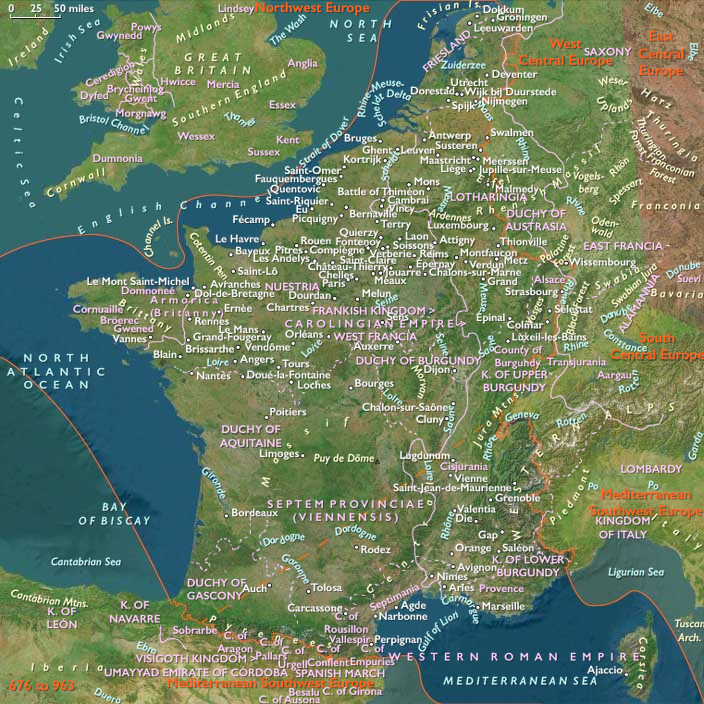
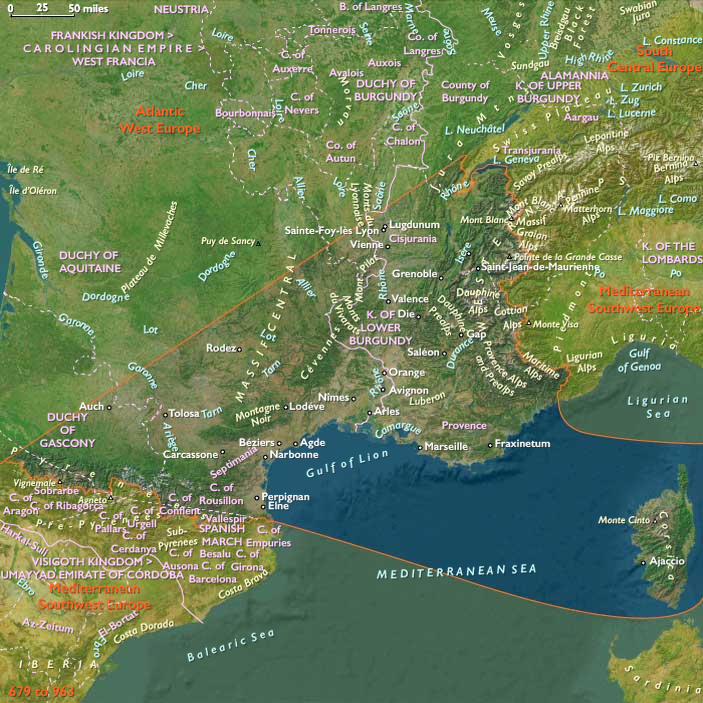
West Europe in this age stretched from the Rhône and Languedoc plains to the Loire and Seine valleys, the Channel coasts, and the Low Countries, forming the western heartlands of the former Carolingian Empire.
Two major subregions framed its geography:
-
Mediterranean West Europe—the Rhône valley, Provence, Languedoc, and Roussillon, connecting Burgundy and the Frankish interior to the western Mediterranean and Pyrenees.
-
Atlantic West Europe—northern France and the Low Countries, dominated by the Seine, Loire, and Scheldt basins opening to the Channel and North Sea.
From the Alpine passes and Jura uplands to the Breton headlands, river systems underpinned trade and defense, while the onset of the Medieval Warm Period after c. 950 lengthened growing seasons and expanded viticulture and grain production.
Societies and Political Developments
Mediterranean West Europe: Provençal Polities and the Rhone Corridor
-
After the Treaty of Verdun (843), the Rhône–Provence–Languedoc belt entered Middle Francia (Lothair’s realm), later fragmenting into Burgundian and Provençal spheres.
-
The County of Provence centered on Arles and Marseille; Septimania (Languedoc) balanced between Frankish and Andalusian influence across the Pyrenees.
-
Corsica remained semi-autonomous but suffered frequent Saracen raids; Monaco and coastal towns fortified themselves under local lords.
-
Lyon served as an ecclesiastical and Carolingian administrative hub, mediating Burgundy’s ties to the Mediterranean.
-
Regional counts in Narbonne, Carcassonne, and Montpellier asserted practical independence, forming the political seedbed of later Occitan culture.
Atlantic West Europe: Carolingian Successors and Viking Frontiers
-
Carolingian fragmentation (843–888) divided the western realm into West Francia, Burgundy, and Lotharingia.
-
Paris emerged as a fortified bastion against Viking fleets, who exploited navigable rivers—Seine, Loire, Scheldt—to plunder Rouen, Nantes, Tours, and Ghent.
-
The Treaty of Saint-Clair-sur-Epte (911) created the Duchy of Normandy under the Viking leader Rollo, securing coastal settlement and Christian conversion.
-
Flanders developed as a fortified marcher county, mediating between West Francia and Lotharingia, while Brittany alternated between independence and Frankish pressure.
-
In the Loire basin, regional counts (Anjou, Blois, Poitiers) consolidated territories that would later define the Capetian and Angevin worlds.
Economy and Trade
-
Agriculture:
-
Provence & Languedoc: olives, vines, wheat, and cattle; terraces and irrigation along the Rhône.
-
Northern France & Flanders: cereals, flax, and wool; viticulture on the Loire and Seine; cattle and dairying in Flanders and the Jura.
-
-
Rhone–Mediterranean trade: wine, salt, and grain moved downriver to Arles and Marseille; silks and spices from Italy moved upriver to Lyon and Burgundy.
-
Atlantic markets: Channel fisheries, salt pans, and wool processing in Flanders; Scheldt trade linked to the Rhine–Meuse.
-
Ports and routes:
-
Marseille, Narbonne, Arles connected inland Gaul to the Mediterranean.
-
Rouen, Nantes, and Bruges became northern entrepôts for textiles, salt, and grain.
-
-
Monetization: Carolingian deniers remained the standard; regional mints in Lyon, Tours, and Rouen circulated silver coins that tied seigneurial economies to long-distance trade.
Subsistence and Technology
-
Cereal expansion: heavy plow adoption on the loess soils of the Seine–Loire basins.
-
Viticulture: Rhone, Burgundy, and Loire slopes terraced for wine; barrels and presses standardized storage.
-
Maritime and river transport: flat-bottomed boats and clinker-built vessels navigated river–sea transitions.
-
Defensive architecture: wooden motte-and-bailey prototypes appeared by the 10th century; stone keeps in Provence and Narbonne guarded trade routes.
-
Monastic estates integrated mills, vineyards, and waterworks, providing food security and technical innovation.
Movement and Interaction Corridors
-
Rhône corridor: Burgundy ⇄ Provence ⇄ Mediterranean ports.
-
Loire & Seine rivers: arteries of Carolingian and Viking-era commerce; connected Paris and Tours to the Atlantic.
-
Via Domitia: Roman road linking Nîmes, Narbonne, and the Pyrenees.
-
Scheldt–Rhine–Meuse delta: network joining Flanders to the Rhineland and North Sea markets.
-
Pyrenean passes: opened communication between Roussillon and Aragon/Andorra, precursors to Catalan integration.
Belief and Symbolism
-
Christianity and reform:
-
Episcopal sees (Lyon, Arles, Narbonne, Reims, Tours) maintained Carolingian ecclesiastical continuity.
-
Cluny Abbey (founded 910) in Burgundy initiated the monastic reform movement that revitalized European spirituality and discipline.
-
-
Monastic patronage: monasteries in the Rhône–Saône–Loire triangle (Cluny, Tournus, Vézelay) and in Tourssafeguarded manuscripts and relics during Viking disruptions.
-
Relic cults and pilgrimage: shrines at Tours (St. Martin), Chartres, and Reims drew pilgrims and royal patronage.
-
Syncretism: Christian and regional traditions fused—Roman saints in Languedoc, local miracle cults in Burgundy, and re-sanctified pagan sites in Brittany and the Jura.
Adaptation and Resilience
-
Political decentralization created flexible local governance: counts and bishops stabilized territories when kingship faltered.
-
Riverine redundancy: when overland travel was unsafe, goods moved by river; when Vikings disrupted the Seine, the Loire or Rhône systems took up traffic.
-
Maritime continuity: even during raids, coastal trade adapted through fortified ports and protected monastic harbors.
-
Monastic organization and Cluniac discipline reasserted stability, literacy, and agrarian innovation.
-
Agrarian diversification—grains, vines, livestock—buffered communities from climate and warfare shocks.
Long-Term Significance
By 963 CE, West Europe had reorganized itself around river valleys, fortified counties, and monastic centers:
-
The Rhone–Provence corridor revived Mediterranean exchange under Burgundian and Provençal counts.
-
The Seine–Loire heartland endured Viking assault and birthed Normandy, a hybrid duchy bridging Norse vigor and Frankish order.
-
Flanders and Burgundy prospered as border economies balancing Latin and Germanic realms.
-
The Cluniac reform radiated spiritual renewal from Burgundy across Europe.
These patterns—local lordship, monastic reform, fortified commerce, and riverine unity—defined the political and cultural rebirth that would propel West Europe into the high medieval age.
People
Groups
- Christianity, Chalcedonian
- Corsica, Medieval
- Septimania
- Provence, Early Medieval
- Islam
- Saracens
- Córdoba, Umayyad Emirate of
- Toulouse, County of
- Frankish, or Carolingian (Roman) Empire
- Barcelona, County of
- Francia Occidentalis (West Francia, or France), Kingdom of
- Francia Media (Middle Francia), Kingdom of
- Fraxinetum
- Córdoba, (Umayyad) Caliphate of
- Arles, Kingdom of, or Second Kingdom of Burgundy
Topics
Commodoties
- Fish and game
- Domestic animals
- Oils, gums, resins, and waxes
- Grains and produce
- Textiles
- Ceramics
- Salt
- Beer, wine, and spirits
- Money
- Aroma compounds
Subjects
Regions
Subregions

Years: 820 - 963
People
Groups
- Christianity, Chalcedonian
- Corsica, Medieval
- Septimania
- Provence, Early Medieval
- Islam
- Saracens
- Córdoba, Umayyad Emirate of
- Toulouse, County of
- Frankish, or Carolingian (Roman) Empire
- Barcelona, County of
- Francia Occidentalis (West Francia, or France), Kingdom of
- Francia Media (Middle Francia), Kingdom of
- Fraxinetum
- Córdoba, (Umayyad) Caliphate of
- Arles, Kingdom of, or Second Kingdom of Burgundy
Topics
Commodoties
- Fish and game
- Domestic animals
- Oils, gums, resins, and waxes
- Grains and produce
- Textiles
- Ceramics
- Salt
- Beer, wine, and spirits
- Money
- Aroma compounds
Subjects
Regions
Subregions