
Filters:
The Fracturing of the Empire: Divided Loyalties …
Years: 840 - 840
The Fracturing of the Empire: Divided Loyalties
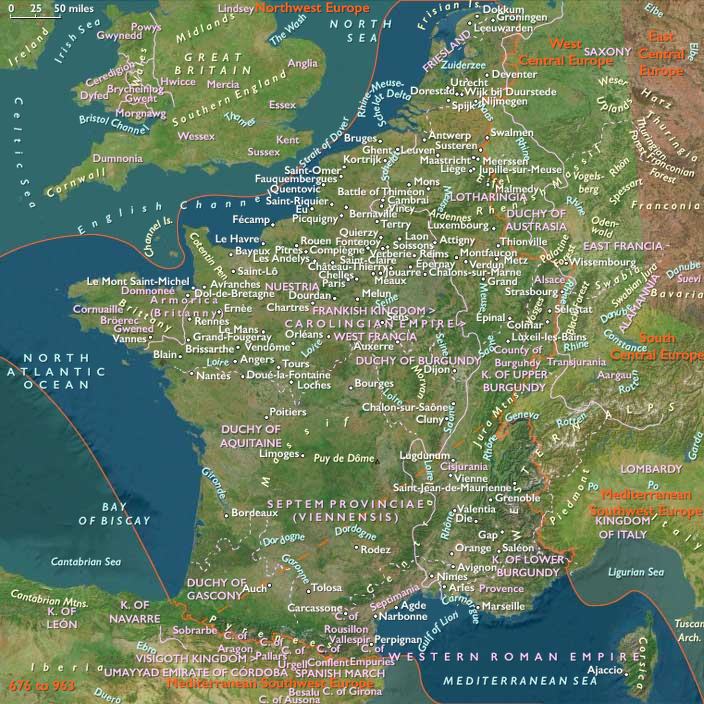
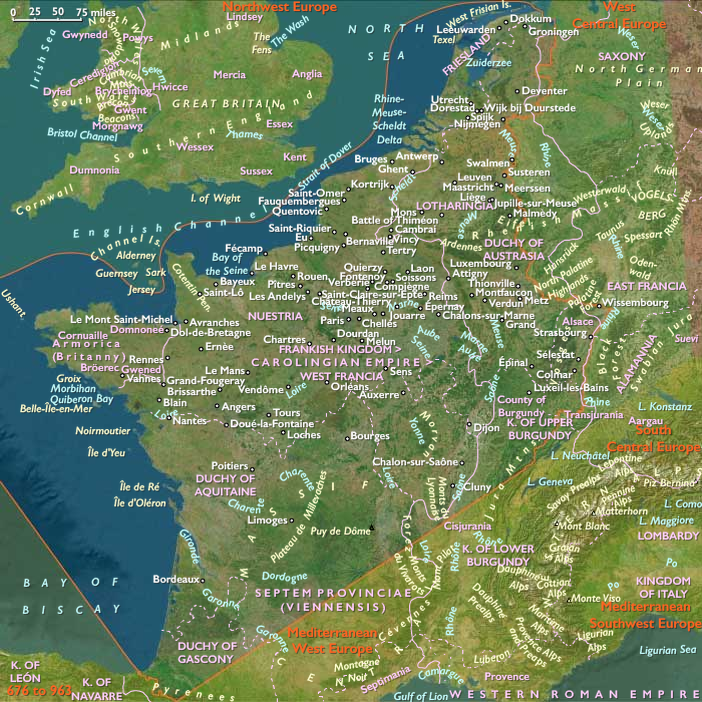
The Carolingian nobility is divided in allegiance, particularly in Burgundy, where counts split between Charles and Lothair:
Lothair’s Supporters
- Ermenaud III of Auxerre
- Arnoul of Sens
- Audri of Autun
- Girard II, Count of Paris (Lothair’s brother-in-law)
Charles’ Supporters
- Guerin of Provence
- Aubert of Avallon
The War’s Outcome: The Treaty of Verdun (843)
The war continues until Charles the Bald and Louis the German defeat Lothair at the Battle of Fontenay (841) and solidify their alliance with the Oaths of Strasbourg (842). This culminates in the Treaty of Verdun (843), which permanently divides the Carolingian Empire into three distinct kingdoms:
- West Francia → Charles the Bald (precursor to France).
- Middle Francia → Lothair I, including the imperial title, but his kingdom will later fracture.
- East Francia → Louis the German (precursor to Germany).
Legacy of the 839 Partition and Civil War
- The dream of a unified Carolingian Empire collapses, marking the beginning of medieval Europe’s political map.
- The Frankish kingdoms begin evolving into separate entities, leading to the future emergence of France and Germany.
- Lothair’s imperial ambitions fail, and his Middle Frankish Kingdom proves unstable, setting the stage for further fragmentation.
Thus, the final partition of Louis the Pious in 839 directly leads to the division of Charlemagne’s empire, shaping the medieval European world for centuries to come.
Locations
People
- Charles the Bald
- Girart de Roussillon
- Guerin of Provence
- Lothair I
- Louis the German
- Pepin II of Aquitaine
Groups
Topics
Commodoties
Subjects
Regions
Subregions
Years: 840 - 840
Locations
People
- Charles the Bald
- Girart de Roussillon
- Guerin of Provence
- Lothair I
- Louis the German
- Pepin II of Aquitaine
Groups
Topics
Commodoties
Subjects
Regions
Subregions