
East Europe (1252 – 1395 CE): Mongol …
Years: 1252 - 1395
East Europe (1252 – 1395 CE): Mongol Suzerainty, Novgorod’s Fur Republic, and Lithuania’s Expansion
Geographic and Environmental Context
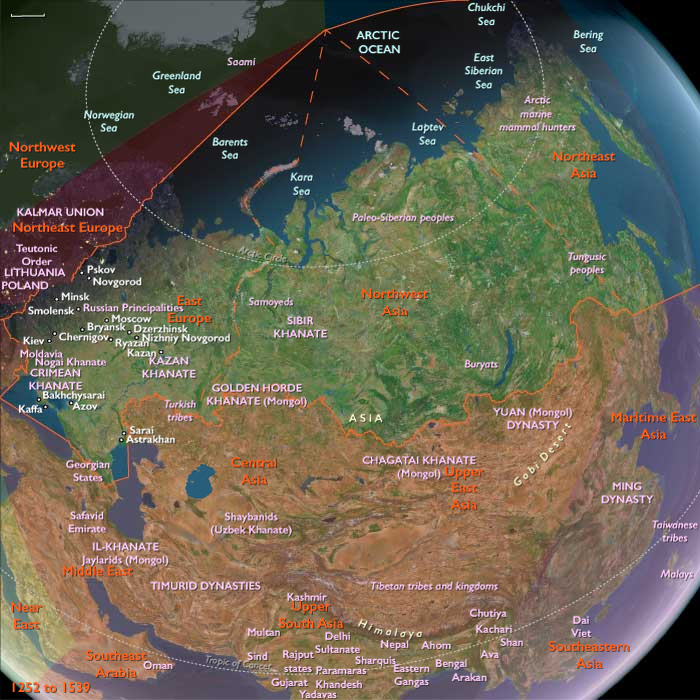
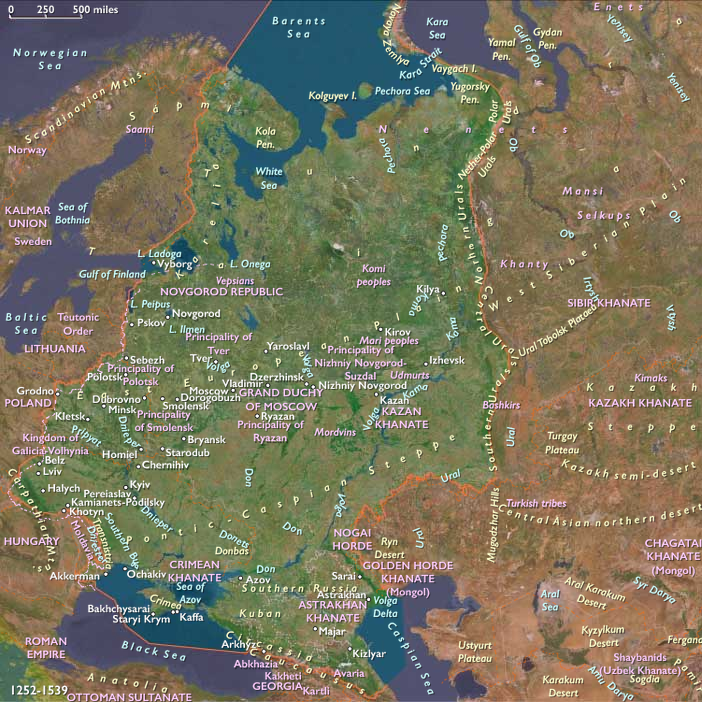
East Europe includes Belarus, Ukraine, and the European portion of Russia (including the sixteen Russian republics west of the Urals).
-
Anchors: the forest and forest-steppe zones of the Dnieper, Volga–Oka, and Upper Dvina basins; the steppe corridor north of the Black Sea; and the Novgorod–Pskov lakelands tied to the Baltic.
-
Strategic axes: Dnieper–Desna, Volga–Oka, Western Dvina, and Don; Baltic connectors through Novgorod and Pskov.
Climate and Environmental Shifts
-
Late Medieval Warm Period yielded to the early Little Ice Age after c. 1300: longer winters, more frequent spring floods, and shorter growing seasons on the northern fringe.
-
River freezes lengthened the winter over-ice transport season, facilitating fur and grain movement to urban markets.
Societies and Political Developments
-
Mongol conquest and the Golden Horde (Jochid ulus):
-
The Mongol campaigns (1237–1240) dismantled the Kievan Rus’ commonwealth. Principalities survived under Horde suzerainty—paying tribute (yasak), hosting basqaq agents, and using the Horde courier system (yam).
-
The Horde’s capitals at Sarai (lower Volga) coordinated levies and trade; steppe raids remained a constant frontier pressure.
-
-
Vladimir–Suzdal’, Tver’, and Moscow:
-
On the Volga–Oka, rival knyaz lines competed for the Horde’s patent (yarlik) to the grand princely title of Vladimir.
-
Moscow rose from a junior appanage: Ivan I “Kalita” (1325–1341) secured the tribute-collector role, attracting boyars and clergy; Dmitry Donskoy defeated Mamai’s army at Kulikovo Field (1380), a landmark of resistance, though Toqtamish burned Moscow (1382).
-
-
Novgorod and Pskov (veche republics):
-
The Novgorod Republic remained autonomous under Horde suzerainty by avoiding direct confrontation, governed by a popular assembly (veche) and posadniks.
-
It dominated the fur–wax–honey trades and dealt with the Hanseatic League via the kontor in Toruń/Visby; Pskov emerged as a semi-independent sister republic.
-
-
Galicia–Volhynia and the rise of Lithuania:
-
King Danylo (Daniel) of Galicia (crowned 1253) revived the southwestern Rus’ realm, but by the 14th c. the Grand Duchy of Lithuania absorbed most Rus’ lands.
-
Under Gediminas (1316–1341) and Algirdas (victory at Blue Waters, 1362), Lithuania took Kiev and the Dnieper marches; after the Union of Krewo (1385) and Christianization of Lithuania (1387), a Polish-Lithuanian dynastic bloc formed, ruling much of Belarus and Ukraine.
-
-
Steppe frontier:
-
Rus’ principalities, Lithuanian border castles, and later Moldavian and Wallachian states contested the Black Sea approaches amid shifting Horde factions.
-
Economy and Trade
-
Agrarian base: rye, oats, and barley dominated the forest zone; wheat and millet in the forest-steppe. Three-field rotation spread on the more southerly soils.
-
Fur economy: sable, marten, squirrel, and fox from taiga and mixed forests remained the premier export through Novgorod–Hanse channels and via Volga routes to Sarai.
-
Long-distance routes:
-
Volga corridor: grain, salt, fish, and crafted goods moved to the Horde markets and the Caspian.
-
Baltic corridor: Novgorod and Pskov exported furs, wax, and flax; imported silver, cloth, and salt through Hanseatic towns.
-
Dnieper–Black Sea traffic declined after the Mongol shock but partially revived under Lithuanian protection in the later 14th c.
-
-
Urban crafts & coinage: smithing, tanning, and milling flourished in river towns; silver grivna bars and later fractional pennies circulated alongside foreign denars and Prague groschen.
Subsistence and Technology
-
Agriculture & stock: ard and heavy plough on loams; horse and ox traction; beekeeping (forest apiculture) supplied wax and honey.
-
Fortifications: timber-earth ramparts and later stone kremlins (e.g., Moscow’s white-stone walls from 1367) secured capitals and river nodes.
-
Transport: river barges in ice-free seasons; winter sled-trains along frozen rivers and packed snow routes; Horde yam way-stations accelerated couriers and tribute convoys.
Movement and Interaction Corridors
-
Volga–Oka–Klyazma triangle: heartland of northeast Rus’ power (Vladimir, Moscow, Tver’).
-
Upper Dnieper–Pripet–Western Dvina: Lithuanian–Rus’ arteries binding Kiev, Smolensk, Polotsk, and Vilnius.
-
Novgorod–Ladoga–Neva: gateway to the Baltic and Hanse.
-
Steppe roads from Sarai to the Don/Lower Dnieper: conduits for tribute, trade, and raids.
Belief and Symbolism
-
Orthodox Christianity: the Metropolitan’s seat shifted from Kiev to Vladimir (1299) and effectively to Moscow (1325); monastic renewal under Sergius of Radonezh (d. 1392) anchored spiritual and agrarian colonization of the northeast.
-
Latin Christianity: strong in Galicia–Volhynia and later within Lithuanian–Polish spheres; cathedral foundations and mendicant houses appeared in frontier towns.
-
Mission & frontier faiths: St Stephen of Perm (d. 1396) evangelized among the Komi; in steppe zones, Islam advanced within the Horde elite while popular Tengrism persisted.
-
Cult and memory: chronicles, saints’ lives, and battle legends (e.g., Kulikovo) forged shared identities across fragmented polities.
Adaptation and Resilience
-
Political layering: veche republics, appanage principalities, Horde suzerainty, and Lithuanian grand-ducal rule coexisted—allowing trade and church life to continue despite warfare.
-
Route redundancy: when Dnieper routes faltered, Volga and Baltic corridors carried exchange; winter travel compensated for summer insecurity.
-
Monastic colonization: cleared forests, drained bogs, and created agricultural oases that stabilized settlement and provided safe havens.
-
Fiscal pragmatism: tribute arrangements with the Horde and yarlik politics bought breathing room for rising centers (notably Moscow).
Long-Term Significance
By 1395, East Europe had reconfigured its political geography:
-
The Golden Horde still dominated the steppe; yet its internal strife and Timur’s blows (1380s–1395) weakened control.
-
Lithuania ruled most southwestern Rus’ lands, while Moscow emerged as the chief collector and defender in the northeast.
-
Novgorod remained a Baltic fur-empire under veche rule.
-
The Orthodox Church and monastic networks provided cohesion—laying the spiritual and institutional groundwork for Muscovy’s 15th-century ascent and for a durable Lithuanian-Rus’ commonwealth across the Dnieper and Dvina.
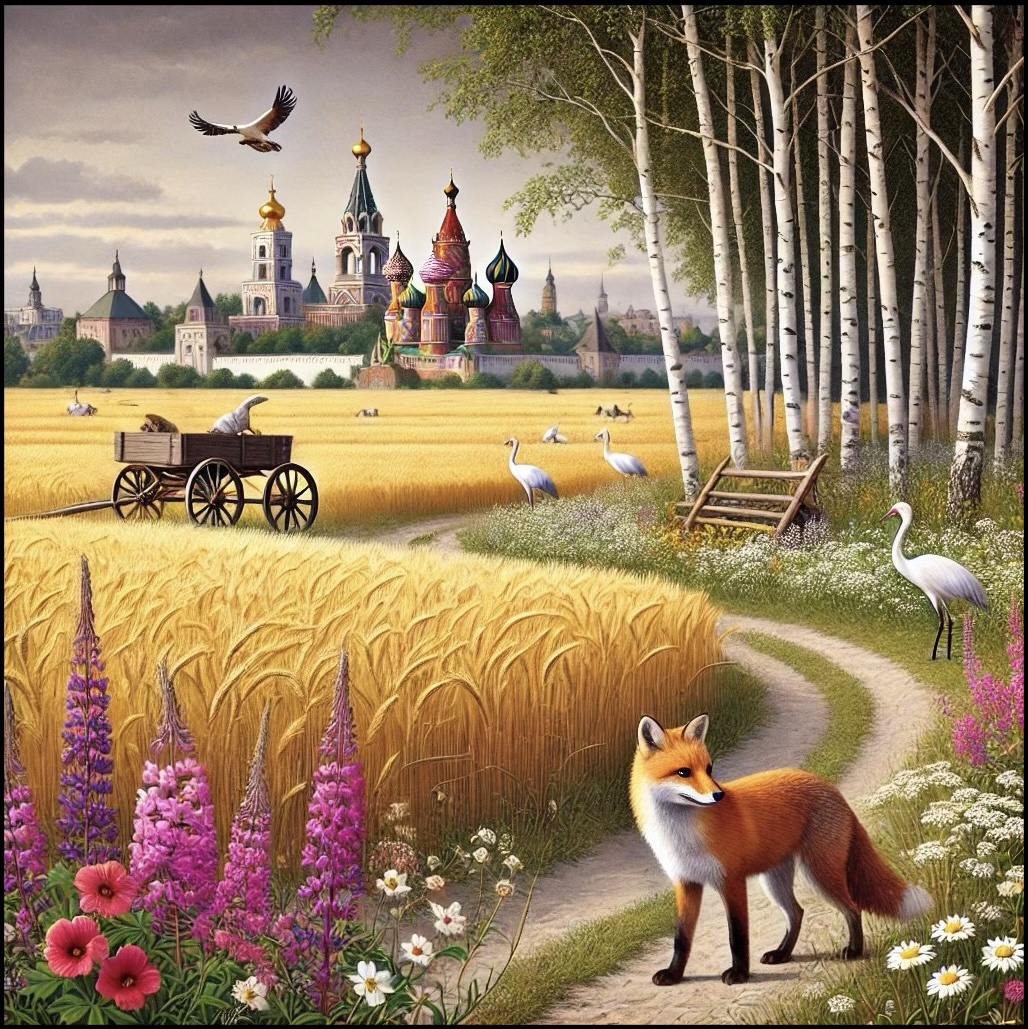
East Europe (with civilization) ©2024-25 Electric Prism, Inc. All rights reserved.
People
- Algirdas
- Daniel of Galicia
- Dmitry Donskoy
- Gediminas
- Ivan I of Moscow
- Mamai
- Sergius of Radonezh
- Stephen of Perm
- Timur
- Tokhtamysh
Groups
- Kievan Rus', or Kiev, Great Principality of
- Christians, Eastern Orthodox
- Halych (Galicia), Principality of
- Mongols
- Novgorod Republic
- Ryazan, Principality of
- Vladimir-Suzdal, Great Principality of
- Galicia–Volhynia, Principality of
- Mongol Empire
- Golden Horde, Khanate of the (Mongol Khanate)
- Tver, Principality of
- Lithuania, Grand Duchy of
- Roman Empire, Eastern: Palaiologan dynasty
- Moscow, Grand Principality of
- Lithuania, Grand Duchy of
- Pskov, Republic of
- Hanseatic League
- Golden Horde, Khanate of the (Kipchak Khanate)
- Lithuania, Grand Duchy of
Topics
Commodoties
- Weapons
- Hides and feathers
- Gem materials
- Domestic animals
- Oils, gums, resins, and waxes
- Grains and produce
- Ceramics
- Strategic metals
- Slaves
- Sweeteners
- Beer, wine, and spirits
- Money
Subjects
- Decorative arts
- Conflict
- Mayhem
- Faith
- Government
- Custom and Law
- Technology
- Human Migration
- Metallurgy
Regions
Subregions
Related Events
Showing 10 events out of 46611 total
Years: 1252 - 1395
East Europe (with civilization) ©2024-25 Electric Prism, Inc. All rights reserved.
People
- Algirdas
- Daniel of Galicia
- Dmitry Donskoy
- Gediminas
- Ivan I of Moscow
- Mamai
- Sergius of Radonezh
- Stephen of Perm
- Timur
- Tokhtamysh
Groups
- Kievan Rus', or Kiev, Great Principality of
- Christians, Eastern Orthodox
- Halych (Galicia), Principality of
- Mongols
- Novgorod Republic
- Ryazan, Principality of
- Vladimir-Suzdal, Great Principality of
- Galicia–Volhynia, Principality of
- Mongol Empire
- Golden Horde, Khanate of the (Mongol Khanate)
- Tver, Principality of
- Lithuania, Grand Duchy of
- Roman Empire, Eastern: Palaiologan dynasty
- Moscow, Grand Principality of
- Lithuania, Grand Duchy of
- Pskov, Republic of
- Hanseatic League
- Golden Horde, Khanate of the (Kipchak Khanate)
- Lithuania, Grand Duchy of
Topics
Commodoties
- Weapons
- Hides and feathers
- Gem materials
- Domestic animals
- Oils, gums, resins, and waxes
- Grains and produce
- Ceramics
- Strategic metals
- Slaves
- Sweeteners
- Beer, wine, and spirits
- Money
Subjects
- Decorative arts
- Conflict
- Mayhem
- Faith
- Government
- Custom and Law
- Technology
- Human Migration
- Metallurgy
Regions
Subregions