
East Central Europe (832–843 CE): Rastislav’s Moravia, …
Years: 832 - 843
East Central Europe (832–843 CE): Rastislav’s Moravia, Carolingian Turmoil, and Saxon Dynastic Foundations
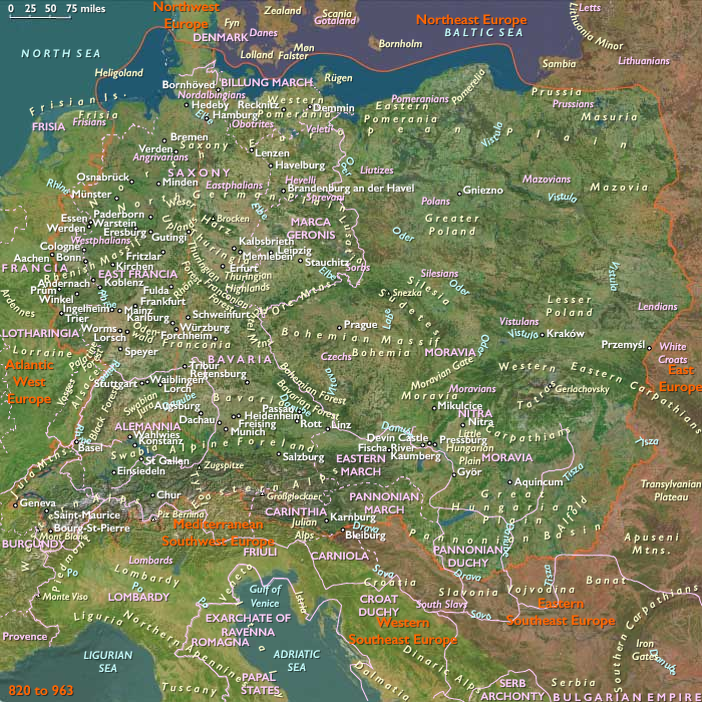
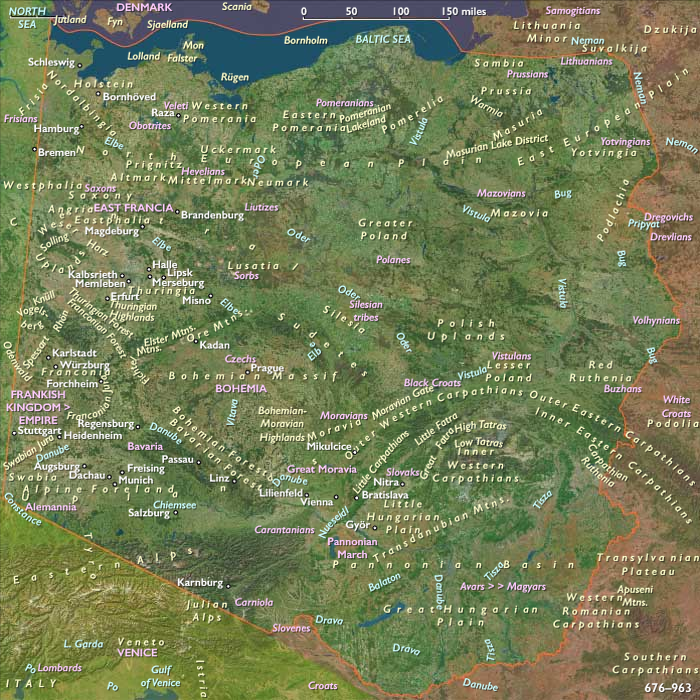
Between 832 and 843 CE, East Central Europe—comprising modern-day Poland, Czechia, Slovakia, Hungary, and the eastern parts of Germany and Austria lying east of 10°E and north of a line from roughly 48.2°N at 10°E southeastward to the Austro-Slovenian border near 46.7°N, 15.4°E—witnessed significant shifts driven by internal Carolingian instability and rising Slavic and Saxon political autonomy. In Great Moravia, the ascension of Rastislav (r. 846–870) laid the groundwork for greater independence. Saxon noble houses, particularly the emerging Liudolfings, further solidified their regional influence, while the wider Carolingian Empire, wracked by internal divisions culminating in the landmark Treaty of Verdun (843 CE), saw its hold on East Central Europe challenged.
Political and Military Developments
Rise of Rastislav and Moravian Autonomy
-
Although officially ascending in 846, Rastislav began exerting political influence in the early 840s, consolidating Great Moravia’s territories, strengthening internal governance, and asserting greater independence from Carolingian overlordship.
-
Rastislav skillfully navigated relationships with neighboring Frankish rulers, setting the stage for Moravia’s diplomatic and military prominence.
Carolingian Internal Struggles and Treaty of Verdun (843 CE)
-
Following the death of Emperor Louis the Pious in 840 CE, the Carolingian Empire plunged into civil war among his sons, Louis the German, Lothair I, and Charles the Bald.
-
The resulting Treaty of Verdun (843 CE) partitioned the empire, with East Francia, including Bavaria, Thuringia, and Saxony, falling under Louis the German, significantly reshaping the political landscape of East Central Europe.
Strengthening of Saxon Noble Dynasties
-
Saxon noble power consolidated under influential figures like Liudolf, whose expanding territory and strategic marriages began to elevate the Liudolfing (Ottonian) lineage into a dominant regional force.
-
The groundwork laid by Liudolf would eventually position the Liudolfings as future rulers of East Francia.
Economic and Technological Developments
Economic Continuity and Growth
-
Regional trade networks remained robust despite Carolingian internal disruptions, sustaining prosperity in Bavaria, Thuringia, Saxony, and Moravia through commerce in metals, textiles, agricultural goods, and luxury items.
Infrastructure and Fortifications
-
Infrastructure and defensive fortifications across the Carolingian frontier, Saxon territories, and Moravia continued to improve, reflecting sustained economic activity, administrative stability, and military preparedness.
Cultural and Artistic Developments
Cultural Flourishing in Great Moravia
-
Rastislav’s Moravia experienced intensified cultural developments, expressed through distinctive artistic styles, ceramics, metalwork, and fortifications, reinforcing a unified Slavic identity.
Continued Saxon Cultural Integration
-
Saxon territories deepened their cultural assimilation into the Carolingian framework through religious patronage, the growth of monasteries such as Gandersheim Abbey, and the adoption of Frankish administrative customs, shaping a new Saxon aristocratic culture.
Settlement and Urban Development
Expansion of Moravian Urban Centers
-
Under Rastislav, Moravian settlements grew rapidly into influential centers of governance, commerce, and culture, laying the groundwork for the significant political and ecclesiastical hubs that defined Great Moravia.
Stable Growth in Carolingian and Saxon Urban Areas
-
Bavarian, Thuringian, and Saxon settlements continued their growth, supported by stable governance and regional commerce, reinforcing their importance within East Francia.
Social and Religious Developments
Advancing Christianization
-
Christianity continued its rapid expansion throughout the region, especially in Saxony and Moravia, where local leaders actively patronized missionary efforts, solidifying the integration of these territories into the Christian European cultural sphere.
Emergence of Noble Dynasties and Social Hierarchies
-
The growing power of noble dynasties, notably the Liudolfings in Saxony and Mojmirid rulers in Moravia, solidified hierarchical social structures that profoundly influenced subsequent regional governance and societal organization.
Long-Term Consequences and Historical Significance
The period 832–843 CE significantly reshaped East Central Europe's historical trajectory. Rastislav's ascendance in Moravia, Carolingian internal strife marked by the Treaty of Verdun, and the steady rise of powerful Saxon noble dynasties together laid critical foundations for future political entities. These events decisively influenced the region's medieval history, reshaping its cultural identities, political boundaries, and social hierarchies for generations.
People
- Charles the Bald
- Lothair I
- Louis the German
- Louis the Pious
- Mojmir I of Moravia
- Rastislav of Moravia
Groups
- Polytheism (“paganism”)
- Franks
- Germans
- Saxons
- Wends, or Sorbs (West Slavs)
- Christianity, Chalcedonian
- Bavarians (West Germanic tribe)
- Thuringia, Duchy of
- Thuringia, (Frankish) Duchy of
- Carantania
- Carantanians
- Francia (Carolingians)
- Bavaria, Carolingian Duchy of
- Saxony, Duchy of
- Roman Empire, Eastern: Phrygian or Armorian dynasty
- Moravia, Great, Kingdom of
Topics
Commodoties
Subjects
Regions
Subregions
Years: 832 - 843
People
- Charles the Bald
- Lothair I
- Louis the German
- Louis the Pious
- Mojmir I of Moravia
- Rastislav of Moravia
Groups
- Polytheism (“paganism”)
- Franks
- Germans
- Saxons
- Wends, or Sorbs (West Slavs)
- Christianity, Chalcedonian
- Bavarians (West Germanic tribe)
- Thuringia, Duchy of
- Thuringia, (Frankish) Duchy of
- Carantania
- Carantanians
- Francia (Carolingians)
- Bavaria, Carolingian Duchy of
- Saxony, Duchy of
- Roman Empire, Eastern: Phrygian or Armorian dynasty
- Moravia, Great, Kingdom of
Topics
Commodoties
Subjects
Regions
Subregions