
The Fragmentation of …
Years: 820 - 963
The Fragmentation of Middle Francia and the End of Viking Rule in Frisia (843–900)
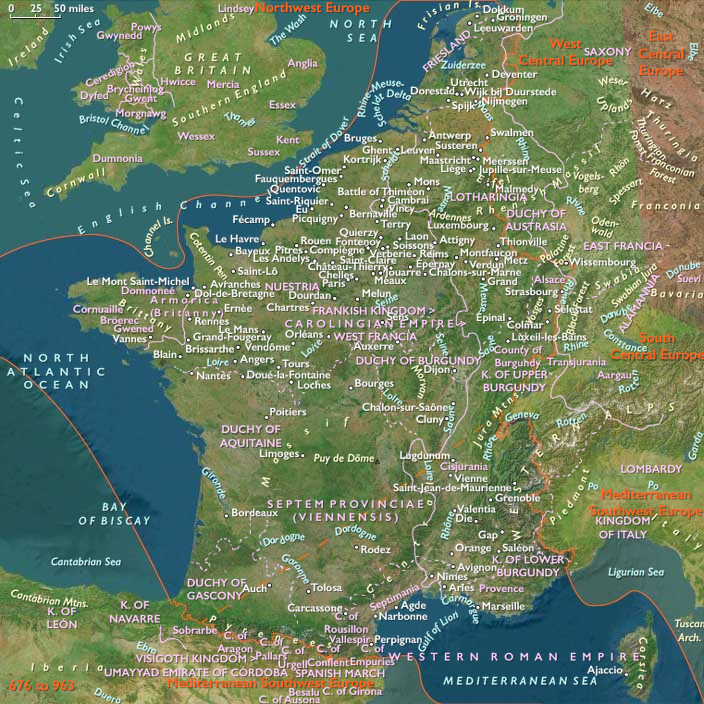
Following the Treaty of Verdun (843), the Carolingian Empire is divided into three distinct kingdoms:
- West Francia → The precursor to modern France.
- East Francia → The precursor to modern Germany and Austria.
- Middle Francia → A weak and politically unstable kingdom stretching from Frisia in the north to Italy in the south, including the Low Countries.
Viking Control in Frisia (850–885)
- Around 850, Lothair I of Middle Francia, unable to defend his northern territories from Viking incursions, acknowledges Rorik of Dorestad, a Danish Viking leader, as ruler of most of Frisia in exchange for his nominal loyalty.
- When Middle Francia is partitioned in 855, the northern lands pass to Lothair II, forming Lotharingia.
- After Lothair II’s death in 869, Lotharingia is divided into Upper and Lower Lotharingia, with the Low Countries becoming part of East Francia in 870 (under the Treaty of Meerssen). However, despite this formal annexation, the region remains effectively under Viking control, as Frisian and Frankish towns are frequently raided.
The Rise and Fall of Viking Rule in Frisia
- In 879, another Viking leader, Godfrid, Duke of Frisia, launches new raids on the Frisian lands, further destabilizing Frankish authority.
- The inability of West and East Francia to maintain control over Frisia allows local noblemen to take up the fight against Viking rule.
- Among these rising local leaders is Gerolf of Holland, who emerges as a key figure in the struggle for power.
The End of Viking Rule: Gerolf of Holland and the Assassination of Godfrid
- In 885, Gerolf, alongside other Frankish nobles, helps assassinate Godfrid, marking the end of Viking dominance in Frisia.
- In recognition of his role, Gerolf assumes lordship over Frisia, further cementing the transition from Carolingian royal rule to local noble governance.
The Legacy: The Fragmentation of Lower Lotharingia
- With the decline of central authority and the failure of East Francia to enforce its rule, Lower Lotharingia begins to fragment into semi-independent feudal states.
- The power vacuum left by the Carolingians and the Viking invasions strengthens the territorial lords, paving the way for the formation of the medieval Dutch and Flemish counties.
- Over time, these emerging feudal domains—such as Holland, Flanders, Brabant, and Gelre—will form the foundation of the medieval Low Countries, ultimately shaping the region’s future as an independent political entity.
Thus, what began as Carolingian instability and Viking incursions in the 9th century ultimately leads to the rise of regional feudal states, setting the stage for the later development of the Netherlands and Belgium.
People
- Gerolf of Holland
- Godfrid, Duke of Frisia
- Lothair I
- Lothair II, King of Lotharingia
- Rorik of Dorestad
Groups
- Franks
- Germans
- Dutch people
- Frisians
- Francia (Carolingians)
- Italy, Carolingian Kingdom of
- Vikings
- Frankish, or Carolingian (Roman) Empire
- Francia Orientalis (East Francia), Kingdom of
- Francia Media (Middle Francia), Kingdom of
- Francia Occidentalis (West Francia, or France), Kingdom of
- Lotharingia, Kingdom of
- Lotharingia, Duchy of
- Lorraine (Lothier), Upper, Duchy of
- Lorraine (Lotharingia), Lower, (first) Duchy of
Topics
Subjects
Regions
Subregions

Related Events
Filter results
Showing 10 events out of 54673 total
The term “glass” developed in the late Roman Empire.
It was in the Roman glassmaking center at Trier, now in modern Germany, that the late-Latin term glesum originated, probably from a Germanic word for a transparent, lustrous substance.
While naturally occurring glass, especially the volcanic glass obsidian, had been used by many Stone Age societies across the globe for the production of sharp cutting tools and, due to its limited source areas, was extensively traded, archaeological evidence suggests that the first true glass was made in coastal north Syria, Mesopotamia or Ancient Egypt.
The earliest known glass objects, of the mid-third millennium BCE, were beads, perhaps initially created as accidental byproducts of metalworking (slags) or during the production of faience, a pre-glass vitreous material made by a process similar to glazing.
Glass remained a luxury material, and the disasters that overtook Late Bronze Age civilizations seem to have brought glassmaking to a halt.
Indigenous development of glass technology in South Asia may have begun in 1730 BCE, whereas in ancient China, glassmaking seems to have a late start, compared to ceramics and metal work.
In the Roman Empire, glass objects have been recovered across the Roman Empire in domestic, industrial and funerary contexts.
Glass begins to be used extensively during the Middle Ages.
Anglo-Saxon glass has been found across England during archaeological excavations of both settlement and cemetery sites.
Glass in the Anglo-Saxon period is used in the manufacture of a range of objects including vessels, beads, windows and was also used in jewelry.
Optical glass for spectacles has been in use since the late Middle Ages.
The production of lenses has become increasingly proficient, aiding astronomers as well as having other application in medicine and science.
Glass is employed from the tenth century onward in stained glass windows of churches and cathedrals, with famous examples at Chartres Cathedral and the Basilica of Saint Denis.
Architects by the fourteenth century are designing buildings with walls of stained glass such as Sainte-Chapelle, Paris, (1203-1248) and the East end of Gloucester Cathedral.
Stained glass has a major revival with Gothic Revival architecture in the nineteenth century.
The use of large stained glass windows becomes less prevalent with the Renaissance and a change in architectural style.
The use of domestic stained glass increases until it is general for every substantial house to have glass windows.
These are initially of small panes leaded together, but with the changes in technology, glass can be manufactured relatively cheaply in increasingly larger sheets, leading to larger window panes, and, in the twentieth century, to much larger windows in ordinary domestic and commercial premises.
Such new types of glass as laminated glass, reinforced glass and glass bricks in the twentieth century increase the use of glass as a building material and result in new applications of glass.
Multistory buildings are frequently constructed with curtain walls made almost entirely of glass.
Similarly, laminated glass is widely applied to vehicles for windscreens.
While glass containers have always been used for storage and are valued for their hygienic properties, glass has been utilized increasingly in industry.
Glass is also employed as the aperture cover in many solar energy systems.
The Samoyeds, a group of Uralic-Samoyedic-speaking Asiatic peoples including the Nensty, the Entsy, the Sel'kup and the Nganasan, characterized, like the Khant, by yellowish white skin, straight or concave noses, high cheek bones, and short stature, migrate during the first millennium CE from the Sayan Mountains to a new homeland, the tundras and forests of northern Russia between the Kola and Taymyr peninsulas.
East Micronesia (820–1971 CE): Colonization, Resistance, and Independence
Political and Military Developments
Indigenous Governance and Societal Structures
Between 820 and 1800 CE, indigenous East Micronesian societies, including those in Kosrae, the Marshall Islands, Kiribati, and Nauru, continued developing complex social structures and political systems based on clan leadership, community consensus, and strategic alliances.
European Exploration and Colonization
European exploration significantly impacted East Micronesia beginning in the 16th century, but substantial colonization efforts intensified in the late 19th century. Germany established colonial control over the Marshall Islands and Nauru in 1886 and 1888, respectively. Kiribati fell under British protection in 1892, while Kosrae became part of German Micronesia until it transferred to Japanese administration post-World War I.
Japanese and American Administration
Post-World War I, Japan administered the region under a League of Nations mandate until its defeat in World War II. Afterward, the United States assumed administrative authority over the Marshall Islands and Kosrae under the Trust Territory of the Pacific Islands. Nauru became jointly administered by Australia, New Zealand, and Britain, while Kiribati remained under British colonial rule.
Movement Toward Independence
Throughout the 20th century, nationalist movements and demands for self-governance intensified. By the late 1960s, significant strides toward independence occurred, culminating in eventual sovereignty for many island states in subsequent years.
Economic and Technological Developments
Economic Transformation under Colonial Rule
Colonial rule introduced significant economic transformations, including the commercialization of copra production, phosphate mining in Nauru beginning in 1906, and infrastructure improvements aimed at facilitating resource extraction and colonial governance.
Technological and Infrastructure Advances
Colonial powers introduced modern infrastructure such as transportation networks, telecommunications, and improved maritime facilities. These developments fundamentally reshaped local economies, social structures, and everyday life in East Micronesia.
Cultural and Artistic Developments
Cultural Preservation and Adaptation
Despite colonial pressures, East Micronesian communities preserved many traditional cultural practices, including oral histories, navigational traditions, and communal rituals. Artistic expressions blended indigenous and colonial influences, creating dynamic cultural landscapes.
Revival and Assertion of Indigenous Culture
The 20th century saw concerted efforts to revive and assert indigenous cultural identities, particularly in response to external influences and increasing calls for independence and autonomy.
Social and Religious Developments
Impact of Christianity
Missionaries significantly impacted religious and social structures throughout East Micronesia. Christianity, predominantly Protestantism and Catholicism, became widely adopted, integrating with traditional belief systems and influencing community practices and societal norms.
Social Transformation
Colonial administration introduced Western education, legal frameworks, and governance models, dramatically reshaping local societies. However, traditional kinship systems, clan structures, and communal decision-making practices persisted as core societal foundations.
Long-Term Consequences and Historical Significance
The period from 820 to 1971 CE marked transformative developments in East Micronesia, characterized by colonial encounters, economic changes, cultural adaptation, and the drive toward self-determination. These centuries profoundly influenced regional identities, social structures, and economic foundations, setting the stage for post-colonial nation-building and ongoing regional dynamics.
East Melanesia (820–1971 CE): Interactions, Colonization, and Independence
Political and Military Developments
Chiefdoms and Inter-Island Alliances
From 820 CE onward, East Melanesia experienced significant growth of complex chiefdoms, notably in Fiji, Vanuatu, and the eastern Solomon Islands. These chiefdoms formed intricate networks of alliances and rivalries, reflecting advanced political organization and military strategies.
European Contact and Colonization
European explorers, beginning in the 17th century, profoundly impacted East Melanesia. Initial exploration was followed by colonization, particularly by British and French powers. New Caledonia became a French colony in 1853, while Fiji was ceded to Britain in 1874, and Vanuatu was jointly administered by Britain and France from 1906 as the New Hebrides Condominium.
Road to Independence
During the 20th century, nationalist movements intensified across East Melanesia. Fiji gained independence in 1970, and later Vanuatu in 1980, highlighting significant shifts towards self-governance and regional sovereignty.
Economic and Technological Developments
Agricultural Innovation and Trade
Agricultural techniques continued evolving, with innovations in crop diversification, cultivation methods, and trade expansion. Copra (dried coconut meat), sandalwood, and sugar became significant economic commodities, fostering regional and global trade.
Technological Integration and Modernization
European colonization introduced new technologies, including metal tools, firearms, and improved shipbuilding techniques. These advancements altered economic practices, transportation, and military dynamics within the region.
Cultural and Artistic Developments
Syncretism and Cultural Adaptation
Cultural traditions adapted and syncretized indigenous Melanesian practices with European influences. Artistic expression, including traditional carvings, dances, and music, incorporated external elements, reflecting evolving cultural identities.
Preservation of Indigenous Traditions
Despite colonial pressures, many indigenous cultural traditions were preserved and revitalized. Ceremonial practices, storytelling, and traditional knowledge systems remained critical components of community cohesion and identity.
Social and Religious Developments
Impact of Christianity
Missionary activities beginning in the 19th century profoundly reshaped religious landscapes, introducing Christianity widely throughout East Melanesia. This led to the blending of indigenous religious practices with Christian doctrines.
Social Changes and Community Structures
Colonialism significantly influenced social structures, introducing Western legal systems, education, and governance models. Nevertheless, traditional community organization, chiefly hierarchies, and kinship networks continued playing vital roles.
Long-Term Consequences and Historical Significance
From 820 to 1971 CE, East Melanesia underwent transformative changes through internal dynamics, external influences, and colonization. The resulting synthesis of traditional and introduced elements profoundly shaped contemporary political structures, economic foundations, cultural identities, and social systems, laying critical groundwork for the post-colonial era.
Northern South Asia (820–1971 CE): Empires, Colonialism, and the Birth of Modern Nations
Medieval Empires and Dynastic Rule
From the early medieval period onward, Northern South Asia experiences significant dynastic changes. Islamic empires begin exerting influence from the 11th century with the Ghaznavids and later the Delhi Sultanate, reshaping cultural and political landscapes through trade, conquest, and cultural exchanges. Simultaneously, Afghanistan becomes a crucial frontier region, witnessing invasions and rule by various Turkic and Persian dynasties, including the Timurids and the early Mughals.
Nepal and Bhutan remain largely isolated, developing distinctive Himalayan cultures and systems of governance. In Nepal, the medieval period is characterized by the rule of various dynasties, such as the Mallas, who foster rich cultural and architectural traditions.
Mughal Ascendancy and Cultural Synthesis
The rise of the Mughal Empire in the 16th century under rulers like Babur, Akbar, and Aurangzeb marks a pinnacle of political and cultural achievement. The Mughals integrate diverse traditions, fostering a unique synthesis of Persian, Indian, and Central Asian cultures. Monumental architecture flourishes, exemplified by the Taj Mahal and the Red Fort. Administrative systems established under Akbar provide stability and governance across the empire, extending influence into modern-day Pakistan, Bangladesh, and parts of Afghanistan.
British Colonial Expansion
The weakening Mughal Empire in the 18th century facilitates the expansion of the British East India Company, climaxing with the pivotal Battle of Plassey in 1757. British dominance consolidates rapidly, leading to direct British rule following the Indian Rebellion of 1857–58. Afghanistan, however, remains fiercely independent, becoming a contested region between British India and Imperial Russia, sparking several Anglo-Afghan wars.
Meanwhile, Nepal under the Shah Dynasty and Bhutan under the leadership of the Wangchuck Dynasty maintain autonomy, though both engage diplomatically and militarily with British India. Bhutan eventually signs treaties with Britain, securing internal sovereignty while ceding some frontier territories.
Rise of Nationalist Movements
Nationalist movements emerge by the late 19th century, notably with the establishment of the Indian National Congress in 1885. Parallel to this, Sir Syed Ahmad Khan spearheads educational reforms for Muslims, founding the Muhammadan-Anglo Oriental College in 1875 (later Aligarh Muslim University), laying the foundation for Muslim political activism.
Afghanistan sees modernization and centralization efforts under leaders like Amir Abdur Rahman Khan (1880–1901), who solidifies borders and establishes the Durand Line with British India, a source of enduring tension.
Independence, Partition, and the Emergence of Modern States
Intense nationalist struggles, notably under Mahatma Gandhi and Muhammad Ali Jinnah, culminate in independence and the partition of British India in 1947, creating the independent dominions of India and Pakistan. The partition triggers massive migrations and communal violence, significantly reshaping the region.
Afghanistan navigates neutrality during this period, balancing relations between emerging global powers, while Nepal and Bhutan maintain independent monarchies, cautiously opening diplomatic relations with neighboring nations and beyond.
Post-Independence Challenges and Conflicts
The new states face immediate challenges, including economic stabilization, integration of princely states, and border disputes, notably over Kashmir. Pakistan experiences internal turmoil, leading to the separation of East Pakistan and the birth of Bangladesh in 1971, following a violent liberation struggle. India maintains democratic governance, embarking on industrialization and social reforms.
Afghanistan becomes a focal point of Cold War rivalry, undergoing rapid modernization, yet experiencing deep internal divisions, leading to instability that intensifies in subsequent decades.
Nepal and Bhutan cautiously engage in modernization while striving to preserve traditional identities. Bhutan introduces controlled development policies under the monarchy, and Nepal gradually opens to external influence.
Legacy of the Epoch
The epoch from 820 to 1971 profoundly shapes Northern South Asia, witnessing transitions from medieval empires to colonial subjugation, culminating in complex realities of independent nation-states. Legacies include cultural syncretism, unresolved regional tensions (particularly over Kashmir and the Durand Line), and socio-political structures inherited from colonial rule. These dynamics continue influencing contemporary geopolitics and societal developments across Northern South Asia.
East Polynesia (820–1971 CE): Isolation, Contact, and Cultural Persistence
Political and Social Developments
Initial Settlement and Community Formation
Between approximately 800 and 1200 CE, Polynesian settlers reached and established communities on Easter Island (Rapa Nui) and the Pitcairn Islands. These communities developed distinct cultural identities and social structures, adapting to their isolated environments.
Chiefdoms and Social Organization
Rapa Nui evolved into a complex chiefdom society characterized by hierarchical leadership structures and extensive clan-based organization. Pitcairn Islands experienced smaller-scale societal structures due to their limited land and resource bases.
European Contact and Subsequent Impacts
European explorers first made contact with Easter Island in 1722 and the Pitcairn Islands in 1767. These interactions significantly disrupted traditional societies through disease, resource exploitation, and demographic decline.
Economic and Technological Developments
Sustainable Resource Management
Island economies centered on agriculture, fishing, and bird hunting, tailored to local ecosystems. Easter Islanders notably developed sophisticated agricultural systems, including stone gardens (manavai), and managed marine resources sustainably.
Introduction of European Technology
European contact brought new technologies, including metal tools, firearms, and ships, profoundly altering traditional economies and resource management strategies. These changes reshaped livelihoods and community dynamics significantly.
Cultural and Artistic Developments
Monumental Architecture and Sculpture
Rapa Nui is renowned for its monumental stone statues (moai), reflecting sophisticated engineering and artistic capabilities. These sculptures hold cultural and religious significance, symbolizing ancestral veneration and social hierarchy.
Preservation of Traditional Knowledge
Despite external disruptions, islanders preserved traditional navigational skills, oral histories, and artisanal practices. Cultural expressions persisted, demonstrating resilience amid extensive demographic and social challenges.
Religious Developments
Indigenous Religious Practices
Religious practices centered around ancestor worship, natural deities, and ceremonial rites that reinforced community cohesion and social order. Rituals included elaborate ceremonies and offerings, reflecting deep spiritual connections to the environment.
Influence of Christianity
Christianity was introduced primarily during the 19th century, significantly transforming religious beliefs and practices. Indigenous spirituality often syncretized with Christian beliefs, shaping contemporary religious landscapes.
Long-Term Consequences and Historical Significance
The period from 820 to 1971 CE profoundly shaped East Polynesia through initial settlement, cultural flourishing, external contacts, and socio-economic transformations. These developments underscore the resilience and adaptability of isolated Pacific societies, leaving lasting legacies that continue to influence regional identities and global perspectives on sustainability and cultural heritage.
The Division of the Carolingian Empire and the Rise of Feudal France (843–10th Century)
Though Louis the Pious (814–840) successfully maintains the unity of Charlemagne’s empire during his lifetime, his death leads to a power struggle among his sons. This results in the Treaty of Verdun (843), which formally divides the Carolingian Empire into three separate kingdoms:
- East Francia → Louis the German (precursor to the Holy Roman Empire/Germany)
- Middle Francia → Lothair I (including the imperial title and lands stretching from the North Sea to Italy)
- West Francia → Charles the Bald (the forerunner of modern France)
Of these, West Francia, which roughly corresponds to modern France, will experience increasing decentralizationand internal fragmentation, setting the stage for the rise of feudalism.
The Viking Threat and the Decline of Royal Power
Throughout the 9th and 10th centuries, Viking raiders devastate the coasts and river valleys of France, frequently sacking towns, monasteries, and trade centers. With the Carolingian monarchy weakened by internal division, local nobles take increasing responsibility for defense and governance.
This period witnesses a major shift in power:
- Titles and lands become hereditary, rather than being granted or revoked by the king.
- Local lords build castles and raise private armies, exerting more control over their regions.
- The French king’s authority weakens, becoming more religious and ceremonial rather than military and administrative.
This process leads to the emergence of feudalism, where the king’s power is increasingly challenged by powerful noblemen who act as semi-independent rulers within their own domains.
The Rise of Overmighty Vassals: The Norman Challenge
Over time, some of the king’s vassals become so powerful that they rival or even surpass royal authority. One of the most notable examples is the Duke of Normandy:
- In 1066, William the Conqueror, Duke of Normandy, invades England and claims the English crown after his victory at the Battle of Hastings.
- As both King of England and Duke of Normandy, William remains a vassal of the French king in Normandy but also a sovereign ruler in England, creating recurring tensions between the two realms.
- This dual status will lead to centuries of conflict, culminating in the Hundred Years’ War (1337–1453) between England and France.
The Legacy of the Treaty of Verdun
The Treaty of Verdun (843) marks the beginning of medieval Europe’s political landscape, dividing Charlemagne’s empire into the roots of modern France, Germany, and Italy. However, the weakening of royal power in West Francia ensures that France will take centuries to reassert central authority, with feudal lords ruling their lands like independent princes until the emergence of stronger monarchs in the 12th and 13th centuries.
The territories of present-day Switzerland become divided into Middle Francia and East Francia until they are reunified under the Holy Roman Empire around 1000.
The Lemtuna, one of the Berber groups that had arrived in Mauritania in the eighth century, had attained political dominance in the Adrar and Hodh regions by the ninth century.
Together with two other important Berber groups, the Messufa and the Djodala, they set up the Sanhaja Confederation.
From their capital, Aoudaghast, the Lemtuna control this loose confederation and the western routes of the Saharan caravan trade that had begun to flourish after the introduction of the camel.
At its height, from the eighth to the end of the tenth century, the Sanhaja Confederation is a decentralized polity based on two distinct groups: the nomadic and very independent Berber groups, who maintain their traditional religions, and the Muslim, urban Berber merchants, who conduct the caravan trade.
Although dominated by the Sanhaja merchants, the caravan trade has its northern terminus in the Maghrebi commercial city of Sijilmasa and its southern terminus in Koumbi Saleh, capital of the Ghana Empire.
Later, the southern trade route will end in Timbuktu, capital of the Mali Empire.
Gold, ivory, and slaves are carried north in return for salt (ancient salt mines near Kediet Ij ill in northern Mauritania are still being worked), copper, cloth, and other luxury goods.
The fragmentation in the east marks the beginning of German particularism, in which territorial rulers promote their own interests and autonomy without regard to the kingdom as a whole.
The duchies are strengthened when the Carolingian line dies out in 911; subsequent kings will have no direct blood link to the throne with which to legitimate their claims to power against the territorial dukes.
Years: 820 - 963
People
- Gerolf of Holland
- Godfrid, Duke of Frisia
- Lothair I
- Lothair II, King of Lotharingia
- Rorik of Dorestad
Groups
- Franks
- Germans
- Dutch people
- Frisians
- Francia (Carolingians)
- Italy, Carolingian Kingdom of
- Vikings
- Frankish, or Carolingian (Roman) Empire
- Francia Orientalis (East Francia), Kingdom of
- Francia Media (Middle Francia), Kingdom of
- Francia Occidentalis (West Francia, or France), Kingdom of
- Lotharingia, Kingdom of
- Lotharingia, Duchy of
- Lorraine (Lothier), Upper, Duchy of
- Lorraine (Lotharingia), Lower, (first) Duchy of
Topics
Subjects
Regions
Subregions