
Western Southeast Europe
Related Events
Filter results
Showing 10 events out of 3071 total
The Middle of the Earth, one of the twelve divisions of the globe, encompasses Africa down to its subcontinent, the lands and seas of the Mediterranean Basin and the Red Sea, the Canary Islands, and the Cape Verde Islands.
The northwestern boundary extends from south-central Germany along the Swiss border, encompassing all Swiss cities except Basel. It then separates southern France from northern France, continues through Spain, and divides Portugal at Setúbal, marking a north-south division within both countries. The boundary then extends into the Atlantic Ocean, where it distinguishes Madeira (a Portuguese territory) from the Canary Islands (ruled by Spain).
The northeastern boundary separates Alpine Austria from the rest of the country, then moves through the Balkans, roughly following the borders between:
- Hungary and Slovenia,
- Serbia and Croatia,
- Bosnia and Herzegovina, Montenegro, and Kosovo,
- Bulgaria and North Macedonia,
- Turkey-in-Europe and Greece.
From there, the line continues through western Turkey and Cyprus, dividing Syria and most of Lebanon from Israel and most of Jordan, and marking the separation between western and eastern Arabia.
The southeastern boundary follows the historic division between North and South Yemen, then extends through eastern Africa, delineating Mozambique from Zambia.
HistoryAtlas contains 18,610 entries for the Middle of The Earth from the Paleolithic period to 1899.Narrow results by searching for a word or phrase or select from one or more of a dozen filters.
Human feet have a very distinctive shape, different from all other land animals.
The combination of a long sole, five short forward-pointing toes without claws, and a hallux ("big toe") that is larger than the other toes, is unique.
The feet of our closest relatives, the great apes, look more like a human hand with a thumb-like hallux that sticks out to the side.
These footprints, from Trachilos in western Crete, have an unmistakably human-like form.
This is especially true of the toes.
The big toe is similar to our own in shape, size and position; it is also associated with a distinct 'ball' on the sole, which is never present in apes.
At approximately 5.7 million years, these footprints are younger than the oldest known fossil hominin, Sahelanthropus from Chad, and contemporary with Orrorin from Kenya, but more than a million years older than Ardipithecus ramidus with its ape-like feet.
The Trachilos footprints are securely dated using a combination of foraminifera (marine microfossils) from over- and underlying beds, plus the fact that they lie just below a very distinctive sedimentary rock formed when the Mediterranean sea briefly dried out, 5.6 million years ago.
During the time when the Trachilos footprints were made, a period known as the late Miocene, the Sahara Desert did not exist; savannah-like environments extended from North Africa up around the eastern Mediterranean.
Furthermore, Crete had not yet detached from the Greek mainland.
It is thus not difficult to see how early hominins could have ranged across south-east Europe and well as Africa, and left their footprints on a Mediterranean shore that will one day form part of the island of Crete.
The cave of Šandalja near Pula/Pola bears evidence of the presence of Homo erectus from about one million years BP, the earliest traces of human life in this part of Europe.
The earliest evidence of the presence of human ancestors in the southern Balkans, dated to around 270,000 BCE, is to be found in the Petralona cave, in the Greek province of Macedonia.
The fossil, the skull of an adult female, has heavy browbridges, and a large projecting face.
This specimen is similar to those found on other fossil skulls from about the same time period in Europe, including the partial skull from Steinheim in southern Germany, and the skull from Swanscombe cave in southern England.
These archaic Homo sapiens represent the early stages of Homo sapiens evolution in Europe.
Cultural practices associated with modern humans—such as the careful burial of the dead, the creation of elaborate cave art, and the decoration of everyday objects—emerge during this period, reflecting an increasing sense of ritual, symbolism, and aesthetic expression.
The rapid expansion of anatomically modern humans out of Africa, beginning around 60,000 years ago, appears to coincide with the development of new stone tool-making techniques.
These innovations, which define the Upper Paleolithic period, distinguish the stone tool culture of Homo sapiens sapiens from the previously similar technologies of Neanderthals and other archaic human groups.
Key advancements include:
- The production of long, narrow flake tools, known as blades, which could be fashioned into a variety of specialized tools,
- The emergence of bone and ivory artifacts, and
- The eventual development of clothing, often sewn together and adorned with beads.
These technological advancements likely played a crucial role in the success and adaptability of early modern humans as they spread across new environments.
The invention of writing was not a single event, but rather a gradual evolution, preceded by the use of symbols, possibly originating for ritual or cultic purposes.
Researchers from the University of Victoria in Canada suggest that Neolithic cave painters employed symbolism as a form of early communication.
"...Von Petzinger and Nowell were surprised by the clear patterning of the symbols across space and time—some of which remained in use for over twenty thousand years.
Their research identifies twenty-six distinct signs, which may represent the earliest evidence of a graphic code used by humans shortly after their arrival in Europe from Africa—or possibly even earlier, suggesting they brought this practice with them.
If confirmed, these findings would support the growing body of evidence that the so-called "creative explosion"—once thought to have occurred later—actually began tens of thousands of years earlier than previously believed.
Southeast Europe (49,293 – 28,578 BCE): Upper Pleistocene I — Ice, Karst, and River Corridors at the Crossroads of Continents
Geographic and Environmental Context
During the height of the last glacial cycle, Southeast Europe formed one of the great hinge zones of Eurasia — the meeting ground between the Danubian steppe, the Adriatic–Aegean coastlines, and the mountainous Balkans.
Yet, as elsewhere in The Twelve Worlds, the region was less a single landscape than a set of semi-independent natural worlds, linked more by movement than by unity.
-
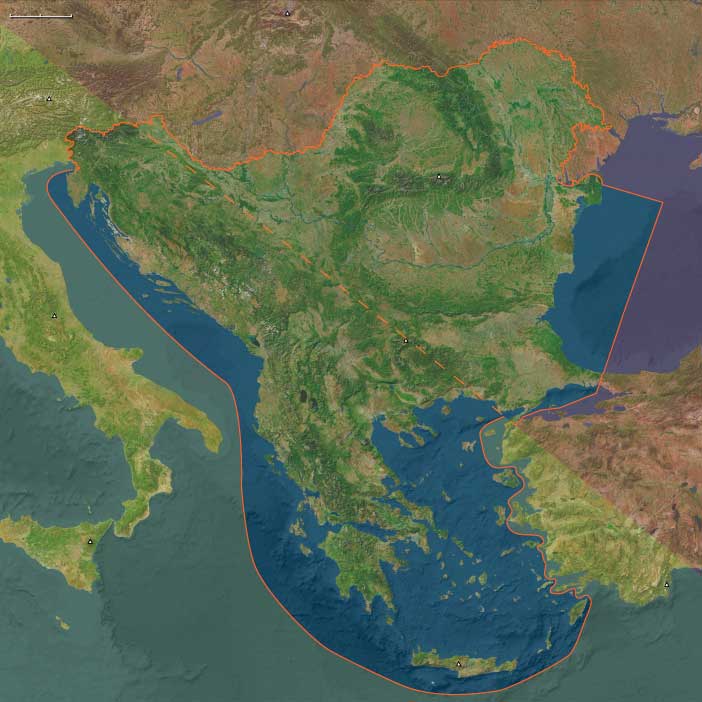
To the northeast, Eastern Southeast Europe—the Lower Danube Plain, Iron Gates, and Dobruja uplands—lay exposed to continental winds, forming a periglacial frontier that looked northward toward the loess plains of Central Europe.
-
To the southwest, Western Southeast Europe—the Adriatic–Ionian karst belt of Croatia, Bosnia, Albania, and Greece—was milder, fractured, and coastal: a refuge of caves and cliffs, connected culturally to Italy and the Mediterranean basins.
-
Between them rose the mountain heartland—the Balkans and Rhodopes, dissected by deep valleys that acted alternately as barriers and conduits depending on the severity of the cold.
Across these contrasting worlds, glacial winds, ice-fed rivers, and karstic refuges structured human movement and memory, binding the Danube corridor to the Adriatic shores through a web of seasonal passages and symbolic ties.
Climate and Environmental Shifts
Southeast Europe lay directly in the path of the shifting polar front.
The Last Glacial Maximum brought cold, dry, and windy conditions, with strong seasonality and extensive loess accumulation across northern plains.
-
In Eastern Southeast Europe, steppe–tundra spread across the Danube Plain and the Carpathian forelands, interrupted by gallery forests along meltwater streams.
-
In the Adriatic karst, temperatures were less extreme; precipitation fell as winter snow or spring rain, feeding caves and limestone springs that formed oases in an otherwise barren landscape.
-
Along the Aegean, fluctuating sea level—often 80–100 m lower than today—exposed a vast coastal shelf that joined many of the present islands to the mainland, widening foraging zones but also reshaping coastlines.
Brief interstadials punctuated the long cold: short-lived warm pulses allowed grasses, shrubs, and forests to return, giving temporary abundance to river valleys before the next advance of ice and dust reset the system.
Lifeways and Settlement Patterns
Human presence across these worlds was thin yet persistent, adapted to extreme variability through mobility and ecological flexibility.
-
In Eastern Southeast Europe, small forager bands camped along Danube terraces and loess promontories, targeting migratory herds of horse, reindeer, and bison. The Iron Gates gorges offered ice-free winter refugia where the river cut through the Carpathian front, concentrating fish and game.
-
In Western Southeast Europe, foragers relied on a dual economy of hunting and coastal gathering. Sheltered karst caves and rockshelters in Istria, Dalmatia, and Epirus served as seasonal bases; coastal plains—now submerged—provided shellfish, seabirds, and tunny during warmer intervals.
-
In the interior highlands, upland valleys hosted seasonal hunting camps that followed red deer and ibex herds between lower forest patches and mountain snowline pastures.
These adaptive patterns were neither isolated nor synchronous. Eastern groups followed the rhythms of continental steppe migrations, while western and southern groups synchronized their calendars with Mediterranean currents and the pulse of spring rains. The region as a whole operated as a gradient of survival strategies, not a unified system.
Technology and Material Culture
A broadly shared Upper Paleolithic tradition linked the region’s foragers to the larger European world, yet each subregion expressed it differently.
-
Eastern Southeast Europe developed rich blade and microblade industries, suited to big-game hunting and hide working. Caves and loess sites yielded burins, endscrapers, and bone points, often associated with hearth features and ochre-stained sediments.
-
Western Southeast Europe maintained similar toolkits but diversified them with marine shell ornaments, amber beads, and small engraved stones — signs of symbolic elaboration likely tied to seasonal aggregation in coastal refugia.
-
Across the mountains, tailored clothing, portable fire kits, and hafted composite tools show that people carried both technology and tradition across ecozones.
Ochre use was widespread, and burials — when found — display the same symbolic care evident from the Franco-Cantabrian to the Don: red pigment, ornamentation, and deliberate positioning within the landscape.
Movement and Interaction Corridors
Geography and ice dictated movement.
Three principal corridors connected the subregions and extended the region’s reach:
-
The Danube–Morava–Vardar Axis linked the northern plains to the Aegean world, allowing fauna, people, and ideas to flow between the steppe and the Mediterranean.
-
The Adriatic Shelf—exposed during glacial lowstands—served as a seasonal migration plain and coastal highway, connecting Dalmatia, Apulia, and the Ionian shores.
-
The Carpathian–Balkan Passes provided east–west transit between river and coast, facilitating the diffusion of stone, amber, and ornament styles.
Through these corridors, Southeast Europe remained in dialogue with its neighbors: the Danube steppe with Central Europe, the Adriatic karst with Italy, and the Aegean margin with Anatolia. It was a hinge, not a border.
Cultural and Symbolic Expressions
Symbolic and ritual behaviors reveal both unity and divergence.
Caves from Istria to Thrace bear evidence of ochre use, ornament caches, and ritual hearths. Portable engravings and figurines—sometimes human, sometimes hybrid—echo the mythic grammar shared across the Ice Age world.
The Iron Gates gorges, already by this period, began to serve as persistent aggregation zones, revisited for millennia thereafter.
In coastal karst, burial and habitation often blended: caves doubled as both dwellings and ancestral repositories, rooting communities in cyclical patterns of return.
Environmental Adaptation and Resilience
Survival depended on versatility.
Populations cycled between open steppe hunting in cold phases and riverine or coastal specialization in milder interludes.
Their success rested on mobility across ecozones, knowledge of migratory game and fish cycles, and symbolic practices that sustained social cohesion in times of isolation.
Fire, clothing, and social networks proved as vital as tools.
Transition Toward the Last Glacial Maximum
By 28,578 BCE, Southeast Europe stood poised between two worlds:
to the north, the continental ice; to the south, the emerging temperate refugia of the Mediterranean.
Its three subregions—Danubian steppe, Adriatic karst, and Aegean–Balkan corridor—remained largely independent, yet continually braided by exchange and migration.
In this interplay lay the region’s enduring pattern: a chain of distinct ecological theaters linked more strongly to their counterparts in neighboring regions than to one another.
Southeast Europe thus embodies The Twelve Worlds’ central insight—that regions are not coherent wholes but crossroads of adjacent worlds, each conserving its own rhythm within the shared drama of human persistence at the edge of ice.
Western Southeast Europe (49,293 – 28,578 BCE) Upper Pleistocene I — Ice-Edge Steppes, Karst Caves, and Coastal Refugia
Geographic and Environmental Context
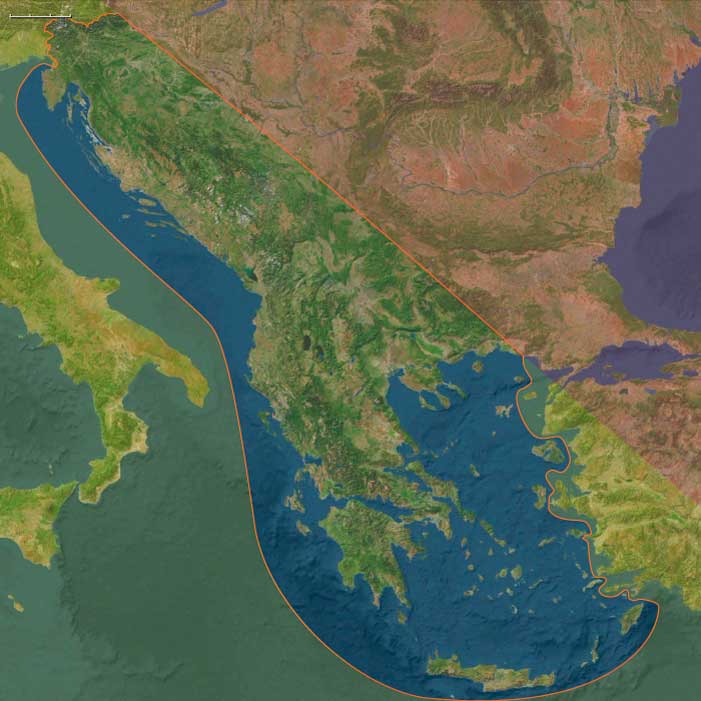
Western Southeast Europe includes Greece (outside Thrace), Albania, Montenegro, North Macedonia, Kosovo, most of Bosnia, southwestern Serbia, most of Croatia, and Slovenia.-
Anchors: Istrian karst caves, Dalmatian coastal benches, Velebit foreland, Neretva delta plain, Epirus–Pindus valleys, Peloponnese capes.
-
The Adriatic stood far below modern level, exposing a broad shelf; inland, steppe–tundra bordered mountain snowlines.
Climate & Environmental Shifts
-
Last Glacial Maximum: cold, dry, windy; periglacial loess mantled forelands; glaciers held high passes.
Subsistence & Settlement
-
Big-game foragers hunted horse, bison, ibex, red deer along terrace edges; coastal groups exploited shellfish and fish on the widened shelf.
-
Caves/rockshelters (Istria, Dalmatia, Epirus) served as winter bases; open camps along river mouths.
Technology & Material Culture
-
Blade–microblade toolkits, burins and endscrapers; bone points; eyed needles for tailored hides.
-
Ornaments (pierced teeth, shell, amber), extensive ochre use.
Movement & Interaction Corridors
-
Sava–Drava–Danube foreland routes; Neretva and Cetina mouths as seasonal nodes; coastal shelf “highway” in summer.
Cultural & Symbolic Expressions
-
Engraved bone/stone motifs; ochred burials in caves; ritual hearth renewal.
The Arrival of Early Modern Humans in Eurasia
Homo sapiens sapiens, the same physical type as modern humans, appeared in various regions by at least 50,000 BCE. These Early European Modern Humans (EEMH), formerly known as Cro-Magnon peoples, represent the first anatomically modern humans in Europe.
Migration into Eurasia
- Early modern humans entered Eurasia via the Arabian Peninsula approximately 60,000 years ago.
- One group rapidly settled coastal areas around the Indian Ocean, expanding into South and Southeast Asia.
- Another group migrated north, reaching the steppes of Central Asia and eventually spreading into Europe.
Coexistence with Neanderthals
- Neanderthals and modern humans coexisted across Europe and western Asia for thousands of years.
- Evidence suggests that interactions may have been peaceful, with possible cultural exchanges.
Interbreeding and Genetic Legacy
- Genetic studies indicate that Neanderthals and modern humans interbred occasionally, with non-African populations today carrying traces of Neanderthal DNA.
- However, there is no strong evidence supporting the existence of true Neanderthal-modern hybrids as a distinct population. Instead, interbreeding events were limited, contributing only small genetic fragments to the modern human genome.
The arrival of modern humans in Eurasia marked a significant turning point, eventually leading to the replacement of Neanderthals, though traces of their genetic legacy remain in human populations today.