
South Central Europe
Related Events
Filter results
Showing 10 events out of 705 total
The Middle of the Earth, one of the twelve divisions of the globe, encompasses Africa down to its subcontinent, the lands and seas of the Mediterranean Basin and the Red Sea, the Canary Islands, and the Cape Verde Islands.
The northwestern boundary extends from south-central Germany along the Swiss border, encompassing all Swiss cities except Basel. It then separates southern France from northern France, continues through Spain, and divides Portugal at Setúbal, marking a north-south division within both countries. The boundary then extends into the Atlantic Ocean, where it distinguishes Madeira (a Portuguese territory) from the Canary Islands (ruled by Spain).
The northeastern boundary separates Alpine Austria from the rest of the country, then moves through the Balkans, roughly following the borders between:
- Hungary and Slovenia,
- Serbia and Croatia,
- Bosnia and Herzegovina, Montenegro, and Kosovo,
- Bulgaria and North Macedonia,
- Turkey-in-Europe and Greece.
From there, the line continues through western Turkey and Cyprus, dividing Syria and most of Lebanon from Israel and most of Jordan, and marking the separation between western and eastern Arabia.
The southeastern boundary follows the historic division between North and South Yemen, then extends through eastern Africa, delineating Mozambique from Zambia.
HistoryAtlas contains 18,610 entries for the Middle of The Earth from the Paleolithic period to 1899.Narrow results by searching for a word or phrase or select from one or more of a dozen filters.
The Moderns are taller, more slender, and less muscular than the Neanderthals, with whom they share—perhaps uneasily—the Earth.
Though their brains are smaller in overall size, they are heavier in the forebrain, a difference that may allow for more abstract thought and the development of complex speech.
Yet, the inner world of the Neanderthals remains a mystery—no one knows the depths of their thoughts or how they truly expressed them.
The fearsome cave bear (Ursus spelaeus) likely became extinct around 27,800 years ago, according to recent fossil reassessments.
Rather than a single cause, a combination of factors is believed to have led to its extinction. While overhunting by humans has largely been dismissed—since human populations at the time were too small to pose a significant threat—evidence suggests that cave bears and humans may have competed for shelter, particularly in caves.
Mitochondrial DNA research indicates that the cave bear's genetic decline began long before its extinction, ruling out climate change-induced habitat loss as the direct cause. However, a recent DNA study suggests that cave bear populations started declining around 50,000 years ago, coinciding with an increase in human populations.
Unlike its close relative, the brown bear, the cave bear was highly dependent on a vegetarian diet, making it less adaptable to environmental changes. Additionally, evidence suggests that cave bears exclusively used caves for hibernation, unlike brown bears, which could hibernate in thickets or other natural shelters. This specialized hibernation behavior likely contributed to high winter mortality when suitable caves were unavailable.
As human populations gradually expanded, both Neanderthals and anatomically modern humans increasingly occupied caves as living quarters, reducing the availability of essential hibernation sites for cave bears. Over time, this competition for shelter may have contributed to their gradual extinction.
Interestingly, cave bears are rarely depicted in prehistoric cave paintings, leading some researchers to speculate that human hunters may have avoided them, or that their habitat preferences simply did not overlap with early human settlements.
Collections of bear bones at several widely dispersed sites suggest that Neanderthals may have worshiped cave bears, especially at Drachenloch above Vättis, in Switzerland, where a stone chest was discovered with a number of bear skulls stacked upon it.
Neanderthals, who also inhabited the entrance of the cave, are believed to have built it.
A massive stone slab covered the top of the structure.
At the cave entrance, seven bear skulls were arranged with their muzzles facing the cave entrance, while deeper in the cave, a further six bear skulls were lodged in niches along the wall.
Next to these remains were bundles of limb bones belonging to different bears.
Around 55,000 years ago, global weather patterns begin to fluctuate dramatically, shifting from extreme cold to milder conditions and back within just a few decades.
By 50,000 years ago, the Wisconsin glaciation (known in Europe as the Würm glaciation) is well advanced. Expanding ice sheets in North America and Europe push climatic zones southward, transforming the temperate regions of Europe and North America into Arctic tundra-like landscapes. Meanwhile, rain bands typical of temperate zones shift south, reaching as far as northern Africa.
Neanderthals and Climate Adaptation
The Neanderthals, well adapted to cold climates with their barrel chests and stocky limbs, are better suited than Cro-Magnons to retain body heat. However, the rapid and unpredictable climate fluctuations cause ecological upheavals, replacing familiar plants and animals within a single lifetime—a shift to which Neanderthals struggle to adapt.
One major challenge is the replacement of forests by grasslands during the Mousterian Pluvial, an effect of the last Ice Age’s climatic shifts. This change disrupts the Neanderthals’ ambush-based hunting techniques, making it harder for them to secure food. As a result, large numbers of Neanderthals likely perish due to food scarcity and environmental stress, with the crisis peaking around 30,000 years ago.
Neanderthal Burial and Final Strongholds
Despite their decline, Neanderthals appear to be the first humans to intentionally bury their dead, often in simple graves. The last known traces of Mousterian culture, though lacking human remains, have been discovered at Gorham’s Cave on Gibraltar’s remote south-facing coast, dating between 30,000 and 24,500 years ago.
Possible Scenarios for Neanderthal Extinction
Several hypotheses attempt to explain the disappearance of the Neanderthals from the fossil record around 25,000 years ago:
-
Complete Extinction and Replacement: Neanderthals were a separate species from modern humans and became extinct due to climate change and/or competition with Homo sapiens, who expanded into their territories starting around 80,000 years ago. Anthropologist Jared Diamond suggests that violent conflict and displacement played a role in their demise.
-
Interbreeding and Absorption: Neanderthals were a contemporary subspecies that interbred with modern humans, gradually disappearing through genetic absorption.
-
Volcanic Catastrophe: A Campanian Ignimbrite super-eruption around 40,000 years ago, followed by a second eruption a few thousand years later, may have severely impacted Neanderthal populations. Evidence from Mezmaiskaya Cave in the Caucasus Mountains of southern Russia supports this theory, with mitochondrial DNA (mtDNA) analysis showing a distinct Neanderthal lineage separate from modern humans.
Energy Needs and Survival Challenges
Neanderthals had higher caloric requirements than any other known human species. They required 100 to 350 more calories per day than an anatomically modern human male (68.5 kg) or female (59.2 kg). This higher energy demand may have made them especially vulnerable when food sources became scarce, further contributing to their extinction.
Ultimately, by 25,000 years ago, Neanderthals disappear from the fossil record, leaving behind traces of their culture—but no direct descendants in the modern human genetic lineage.
As humans develop more advanced skills and techniques, evidence of early construction begins to emerge.
Fossil remains of Cro-Magnons, Neanderthals, and other Homo sapiens subspecies have been found alongside foundation stones and stone pavements arranged in the shape of houses, suggesting a shift toward settled lifestyles and increasing social stratification.
In addition to building on land, early humans also develop seafaring technology. The proto-Australians appear to be the first known people to cross open water to an unseen shore, ultimately peopling Australia—a remarkable achievement in early maritime exploration.
During this period, Neanderthals are gradually being displaced as modern humans expand into Europe.
The slow pace of human migration into Europe suggests that Homo sapiens and Neanderthals may have been in continuous competition for territory over an extended period.
Neanderthals, with their larger, more robust frames, were likely physically stronger than modern Homo sapiens. Having inhabited Europe for over 200,000 years, they were also better adapted to cold climates, giving them a potential survival advantage in harsh Ice Age conditions.
South Central Europe (49,293 – 28,578 BCE) Upper Pleistocene I — Glacial Valleys, Loess Forelands, and Cave Lifeways
Geographic and Environmental Context
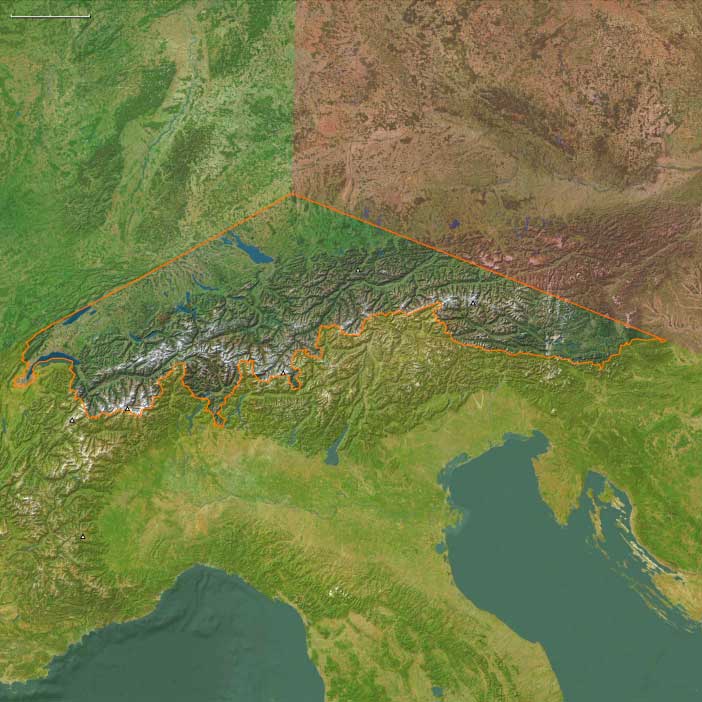
Western Southeast Europe includes southern and western Austria (including Carinthia; excluding Salzburg), Liechtenstein, Switzerland (excluding Basel and the eastern Jura), southeastern Swabia (southeastern Baden-Württemberg), and southwestern Bavaria.-
Anchors: Inn–Salzach terraces, Tyrolean valleys, Swiss Plateau cave belts, Valais rock shelters, Rheintal benches, Drava–Carinthia forelands.
-
Alpine glaciers dominated; loess accumulated on forelands; river terraces provided dry footing.
Climate & Environmental Shifts
-
Last Glacial Maximum: cold, arid, windy; strong seasonal contrasts; heavy snowpack in high ranges.
Subsistence & Settlement
-
Foragers hunted ibex, chamois, red deer, horse, and marmot around valley mouths and passes.
-
Caves/rockshelters (Swiss Plateau, Valais) and terrace camps alternated seasonally.
Technology & Material Culture
-
Aurignacian–Gravettian–Magdalenian successions: blade/microblade kits; antler points; eyed needles; portable art.
-
Ornaments (teeth, shell); ochre burials.
Movement & Interaction Corridors
-
Rhône–Valais–Great St. Bernard, Reuss–Ticino–St. Gotthard, Inn–Brenner–Adige, and Rheintal–Lake Constance formed key glacial corridors.
Cultural & Symbolic Expressions
-
Portable engravings and cave art; ritual hearth renewal at seasonal bases.
Central Europe (49,293 – 28,578 BCE): Upper Pleistocene I — Ice-Edge Worlds and the Corridors Between the Rivers
Geographic and Environmental Context
Late-Pleistocene Central Europe was less a single land than a loose archipelago of habitats caught between ice and plain, forest and steppe.
Its three great subregions formed parallel worlds, each facing a different horizon of connection:
-
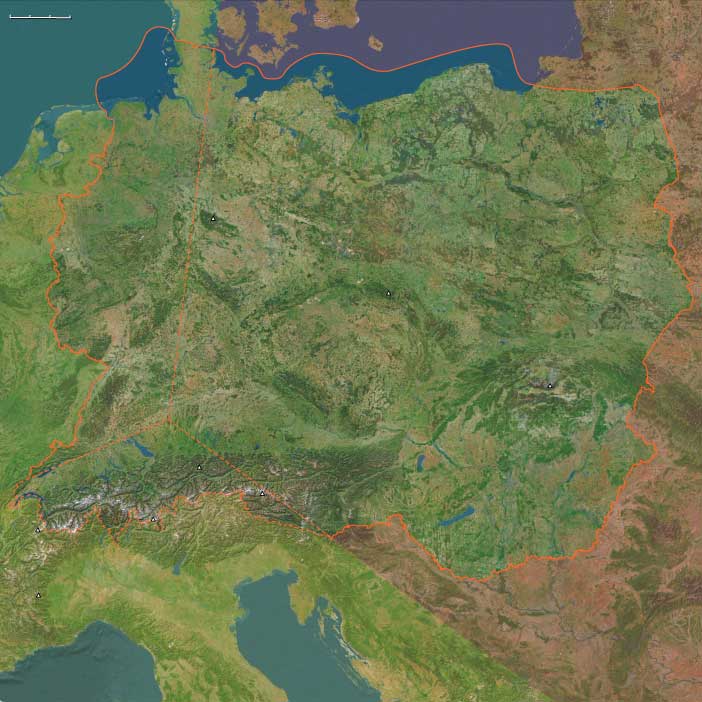
East Central Europe, stretching from the Carpathian Basin through the Moravian and Polish uplands, was a broad loess-steppe platform—cold, windy, and open, linked eastward to the Ukrainian plains.
-
South Central Europe, the Alpine and Carpathian forelands, was a world of glacial valleys, meltwater terraces, and limestone shelters, continuous in culture with the northern Mediterranean refugia.
-
West Central Europe, defined by the Rhine–Jura arc, served as a bridge between the Atlantic basins and the continental interior, its valleys and caves preserving the densest traces of human symbolism.
These three subregions touched but rarely blended. Each possessed its own climate rhythm, resource base, and exchange direction—making Central Europe a corridor of encounter rather than a unified realm.
Climate and Environmental Shifts
The era encompassed the build-up to the Last Glacial Maximum, marked by advancing ice sheets and periglacial drought.
-
East Central Europe lay beneath fierce katabatic winds; loess mantled the plains, rivers braided across frozen ground, and vegetation shrank to steppe and tundra grasses.
-
South Central Europe oscillated between frozen winters and brief warm interstadials: glaciers filled Alpine troughs while lowland oases along the Danube and Rhine supported willow, pine, and migrating herds.
-
West Central Europe experienced repeated cycles of forest retreat and regrowth, its limestone valleys offering milder refuges when the northern plains froze.
Across the region, short-lived thaws—the Bölling–Allerød precursors—brought pulses of moisture and game, reawakening networks of movement before renewed cold sealed them again.
Lifeways and Settlement Patterns
Human presence threaded these worlds along rivers, caves, and terrace ridges.
Bands of twenty to forty people followed predictable seasonal circuits, their economies tuned to local constraints:
-
On the eastern loess plains, foragers pursued mammoth, horse, and reindeer in open steppe country, camping on wind-sheltered bluffs above the Danube, Morava, or Vistula.
-
In the southern forelands, smaller groups alternated between glacial valley hunts—ibex, chamois, red deer—and winter residence in limestone shelters such as those of the Swiss Plateau and Tyrol.
-
Along the western Rhine and Jura, semi-recurrent occupation of caves and river terraces sustained communities rich in art and ornament, their subsistence broadening to include fish, birds, and gathered plants during interstadials.
Despite distance, these groups shared mutual rhythms: winter aggregation in protected valleys, spring dispersal onto the plains, and late-summer exchange at river junctions where herds converged and trade could occur.
Technology and Material Culture
A shared Upper Paleolithic toolkit unified the region while regional ecology drove variation.
-
Blade and microblade industries dominated across the loess plains; Moravian and Polish sites specialized in fine chert and radiolarite production.
-
In the Alpine forelands, antler and bone working produced projectile points, needles, and pendants—artistry often preserved in caves such as Vogelherd and Hohle Fels.
-
Ochre use was near-universal; beads of shell, ivory, and amber marked social identity and inter-group alliance.
These artifacts reveal not only adaptation but memory—the technological continuity linking Magdalenian, Gravettian, and Aurignacian horizons across multiple climatic pulses.
Movement and Interaction Corridors
Rivers and passes stitched the subregions together, defining both movement and meaning.
-
The Danube–Tisza–Morava Axis served as the region’s vertebra, carrying people and materials from the Pannonian Basin westward to the Rhine and eastward toward the Pontic steppe.
-
The Rhine–Moselle–Jura Corridor connected the interior to the Atlantic, exchanging flint, shells, and ideas with France and the Low Countries.
-
The Alpine and Carpathian Passes—Brenner, St. Gotthard, and Moravian Gate—linked Central Europe with Italy’s northern refugia and the Balkans.
Through these conduits flowed not only tools and pigments but shared symbolic grammars—evidence that even as geography divided, communication endured.
Cultural and Symbolic Life
Symbolic creativity reached a profound maturity.
Across caves and campgrounds alike appear engraved plaquettes, figurines, and ochred burials, mirroring yet localizing the broader European Ice-Age tradition.
-
In the west, ivory and limestone Venus figurines embodied fertility or continuity, perhaps exchanged among allied bands.
-
In the south, painted and engraved animals—ibex, horse, bison—evoked the seasonal pulse of the hunt.
-
In the east, portable ornaments and engraved bone served as tokens of connection across the wide steppe.
Ritual practices—hearth renewal, pigment scattering, burial of tools with the dead—provided spiritual ballast in an unstable world, rooting identity in cyclical return.
Environmental Adaptation and Resilience
Adaptation in Central Europe depended on mobility, cooperation, and foresight.
Layered clothing, well-insulated shelters, and stored fuel extended occupation deep into glacial winters.
Networks of kin and alliance allowed information to travel faster than ice: which valley still held red deer, which cave spring had thawed, which flint source remained exposed.
The interplay of diverse habitats—steppe, riverine, alpine—offered redundancy against failure; when one closed, another opened.
In this diversity lay the region’s strength: not uniformity but connectivity.
Transition Toward the Last Glacial Maximum
By 28,578 BCE, the Central European corridor tightened between advancing ice sheets and rising aridity.
Yet life persisted: steppe herds still crossed the loess plains, smoke still curled from Jura caves, and travelers still traced the Danube from one refuge to another.
Its three natural subregions—the eastern loess plains, the southern glacial valleys, and the western limestone uplands—remained largely self-contained, but each was part of a wider web reaching far beyond the heart of Europe.
Thus even at the peak of cold, Central Europe exemplified the premise of The Twelve Worlds: that the coherence of a region lies not in its unity but in the tension between its neighboring worlds, whose dialogue across ice, river, and mountain sustained human culture through the harshest ages of Earth’s memory.
The Arrival of Early Modern Humans in Eurasia
Homo sapiens sapiens, the same physical type as modern humans, appeared in various regions by at least 50,000 BCE. These Early European Modern Humans (EEMH), formerly known as Cro-Magnon peoples, represent the first anatomically modern humans in Europe.
Migration into Eurasia
- Early modern humans entered Eurasia via the Arabian Peninsula approximately 60,000 years ago.
- One group rapidly settled coastal areas around the Indian Ocean, expanding into South and Southeast Asia.
- Another group migrated north, reaching the steppes of Central Asia and eventually spreading into Europe.
Coexistence with Neanderthals
- Neanderthals and modern humans coexisted across Europe and western Asia for thousands of years.
- Evidence suggests that interactions may have been peaceful, with possible cultural exchanges.
Interbreeding and Genetic Legacy
- Genetic studies indicate that Neanderthals and modern humans interbred occasionally, with non-African populations today carrying traces of Neanderthal DNA.
- However, there is no strong evidence supporting the existence of true Neanderthal-modern hybrids as a distinct population. Instead, interbreeding events were limited, contributing only small genetic fragments to the modern human genome.
The arrival of modern humans in Eurasia marked a significant turning point, eventually leading to the replacement of Neanderthals, though traces of their genetic legacy remain in human populations today.