
Middle East
Related Events
Filter results
Showing 10 events out of 4938 total
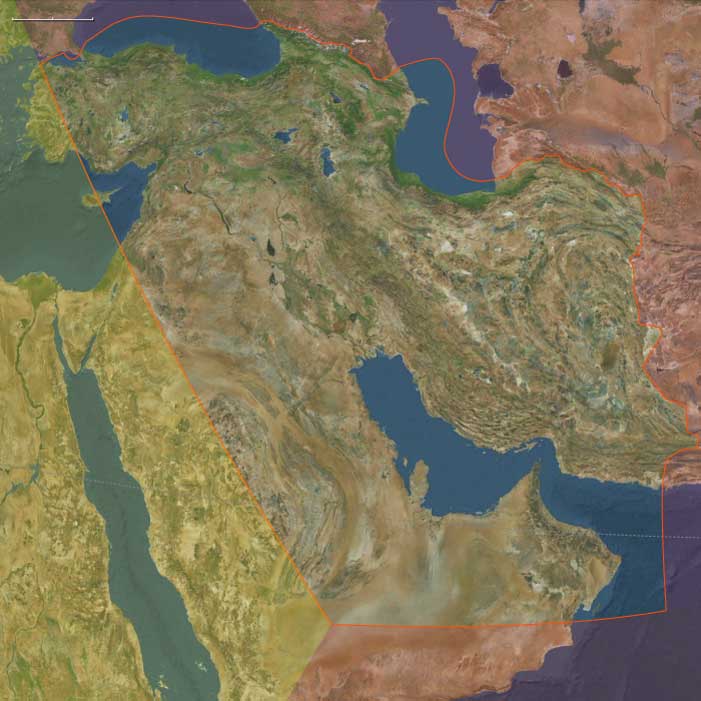
The Great Crossroads, one of the twelve divisions of the globe, is centered on Eurasia, with its northernmost extent meeting Northern Oceania and The Atlantic World at the North Pole. This vast region excludes the eastern, western, and southern extremities of the Eurasian landmass, which spans a significant portion of the Earth's surface.
The Ural Mountains, running approximately north to south, serve as the traditional boundary between Europe and Asia, as well as between Russia proper and Siberia.
For the purposes of this framework, The Great Crossroads includes Mongolia; western China, including Xinjiang and the Tibetan Plateau; the northern half of the Indian subcontinent; Afghanistan; the Iranian Plateau; Mesopotamia; eastern Arabia; the northern Levant; northeastern Cyprus; western and southwestern Anatolia; the Caucasus; Eastern Europe; Siberia; the Eastern Balkans; Eastern Scandinavia; the Baltic Sea basin; and Middle Europe.
- The southwestern boundary runs diagonally from south-central Germany, through the eastern Alps, the Balkans, and western Asia, terminating in the southern third of the Arabian Peninsula in the vast desert known as the Rub’ al Khali.
- The southern boundary divides South India from North India, following the generally recognized demarcation that includes the Narmada River, and separates the Indian Ocean-facing southeastern Arabian coast from the Persian Gulf-focused eastern Arabia.
- The southeastern boundary runs diagonally from the Bay of Bengal, following India’s border with Myanmar, marking the division between South Asia and both Southeast Asia and Eastern Asia.
Narrow results by searching for a word or phrase or select from one or more of a dozen filters.
Homo georgicus is a species of Homo that was suggested in 2002 to describe fossil skulls and jaws found in Dmanisi, Georgia in 1999 and 2001, which seem intermediate between Homo habilis and H. erectus.
A partial skeleton was discovered in 2001.
The fossils are about one million eight hundred thousand years old.
The remains were first discovered in 1991 by Georgian scientist, David Lordkipanidze, accompanied by an international team which unearthed the remains.
Implements and animal bones were found alongside the ancient human remains.
Scientists thought at first that they had found mandibles and skulls belonging to Homo ergaster, but size differences led them to name a new species, Homo georgicus, which would be the descendant of Homo habilis and ancestor of Asian Homo erectus.
The fearsome cave bear (Ursus spelaeus) likely became extinct around 27,800 years ago, according to recent fossil reassessments.
Rather than a single cause, a combination of factors is believed to have led to its extinction. While overhunting by humans has largely been dismissed—since human populations at the time were too small to pose a significant threat—evidence suggests that cave bears and humans may have competed for shelter, particularly in caves.
Mitochondrial DNA research indicates that the cave bear's genetic decline began long before its extinction, ruling out climate change-induced habitat loss as the direct cause. However, a recent DNA study suggests that cave bear populations started declining around 50,000 years ago, coinciding with an increase in human populations.
Unlike its close relative, the brown bear, the cave bear was highly dependent on a vegetarian diet, making it less adaptable to environmental changes. Additionally, evidence suggests that cave bears exclusively used caves for hibernation, unlike brown bears, which could hibernate in thickets or other natural shelters. This specialized hibernation behavior likely contributed to high winter mortality when suitable caves were unavailable.
As human populations gradually expanded, both Neanderthals and anatomically modern humans increasingly occupied caves as living quarters, reducing the availability of essential hibernation sites for cave bears. Over time, this competition for shelter may have contributed to their gradual extinction.
Interestingly, cave bears are rarely depicted in prehistoric cave paintings, leading some researchers to speculate that human hunters may have avoided them, or that their habitat preferences simply did not overlap with early human settlements.
Cultural practices associated with modern humans—such as the careful burial of the dead, the creation of elaborate cave art, and the decoration of everyday objects—emerge during this period, reflecting an increasing sense of ritual, symbolism, and aesthetic expression.
The invention of writing was not a single event, but rather a gradual evolution, preceded by the use of symbols, possibly originating for ritual or cultic purposes.
Researchers from the University of Victoria in Canada suggest that Neolithic cave painters employed symbolism as a form of early communication.
"...Von Petzinger and Nowell were surprised by the clear patterning of the symbols across space and time—some of which remained in use for over twenty thousand years.
Their research identifies twenty-six distinct signs, which may represent the earliest evidence of a graphic code used by humans shortly after their arrival in Europe from Africa—or possibly even earlier, suggesting they brought this practice with them.
If confirmed, these findings would support the growing body of evidence that the so-called "creative explosion"—once thought to have occurred later—actually began tens of thousands of years earlier than previously believed.
The rapid expansion of anatomically modern humans out of Africa, beginning around 60,000 years ago, appears to coincide with the development of new stone tool-making techniques.
These innovations, which define the Upper Paleolithic period, distinguish the stone tool culture of Homo sapiens sapiens from the previously similar technologies of Neanderthals and other archaic human groups.
Key advancements include:
- The production of long, narrow flake tools, known as blades, which could be fashioned into a variety of specialized tools,
- The emergence of bone and ivory artifacts, and
- The eventual development of clothing, often sewn together and adorned with beads.
These technological advancements likely played a crucial role in the success and adaptability of early modern humans as they spread across new environments.
Shanidar Cave, an archaeological site in the Zagros Mountains in South-Kurdistan (in Iraq), located in the valley of the Great Zab, was excavated between 1957-1961 by Ralph Solecki and his team from Columbia University and yielded the first adult Neanderthal skeletons in Iraq, dating between 60-80,000 years BP (Before Present).
The excavated area produced nine skeletons of Neanderthals of varying ages and states of preservation and completeness (labeled Shanidar I - IX).
M. Zeder recently discovered the tenth individual during examination of a faunal assemblage from the site at the Smithsonian Institution.
The remains seemed to Zeder to suggest that Neandertals had funeral ceremonies, burying their dead with flowers (although the flowers are now thought to be a modern contaminant), and that they took care of injured individuals.
Shanidar I, an elderly Neanderthal male known as Shanidar I, or ‘Nandy’ to its excavators, was aged between 40-50 years, which was considerably old for a Neanderthal, equivalent to eighty years old today, displaying severe signs of deformity.
He was one of four reasonably complete skeletons from the cave that displayed trauma-related abnormalities, which in his case would have been debilitating to the point of making day-to-day life painful.
At some point in his life, he had suffered a violent blow to the left side of his face, creating a crushing fracture to his left orbit that would have left Nandy partially or completely blind in one eye.
He also suffered from a withered right arm which had been fractured in several places and healed, but which caused the loss of his lower arm and hand.
This is thought to be either congenital, a result of childhood disease and trauma or due to an amputation later in his life.
The arm had healed but the injury may have caused some paralysis down his right side, leading to deformities in his lower legs and foot and would have resulted in him walking with a pronounced, painful limp.
All these injuries were acquired long before death, showing extensive healing and this has been used to infer that Neanderthals looked after the sick and aged, denoting implicit group concern.
Shanidar I is not the only Neanderthal at this site, or in the entire archaeological record, which displays both trauma and healing.
The descendants of the immigrants to West Asia who had remained in the south (or taken the southern route) had spread generation by generation around the coast of Arabia and the Iranian plateau until they reached India.
One of the groups that had gone north (east Asians were the second group) had ventured inland and radiated to Europe, eventually displacing the Neanderthals.
They had also radiated to India from Central Asia.
The former group headed along the southeast coast of Asia, reaching Australia between fifty-five thousand and thirty thousand years ago, with most estimates placing it about forty-six thousand to forty-one thousand years ago.
Sea level is much lower during this time, and most of Maritime Southeast Asia is one land mass known as the lost continent of Sunda.
The settlers probably continued on the coastal route southeast until they reached the series of straits between Sunda and Sahul, the continental land mass that was made up of present-day Australia and New Guinea.
The widest gaps are on the Weber Line and are at least ninety kilometers wide, indicating that settlers had knowledge of seafaring skills.
Archaic humans such as Homo erectus never reached Australia.
If these dates are correct, Australia was populated up to ten thousand years before Europe.
This is possible because humans avoided the colder regions of the North favoring the warmer tropical regions to which they were adapted given their African homeland.
Another piece of evidence favoring human occupation in Australia is that about forty-six thousand years ago, all large mammals weighing more than one hundred kilograms suddenly became extinct.
The new settlers were likely to be responsible for this extinction.
Many of the animals may have been accustomed to living without predators and become docile and vulnerable to attack (as will occur later in the Americas).
Modern human culture begins to evolve at an accelerated pace, marking a significant shift in behavior and innovation.
Some anthropologists, notably Jared Diamond, author of The Third Chimpanzee, describe this period as a "Great Leap Forward." During this time, modern humans adopt new cultural and technological practices, including:
- Burying their dead, often with grave goods, suggesting ritual or symbolic thought,
- Crafting clothing from hides, improving survival in colder climates,
- Developing advanced hunting techniques, such as trapping pits or driving animals off cliffs, and
- Creating cave paintings and other forms of artistic expression.
As human culture advances, different populations begin to introduce novelty into existing technologies. Unlike earlier hominins, modern humans show regional variations in artifacts such as fish hooks, buttons, and bone needles, demonstrating a previously unseen diversity of tools and personal items.
Anthropologists identify several key markers of modern human behavior, including:
- Tool specialization,
- Adornment with jewelry and symbolic imagery (such as cave drawings),
- Organized living spaces,
- Elaborate rituals, including burials with grave gifts,
- Exploration of harsh or previously uninhabited environments, and
- The development of barter trade networks.
Debate continues over whether these advancements were the result of a sudden cognitive "revolution"—sometimes called "the big bang of human consciousness"—or whether they emerged through a more gradual evolutionary process.