
East Central Europe
Related Events
Filter results
Showing 10 events out of 3901 total
The Great Crossroads, one of the twelve divisions of the globe, is centered on Eurasia, with its northernmost extent meeting Northern Oceania and The Atlantic World at the North Pole. This vast region excludes the eastern, western, and southern extremities of the Eurasian landmass, which spans a significant portion of the Earth's surface.
The Ural Mountains, running approximately north to south, serve as the traditional boundary between Europe and Asia, as well as between Russia proper and Siberia.
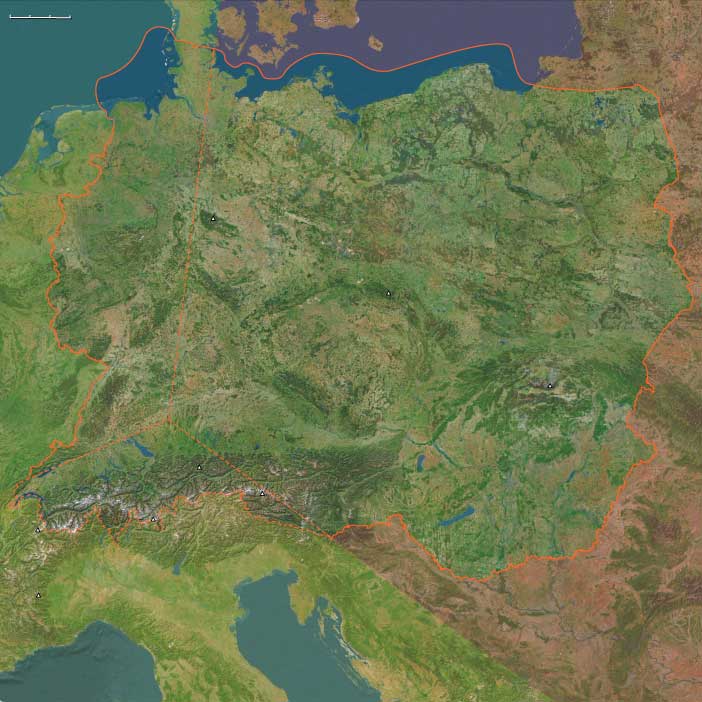
For the purposes of this framework, The Great Crossroads includes Mongolia; western China, including Xinjiang and the Tibetan Plateau; the northern half of the Indian subcontinent; Afghanistan; the Iranian Plateau; Mesopotamia; eastern Arabia; the northern Levant; northeastern Cyprus; western and southwestern Anatolia; the Caucasus; Eastern Europe; Siberia; the Eastern Balkans; Eastern Scandinavia; the Baltic Sea basin; and Middle Europe.
- The southwestern boundary runs diagonally from south-central Germany, through the eastern Alps, the Balkans, and western Asia, terminating in the southern third of the Arabian Peninsula in the vast desert known as the Rub’ al Khali.
- The southern boundary divides South India from North India, following the generally recognized demarcation that includes the Narmada River, and separates the Indian Ocean-facing southeastern Arabian coast from the Persian Gulf-focused eastern Arabia.
- The southeastern boundary runs diagonally from the Bay of Bengal, following India’s border with Myanmar, marking the division between South Asia and both Southeast Asia and Eastern Asia.
Narrow results by searching for a word or phrase or select from one or more of a dozen filters.
The fragments of a Neanderthal skull disinterred from a deposit of limestone at the Ehringsdorf quarries along the Ilm River, roughly two point four kilometers from Weimar, Germany, is known as the Ehringsdorf skull.
The deposits in which this skull were found came from the travertines belonging to the second half of the last (Eemian) interglacial period.
The estimated age of the remains are one hundred and fifty thousand to one hundred and twenty thousand years.
German anthropologist Franz Weidenreich will publish a monograph on the subject in 1928, titled Der Schädelfund von Weimar-Ehringsdorf, where he will describes it as the skullcap of an adult female.
His suggestion that the frontal area of the remains showed evidence of being struck leads to the conclusion that the subject was murdered.
In addition, he determined that the lack of a cranial base meant the skull had been opened for the purpose of extracting the brain.
However, the remains are so fragmentary that little attention was paid to this opinion.
Scottish anthropologist Arthur Keith made a study of the skull in 1931, concluding that it belonged to an individual less than twenty years old.
Although classed as an early Neanderthal type, the skull bears some features found in the species Homo sapiens.
In particular, it has a rounded occipital bone.
The Moderns are taller, more slender, and less muscular than the Neanderthals, with whom they share—perhaps uneasily—the Earth.
Though their brains are smaller in overall size, they are heavier in the forebrain, a difference that may allow for more abstract thought and the development of complex speech.
Yet, the inner world of the Neanderthals remains a mystery—no one knows the depths of their thoughts or how they truly expressed them.
The fearsome cave bear (Ursus spelaeus) likely became extinct around 27,800 years ago, according to recent fossil reassessments.
Rather than a single cause, a combination of factors is believed to have led to its extinction. While overhunting by humans has largely been dismissed—since human populations at the time were too small to pose a significant threat—evidence suggests that cave bears and humans may have competed for shelter, particularly in caves.
Mitochondrial DNA research indicates that the cave bear's genetic decline began long before its extinction, ruling out climate change-induced habitat loss as the direct cause. However, a recent DNA study suggests that cave bear populations started declining around 50,000 years ago, coinciding with an increase in human populations.
Unlike its close relative, the brown bear, the cave bear was highly dependent on a vegetarian diet, making it less adaptable to environmental changes. Additionally, evidence suggests that cave bears exclusively used caves for hibernation, unlike brown bears, which could hibernate in thickets or other natural shelters. This specialized hibernation behavior likely contributed to high winter mortality when suitable caves were unavailable.
As human populations gradually expanded, both Neanderthals and anatomically modern humans increasingly occupied caves as living quarters, reducing the availability of essential hibernation sites for cave bears. Over time, this competition for shelter may have contributed to their gradual extinction.
Interestingly, cave bears are rarely depicted in prehistoric cave paintings, leading some researchers to speculate that human hunters may have avoided them, or that their habitat preferences simply did not overlap with early human settlements.
Cultural practices associated with modern humans—such as the careful burial of the dead, the creation of elaborate cave art, and the decoration of everyday objects—emerge during this period, reflecting an increasing sense of ritual, symbolism, and aesthetic expression.
The rapid expansion of anatomically modern humans out of Africa, beginning around 60,000 years ago, appears to coincide with the development of new stone tool-making techniques.
These innovations, which define the Upper Paleolithic period, distinguish the stone tool culture of Homo sapiens sapiens from the previously similar technologies of Neanderthals and other archaic human groups.
Key advancements include:
- The production of long, narrow flake tools, known as blades, which could be fashioned into a variety of specialized tools,
- The emergence of bone and ivory artifacts, and
- The eventual development of clothing, often sewn together and adorned with beads.
These technological advancements likely played a crucial role in the success and adaptability of early modern humans as they spread across new environments.
As humans develop more advanced skills and techniques, evidence of early construction begins to emerge.
Fossil remains of Cro-Magnons, Neanderthals, and other Homo sapiens subspecies have been found alongside foundation stones and stone pavements arranged in the shape of houses, suggesting a shift toward settled lifestyles and increasing social stratification.
In addition to building on land, early humans also develop seafaring technology. The proto-Australians appear to be the first known people to cross open water to an unseen shore, ultimately peopling Australia—a remarkable achievement in early maritime exploration.
Around 55,000 years ago, global weather patterns begin to fluctuate dramatically, shifting from extreme cold to milder conditions and back within just a few decades.
By 50,000 years ago, the Wisconsin glaciation (known in Europe as the Würm glaciation) is well advanced. Expanding ice sheets in North America and Europe push climatic zones southward, transforming the temperate regions of Europe and North America into Arctic tundra-like landscapes. Meanwhile, rain bands typical of temperate zones shift south, reaching as far as northern Africa.
Neanderthals and Climate Adaptation
The Neanderthals, well adapted to cold climates with their barrel chests and stocky limbs, are better suited than Cro-Magnons to retain body heat. However, the rapid and unpredictable climate fluctuations cause ecological upheavals, replacing familiar plants and animals within a single lifetime—a shift to which Neanderthals struggle to adapt.
One major challenge is the replacement of forests by grasslands during the Mousterian Pluvial, an effect of the last Ice Age’s climatic shifts. This change disrupts the Neanderthals’ ambush-based hunting techniques, making it harder for them to secure food. As a result, large numbers of Neanderthals likely perish due to food scarcity and environmental stress, with the crisis peaking around 30,000 years ago.
Neanderthal Burial and Final Strongholds
Despite their decline, Neanderthals appear to be the first humans to intentionally bury their dead, often in simple graves. The last known traces of Mousterian culture, though lacking human remains, have been discovered at Gorham’s Cave on Gibraltar’s remote south-facing coast, dating between 30,000 and 24,500 years ago.
Possible Scenarios for Neanderthal Extinction
Several hypotheses attempt to explain the disappearance of the Neanderthals from the fossil record around 25,000 years ago:
-
Complete Extinction and Replacement: Neanderthals were a separate species from modern humans and became extinct due to climate change and/or competition with Homo sapiens, who expanded into their territories starting around 80,000 years ago. Anthropologist Jared Diamond suggests that violent conflict and displacement played a role in their demise.
-
Interbreeding and Absorption: Neanderthals were a contemporary subspecies that interbred with modern humans, gradually disappearing through genetic absorption.
-
Volcanic Catastrophe: A Campanian Ignimbrite super-eruption around 40,000 years ago, followed by a second eruption a few thousand years later, may have severely impacted Neanderthal populations. Evidence from Mezmaiskaya Cave in the Caucasus Mountains of southern Russia supports this theory, with mitochondrial DNA (mtDNA) analysis showing a distinct Neanderthal lineage separate from modern humans.
Energy Needs and Survival Challenges
Neanderthals had higher caloric requirements than any other known human species. They required 100 to 350 more calories per day than an anatomically modern human male (68.5 kg) or female (59.2 kg). This higher energy demand may have made them especially vulnerable when food sources became scarce, further contributing to their extinction.
Ultimately, by 25,000 years ago, Neanderthals disappear from the fossil record, leaving behind traces of their culture—but no direct descendants in the modern human genetic lineage.
The development of stone tools appears to have progressed in gradual steps until around 50,000 to 40,000 years ago.
Each successive Homo species—from H. habilis to H. ergaster to H. neanderthalensis—began at a higher technological level than its predecessor. However, once a phase began, further innovation remained slow, reflecting a culturally conservative approach to tool-making.
Around 50,000 BP, however, modern human culture began to evolve at a significantly faster pace. While Neanderthal populations typically displayed little variation in their tool-making techniques, the Cro-Magnon immigrants introduced increasingly refined and specialized flint tools, such as knives, blades, and skimmers.
Additionally, Cro-Magnons expanded beyond stone, pioneering the use of bone tools, marking a major advancement in prehistoric technology.
The debate over the origins of Europeans has often been framed as a question of cultural diffusion versus demic diffusion.
Both archaeological and genetic evidence strongly support demic diffusion—the idea that a population spread from the Middle East over the last 12,000 years, gradually replacing or assimilating earlier groups.
However, some researchers have challenged this view using the genetic concept of Time to Most Recent Common Ancestor (TMRCA). This approach has been used to argue in favor of cultural diffusion, suggesting that technological and cultural advancements spread without significant population movement.
The debate remains ongoing, with scholars examining the complex interplay between migration, gene flow, and cultural exchange in shaping Europe's early populations.