
Northern West Indies
Related Events
Filter results
Showing 10 events out of 222 total
The Atlantic World, a pentagonal region encompassing one twelfth of the Earth, includes the Azores, Madeira, northwestern Europe (including western Denmark and western Norway), the British Isles, the Orkney Islands, the Shetland Islands, the Faroe Islands, Iceland, Greenland, Newfoundland, eastern and central North America, the northern section of Hispaniola, and several smaller island groups, notably Bermuda, the Bahamas, and the Turks and Caicos.
The eastern boundary, marked at 10° east longitude, divides Scandinavia into Eastern and Western sections, with Western Scandinavia oriented toward the North Atlantic and Eastern Scandinavia centered on the Baltic Sea Basin. This boundary also aligns with the historical eastern border of West Germany (1949–1990), before terminating in south-central Germany at its junction with the neighboring region to the southeast.
The western boundary, at 110° west longitude, cuts through Canada, separating the northern districts of Nunavut and the Northwest Territories from Alberta and Saskatchewan, approximately 75 miles south of the Alberta-Saskatchewan-Montana junction (48.1896851°N)—the northernmost point of the neighboring world to the southwest.
The southwestern boundary follows the division between the upper and lower Mississippi River Basin, then extends eastward into the Atlantic Ocean just south of Jacksonville, Florida, before terminating in northwestern Hispaniola.
HistoryAtlas contains 18,139 entries for The Atlantic World from the Paleolithic period to 1899.Narrow results by searching for a word or phrase or select from one or more of a dozen filters.
The West Indies (49,293–28,578 BCE): Upper Pleistocene I — Exposed Banks, Reef Arcs, and Island Worlds Without People
Geographic and Environmental Context
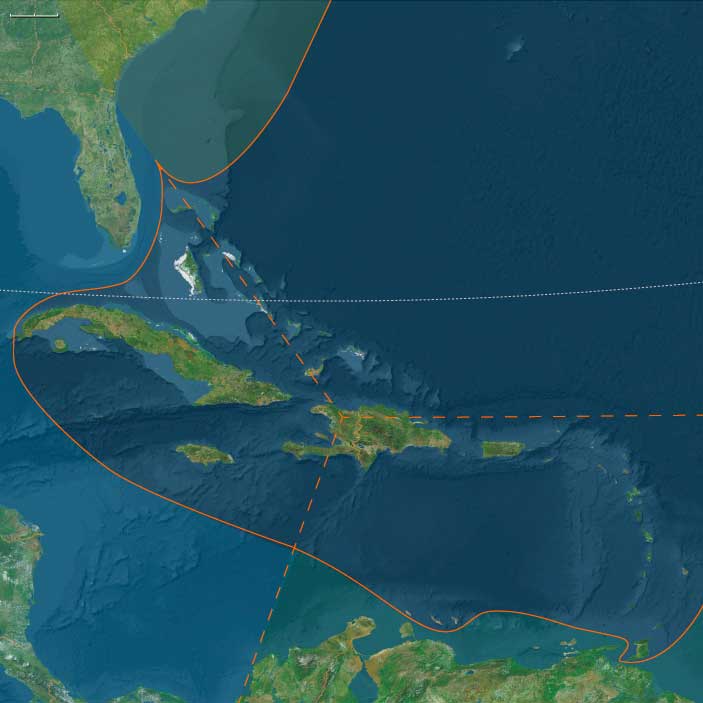
During the late Pleistocene, the West Indian archipelagos—stretching from the Bahama banks to Trinidad—were vast, emergent shelves divided into three natural subregions that would later become cultural zones: the Northern, Eastern, and Western West Indies.
-
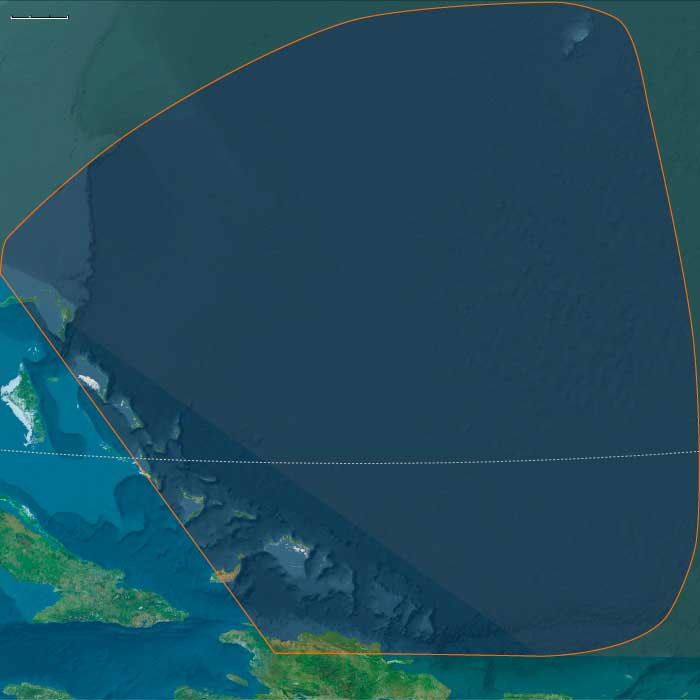
The Northern West Indies comprised the Bahamas and Turks & Caicos banks and the northern coast of Hispaniola.
Sea levels ~100 m lower than today fused many of the present islands into broad limestone plains dotted with sinkholes and dune fields. The Cibao Valley and the Massif du Nord of Hispaniola formed the rugged southern margin of this shelf sea. -
The Eastern West Indies traced a long volcanic and carbonate arc from Puerto Rico and the Virgin Islands through the Lesser Antilles to Trinidad & Tobago, where the chain met the South American shelf.
Active volcanoes alternated with uplifted reef terraces and deep inter-island channels shaped by the northeast trades. -
The Western West Indies included Cuba, Jamaica, the Cayman Ridge, and western Hispaniola, flanked by the deep Cayman Trench and the Windward Passage.
Here, broad banks and narrow straits created a labyrinth of shelves, slopes, and enclosed lagoons fringed by coral and seagrass ecosystems.
These three subregions were already differentiated by geology and oceanography: the Northern banks were broad, flat, and porous; the Eastern arc steep and windward; the Western ridge mountainous and trench-bound. Together they formed the tropical hinge between the Atlantic and Caribbean basins—an archipelago before humanity, alive only with reefs, birds, and tides.
Climate and Environmental Shifts
The interval coincided with the approach to the Last Glacial Maximum, producing climatic contrasts across latitude and elevation:
-
Sea level fall of 90–110 m exposed vast carbonate platforms in the Bahamas and Caicos and broadened coastal plains around Cuba and Hispaniola.
-
Trade winds intensified as global temperature gradients sharpened, driving upwelling and enhancing nutrient flows along windward coasts.
-
Cooler sea-surface temperatures slowed coral accretion but favored calcareous algae, sponges, and mollusks, maintaining high marine productivity.
-
Periodic northers and dry seasons reduced rainfall, particularly over the northern and western islands, while volcanic highlands in the east retained moist forests and orographic rainfall.
The result was a gradient from arid limestone plains in the north to humid volcanic slopes in the east, already anticipating the ecological zones that would later support very different island societies.
Biotic Assemblages and Ecological Structure
With no humans yet present, the Pleistocene West Indies were laboratories of insular evolution:
-
Seabirds dominated: vast rookeries of boobies, frigatebirds, shearwaters, and petrels nested on cliffs and dunes from the Bahamas to the Grenadines.
-
Reptiles and amphibians were diverse, including large lizards and ground-dwelling tortoises on the larger banks.
-
Mammals were limited to endemic rodents and small insectivores; ground sloths and monkeys persisted on Cuba and Hispaniola into later millennia.
-
Marine ecosystems—reef flats, turtle-nesting beaches, mangrove-lined lagoons—functioned at full productivity, unaltered by hunting or fire.
-
Beneath the islands, freshwater lenses formed within porous limestones, supporting vegetation pockets and stabilizing the water table.
These pristine ecologies, organized by rainfall and ocean currents rather than human movement, set the template for all later biological and cultural differentiation in the Caribbean.
Movement and Interaction Corridors
Although uninhabited, the region was threaded by powerful oceanic highways that would later shape both migration and commerce:
-
The North Equatorial Current and its offshoot, the Florida Current, swept westward across the Lesser Antilles and northward through the Bahamas toward the Gulf Stream.
-
Countercurrents and eddies along the Caribbean side of the arc distributed larvae, seeds, and drifting vegetation between islands, knitting their ecosystems together.
-
These same pathways would eventually become the maritime corridors of human voyaging; in this epoch, they served only seabirds and sea turtles, tracing the routes that future canoes would follow.
Cultural and Symbolic Dimensions
No human symbolic system had yet entered this landscape, yet the environment itself encoded rhythms and structures that later peoples would mythologize: the circularity of atolls, the seasonal pulse of trade winds, the nesting cycles of seabirds, the periodic flooding and drying of lagoons.
These were the physical archetypes of later Caribbean cosmologies—worlds of tide and return, absence and reemergence.
Environmental Adaptation and Resilience
In biological terms, the archipelago functioned as a self-balancing triad:
-
Northern carbonate banks acted as vast nurseries for marine life, their freshwater lenses and seagrass meadows stabilizing regional nutrient budgets.
-
Eastern volcanic islands provided vertical zonation—reef, mangrove, forest—that buffered storms and erosion.
-
Western highlands generated sediment and nutrients feeding neighboring shelves.
Interconnected by wind and current, these systems maintained equilibrium without external disturbance. Each island was autonomous yet ecologically interdependent—an early analogue of the inter-island diversity that would later underpin cultural resilience in the peopled Caribbean.
Transition Toward the Last Glacial Maximum
By 28,578 BCE, the West Indies were an archipelago of abundance awaiting discovery.
Emergent banks and volcanic ridges, swept by steady trades, supported some of the most productive reef and seabird ecosystems on Earth.
No human footprints yet marked their dunes, but the stage was set: broad shelves for future navigation, fertile soils for cultivation, and ecological gradients for diversification.
In this epoch, the Caribbean existed as a network of natural worlds, poised—like the other realms of The Twelve Worlds—to become human worlds when the seas rose again.
Northern West Indies (49,293–28,578 BCE) Upper Pleistocene I — Reef Benches, Limestone Lenses, and Seabird Realms (No People)
Geographic and Environmental Context
Northern West Indies includes the Outer Bahamas (Lucayan archipelago), the Turks & Caicos Islands, and northern Hispaniola — northern Haiti (Cap-Haïtien, Massif du Nord) and the Cibao/north coast of the Dominican Republic (Santiago de los Caballeros, Puerto Plata).
Anchors: Andros–Abaco–Eleuthera–San Salvador–Exuma banks, Turks & Caicos banks and passes, Cap-Haïtien–Massif du Nord, Cibao–Puerto Plata–Santiago river valleys and coastal shelves.
-
Sea level ~100 m lower exposed broad carbonate benches and dune fields on Bahama and Caicos banks; northern Hispaniola held narrow shelf and uplifted limestone foothills.
Climate & Environmental Shifts
-
LGM cooling strengthened winter trades and lowered SSTs; upwelling pulses still supported reef productivity.
Subsistence & Settlement
-
No human occupation; seabird/turtle rookeries and shallow lagoons formed dense trophic webs.
Technology & Material Culture — N/A.
Movement & Interaction Corridors
-
Ocean currents (Florida Current/North Equatorial) set cross-bank drift patterns; purely ecological connectivity.
Cultural & Symbolic Expressions — N/A.
Environmental Adaptation & Resilience
-
Pristine island biotas matured on freshwater lenses beneath the larger cays.
Transition
By 28,578 BCE, the banks and north Hispaniola coast were high-productivity carbonate landscapes awaiting people.
West Indies (28,577 – 7,822 BCE): Upper Pleistocene II → Early Holocene — Deglacial Shores, Mangrove Margins, and the First Island Stopovers
Geographic & Environmental Context
Spanning the Lucayan (Outer Bahamas) and Turks & Caicos banks, the Greater Antillean north coast (north Haiti’s Cap-Haïtien–Massif du Nord and the Cibao–Puerto Plata–Santiago corridor), the Puerto Rico–Virgin arc, the Lesser Antilles (Anguilla → Aruba), and Trinidad & Tobago at the Orinoco gate, the West Indies entered the Early Holocene as a necklace of rising reefs and widening lagoons.
As postglacial seas climbed ~60–80 m toward near-modern levels, exposed carbonate benches on the Bahama and Caicos platforms flooded into back-reef lagoons cut by new tidal passes; mangrove skirts thickened on leeward rims. Along northern Hispaniola, faulted ranges (Massif du Nord) shed sediments into incising Cibao rivers, building fertile fans against an enlarging shelf.
Across the eastern (Hispaniola–Puerto Rico–Lesser Antilles) and western (Cuba–Jamaica–Caymans–Gonâve) arcs, rocky promontories framed new embayments, while Trinidad & Tobago stood as the western hinge between island and continent. The Bahama–Caicos platforms remained vast, low, and storm-swept—physically inviting but thin-soiled and freshwater-poor.
Climate & Environmental Shifts
-
Bølling–Allerød (c. 14.7–12.9 ka): Regional seas warmed and coasts moistened; coral growth accelerated, reef flats aggraded toward sea level; mangroves colonized freshly flooded margins.
-
Younger Dryas (c. 12.9–11.7 ka): A short, cool–dry reversal lowered effective moisture and tempered reef accretion; dunes reactivated and lagoons periodically breached under stronger storms.
-
Early Holocene (post-11.7 ka): Monsoonal stability returned; trade-wind regimes regularized swell and rainfall; back-reef and mangrove systems stabilized, setting the physical template for later settlement.
Subsistence & Settlement
Occupation was sparse and episodic, with strongest signals at north-coast Hispaniola and Trinidad & Tobago; most outer banks and smaller islands (e.g., Turks & Caicos, Bahamas, many Lesser Antilles) show, at most, transient landfalls without durable villages.
-
Northern West Indies (Lucayan–Turks & Caicos–north Hispaniola):
• Hispaniola (north coast/Cibao): Preceramic Archaic foragers likely established semi-recurrent river-mouth camps, exploiting sturgeon-like fishes, reef and lagoon fish, mollusks, waterfowl, and deer/boar/ibex analogues in nearby foothills; shell scatters and simple hearths hint at feasting episodes.
• Bahamas & Turks/ Caicos: Cays and bank edges served as canoe stops and opportunistic foraging grounds (conch, turtles, seabirds); freshwater scarcity and storm-prone strandplains precluded stable occupation. -
Eastern West Indies (Hispaniola E., Puerto Rico, Virgin & Lesser Antilles, Trinidad & Tobago):
Seasonal shore stations formed at lagoon mouths and coves, especially where mangrove channels and fringe reefs concentrated resources. Trinidad & Tobago, tight to the Orinoco outflow and rich in estuarine fish, manatees, and turtles, were probable gateway nodes for ephemeral camps and knowledge transfer between mainland and islands. -
Western West Indies (Cuba–Jamaica–Caymans–W. Hispaniola):
Deglacial pass formation (e.g., Windward Passage, Jamaica Channel) created short-hop routes. Forager groups from the Greater Antilles likely made intermittent use of north-Cuba and Tortuga–Gonâve shorelines for marine harvests and lithic forays, leaving light, discontinuous scatters rather than permanent villages.
Technology & Material Culture
A preceramic, highly mobile toolkit prevailed:
-
Flaked stone: simple cores, expedient flakes, backed bladelets, scrapers for butchery and wood-working.
-
Bone tools: points, gorges, barbs for fish and turtle capture; awls/needles for skin and cordage work.
-
Watercraft: rafts and early dugout/dug-plank craft inferred from cross-channel movements and bank-edge stopovers.
-
Ornaments: shell beads and drilled teeth appear in coastal contexts; ochre used in body/ritual marking.
Movement & Interaction Corridors
The archipelago functioned as a stepping-stone seaway:
-
Hispaniola’s north coast as a launch/landfall interface with protected inlets and nearby freshwater.
-
Turks & Caicos and Bahama banks as seasonal corridors, utilized in calm-season windows, but largely uninhabited.
-
Orinoco–Trinidad–Lesser Antilles as a western Atlantic gateway, enabling episodic east–west drift and directed canoeing.
-
Windward Passage / Jamaica Channel as tentative links into western arcs (Cuba–Jamaica–Caymans), primarily for opportunistic forays.
Cultural & Symbolic Expressions
Where occupation occurred, waterfront places became mnemonic anchors:
-
Shell accumulations mark communal harvests and feasts at river mouths and coves, inscribing early claims to landing places.
-
Simple ornaments in coastal sites imply emergent identities and ties across shores.
-
In the absence of sustained settlement on the banks and many outer isles, natural rhythms—turtle crawls, seabird rookeries, seasonal fish runs—formed the ‘calendar’ of place.
Environmental Adaptation & Resilience
Foragers balanced littoral and riverine portfolios to ride climatic swings:
-
Mangrove-fringe shellfish and reef fishes buffered against cool/dry spells; riverine fish and riparian game underwrote lean seasons.
-
Mobility and short-stay landfalls mitigated storm risk on low, water-poor banks.
-
Knowledge of passes, currents, and bank hydrology—the seeds of later navigational traditions—was itself an adaptive asset.
Long-Term Significance
By 7,822 BCE, the West Indies remained lightly and unevenly touched by people: north-coast Hispaniola sustained semi-recurrent Archaic camps, Trinidad & Tobago functioned as a continental bridge, and the Bahama–Caicos–Lesser Antilles served mainly as episodic stopovers.
Yet the physical groundwork was laid—back-reef lagoons, mangrove larders, and bank-edge routes—for the later Ceramic-age colonization of the archipelago. The region’s defining pattern was already in motion: mobility across an aquatic landscape, with estuaries and reefs as granaries and coves as memory-sites that would guide the great peopling to come.
Northern West Indies (28,577–7,822 BCE) Upper Pleistocene II — Deglaciation, Lagoon Formation, and Mangrove Fringes (Sparse/Episodic Use)
Northern West Indies includes the Outer Bahamas (Lucayan archipelago), the Turks & Caicos Islands, and northern Hispaniola — northern Haiti (Cap-Haïtien, Massif du Nord) and the Cibao/north coast of the Dominican Republic (Santiago de los Caballeros, Puerto Plata).
Anchors: Andros–Abaco–Eleuthera–San Salvador–Exuma banks, Turks & Caicos banks and passes, Cap-Haïtien–Massif du Nord, Cibao–Puerto Plata–Santiago river valleys and coastal shelves.
-
Rapid sea rise flooded benches into back-reef lagoons and pass channels; mangroves expanded on leeward rims; Cibao rivers incised into fertile alluvium.
Climate & Environmental Shifts
-
Bølling–Allerød warmth moistened coasts; Younger Dryas brief cool/dry; Early Holocene stabilized rainfall and reef accretion.
Subsistence & Settlement
-
Regional Archaic foragers (Greater Antilles) likely reached north Hispaniola’s river mouths; Bahama/Caicos use was episodic at most (canoe stops, no firm villages yet).
Technology & Material Culture
-
Preceramic flake toolkits; shell/stone scrapers; bone points; raft/dugout precursors regionally.
Movement & Interaction Corridors
-
North coast Hispaniola as an early stepping-stone; bank-edge landfalls on Turks & Caicos during calm seasons.
Cultural & Symbolic Expressions
-
Shell deposits as feasting traces; simple ornaments in coastal sites (Hispaniola).
Environmental Adaptation & Resilience
-
Littoral foraging + riverine resources buffered interannual variability.
Transition
By 7,822 BCE, northern Hispaniola sustained semi-recurrent Archaic camps; Bahama–Caicos remained largely unsettled.
West Indies (7,821 – 6,094 BCE): Early Holocene — Reef Corridors, River Mouth Villages, and Shell-Midden Memory
Geographic & Environmental Context
During the Early Holocene, the West Indies coalesced into a three-part maritime world:
-
Northern arc—the Outer Bahamas–Turks & Caicos banks and northern Hispaniola (Cibao–Puerto Plata–Cap-Haïtien), where broad carbonate shelves, perched freshwater lenses, and stable river fans framed reef-rich shorelines.
-
Eastern arc—Puerto Rico, the Virgin Islands, and the Lesser Antilles to Trinidad & Tobago, a necklace of volcanic and limestone isles with reef-protected bays and short inter-island channels.
-
Western arc—Cuba, Jamaica, Cayman, and west Hispaniola (Gonâve Gulf, Tiburon), a littoral of wide shelves, tidal embayments, and straits (Windward Passage, Jamaica Channel).
Rising seas neared modern levels, converting drowned valleys to embayments and tightening the pass-and-channel geometry that would guide canoe movement for millennia.
Climate & Environmental Shifts
The Holocene thermal optimum delivered warm, humid stability with episodic but seasonally predictable storms.
River discharges on northern Hispaniola sustained fertile deltas; reef flats and seagrass meadows diversified across all arcs; freshwater lenses on the Bahama–Caicos banks matured, creating dependable (if limited) water stores.
Subsistence & Settlement
A semi-sedentary, coastal-forager mosaic spanned the archipelago, with mobility keyed to storms and spawning runs:
-
Northern arc: river–reef coupling on Hispaniola underwrote camps at river mouths and beach ridges—shellfish, reef fish, turtle, manatee, with deer/hutía inland. On the Bahamas–Caicos banks, visits were brief and seasonal—fishing, rookery harvests—but no durable villages formed.
-
Eastern arc: seasonal hamlets clustered in reef-protected bays of Puerto Rico, the Virgin Islands, and the Leewards/Windwards; diets blended turtle, fish, and shellfish with inland fruit–root rounds. Trinidad & Tobago functioned as the Orinoco gate, mediating mainland contacts.
-
Western arc: strand camps dotted north Cuba and Gonâve Gulf/Tiburon margins, mixing shellfish, fish, turtle, manatee with deer/hutía where present; settlement was nodal but repeatedly reoccupied.
Across all arcs, households returned to the same coves, levees, and dune bars, building shell-midden villages that doubled as waypoints and memory sites.
Technology & Material Culture
A shared maritime toolkit matured: bone gorges and barbed hooks, shell adzes, nets and basket traps, and dugout canoes for near-shore runs and calm-season channel crossings. Early net floats/weights and smoking racks supported storage; ornaments in shell and bone accompanied everyday dress and burial.
Movement & Interaction Corridors
Short-hop canoeing defined the region’s reef-and-pass logistics:
-
Northern coast lanes tied Cibao estuaries and allowed calm-season jumps onto the Caicos banks.
-
Eastern passages (Virgin–Anegada–Leeward straits) stitched island hamlets; Trinidad relayed goods and news from the Orinoco.
-
Western straits (Windward Passage, Jamaica Channel) enabled near-shore corridors among Cuba–Hispaniola–Jamaica–Cayman.
These braided routes created redundancy—if a reef failed or storms reshaped a cove, another bay or bank supplied protein and salt.
Cultural & Symbolic Expressions
Middens became monuments: curated shell terraces and ridge-top burial zones anchored ancestor veneration at landing places. Patterned discard around first-catch feasts hints at ritual season openers; storm-season departures and returns likely carried narratives of guardianship over passes, rookeries, and river mouths.
Environmental Adaptation & Resilience
Security rested on storage + mobility + multi-habitat scheduling:
Smoked/dried fish and turtle, oil-rich meats, and shellfish stores bridged lean spells; storm mobility shifted camps to lee shores; river–reef alternation diversified risk. Access to freshwater lenses on banks and springs at headlands governed camp viability and route choice.
Long-Term Significance
By 6,094 BCE, the West Indies had consolidated into a canoe-linked, semi-sedentary seascape: stable Archaic lifeways on Hispaniola and the larger isles, a densifying forager lattice across the eastern chain, and lightly used blue larders on the Bahama–Caicos banks. The operating code—reef logistics, shell-midden ancestry, short-hop corridors, and storm-season choreography—set the template that later ceramic horticulturalists would inherit and extend across the Caribbean.
Northern West Indies (7,821–6,094 BCE) Early Holocene — River–Coast Foraging on Hispaniola; Banks as Blue Larders
Geographic and Environmental Context
Northern West Indies includes the Outer Bahamas (Lucayan archipelago), the Turks & Caicos Islands, and northern Hispaniola — northern Haiti (Cap-Haïtien, Massif du Nord) and the Cibao/north coast of the Dominican Republic (Santiago de los Caballeros, Puerto Plata).
Anchors: Andros–Abaco–Eleuthera–San Salvador–Exuma banks, Turks & Caicos banks and passes, Cap-Haïtien–Massif du Nord, Cibao–Puerto Plata–Santiago river valleys and coastal shelves.
-
Mature Andros/Eleuthera lenses; Cibao fluvial belts stable; reef flats diversified.
Climate & Environmental Shifts
-
Warm, humid optimum; storms episodic but predictable.
Subsistence & Settlement
-
Northern Hispaniola: shellfish, reef fish, turtle, manatee; deer/hutía inland; camps near river mouths and beach ridges.
-
Bahamas/Turks & Caicos: brief sojourns for fishing/rookeries; no durable villages.
Technology & Material Culture
-
Bone gorges/harpoons, shell adzes; dugouts likely for near-shore.
Movement & Interaction Corridors
-
North coast canoe lanes linked Cibao estuaries; calm-season jumps onto Caicos banks.
Cultural & Symbolic Expressions
-
Shell-heap cemeteries and ancestral loci begin on Hispaniola.
Environmental Adaptation & Resilience
-
River–reef coupling provided year-round protein; storm mobility critical.
Transition
By 6,094 BCE, northern Hispaniola underwrote stable Archaic lifeways; the banks were known but lightly used.
The West Indies (6,093 – 4,366 BCE): Middle Holocene — Archaic Islands and the First Canoe Networks
Geographic & Environmental Context
During the Middle Holocene, The West Indies—stretching from Cuba and Jamaica through Hispaniola and Puerto Rico to the Leeward and Windward chains and Trinidad & Tobago—was a world in the making: an archipelago of rising reefs, deepening channels, and newly stabilized shorelines.
Sea levels approached modern positions by 6000 BCE, flooding former coastal plains and isolating the great islands. The result was a chain of biogeographic bridges and barriers, each sustaining unique combinations of flora, fauna, and marine resources.
Three interconnected island groups defined this early world:
-
The Western West Indies—Cuba, Jamaica, the Caymans, and western Hispaniola—where broad shelves, mangrove lagoons, and turtle-rich cays invited repeated human visitation.
-
The Eastern West Indies—Puerto Rico, the Virgin Islands, the Lesser Antilles, and Trinidad & Tobago—where small fertile valleys and volcanic arcs created microecologies for horticulture and reef harvesting.
-
The Northern arc (Bahamas, Turks & Caicos, northern Hispaniola)—not yet settled but already part of the region’s ecological sphere.
Across these scattered lands, the Middle Holocene marked the first sustained human presence: mobile foragers and fishers adapting to island diversity and testing the limits of ocean voyaging.
Climate & Environmental Shifts
The Hypsithermal warm optimum stabilized weather patterns and brought mild, humid conditions to the Caribbean basin.
-
Sea level rise slowed, producing permanent coastlines, wide coral reefs, and mangrove forests.
-
Periodic hurricanes and tropical storms sculpted barrier spits and inland lagoons, enriching estuarine productivity.
-
Seasonal rainfall and freshwater springs on volcanic islands supported both terrestrial and coastal food webs.
This climatic harmony fostered the expansion of inter-island ecosystems—reef, lagoon, forest, and river—each supporting specialized human economies.
Subsistence & Settlement
Throughout the archipelago, Archaic foragers developed flexible coastal–inland rounds:
-
On the larger western islands (Cuba, Hispaniola, Jamaica), semi-permanent bayside hamlets appeared, where communities harvested shellfish, turtles, and manatees while collecting fruits, palms, and root crops from nearby forests.
-
In the eastern and southern chains (Puerto Rico to Trinidad), coastal gardens and tended groves hinted at proto-arboriculture—the deliberate maintenance of edible trees near camp sites.
-
Trinidad & Tobago, at the mouth of the Orinoco, served as the continental gateway, linking island foragers to South American riverine networks and tropical forest goods.
-
Fishing technologies—nets, weirs, and fish traps—grew in sophistication, while dugout canoes allowed regular travel among near islands and barrier cays.
These were maritime foragers rather than agricultural colonists: communities that lived by season, tide, and current.
Technology & Material Culture
Material culture across the West Indies reflected continuity and innovation:
-
Bone fishhooks, shell adzes, and net weights were common, often finely worked for durability.
-
Stone and coral tools served for woodcarving, basketry, and canoe construction.
-
Dugout canoes carved from hardwoods provided reliable transport between islands, inaugurating the first inter-island navigation circuits.
-
In the eastern arc, toolkits diversified to include ornaments, shell beads, and small polished stones, indicating both craft specialization and social signaling.
Though ceramics had yet to appear, these technologies reveal an emerging maritime toolkit that would support later horticultural societies.
Movement & Interaction Corridors
By the mid-Holocene, the Caribbean had become a connected sea:
-
Canoe corridors traced predictable wind and current patterns through the Windward Passage, the Anegada Channel, and the Grenada–Trinidad–Orinoco chain.
-
Trinidad & Tobago acted as a continental hinge, mediating goods and knowledge from the South American coast—nuts, fibers, resins—into the island world.
-
Along the western islands, exploratory runs reached the Caymans and outer banks for turtle and salt gathering, establishing the first trans-archipelago foraging networks.
These routes foreshadowed the later ceramic-age migrations, but already they sustained regular contact and ecological knowledge exchange among island communities.
Cultural & Symbolic Expressions
Early West Indian societies embedded their worldviews in both material and ritual practice:
-
Ancestor stones and shell middens served as focal points for communal feasting and remembrance.
-
Repeated use of reef-head shelters and beach ridges for seasonal gatherings transformed natural features into sacred sites.
-
**Marine animals—manatees, sharks, and turtles—**featured prominently in ritual life, symbolizing fertility and renewal.
-
Social memory was carried through song and route, as canoe voyages linked distant coasts into a shared maritime consciousness.
These were cultures of continuity, where the rhythm of tide and season structured both livelihood and belief.
Environmental Adaptation & Resilience
Adaptation depended on mobility, redundancy, and ecological diversification:
-
Reef–grove pairing—the combined exploitation of coral flats and forest resources—provided food security through storms and dry spells.
-
Canoe mobility enabled rapid relocation when hurricanes or resource depletion struck.
-
Multi-island kin networks ensured social and material support, distributing risk across the archipelago.
-
Shell middens and managed groves acted as long-term stores of nutrients and food sources, evidence of environmental engineering on an island scale.
This system produced resilient coastal societies, sustained not by domestication but by precise ecological management.
Long-Term Significance
By 4,366 BCE, the West Indies had entered a phase of established maritime foraging and inter-island exchange.
Communities across Cuba, Hispaniola, Puerto Rico, and the Lesser Antilles shared a common technological and ecological foundation—canoes, nets, shell tools, and coastal gardens—that would, centuries later, enable the Saladoid and Arawakan expansions from the South American mainland.
The Middle Holocene Caribbean thus stands as the protohistory of navigation and adaptation in the Americas: a world where people learned to live with the sea, mapping its winds, reefs, and stars long before the first ceramics or crops arrived.
The archipelago was not yet agricultural—but it was already civilizational in scale, a maritime network of memory and motion stretching from the Orinoco to the Windward Passage.
Northern West Indies (6,093–4,366 BCE) Middle Holocene — Estuary Villages, Upland-Lowland Circuits
Geographic and Environmental Context
Northern West Indies includes the Outer Bahamas (Lucayan archipelago), the Turks & Caicos Islands, and northern Hispaniola — northern Haiti (Cap-Haïtien, Massif du Nord) and the Cibao/north coast of the Dominican Republic (Santiago de los Caballeros, Puerto Plata).
Anchors: Andros–Abaco–Eleuthera–San Salvador–Exuma banks, Turks & Caicos banks and passes, Cap-Haïtien–Massif du Nord, Cibao–Puerto Plata–Santiago river valleys and coastal shelves.
-
Coastal passes fixed; mangroves stabilized leeward lagoons.
Climate & Environmental Shifts
-
Continued Holocene warmth; storms reworked passes without collapsing fisheries.
Subsistence & Settlement
-
Northern Hispaniola semi-sedentary coastal hamlets; upland excursions into Massif du Nord/Cibao for tubers/fruit.
-
Bahama–Caicos remained without permanent settlements.
Technology & Material Culture
-
Grindstones, net weights; shell beads; refined bone hooks.
Movement & Interaction Corridors
-
Canoe shuttles among north-coast inlets; occasional cross-bank ventures for turtle/salt.
Cultural & Symbolic Expressions
-
Coastal shrine-stones; feasts mark turtle seasons.
Environmental Adaptation & Resilience
-
Stored smoked fish and shellfish; diversification into upland fruit–root rounds.
Transition
By 4,366 BCE, coast–upland economies on Hispaniola were entrenched.
The West Indies (4,365 – 2,638 BCE): Late Holocene — Islands in Formation and Pathways of Arrival
Geographic & Environmental Context
The West Indies—spanning the arc of islands between the Gulf of Mexico and the Atlantic Ocean—was, in this epoch, a world of reefs, banks, and volcanic ridges still stabilizing after the final postglacial sea-level rise. The region extended from the Bahamas and Turks & Caicos through the Greater and Lesser Antilles to Trinidad & Tobago and the coastal shelves of northern South America.
Shallow carbonate platforms in the north (Bahamas, Caicos, northern Hispaniola) contrasted with the high volcanic and limestone islands of the east (Puerto Rico, the Virgin Islands, the Leewards, and Windwards) and the mangrove-fringed deltas of the southern approaches. Each zone offered its own ecological portfolio—shellfish banks, fertile alluvial fans, and forested uplands—linked by predictable trade-wind and current corridors.
Climate & Environmental Shifts
The regional climate was warm, humid, and increasingly seasonal, with modest drying between 3500 and 3000 BCE. Sea levels stabilized close to modern heights, coral reefs flourished, and near-shore lagoons accumulated thick mangrove and shell sediments. Storm frequency increased slightly late in the epoch, but the long hurricane-free intervals allowed reef and beach regeneration. Rain-shadow valleys on larger islands such as Hispaniola and Puerto Rico promoted early dry-farming niches amid overall tropical abundance.
Subsistence & Settlement
For much of this epoch, island societies remained Archaic forager–fishers, their camps strung along bays and river mouths. Coastal peoples gathered shellfish, netted reef fish, and hunted hutia, iguana, and seabirds; in fertile interior valleys they collected palms, root crops, and wild fruit.
In the east, however, the first Saladoid horticulturalists from the Orinoco basin began to expand northward late in the period (after ~3000 BCE). Their cassava gardens and red-slipped ceramics spread through Trinidad & Tobago and the Lesser Antilles, while northern Hispaniola and the Bahamian banks remained preceramic. Thus, by the close of the epoch, the archipelago exhibited a cultural gradient—foragers and shell-midden communities in the north and west, horticultural pioneers in the east and south.
Technology & Material Culture
Preceramic technologies persisted across most islands: flake-stone tools, shell adzes, and bone points crafted for woodworking and fishing. In the southeastern chain, ceramic and weaving traditions appeared with incoming Saladoid groups—red-slipped, painted pottery, cassava griddles, spindle whorls, and finely carved stone celts. Canoe technology advanced everywhere: light dugouts and lashed-plank variants capable of inter-island travel in trade-wind intervals. Ornaments of shell, coral, and early copper beads reached select islands through down-the-line exchange from South American coasts.
Movement & Interaction Corridors
The sea was the connective tissue of West Indian life.
-
Northern lanes: through the Bahamas–Turks & Caicos–Hispaniola passages, seasonal canoe travel linked bank fisheries and shell-exchange networks.
-
Eastern corridors: the Orinoco–Trinidad–Windwards–Leewards–Puerto Rico chain carried Saladoid horticulturalists, ceramics, and crops northward.
-
Western approaches: currents along the Yucatán–Cuba–Hispaniola rim moved lithic materials and ritual shells between mainland and islands.
These pathways established the foundations for the later pan-Caribbean canoe economies that would tie every island to the continental margins.
Belief & Symbolism
Spiritual expression drew on ancestral ties to land and sea. Shell middens served as both larders and ritual monuments; burials within or beside them linked families to specific beaches and lagoons. In the eastern islands, ancestor house-shrines and feasting plazas emerged with the Saladoid horizon, marking a transition toward horticultural ritual economies. Rock engravings and painted stones—depicting humans, fish, and spiral motifs—evoked continuity between ocean currents and kin lines.
Environmental Adaptation & Resilience
Islanders lived by redundancy and mobility. Diverse food webs—reef, river, and forest—buffered cyclone damage. In the north, foragers rotated among cays and inland refugia; in the south and east, cultivators paired cassava plots with coastal fisheries to offset drought and storm loss. Storage of dried fish and shell meat, and the maintenance of canoe alliances across islands, provided social insurance against local failures.
Long-Term Significance
By 2,638 BCE, the West Indies had become a fully occupied maritime world, though still divided between forager heartlands and nascent horticultural colonies. Stable seas, flourishing reefs, and well-mapped canoe routes created a physical and cultural infrastructure that later Ceramic-Age societies would inherit and expand. The region’s enduring pattern—ecological diversity bound by mobility and ritual exchange—was already in place, preparing the islands for the flowering of Saladoid and later Arawakan civilizations that would knit the Caribbean into one of the ancient world’s most connected archipelagos.