
Northwest Europe
Related Events
Filter results
Showing 10 events out of 5316 total
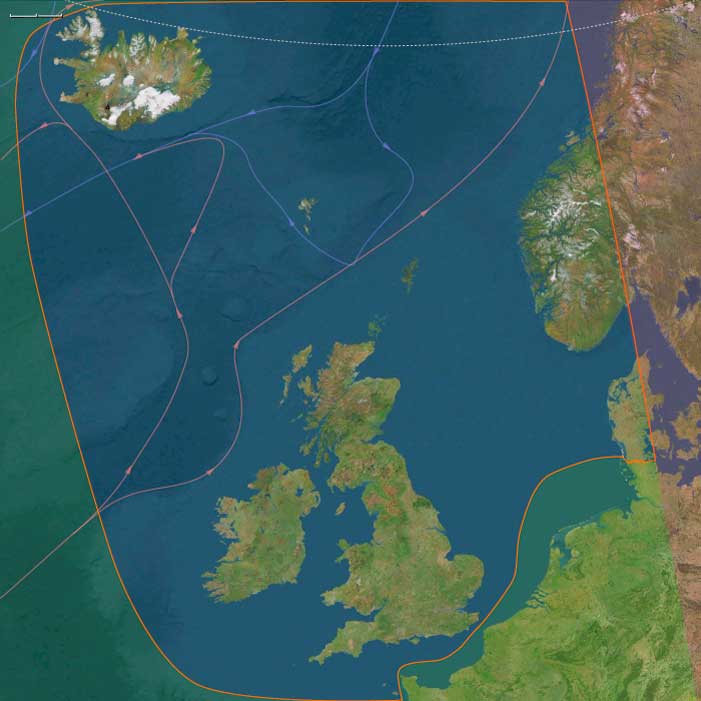
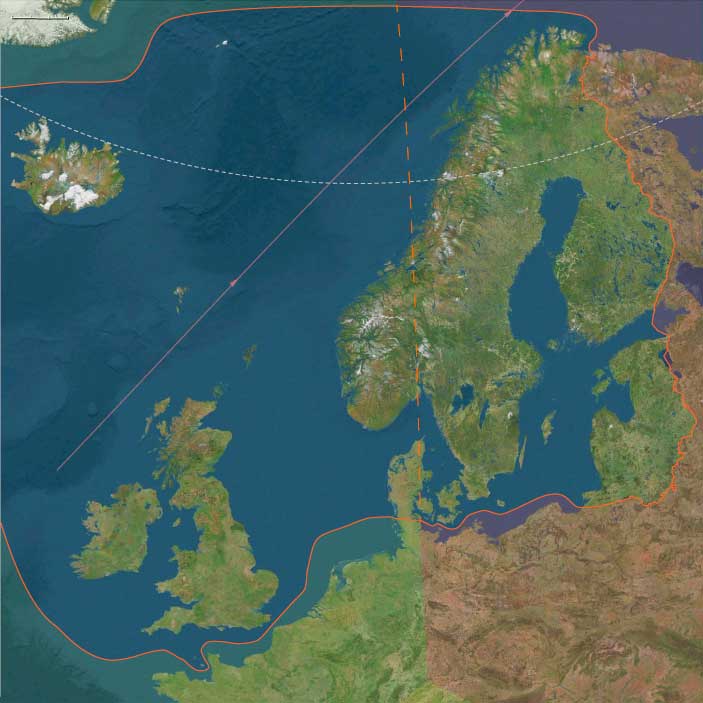
The Atlantic World, a pentagonal region encompassing one twelfth of the Earth, includes the Azores, Madeira, northwestern Europe (including western Denmark and western Norway), the British Isles, the Orkney Islands, the Shetland Islands, the Faroe Islands, Iceland, Greenland, Newfoundland, eastern and central North America, the northern section of Hispaniola, and several smaller island groups, notably Bermuda, the Bahamas, and the Turks and Caicos.
The eastern boundary, marked at 10° east longitude, divides Scandinavia into Eastern and Western sections, with Western Scandinavia oriented toward the North Atlantic and Eastern Scandinavia centered on the Baltic Sea Basin. This boundary also aligns with the historical eastern border of West Germany (1949–1990), before terminating in south-central Germany at its junction with the neighboring region to the southeast.
The western boundary, at 110° west longitude, cuts through Canada, separating the northern districts of Nunavut and the Northwest Territories from Alberta and Saskatchewan, approximately 75 miles south of the Alberta-Saskatchewan-Montana junction (48.1896851°N)—the northernmost point of the neighboring world to the southwest.
The southwestern boundary follows the division between the upper and lower Mississippi River Basin, then extends eastward into the Atlantic Ocean just south of Jacksonville, Florida, before terminating in northwestern Hispaniola.
HistoryAtlas contains 18,139 entries for The Atlantic World from the Paleolithic period to 1899.Narrow results by searching for a word or phrase or select from one or more of a dozen filters.
A huge length of time, it sees many changes in the environment, encompassing several glacial and interglacial periods that greatly affect human settlement in the region.
Providing dating for this distant period is difficult and contentious.
The inhabitants of the region at this time are bands of hunter-gatherers who roam northern Europe following herds of animals, or who support themselves by fishing.
Recent (2006) scientific evidence regarding mitochondrial DNA sequences from ancient and modern Europe has shown a distinct pattern for the different time periods sampled in the course of the study.
Despite some limitations regarding sample sizes, the results were found to be non-random.
As such, the results indicate that, in addition to populations in Europe expanding from southern refugia after the last glacial maximum (especially the Franco-Cantabrian region), evidence also exists for various northern refugia.
Southern and eastern Britain at this time are linked to continental Europe by a wide land bridge allowing humans to move freely.
The current position of the English Channel is a large river flowing westwards and fed by tributaries that will later become the Thames and Seine.
Reconstructing this ancient environment has provided clues to the route first visitors took to arrive at what was then a peninsula of the Eurasian continent.
There is evidence from bones and flint tools found in coastal deposits near Happisburgh in Norfolk and Pakefield in Suffolk that a species of Homo was present in what is now Britain around seven hundred thousand years ago.
Cranial capacity had again doubled within the Homo genus by six hundred thousand years ago, from H. habilis to an archaic Homo species called Homo heidelbergensis, the second human wave to be pumped from Africa into the Middle East and Western Europe.
Sites such as Boxgrove in Sussex illustrate the later arrival in the archaeological record of heidelbergensis around five hundred thousand years ago.
The cranial capacity of H. heidelbergensis overlaps with the range found in modern humans; these early peoples make Acheulean flint tools (hand axes) and hunt the large native mammals of the period.
They are thought to have driven elephants, rhinoceroses, and hippopotamuses over the tops of cliffs or into bogs to kill them more easily.
Up until the 1970s, these kill sites, often at waterholes where animals would gather to drink, were interpreted as being where Acheulean tool users killed game, butchered their carcasses, and then discarded the tools they had used.
Since the advent of zooarchaeology, which has placed greater emphasis on studying animal bones from archaeological sites, this view has changed.
Many of the animals at these kill sites have been found to have been killed by other predator animals, so it is likely that humans of the period supplemented hunting with scavenging from already dead animals.
The extreme cold of the Anglian Stage, from four hundred and seventy-eight thousand to four hundred and twenty-four thousand years ago, is likely to have driven humans out of Britain altogether and the region will apparently be unoccupied until the ice recedes during the Hoxnian Stage.
The Wolstonian Stage, a Middle Pleistocene stage of the geological history of earth that precedes the Ipswichian Stage (Eemian Stage in Europe) and follows the Hoxnian Stage in the British Isles, apparently includes three periods of glaciation.
Commencing three hundred and fifty-two thousand years ago and ending one hundred and thirty thousand years ago, it is temporally analogous to the Warthe Stage and Saalian Stage in northern Europe and the Riss glaciation in the Alps, and temporally equivalent to all of the Illinoian Stage and the youngest part of the Pre-Illinoian Stage in North America.
It is contemporaneous with the North American Pre-Illinoian A, Early Illinoian, and Late Illinoian glaciations.
Britain first becomes an island about three hundred and fifty thousand years ago, near the beginning of the Wolstonian stage, named after the site of Wolston in the English county of Warwickshire where corresponding deposits were first identified.
This period sees the introduction of Levallois flint tools, possibly by humans arriving from Africa, although finds from Swanscombe and Botany Pit in Purfleet support Levallois technology as a European rather than African introduction.
This more advanced flint technology, which made hunting more efficient, therefore made Britain a more worthwhile place to remain until the increasingly cool climate of the Wolstonian Stage, which apparently includes three periods of glaciation, made continued habitation unattractive, if not impossible.
Acheulean flint tools, typically found with Homo erectus remains, have been found in Wolstonian deposits.
Neanderthals probably diverge from Homo heidelbergensis some three hundred thousand years ago in Europe during the Wolstonian Stage, from three hundred and fifty-two thousand to one hundred and thirty thousand years ago.
There is little evidence of human occupation in Britain during the Ipswichian Stage (Eemian Stage elsewhere) between around one hundred and thirty thousand and one hundred and ten thousand years ago.
Meltwaters from the previous glaciation cut Britain off from the continent during this period, which may explain the lack of activity.
Overall, there appears to be a gradual decline in population between the Hoxnian Stage and this time suggesting that the absence of humans in the archaeological record here was is the result of gradual depopulation.
The Moderns are taller, more slender, and less muscular than the Neanderthals, with whom they share—perhaps uneasily—the Earth.
Though their brains are smaller in overall size, they are heavier in the forebrain, a difference that may allow for more abstract thought and the development of complex speech.
Yet, the inner world of the Neanderthals remains a mystery—no one knows the depths of their thoughts or how they truly expressed them.
Britain is grassland from 60,000 to 40,000 BCE, with giant deer and horse, woolly mammoths, rhino and carnivores.
During this period, Neanderthals are gradually being displaced as modern humans expand into Europe.
The slow pace of human migration into Europe suggests that Homo sapiens and Neanderthals may have been in continuous competition for territory over an extended period.
Neanderthals, with their larger, more robust frames, were likely physically stronger than modern Homo sapiens. Having inhabited Europe for over 200,000 years, they were also better adapted to cold climates, giving them a potential survival advantage in harsh Ice Age conditions.