Southwest Indian Ocean (28,577–7,822 BCE): From Glacial Dominance to Holocene Beginnings
Geographic & Environmental Context
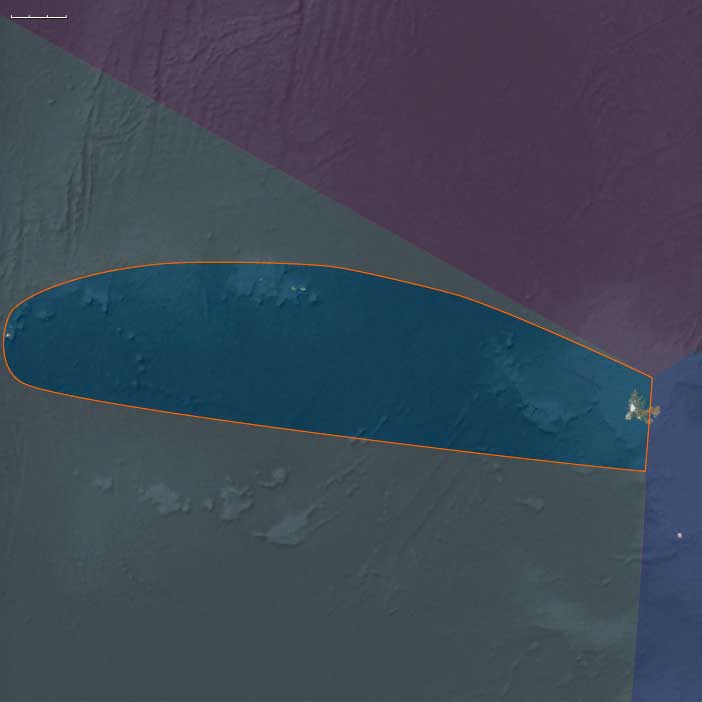
The subregion of Southwest Indian Ocean includes Kerguelen west of 70°E, the Îsles Crozet, Prince Edward Island, and Marion Island. Western Kerguelen’s ice-carved plateaus, the rugged volcanic Crozet peaks, and the smaller Prince Edward and Marion Islands defined this scattered maritime landscape.
Climate & Environmental Shifts
At the epoch’s start, glaciers dominated highlands across Kerguelen and the Crozets. By the Holocene transition, ice had retreated considerably, exposing valleys, coasts, and fertile volcanic soils. Sea levels rose globally, redrawing shorelines and submerging land bridges. Winds remained fierce, but slightly warmer temperatures lengthened ice-free seasons. The Southern Ocean’s productivity shifted with changing currents, supporting immense marine populations.
Subsistence & Settlement
Still unpeopled, the islands thrived ecologically. Vegetation expanded onto newly deglaciated slopes—mosses, lichens, and grasses colonized volcanic soils enriched by seabird guano. Seals, penguins, and albatrosses grew in numbers as ice-free coasts multiplied. Whales continued to feed in surrounding waters, making the subregion a biological hotspot.
Technology & Material Culture
Globally, Upper Paleolithic humans refined tools, ornaments, and symbolic practices, yet no trace of such material culture touched these isolated islands. Their inaccessibility underscored the limits of human seafaring in the Pleistocene.
Movement & Interaction Corridors
The Antarctic Circumpolar Current and westerly winds shaped ecosystems and migration. Birds nested across multiple island groups, creating interlinked ecological arcs. Whales moved along predictable feeding circuits. These corridors later drew human whalers and explorers, though in this epoch they remained exclusively natural.
Cultural & Symbolic Expressions
The subregion carried no human symbolic imprint. Instead, its symbolic resonance lay only in the ecological patterns—rookeries as centers of renewal, volcanic peaks as markers of resilience—beyond human perception at the time.
Environmental Adaptation & Resilience
Ecosystems reorganized dynamically as ice retreated. Vegetation colonized bare rock, seabird populations redistributed, and marine mammals adapted to shifting ice margins. The resilience of life in this harsh zone foreshadowed ecological strategies that would continue into the Holocene.
Transition
By 7,822 BCE, the glacial epoch was ending. The Southwest Indian Ocean islands emerged into a new climatic regime—still remote, storm-battered, and uninhabited, yet ecologically flourishing. They stood as silent reservoirs of life at the dawn of a warmer age.