Zubayr ibn al-Awam
a companion of Muhammad and a commander in the Rashidun army
Years: 594 - 656
Az-Zubayr ibn Al-Awam (594-656) is a companion of Muhammad and a commander in the Rashidun army.

Related Events
Filter results
Showing 10 events out of 11 total
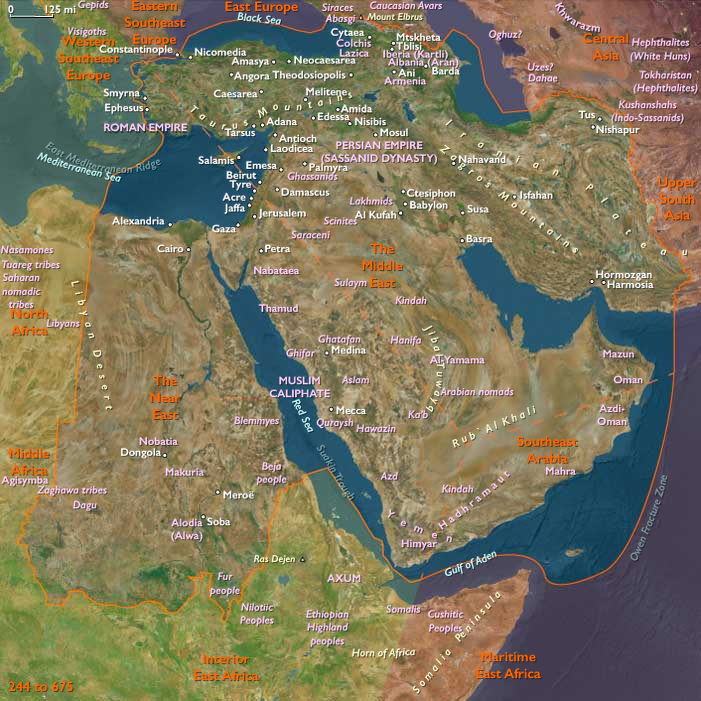
The concentrations of rebels nearest Medina are located in two areas: Abraq, seventy-two miles northeast of Medina, and Dhu Qissa, twenty-four miles east of Medina.
These concentrations consist of the tribes of Banu Ghatafan, the Hawazin, and the Tayy.
Abu Bakr sends envoys to all the enemy tribes, calling upon them to remain loyal to Islam and continue to pay their Zakat.
A week or two after the departure of the Islamic army under Usama, the rebel tribes had surrounded Medina, knowing that there are few fighting forces in city.
Meanwhile, Tulayha, a self-proclaimed prophet, reinforces the rebels at Dhu Qissa.
In the third week of July 632, the apostate army moves from Dhu Qissa to Dhu Hussa, from where they prepare to launch an attack on Medina.
Abu Bakr receives intelligence of this move of rebels, and immediately prepares for the defense of Medina.
As the main army is out of Medina under Usama, Abu Bakr scrapes together a fighting force mainly from the clan of Mohammad, the Banu Hashim.
The army has stalwarts like Ali ibn Abi Talib, Talha ibn Ubaidullah and Zubair ibn al-Awam, who will later (in the 640s) conquer Egypt.
Each of them is appointed as commander of one-third of the newly organized force.
Before the apostates can do anything, Abu Bakr launches his army against their outposts and drives them back to Dhu Hussa.
The following day, Abu Bakr marches from Medina with the main army and moves towards Dhu Hussa.
As the riding camels are all gone with Usama's army, he can only muster inferior pack camels, and the army mounts these camels.
These, being untrained for battle, bolt when Hibal, the apostate commander at Zhu Hussa, makes a surprise attack from the hills on the Muslims; and the Muslims retreat to Medina.
The apostates recapture the outposts that they had lost a few days earlier.
At Medina Abu Bakr reorganizes the army for the battle and attacks the apostates during the night, taking them by surprise.
The apostates retreat from Dhu Hussa to Dhu Qissa.
In the morning, Abu Bakr leads his forces to Dhu Qissa and defeats the rebel tribes, capturing Dhu Qissa on August 1, 632.
The defeated apostate tribes retreat to Abraq, where more clansmen of the Ghatfan, the Hawazin, and the Tayy are gathered.
Abu Bakr leaves a residual force of soldiers under the command of An-Numan ibn Muqarrin at Dhu Qissa and returns with his main army to Medina.
Usama had meanwhile marched to Mu'tah and attacked the Christian Arabs of the tribes of Banu Kalb and Ghassanids in a small battle.
He returns to Medina on August 4, bringing with him a large number of captives and a considerable amount of wealth, part of which comprises the spoils of war and part taxation of the re-conquered tribes.
The Islamic army had remained out of Medina for forty days.
Abu Bakr orders Usama to rest his men in Medina and re-equip them to fight against the rebels.
Meanwhile in the second week of August 632, Abu Bakr with his army moves to Zhu Qissa.
Taking the remaining forces from Numan ibn Muqarrin under his command, he moves to Abraq, where the retreated rebels have gathered, and defeats them.
The remaining rebels retreat to Buzakha, where Tulayha has moved with his army from Samira.
Tulayha, a tribal chief of Bani Asad at Buzakha in north central Arabia is another self-proclaimed prophet: he leads the rebellion against Medina aided by the allied tribes of Banu Ghatfan, the Hawazin, and the Tayy.
On receiving intelligence of the Muslims preparations, Tulayha prepares also for a battle, and is further reinforced by the contingents of the allied tribes.
Abu Bakr, before launching Khalid against Tulayha, seeks ways and means of reducing the latter's strength, so that the battle can be fought with the maximum prospects of victory.
Nothing can be done about the tribes of Bani Assad and Banu Ghatafan, which stand solidly behind Tulayha, but the Tayy are not so staunch in their support of Tulayha, and their chief, Adi ibn Hatim, is a devout Muslim.
Adi is appointed by Abu Bakr to negotiate with the tribal elders to withdraw their contingent from Tulayha's army.
The negotiations are a success, and Adi brings with him five hundred horsemen of his tribe to reinforce Khalid's army.
Khalid next marches against another apostate tribe, Jadila.
Here again Adi ibn Hatim offers his services to persuade the tribe to submit without bloodshed.
Bani Jadila submits, and their thousand warriors join Khalid's army.
Khalid, now much stronger than when he had left Zhu Qissa, marches for Buzakha.
Here, in mid-September 632 CE, he defeats Tulayha in the Battle of Buzakha.
The remaining army of Tulayha retreats to Ghamra, 20 miles from Buzakha, and are defeated in the Battle of Ghamra in the third week of September 632 CE.
Several tribes submits to the Caliph after Khalid's decisive victories.
Moving south from Buzakha, Khalid reaches Naqra in October 632 CE, with an army now six thousand strong, and defeats the rebel tribe of Banu Saleem in the Battle of Naqra.
632 In third week of October 632 CE, Khalid defeats a tribal mistress, Salma, in the battle of Zafar.
Afterwards, …
Abu Bakr moves in the fourth week of August 632 to Zhu Qissa with all available fighting forces.
Here he plans the strategy of the Campaign of the Apostasy to deal with the various enemies who occupy the entire land of Arabia except for the small area in the possession of the Muslims.
The battles which he had fought recently against the apostate concentrations at Zhu Qissa and Abraq had been in the nature of immediate preventive action to protect Medina and discourage further offensives by the enemy.
These actions have enabled Abu Bakr to secure a base from which he can fight the major campaign that lies ahead, thus gaining time for the preparation and launching of his main forces.
Abu Bakr has to fight not one but several enemies: Tulayha at Buzakha, Malik bin Nuwaira at Butah, Musaylima at Yamamah.
He has to deal with widespread apostasy on the eastern and southern coasts of Arabia: in Bahrain, in Oman, in Mahra, in Hadhramaut and in Yemen.
There is apostasy in the region south and east of Mecca and by the Khuza’ah in northern Arabia.
Abu Bakr forms the army into several corps.
The strongest corps, the main striking arm of the Muslims, is that of Khalid ibn Walid, used to fight the most powerful of the rebel forces.
Other corps are given areas of secondary importance in which to subdue the less dangerous apostate tribes.
The first corps to go into action is that of Khalid.
The timing of the dispatch of other corps hinges on the operations of Khalid, who is tasked with fighting the strongest enemy forces one after the other.
As soon as the organization of the corps is complete, Khalid marches off, to be followed a little later by Ikrimah and 'Amr ibn al-'As.
The other corps are held back by the caliph to be dispatched weeks and even months later.
Before the various corps leave Zhu Qissa, however, envoys will be sent by Abu Bakr to all apostate tribes in a final attempt to induce them to submit.
Apart from their specific objectives, the corps commanders are given the following instructions: Seek the tribes that are your objectives Call the Azaan.
If the tribe answers with the Azaan, do not attack.
After the Azaan, ask the tribe to confirm its submission, including the payment of zakat.
If confirmed, do not attack.
Those who submit will not be attacked.
Those who do not answer with the Azaan, or after the Azaan do not confirm full submission, will be dealt with by the sword.
All apostates who have killed Muslims will be killed.
With these instructions, Abu Bakr launches the forces of Islam against the apostates.
His plan is first to clear the area of west central Arabia (the area nearest to Medina), then tackle Malik bin Nuwaira, and finally concentrate against the most dangerous and powerful enemy: the self-proclaimed prophet Musaylima, who is mainly supported by the powerful tribe of Banu Hanifa, in the fertile region of Yamamah.
Khalid moves to Najd against the rebel tribe of Banu Tamim and their Sheikh Malik ibn Nuwayrah.
At Najd, getting the news of Khalid's decisive victories against apostates in Buzakha, many clans of Banu Tamim hasten to visit Khalid, but the Banu Yarbu', a branch of Bani Tamim, under their chief, Malik ibn Nuwayrah, hangs back.
Malik is a chief of some distinction: a warrior, noted for his generosity, and a famous poet.
At the time of Muhammad, he had been appointed as a tax collector for the tribe of Banu Tamim.
As soon as Malik heard of the death of Muhammad, he gave back all the tax to his tribespeople, saying, "Now you are the owner of your wealth."
His riders are stopped by Khalid's army at the town of Buttah.
Khalid asks them about the signing of pact with Sajjah; they said it was just because they wanted revenge against their terrible enemies.
When Khalid reaches Najd he finds no opposing army.
He sends his cavalry to nearby villages and orders them to call the Azaan (call for prayers) to each party they meet.
Zirrar bin Azwar, a squadron leader, arrests the family of Malik, claiming they had not answered the call to prayer.
Malik avoids direct contact with Khalid's army and orders his followers to scatter, and he and his family apparently move away across the desert.
He refuses to give zakat, hence differentiating between prayer and zakat.
Nevertheless, Malik is accused of rebellion against the state of Medina.
He is also to be charged for his entering in an anti-Caliphate alliance with Sajjah, a self-proclaimed prophetess.
Malik is arrested along with his clansmen, and is asked by Khalid about his crimes.
Malik's response is "your master said this your master said that" referring to Abu Bakr.
Khalid declares Malik a rebel apostate and orders his execution.
Khalid bin Walid kills Malik ibn Nuwayra.
In Medina, ‘Umar told Khâlid: “You enemy of Allâh!
You killed a Muslim man and then rape his wife.
By Allâh, I will stone you".
Khalid had taken Malik’s wife, Layla bint al-Minhal.
Shias claim that Islamically, Khalid would have had to wait for her to complete the waiting period iddah (three menstrual cycles) before Khalid would have been able to marry her.
Sunnis believe that since Malik and his tribe were judged apostates, they were taken captives and Idda rules do not apply to apostates.
Shias also claim that Abu Qatada Ansari was so shocked at Malik's murder by Khalid that he immediately returned to Medina, and told Abu Bakr that he would not serve under a commander who had killed a Muslim.
The death of Malik and Khalid's taking of his wife Layla creates a controversy.
Some officers of his army—including a prominent companion of Muhammad, Abu Qatadah—believe that Khalid killed Malik to take his wife.
After the pressure exerted by Umar—Khalid's cousin and one of Caliph Abu Bakr's main advisors—Abu Bakr calls Khalid back to Medina to explain himself.
Islamic Arab forces under Abu Musa al-Asha'ari in the lower Zagros Mountains capture capture and destroy the flourishing Sassanian trade center of Susa in 638.
The Plague of Emmaus causes the death of many prominent companions of Muhammad, drawn from the muhajirun or "migrants"—those who had faith in Muhammad when he began to preach in Mecca who fled with him when he was persecuted there—the ansar—people of Medina who welcomed Muhammad and his companions and stood as their protectors, and the badriyun, who had fought at the Battle of Badr.
An epidemic disease breaks out in Emmaus (Imwas) in Palestine, striking the city and the military camps of the Muslim Arabs, killing most of its population (probably an estimated twenty-five thousand people).
A four-thousand-man Rashidun army under the command of 'Amr ibn al-'As invades Egypt, capturing the strategic Delta town of Pelusium after a two-month siege.
Arab reinforcements led by Zubayr ibn al-Awam are sent from Medina to assist Amr's army.
The losses incurred by the Muslims are ameliorated by Sinai Bedouins, who join the invaders in the conquest of Egypt from the Empire.
Hormuzan, a wealthy nobleman from Mihragan-kadag, serves as satrap of Khuzestan, one of the richest in Iran.
He is from one of the seven Parthian clans of the Sasanian Empire and is the brother-in-law of Khosrau II and the maternal uncle of Kavadh II.
Being proud of this rich heritage, Hormuzan is permitted to wear a crown upon his head; however, it is smaller than the king's.
At the battle of al-Qādisiyyah, he had commanded the right flank of the army and was defeated.
Hormuzan, however, had regrouped and fought at the battle of Jalula but also suffered defeat.
He then escaped from the region, while many of his forces had been captured and killed by the Arab Muslims.
In 642, he leads the resistance in Shushtar against the Arabs but later surrenders.
Hormuzan is then given a pension, but initially refuses to convert to Islam for some time.
He only converts after being told that he should choose between death and Islam.
Ali ibn Abi Talib, the cousin and son-in-law of Muhammad, is invited by the Muslims of Medina to accept the caliphate; reluctant, he agrees only after long hesitation.
Acutely aware of the neglect of the Qur'an and the traditions of Muhammad that his predecessors had allowed to develop, he bases his rule on the Islamic ideals of social justice and equality.
Ali and his party (shi'ah) at first gain power over the representatives of the other leading Meccan families, but his policy is a blow to the interests of the Quraysh aristocracy of Mecca who have grown rich in the wake of the Muslim conquests.
In order to embarrass 'Ali they demand that he bring the murderers of 'Uthman to trial, and when he rejects their request, a rebellion against him is instigated in which two prominent Meccans along with Aishah, Muhammad's widow and the daughter of Abu Bakr, the first caliph, take a leading part.
Aishah, left a childless widow of eighteen at Muhammad's death in 632, had remained politically inactive until the time of 'Uthman, during whose reign she had played an important role in fomenting opposition that led to his murder.