Zbigniew of Poland
Duke of Poland
Years: 1083 - 1113
Zbigniew (ca.
1073 – 8 July 1113?
), is the Duke of Poland (in Greater Poland, Kuyavia and Masovia) from 1102 until 1107.
Related Events
Filter results
Showing 10 events out of 23 total
East Central Europe (1096–1107 CE): Coloman’s Hungarian Consolidation, Polish Fragmentation under Władysław I and Zbigniew, and Bohemian Stability under Bretislav II
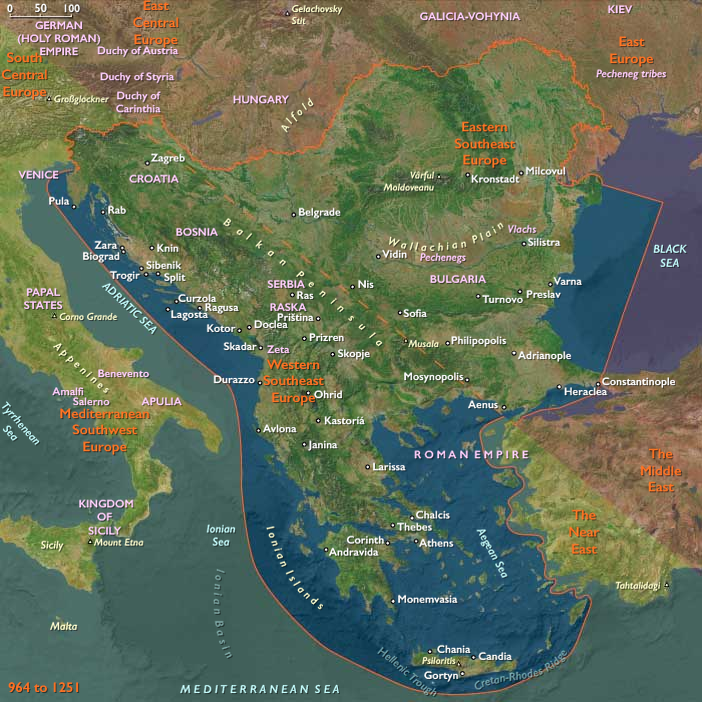
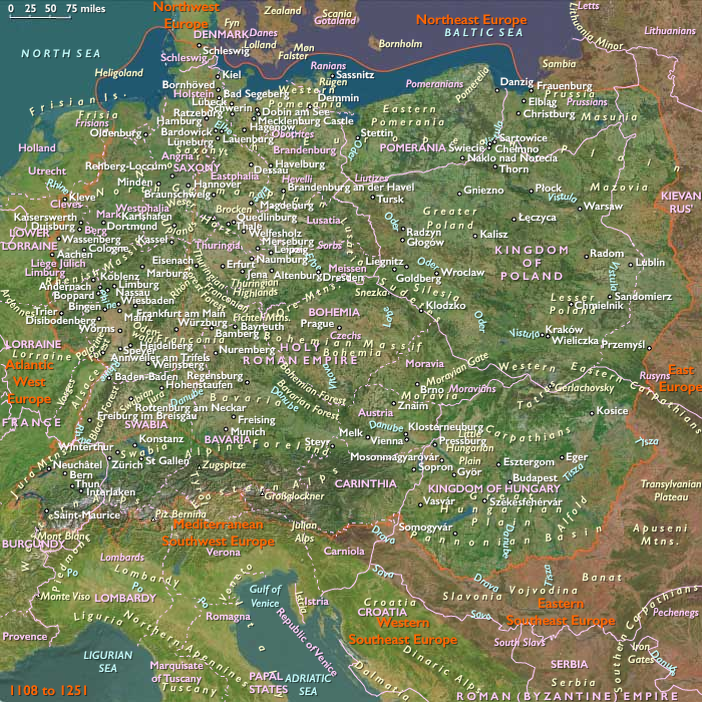
Between 1096 and 1107 CE, East Central Europe—comprising modern-day Poland, Czechia, Slovakia, Hungary, and the eastern portions of Germany and Austria east of 10°E and north of the defined southeastern boundary—experienced critical political, dynastic, and cultural shifts. King Coloman the Learned solidified Hungarian stability and expanded royal authority, Poland remained politically fragmented under the rule of Władysław I Herman and his sons, and Bohemia enjoyed stability and regional influence under Bretislav II. These developments reshaped regional dynamics and set lasting precedents for future medieval statehood.
Political and Military Developments
Hungarian Consolidation and Expansion under Coloman
-
Coloman the Learned (r. 1095–1116) secured internal peace in Hungary after Ladislaus I’s successful reign. He expanded Hungarian influence, notably annexing Croatia (1102), effectively ruling it as part of a personal union. His reforms strengthened legal structures, royal administration, and military capabilities.
Polish Dynastic Fragmentation and Rivalries
-
After Władysław I Herman’s death in 1102, Poland experienced intensified internal conflicts between his sons, Zbigniew and Bolesław III Wrymouth, leading to fragmented territories, internal instability, and weakened royal authority throughout this period.
Stability and Influence of Bohemia under Bretislav II
-
Duke Bretislav II of Bohemia (r. 1092–1100) maintained Přemyslid stability and aligned Bohemia with imperial interests, reinforcing its regional status. His reign was marked by strengthened governance, improved administrative efficiency, and enhanced regional diplomacy.
Imperial Influence under Henry IV and Henry V
-
The Holy Roman Emperors Henry IV and his son Henry V (from 1106) maintained active involvement in East Central European affairs, shaping alliances, succession disputes, and regional power dynamics, especially influencing Bohemia’s strategic alignment.
Economic and Technological Developments
Hungarian Prosperity and Economic Expansion
-
Under Coloman’s reign, Hungary’s economic prosperity grew significantly, benefiting from expanded trade with Byzantium, Venice, and Central European markets. Urban centers flourished, bolstered by increased commercial activity and improved infrastructure.
Polish Economic Disruption and Localized Recovery
-
Poland’s internal dynastic struggles temporarily disrupted economic activity, yet key urban centers (Kraków, Gniezno) continued local recovery, maintaining trade and commerce despite instability.
Continued Bohemian Urban and Economic Growth
-
Prague and other Bohemian towns remained economically robust under Bretislav II, benefiting from stable governance, increased trade, and enhanced urban infrastructure.
Cultural and Artistic Developments
Hungarian Cultural Renaissance under Coloman
-
Coloman the Learned, renowned for his intellectual interests, actively promoted ecclesiastical institutions, supported literary and scholarly activities, and initiated cultural projects, fostering a Hungarian cultural revival and intellectual flourishing.
Bohemian Ecclesiastical and Cultural Vitality
-
Bretislav II’s patronage supported ecclesiastical building programs, monastic foundations, and manuscript production, significantly enriching Bohemia’s cultural and religious life, particularly in Prague.
Polish Cultural Continuity amid Political Instability
-
Despite political fragmentation, Polish monasteries, ecclesiastical institutions, and cultural centers preserved scholarly traditions and cultural identity, providing continuity during ongoing turmoil.
Settlement and Urban Development
Expansion of Hungarian Urban Centers
-
Coloman actively supported urban growth in key Hungarian cities, notably Esztergom, Székesfehérvár, and Zagreb, strengthening administrative efficiency, economic vitality, and regional governance.
Continued Bohemian Urban Prosperity
-
Prague and other Bohemian urban centers experienced continued growth and fortification under Bretislav II, reinforcing their economic and political roles.
Polish Urban Resilience amid Dynastic Strife
-
Major Polish cities, including Kraków and Gniezno, showed resilience and maintained incremental development, ensuring continued administrative and economic significance despite political challenges.
Social and Religious Developments
Consolidation of Ecclesiastical Authority
-
Christianity remained dominant throughout the region, with strengthened ecclesiastical authority evident under Coloman in Hungary and Bretislav II in Bohemia, shaping governance, education, and cultural identities.
Dynastic Power and Aristocratic Influence
-
Dynastic and aristocratic structures continued to solidify, with Hungarian royal authority notably strengthened under Coloman. Meanwhile, Poland’s weakened central authority enhanced aristocratic influence, altering political governance patterns for subsequent decades.
Long-Term Consequences and Historical Significance
The era 1096–1107 CE significantly shaped the medieval trajectory of East Central Europe. Hungary under Coloman experienced significant territorial expansion and cultural flourishing, Poland faced severe dynastic fragmentation and weakened royal authority, and Bohemia maintained stable governance and strengthened regional influence under Bretislav II. These developments profoundly influenced regional alliances, political identities, cultural traditions, and societal structures, laying foundational elements that endured throughout subsequent medieval centuries.
Prince Boleslaw’s childhood had occurred at a time when a massive political migration out of Poland was taking place, due to Sieciech’s political repressions.
Most of the elites who has become political refugees had found safe haven in Bohemia.
Another consequence of Sieciech’s political persecution had ben the kidnapping of Zbigniew by Sieciech’s enemies and his return from abroad in 1093.
Zbigniew had taken refuge in Silesia, a stronghold of negative sentiment for both Sieciech as well as his nominal patron Wladyslaw I Herman.
In the absence of Sieciech and Boleslaw, who had been captured by Hungarians and kept captive, Prince Wladyslaw I had then undertaken a punitive expedition to Silesia, which was unsuccessful and subsequently obliged him to recognize Zbigniew as a legitimate heir.
In 1093, Wladyslaw had I signed an Act of Legitimization that had granted Zbigniew the rights of descent from his line.
Zbigniew had also been granted the right to succeed to the throne.
Following Sieciech and Boleslaw’s escape from Hungary, an expedition against Zbigniew had been mounted by the Count Palatine, its aim the nullification of the Act of Legitimization.
The contestants had met at the battle of Goplo in 1096, where Sieciech’s forces had annihilated the supporters of Zbigniew.
Zbigniew himself had been taken prisoner, but regains his freedom a year later, in May 1097, due to the intervention of the bishops.
At the same time his rights, guaranteed by the Act of Legitimization, are reinstated.
Simultaneously a great migration of Jews from Western Europe to Poland has begun, coincident with the First Crusade.
The tolerant rule of Wladyslaw I Herman attracts the Jews, who are permitted to settle throughout the entire kingdom without restrictions.
The Polish prince takes great care of the Hebrew Diaspora, as he understands its positive influence on the growth of the country’s economy.
The new Jewish citizens will soon gain trust of the gentiles during the subsequent rule of Boleslaw III.
Zbigniew, in view of his father’s disapproval, and after discovering the plans of Sieciech and Duchess Judith-Sophia to take over Poland, gains an ally in the young prince Boleslaw.
Both brothers demand that the reins of government should be handed over to them.
It is difficult to believe, however, that Boleslaw is making independent decisions at this point as he was only twelve years of age.
It is postulated that at this stage he is merely a pawn of the Baron’s power struggle.
Wladyslaw I Herman, however, agrees to divide the realm between the brothers, each to be granted his own province while the Prince—Wladyslaw I himself—retains control of Mazovia and its capital at Plock.
Wladylaw also retains control of the most important cities, i.e., Wroclaw, Krakow and Sandomierz.
Zbigniew’s province encompasses Greater Poland, including Gniezno, Kuyavia, Leczyca Land and Sieradz Land.
Boleslaw’s territory includes Lesser Poland, Silesia and Lubusz Land.
The division of the country and the permission for Boleslaw and Zbigniew to co-rule greatly alarms Sieciech, who now begins preparing to dispose of the brothers altogether.
Sieciech understands that the division of the country will undermine his position.
He initiates a military settlement of the issue and he gains the Prince’s support for it.
The position of Herman is seen as ambiguous as he chooses to support Sieciech’s cause instead of his sons'.
In response to Sieciech’s preparations, Boleslaw and Zbigniew enter into an alliance.
This takes place at a popular assembly or Wiec organized in Wroclaw by a magnate named Skarbmir.
Here it is decided to remove the current guardian of Boleslaw, a noble named Wojslaw who is a relative of Sieciech, and arrange for an expedition against the Palatine.
Subsequently, in 1099, the armies of Count Palatine and Prince Herman encounter the forces of Zbigniew and Boleslaw near Zarnowiec by the river Pilica.
Here the rebel forces of Boleslaw and Zbigniew defeat Sieciech's army, and Wladyslaw I Herman is obliged to permanently remove Sieciech from the position of Count Palatine.
The Polish rebel forces are now further directed towards Sieciechów, where the Palatine takes refuge.
Unexpectedly, Prince Wladyslaw comes to the aid of his besieged favorite with a small force.
At this point, the princes decide to depose their father.
The opposition sends Zbigniew with an armed contingent to Masovia, where he is to take control of Plock, while Boleslaw is directed to the South.
The intention is the encirclement of their father, Prince Wladyslaw I.
The Prince predicts this maneuver and sends his forces back to Masovia.
In the environs of Plock, the battle is finally joined and the forces of Wladyslaw I are defeated.
The Prince is hereafter forced to exile Sieciech from the country.
The Palatine leaves Poland around 1100/1101.
He is known to have sojourned in the German lands.
However, he will eventually return to Poland but will never again play any political role.
He may have been blinded.
Poland is divided into two provinces at the death of Prince Wladyslaw I Herman on June 14, 1102, each administered by one of the late prince’s sons.
The extent of each province closely resembles the provinces that the princes had been granted by their father three years earlier, the only difference being that Zbigniew also controls Mazovia with its capital at lock, effectively ruling the northern part of the kingdom, while his younger half-brother Boleslaw rules its southern portion.
In this way, two virtually separate Polish states are created.
They conduct separate policies internally as well as externally.
They each seek alliances, and sometimes they are enemies of one another.
Such is the case with Pomerania, towards which Boleslaw directs his ambitions.
Zbigniew, whose country borders Pomerania, wishes to maintain good relations with his northern neighbor.
Boleslaw, eager to expand his dominion, organizes several raids into Pomerania and Prussia.
Boleslaw organizes a war party into Pomerania in autumn 1102, during which his forces sack Bialogard.
In reprisal, the Pomeranians send retaliatory war parties into Polish territory, but as Pomerania borders Zbigniew’s territory these raids ravage the lands of the prince who is not at fault.
Therefore, in order to put pressure on Boleslaw, Zbigniew allies himself with Borivoj II of Bohemia, to whom he promises to pay tribute in return for his help.
Zbigniew, by aligning himself with Boleslaw’s southern neighbor, wishes to compel Boleslaw to cease his raids into Pomerania.
Boleslaw, on the other hand, allies himself with Kievan Rus and Hungary.
His marriage to Zbyslava, the daughter of Sviatopolk II Iziaslavich in around 1103, is to seal the alliance between himself and the prince of Kiev.
However, Boleslaw's first diplomatic move had been to recognize Pope Paschal II, which had put him in strong opposition to the Holy Roman Empire.
A later visit of papal legate Gwalo, Bishop of Beauvais, brings the church matters into order, it also increases Boleslaw's influence.
Coloman, like Ladislaus I, proves to be a great legislator, but he prescribes less severe punishments than had his uncle.
He has ordered that transactions between Christians and Jews are to be put into writing.
His laws concerning his Muslim subjects are aimed at their conversion, for instance, by obliging them to marry their daughters to Christians.
The presence of Jewish and Muslim merchants in the kingdom is due to its role as a crossroad of trading routes leading towards Constantinople, Regensburg and Kiev.
Local trade also exists, which enables Coloman to collect the marturina, the traditional in-kind tax of Slavonia, in cash.
Zbigniew sees the marriage of Boleslaw to a princess from Rus' and an alliance with Kiev as a serious threat.
He therefore prevails upon his ally, Borivoj II of Bohemia, to invade Boleslaw’s province.
Boleslaw retaliates with expeditions into Pomerania in 1104–1105, which bring the young prince not only loot, but also effectively disintegrates the alliance of Pomeranians and Zbigniew.
Boleslaw’s partnership with King Coloman of Hungary, whom he had aided in gaining the throne, bears fruit in 1105 when they successfully invade Bohemia.
Also in 1105, Boleslaw enters into an agreement with his stepmother Judith of Swabia, the so-called Tyniec Accord.
According to their agreement, in exchange for a generous grant, the prince is guaranteed Judith's neutrality in his political contest with Zbigniew.
Boleslaw manages in 1106 to bribe Borivoj II of Bohemia and have him join his side in the contest against Zbigniew.
In this same year, Boleslaw formally allies himself with Coloman of Hungary.
During a popular assembly, attended by both princes, it is agreed that neither of the brothers will conduct war, sign peace treaties, or enter into alliances without the agreement of the other.
This creates a very unfavorable situation for Boleslaw, and in effect it leads to civil war, with overlordship of the entire country at stake.