Yeongyang of Goguryeo
26th king of Goguryeo
Years: 555 - 618
King Yeongyang of Goguryeo (died 618) (r. 590–618) is the 26th king of Goguryeo, the northernmost of the Three Kingdoms of Korea.
He is the eldest son of King Pyeongwon (r. 559–590).
Related Events
Filter results
Showing 10 events out of 14 total
A messenger from Goguryeo's King King Yeong-yang to Ashina Rangan happened to be present when Emperor Yang was visiting Ashina Rangan in 607, and Ashina Rangan had introduced him to Emperor Yang.
Emperor Yang had ordered Gao Yuan to come visit him, offering to reward him if he did so and to punish him if he did not do so.
Gao Yuan had not responded, and by 611, Emperor Yang, insulted by the lack of response, is preparing a campaign against Goguryeo.
With Sui appearing to be in its prime, both governmental officials and the people are initially in support of a campaign to conquer Goguryeo.
Emperor Yang goes to Zhuo Prefecture in spring 611 and announces the campaign against Goguryeo.
Several hundred men are conscripted, and it is said that even before they could get to Zhuo Prefecture, disease and fatigue had already caused much loss of life.
In response, a number of conscripted soldiers desert and become agrarian rebels.
Emperor Yang, angry that Western Tujue's khan Ashina Daman, while nominally submissive, had refused to visit him, has Pei Ju persuade Ashina Daman's subordinate khan Ashina Shegui to rebel in 611 against Ashina Daman, promising to give him a Sui princess in marriage.
Ashina Shegui thus rebels against Ashina Daman, forcing Ashina Daman to flee, first to Gaochang, then to Sui.
Emperor Yang accepts Ashina Daman's submission, and thereafter divides his people into three groups, while leaving Ashina Daman as titular khan, although he will never allow Ashina Daman to return to his people.
The ruler of Gaochang, Qu Boya, had in 607 begun paying tribute to the Sui Dynasty.
Emperor Yang in winter 612 arranges the marriage of a daughter of a clansman, whom he creates the Princess Huarong, to Qu Boya, the king of Gaochang.
The Sui soldiers have been gathered at Zhuo Prefecture by 612, and …
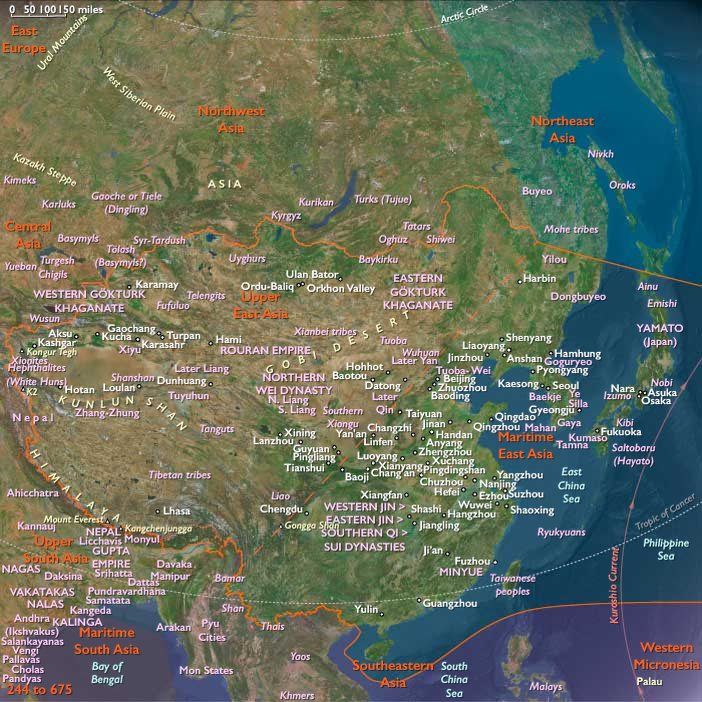
…Emperor Yang launches his attack with a reported one million men, attacking a number of cities in Goguryeo territory, but targeting mainly the important city of Liaodong (in modern Liaoyang, Liaoning) and …
…Goguryeo's capital Pyongyang.
However, contrary to the desires of the generals, Emperor Yang orders that their tactical decisions must first be submitted to and approved by him before they can be carried out.
Thus all the Goguryeo forts and cities are able to withstand Sui forces and thus Manchuria does not have much of a chance to be conquered.
Emperor Yang, however, makes a new plan to keep the Goguryeo forts at bay while sending another army of three hundred and fifty thousand troops, alongside the navy, to siege the Goguryeo capital.
The navy arrives first and under a hastily given order, the navy attacks the capital but is defeated by ambush.
The navy then waits for the land army to arrive.
The supply of food has also been delayed much and many Sui soldiers die of famine.
Then the Goguryeo General Eulji Meundeok rallies Goguryeo forces and constantly ambushes Sui forces while feigning retreat.
The Sui army reaches the Salsu (Chongchon River), but Eulji and the Goguryeo forces are waiting in ambush.
A dam had been made at the Salsu River to make the river seem it is shallow.
When the Sui army is in the middle of the River, the dam is opened and many Sui soldiers drown.
Out of the three hundred and five thousand men that had entered the river, only twenty-seven hundred soldiers escape death.
Thus the Sui army, or what is left of it, makes a speedy retreat retreats back to the Liaodong Peninsula.
This war, which Gorguryeo eventually wins, leaves the Sui dynasty with devastating losses in soldiers, money and support from the people.
Crippled by the enormous loss of manpower and resources as a result of its Korean campaigns, the Sui dynasty soon starts to crumble from within and will finally be brought down by internal strife, to be replaced soon thereafter by the Tang.
Emperor Yang again orders that soldiers be gathered at Zhuo Prefecture, as he prepares a second campaign against Goguryeo in spring 613.
He also selects the most elite of the soldiers into a specialized corps, the Xiaoguo Army (meaning, "the strong and brave").
Hereafter, the Xiaoguo Army becomes his own personal guard.
In response to the conscription order, even more men desert and joined the agrarian rebels, throwing the northern central part of the empire into a state of confusion.
With the prefecture officials having little military training, the rebels largely go unchecked but for the efforts of the general Zhang Xutuo, who is able to defeat some of the rebels but is not able to generally suppress them.
Emperor Yang crosses the Liao River again and puts Manchuria under siege in summer 613.
However, at this time, news arrives that Yang Su's son Yang Xuangan had rebelled near Luoyang.
With the people disaffected by the Goguryeo campaigns, Yang Xuangan receives much popular support and threatens Luoyang.
Emperor Yang, in fear, lifts the siege on Liaodong and also orders the southern offensive to be terminated, returning to Zhuo Prefecture while …
…sending Yuwen and Qutu Tong south to aid Luoyang.
The general in charge of defending Chang'an, Wei Wensheng, also comes to Luoyang's aid.
Together, these forces outnumber Yang Xuangan's and deal him several defeats.
Yang Xuangan decides to try to advance west to capture Chang'an as a base of operations, but on the way is again defeated, and he has his brother Yang Jishan kill him, to avoid capture.
At Emperor Yang's orders, the officials Fan Zigai and Pei Yun carry out mass-scale reprisals, executing a large number of people who had followed Yang Xuangan.