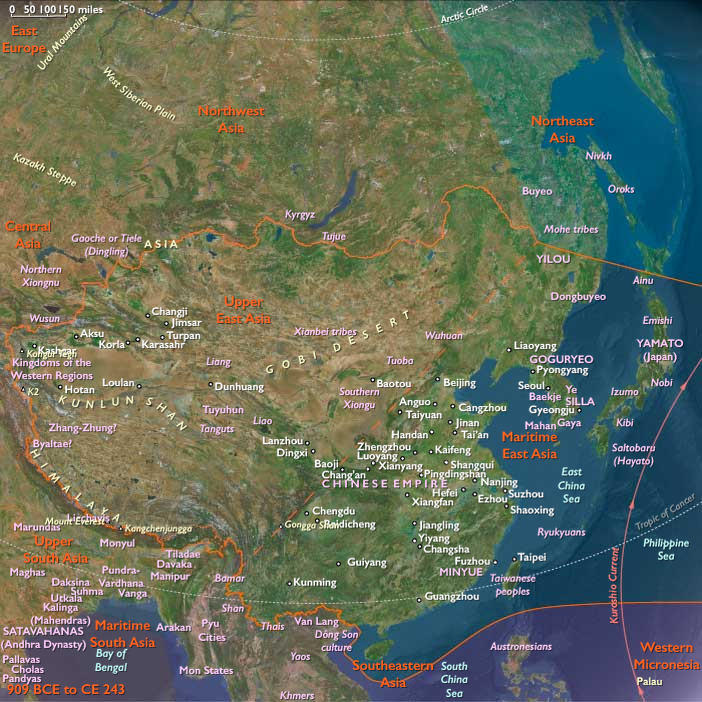
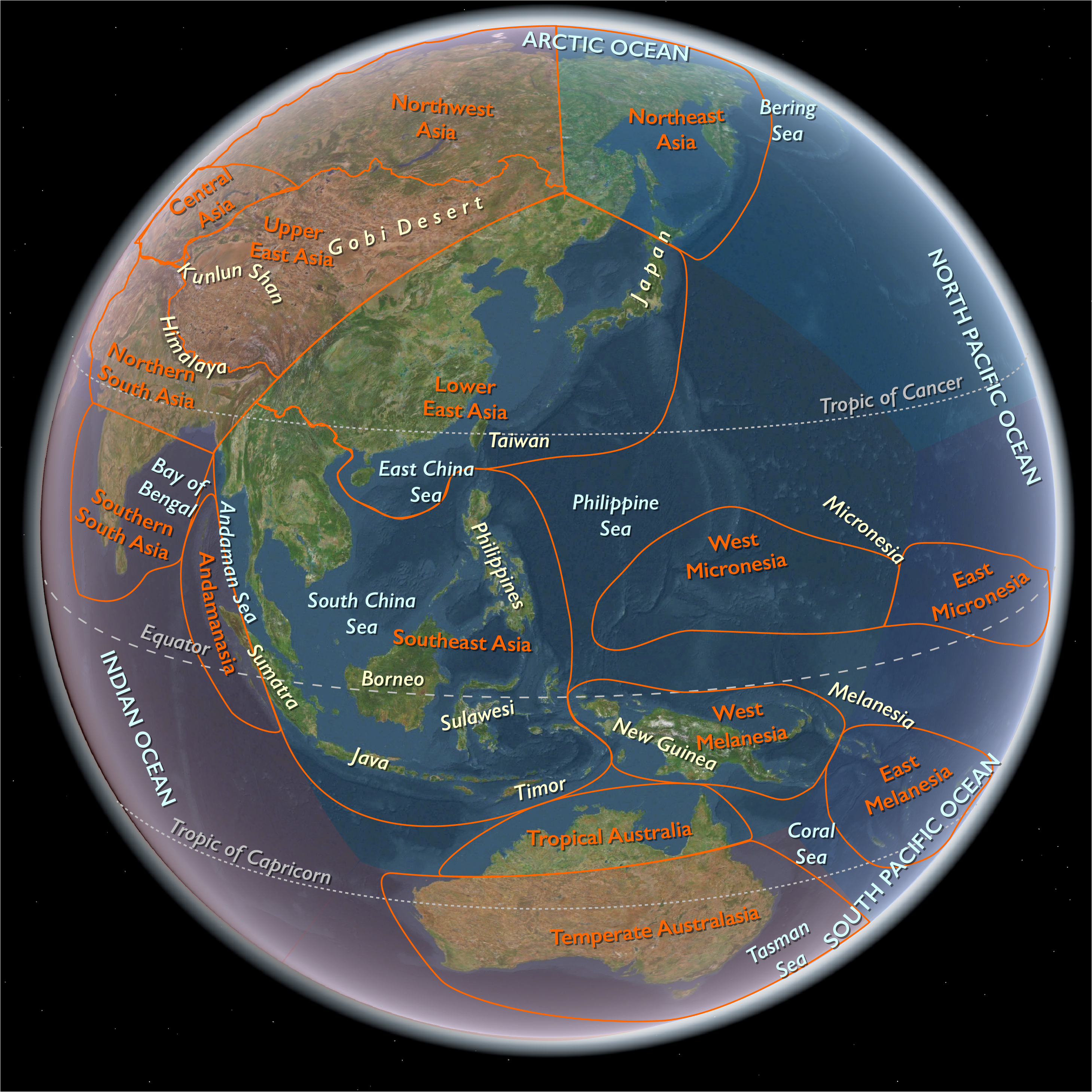
Maritime East Asia (189–46 BCE): Han Dynasty Expansion and Cultural Renaissance
Between 189 BCE and 46 BCE, MAritime East Asia—comprising lower Primorsky Krai, the Korean Peninsula, the Japanese Archipelago below northern Hokkaido, Taiwan, and southern, central, and northeastern China—experiences significant territorial expansion, cultural revival, and technological progress under the Han dynasty.
Establishment and Administration of the Han Dynasty
Following a brief civil war, the Han Dynasty (206 BCE–220 CE) emerges, establishing its capital at Chang'an. The Han rulers maintain much of the Qin administrative structure but temper centralized rule by introducing vassal principalities to facilitate governance. Confucianism, previously suppressed under Qin, becomes the official state ideology, and Confucian scholars become central to civil administration, establishing the earliest civil service examination system.
This era also sees a remarkable cultural renaissance, notably through the work of historian Sima Qian (145–87 BCE), whose Shiji (Historical Records) documents Chinese history comprehensively from legendary periods through Emperor Wu Di (141–87 BCE). Intellectual, literary, and artistic endeavors flourish, profoundly influencing subsequent generations.
Military Expansion and the Silk Road
The Han dynasty is marked by substantial military prowess, expanding westward into the Tarim Basin region (modern Xinjiang), thereby securing and promoting the Silk Road, a crucial trade route linking China with Antioch, Baghdad, and Alexandria. This route becomes synonymous with the export of Chinese silk to the Roman Empire.
Han armies also penetrate into northern Vietnam and northern Korea, where they establish commanderies, notably Lelang (Nangnang) near modern-day P'yongyang. These commanderies facilitate cultural and commercial exchanges, though their governance remains fragile and heavily reliant on diplomatic tributary relationships, symbolized by intermarriages and periodic exchanges of gifts with local rulers.
Developments on the Korean Peninsula
In Korea, the most notable polity is Old Choson, flourishing along the Liao and Taedong rivers, known for its bronze culture and formidable military strength. Under the leadership of Wiman (194–180 BCE), who synthesizes Chinese influence with indigenous traditions, Wiman Choson expands significantly but ultimately falls to Han conquest in 108 BCE.
This era coincides with the peninsula’s shift from bronze to iron culture, profoundly enhancing agricultural productivity through iron tools such as hoes, plowshares, and sickles. Increased grain cultivation supports population growth and lays continuous agrarian foundations for later unified Korean states.
The Han–Xiongnu Conflict
In response to increasing threats from nomadic Xiongnu tribes on the northern frontier, Emperor Wu Di initiates the prolonged Han–Xiongnu War (133 BCE–89 CE). This shift from defensive to offensive strategy characterizes Han foreign policy, further solidifying its control over frontier regions and protecting key trade routes.
Technological and Mathematical Advancements
The Han dynasty witnesses remarkable technological achievements, including the invention of paper and porcelain. In mathematics, the influential text Nine Chapters on the Mathematical Art (Jiu Zhang Suan Shu) introduces negative numbers and innovative methods for solving simultaneous equations, marking significant milestones in mathematical history.
Legacy of the Age: Consolidation and Cultural Synthesis
Thus, the age from 189 to 46 BCE under the Han dynasty marks a pivotal period of territorial expansion, cultural revival, and technological innovation. This era establishes enduring administrative, philosophical, and technological frameworks that profoundly influence East Asian civilization for centuries.