William the Conqueror
King of England
Years: 1028 - 1087
William I (c. 1028 – 9 September 1087), usually known as William the Conqueror and sometimes William the Bastard, is the first Norman King of England, reigning from 1066 until his death in 1087.
The descendant of Viking raiders, he has been Duke of Normandy since 1035 under the style William II.
After a long struggle to establish his power, by 1060 his hold on Normandy is secure, and he launches the Norman conquest of England in 1066.
The rest of his life is marked by struggles to consolidate his hold over England and his continental lands and by difficulties with his eldest son.
William is the son of the unmarried Robert I, Duke of Normandy, by Robert's mistress Herleva.
His illegitimate status and his youth cause some difficulties for him after he succeeds his father, as does the anarchy that plagues the first years of his rule.
During his childhood and adolescence, members of the Norman aristocracy battle each other, both for control of the child duke and for their own ends.
In 1047, William is able to quash a rebellion and begin to establish his authority over the duchy, a process that is not complete until about 1060.
His marriage in the 1050s to Matilda of Flanders provides him with a powerful ally in the neighboring county of Flanders.
By the time of his marriage, William is able to arrange the appointments of his supporters as bishops and abbots in the Norman church.
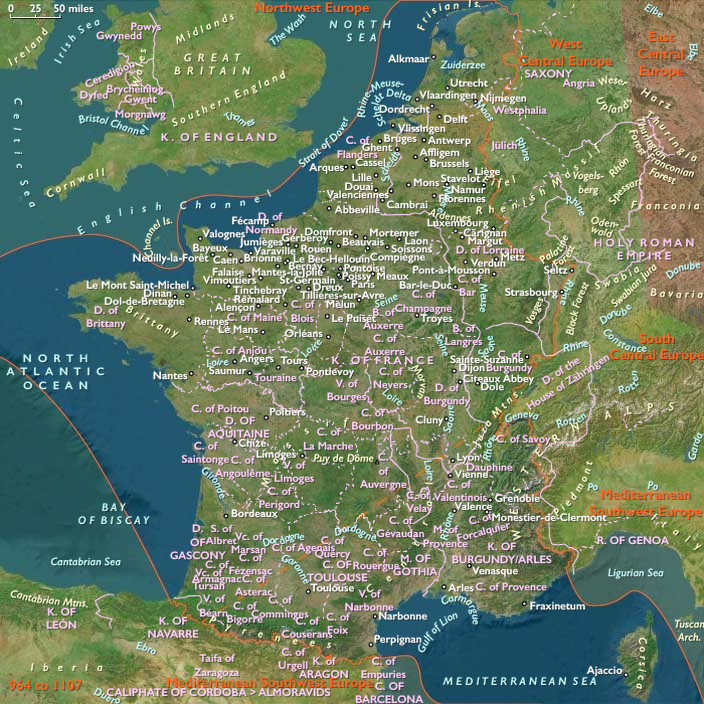
His consolidation of power allows him to expand his horizons, and by 1062 William is able to secure control of the neighboring county of Maine.
In the 1050s and early 1060s, William becomes a contender for the throne of England, at this time held by his childless cousin Edward the Confessor.
There are other potential claimants, including the powerful English earl Harold Godwinson, who is named the next king by Edward on the latter's deathbed in January 1066.
William argues that Edward had previously promised the throne to him, and that Harold had sworn to support William's claim.
William builds a large fleet and invades England in September 1066, decisively defeating and killing Harold at the Battle of Hastings on October 14, 1066.
After further military efforts, William is crowned king on Christmas Day 1066, in London.
He makes arrangements for the governance of England in early 1067 before returning to Normandy.
Several unsuccessful rebellions follow, but by 1075 William's hold on England is mostly secure, allowing him to spend the majority of the rest of his reign on the Continent.
William's final years are marked by difficulties in his continental domains, troubles with his eldest son, and threatened invasions of England by the Danes.
In 1086, William orders the compilation of the Domesday Book, a survey listing all the landholders in England along with their holdings.
William dies in September 1087 while leading a campaign in northern France, and is buried in Caen.
His reign in England is marked by the construction of castles, the settling of a new Norman nobility on the land, and change in the composition of the English clergy.
He does not try to integrate his various domains into one empire, but instead continues to administer each part separately.
William's lands are divided after his death: Normandy goes to his eldest son, Robert, and his second surviving son, William, receives England.