Wenceslaus IV of Bohemia
King of Bohemia
Years: 1361 - 1419
Wenceslaus (also Wenceslas; Czech: Václav; German: Wenzel, nicknamed der Faule ("the Idle"); February 26, 1361 – August 16, 1419) is, by inheritance, King of Bohemia (as Wenceslaus IV) from 1363 and by election, German King (formally King of the Romans) from 1376.
He is the third Bohemian and second German monarch of the Luxembourg dynasty.
Wenceslaus is deposed in 1400 as German King, but continues to rule as King of Bohemia.
Related Events
Filter results
Showing 10 events out of 50 total
Central Europe (1252–1395 CE): Dynastic Crowns, Mining Economies, and Alpine Confederations
Between the Vistula and the Rhine, from the Carpathian passes to the Alpine lakes, Central Europe in the Lower Late Medieval Age entered a period of consolidation, reform, and urban ascent. The age’s empires and kingdoms—the Luxembourgs of Bohemia, the Angevins and early Jagiellons in Hungary and Poland, and the emergent Habsburgs on the Danube—combined dynastic ambition with pragmatic governance. Mining booms, expanding universities, and the spread of urban leagues drew this vast inland heart of the continent into closer alignment with the Mediterranean and Baltic worlds.
In the east and north, the Kingdom of Bohemia, under the Přemyslid and later Luxembourg dynasties, became an imperial powerhouse. Ottokar II (r. 1253–1278) extended Bohemian rule across Austria and Styria before falling at Marchfeld to Rudolf of Habsburg. A generation later, the Luxembourgs transformed Prague into the political and cultural capital of the Holy Roman Empire. Charles IV (r. 1346–1378), King of Bohemia and Holy Roman Emperor, issued the Golden Bull of 1356, defined the imperial electors, founded Charles University (1348), and raised Prague’s Gothic skyline with the Charles Bridge and St. Vitus Cathedral. Prosperity flowed from Kutná Hora’s silver mines, whose revenues funded coinage, civic works, and imperial patronage.
To the east, Poland, long fragmented among regional dukes, was reunited under Władysław I Łokietek in 1320 and reached maturity under Casimir III “the Great” (r. 1333–1370). His reforms of law and administration, his founding of Kraków University (1364), and his incorporation of Red Ruthenia restored the kingdom’s authority. Following Casimir’s death, the Polish crown passed in personal union to Louis I of Hungary, and after his reign the Union of Krewo (1385) joined Poland and Lithuania under Jogaila (as Władysław II Jagiełło) and Queen Jadwiga, forging the Polish–Lithuanian Commonwealth’s earliest foundations.
Hungary, meanwhile, rose again under the Angevin line. Charles I (1308–1342) and Louis I “the Great” (1342–1382) reasserted royal power after the decline of the Árpáds, exploiting rich mineral wealth in Kremnica, Rudabánya, and Upper Hungary (modern Slovakia). Gold florins struck at the Kremnica mint circulated across Europe. Mining towns under German law flourished in the Carpathian uplands, and new roads over the Transylvanian passes carried salt, livestock, and silver north toward Kraków. After 1387, Sigismund of Luxembourg ascended Hungary’s throne, binding it dynastically to Bohemia and the Empire.
Along the Danube, the Habsburgs consolidated their Austrian heartland after 1278, making Vienna both a market city and an intellectual center—its university founded in 1365. Across Germany’s eastern marches, the Golden Bull enshrined the electors of Mainz, Trier, Cologne, Bohemia, Brandenburg, Saxony, and the Palatinate, stabilizing imperial governance. Brandenburg, passing from Ascanian to Wittelsbach and then to Luxembourg control, began its slow ascent under the margraves of the late fourteenth century. Urban prosperity followed river networks: the Elbe, Oder, and Vistula bound inland markets to the Hanseatic League ports on the Baltic.
Farther south, East Central Europe blended into the Alpine and Danubian core. The Swiss Confederation, born of rural leagues at Uri, Schwyz, and Unterwalden (1291), defended its autonomy against Habsburg encroachment at Morgarten (1315). Over the next century, alliances of towns and valleys—Lucerne, Zürich, Bern, and Glarus—coalesced into the early Eidgenossenschaft. To the east, leagues in Graubünden such as the Grey League (late 14th c.) coordinated defense and toll control across the Alpine passes.
The southern corridors—Gotthard, Splügen, St. Bernard, and Brenner—carried Lombard cloth and spices north and sent Alpine wool, hides, and cheese south. Merchant guilds operated fortified warehouses and toll stations, and fairs in Zurich, Chur, and along the Rhine–Bodensee system linked the Alpine world to Frankfurt and the Hanseatic ports. Despite recurrent feuds, city militias and confederate alliances kept trade open, transforming the once-peripheral uplands into Europe’s vital north–south hinge.
In West Central Europe, the Rhine–Main heartland thrived on commerce and ecclesiastical wealth. The Golden Bull of 1356 confirmed Mainz, Trier, and Cologne as prince-electors, cementing the political geography of the Empire. Frankfurt, midway between the Alps and the North Sea, hosted the imperial fairs where Italian bankers met Flemish clothiers and Hanseatic merchants. The Rhine wine trade prospered even under cooler Little Ice Age conditions; vintners adapted vineyards along the Moselle and Rheingau to changing climates.
Cathedral cities—Cologne, Worms, Speyer, Mainz, and Basel—dominated both devotion and diplomacy. Their Gothic towers embodied civic pride as well as spiritual renewal. The Black Death (1348–1352) devastated towns, sparking flagellant processions and persecution of Jewish communities in the Rhine cities, but urban guilds soon recovered, consolidating political voice. Basel, rebuilt after its 1356 earthquake, became a bridge between the Empire and the Swiss Confederation, both commercially and intellectually.
Technological and institutional innovations strengthened recovery throughout Central Europe. The spread of the three-field system, heavy ploughs, and watermills improved yields; water-powered pumps and adit drainage revolutionized mining. Civic law—Magdeburg and Lübeck codes—standardized administration from Kraków to Vienna. Universities in Prague, Kraków, and Vienna formed a northern constellation of learning where scholasticism, Roman law, and natural philosophy converged.
The region’s resilience rested on its networks. When plague or war closed overland routes, merchants shifted to the Vistula and Danube, or joined Hanseatic convoys at the Baltic. Dynastic marriages and elective compromises balanced fragmentation with unity: Luxembourgs linked Bohemia, Hungary, and the Empire; Habsburgs and Angevins wove Austria and Hungary together; and the Jagiellonian alliance bridged Poland and Lithuania. Through mining wealth, market towns, and learning, Central Europe forged institutions strong enough to withstand crisis and to shape the continent’s next age.
By 1395 CE, Central Europe had matured into a dense fabric of crowns and communes. Prague glittered as the imperial capital of the Luxembourgs; Kraków anchored a Polish–Lithuanian union; Buda and Vienna stood astride the Danube as twin centers of royal power; and the Swiss Confederates guarded their Alpine freedoms against princely overlords. The Rhine and Danube, the Vistula and Elbe, carried not only goods but the ideas and alliances that would soon ignite the Hussite reforms, Jagiellonian ascendancy, and Habsburg expansion—making Central Europe the decisive heart of the continent’s late medieval transformation.
East Central Europe (1252 – 1395 CE): Přemyslid–Luxembourg Bohemia, Angevin Hungary, and the Polish–Lithuanian Union
Geographic and Environmental Context
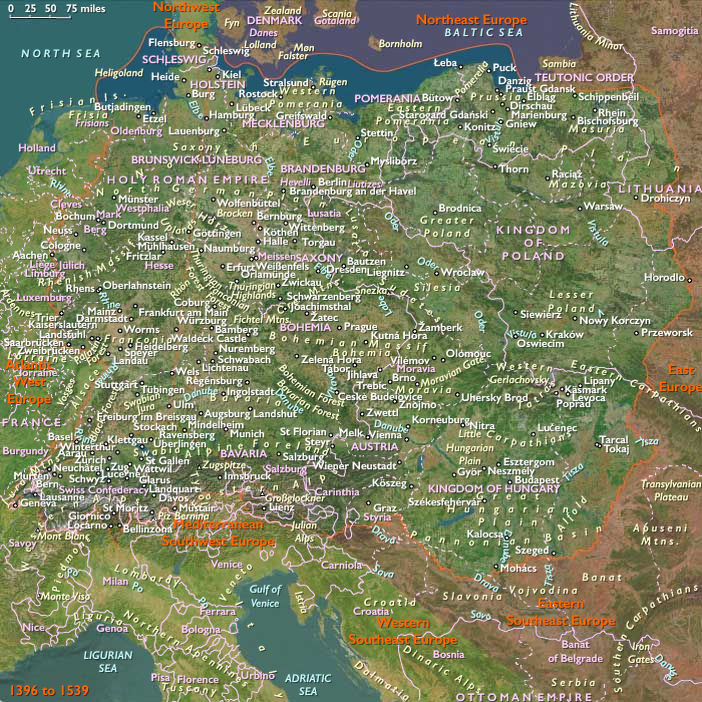
East Central Europe includes Poland, Czechia (Bohemia and Moravia), Slovakia, Hungary, northeastern Austria, and the greater part of Germany (including Berlin, Munich, Hamburg).
-
Strategic river axes: Vistula–Oder–Elbe, Danube–Morava, and Upper Dnieper–Vistula corridors.
-
Resource belts: silver (Kutná Hora), salt (Wieliczka–Bochnia), gold (Kremnica), dense forests and fertile loess soils.
Climate and Environmental Shifts
-
Late Medieval Warm Period tails into the early Little Ice Age after c. 1300: slightly cooler, more variable precipitation.
-
Harvest volatility increased in marginal zones, but river-valley and loess basins sustained surpluses; plague years (1348–1352) punctuated demographic growth.
Societies and Political Developments
-
Bohemia & Moravia (Přemyslid → Luxembourg):
-
Ottokar II (r. 1253–1278) expanded into Austria–Styria before defeat at Marchfeld (1278).
-
From 1310, the Luxembourgs (John, then Charles IV, r. 1346–1378) made Prague an imperial capital: Golden Bull (1356), Charles University (1348), reforms, and urban patronage; Wenceslaus IV (1378–1419) faced magnate unrest.
-
-
Hungary & Slovakia (Árpád → Angevin → Luxembourg):
-
After the Árpád extinction (1301), Charles I (Angevin) (1308–1342) restored royal power; Louis I “the Great” (1342–1382) expanded influence (including personal union with Poland 1370–1382).
-
Mining–monetary reforms (gold florins, Kremnica mint); after 1387 Sigismund of Luxembourg took the crown. Slovakia (Upper Hungary) was the mining and urban core.
-
-
Poland (fragmentation → reunification → union):
-
Władysław I Łokietek crowned (1320) reunified the kingdom; Casimir III “the Great” (1333–1370) reformed law, founded Kraków University (1364), and took Red Ruthenia (1340s); after 1370, union with Hungary under Louis I.
-
Union of Krewo (1385): Jogaila marries Jadwiga, becomes Władysław II Jagiełło (1386), inaugurating the Polish–Lithuanian polity.
-
-
Northeastern Austria (Habsburgs):
-
After 1278 the Habsburgs consolidated Austria–Styria; Vienna grew as a Danube market and (from 1365) university town.
-
-
Germany (eastern zones: Brandenburg, Saxony, Bavaria):
-
Electoral order fixed by Golden Bull (1356) (King of Bohemia, Margrave of Brandenburg, Duke of Saxony among electors).
-
Brandenburg passed from Ascanian to Wittelsbach to Luxembourg control (1373); Munich anchored Upper Bavaria; Berlin–Cölln rose on Spree–Havel trade.
-
-
Order states on the Baltic rim (context to Poland/Lithuania):
-
The Teutonic Order state in Prussia and Livonia pressed the Vistula–Neman frontier, shaping Polish–Lithuanian strategy (the great reckoning at Grunwald lies just beyond 1395).
-
Economy and Trade
-
Mining & mints:
-
Kutná Hora silver funded Luxembourg grandeur (Prague groschen).
-
Kremnica gold struck florins for Hungary; salt from Wieliczka–Bochnia underpinned Polish revenue.
-
-
Agriculture & towns: three-field rotations spread; German-law towns (Ostsiedlung legacy) structured markets from Silesia to Little Poland and Upper Hungary.
-
Trade corridors:
-
Danube–Morava–Vienna funneled Adriatic and Alpine goods into the plain.
-
Vistula–Baltic carried Polish grain, timber, and salt to Gdańsk, linking into Hanseatic circuits.
-
Elbe–Oder routes tied Bohemia/Silesia to Saxon–Brandenburg markets.
-
-
Hanseatic connections: eastern German and Polish ports traded cloth, beer, wax, and furs; inland towns brokered metals and salt.
Subsistence and Technology
-
Hydraulic & agrarian tools: heavy ploughs on loess, watermills on rivers, drainage and vineyard terraces in Bohemia and along the Danube.
-
Urban craft clusters: Prague metalwork and glass; Kraków cloth and salt; Upper Hungary mining technologies (adits, water-powered pumps).
-
Fortifications & courts: stone kremlins, castles, and walled towns; law codes (Magdeburg/Lübeck law, Casimir’s statutes) standardized justice and commerce.
Movement and Interaction Corridors
-
Danube trunk: Vienna ⇄ Bratislava (Pressburg) ⇄ Esztergom/Buda integrated Habsburg and Hungarian nodes.
-
Vistula spine: Kraków ⇄ Toruń/Gdańsk linked the Polish heartland to the Baltic.
-
Elbe–Oder passes: Bohemia ⇄ Saxony/Brandenburg; Moravian Gate tied the Danube to the Vistula–Oder basins.
-
Carpathian routes: salt, wine, and livestock over Transcarpathian passes into Poland and Hungary.
Belief and Symbolism
-
Latin Christianity: cathedral and monastic expansion (Prague, Kraków, Vienna); mendicant orders in towns; scholastic culture around the new universities.
-
Orthodoxy & Unions: Ruthenian borderlands under Lithuania remained Orthodox; Latin-rite Poland extended bishoprics into Red Ruthenia.
-
Popular piety: pilgrimage, confraternities, and plague-era devotions; Jewish communities vital to urban finance faced periodic persecution during the Black Death years.
-
Crown ideology: imperial Prague under Charles IV; Angevin regalia and chivalric display in Hungary; Jagiellonian union rhetoric in Poland–Lithuania.
Adaptation and Resilience
-
Institutional depth: estates and diets (Bohemian land diets, Polish sejmik beginnings, Hungarian diets) mediated taxation and war.
-
Demographic shocks: Black Death mortality (from 1348) hit towns hardest; frontier colonization and mining towns helped recovery.
-
Route redundancy: Danube, Vistula, and Baltic carried trade when war blocked overland links; Hanseatic convoys stabilized supply.
-
Dynastic flexibility: Luxembourg, Habsburg, Angevin, and Jagiellonian strategies (marriage, enfeoffment, union) minimized fragmentation costs.
Long-Term Significance
By 1395, East Central Europe had become a constellation of powerful crowns and rising unions:
-
Prague led an imperial–university renaissance;
-
Hungary monetized mining and projected power into the Balkans;
-
Poland–Lithuania formed a durable union that would reshape the northeast;
-
Habsburg Austria entrenched along the Danube.
Shared corridors of metals, salt, grain, and ideas forged an integrated region poised for 15th-century conflicts and cultural efflorescence—from Hussite revolutions to Jagiellonian and Habsburg ascendancy.
Charles makes Prague into an imperial city.
Extensive building projects undertaken by the king include the founding of the New Town southeast of the old city.
The royal castle, Hradcany, is rebuilt.
Of particular significance is the founding of Charles University in Prague in 1348.
Charles's intention is to make Prague into an international center of learning, and the university is divided into Czech, Polish, Saxon, and Bavarian "nations," each with one controlling vote.
Charles University, however, will become the nucleus of intense Czech particularism.
Charles dies in 1378, and the Bohemian crown goes to his son, Wenceslas IV.
Prague, under Charles I (IV, as German emperor), has become the cultural center of central Europe.
Bohemia’s ruling Luxembourg dynasty invites large numbers of Germans to settle in the mid-fourteenth century in the border districts of Bohemia, Moravia, and those parts of Silesia located within the kingdom, in particular in its cities and in the mountainous borderland areas later called by Germans the Sudetenland.
(The name is derived from that of the Sudetes mountains, which run along the northern Czech border as far as Silesia and contemporary Poland, although it encompasses areas well beyond those mountains.
The word Sudetenland will only came into existence in the early twentieth century, and will only come to prominence after the First World War, when the German-dominated Austria-Hungary is dismembered and the Sudeten Germans find themselves living in the new country of Czechoslovakia.)
The Bohemian Reformation (also known as the Czech Reformation), preceding the Protestant Reformation of the sixteenth century, is a Christian movement in the late medieval and early modern Kingdom and Crown of Bohemia (present-day Czech Republic) striving for a reform of the Roman Catholic Church.
Lasting for more than two hundred years, it will have a significant impact on the historical development of Central Europe.
Rudolf concludes another contract of inheritance with his father-in-law Emperor Charles IV in 1364, providing for mutual inheritance between the Habsburg and Luxembourg dynasties.
East Central Europe (1372–1383 CE): Dynastic Unions, Bohemian Prestige, Hungarian-Polish Union, and Imperial Fragmentation
Between 1372 and 1383 CE, East Central Europe experienced significant dynastic transformations, highlighted by the personal union of Hungary and Poland under Louis I, continued Bohemian prestige under Emperor Charles IV, and deepening rivalries among the Habsburg, Luxembourg, and Wittelsbach dynasties. Imperial fragmentation intensified as regional states and cities pursued greater autonomy, reshaping political alignments. Meanwhile, cultural and economic life flourished, driven by urban growth and expanded trade networks connecting the Hanseatic cities of the Baltic to wider European markets.
Political and Military Developments
Hungarian-Polish Personal Union under Louis I
-
In 1370, following the death of Poland’s Casimir III, Louis I of Hungary assumed the Polish throne, establishing a dynastic union between Hungary and Poland. Although his rule over Poland proved complicated by powerful local nobility and differing political traditions, this union substantially altered regional geopolitical dynamics.
-
Louis’s administrative reforms strengthened centralized monarchy in Hungary, reinforcing its position as a major European power.
Bohemian Prestige under Charles IV
-
Emperor Charles IV of Luxembourg (r. Holy Roman Emperor 1355–1378; King of Bohemia 1346–1378) maintained Bohemia’s cultural and political prestige within Europe. Under his patronage, Prague flourished as an imperial capital, cultural center, and diplomatic hub.
-
The end of Charles’s reign (1378) introduced new uncertainties, setting the stage for future conflicts, notably between his sons, Wenceslaus IV and Sigismund.
Intensified Imperial Rivalries and Fragmentation
-
Imperial rivalries among the dynasties of the Holy Roman Empire intensified, particularly between the Luxembourgs in Bohemia, the Habsburgs in Austria, and the Wittelsbachs in Bavaria. Fragmentation and competition among these dynasties reshaped alliances and destabilized regional politics.
-
In Austria, Habsburg territories saw increased internal consolidation, setting the foundation for future Austrian prominence.
Brandenburg, Mecklenburg, and Northern Principalities
-
The Margraviate of Brandenburg, ruled by the House of Luxembourg after 1373, experienced strategic territorial consolidations and administrative reforms.
-
Northern principalities, such as the Duchy of Mecklenburg and the Principality of Brunswick-Wolfenbüttel, retained political stability, experiencing moderate growth and greater economic integration within the Hanseatic trade networks.
Thuringian Succession and Territorial Stability
-
The aftermath of the earlier War of the Thuringian Succession stabilized the political landscape in central Germany, allowing the Duchy of Thuringia to recover economically and politically, while still influencing regional politics within the empire.
Economic and Technological Developments
Expansion of Hanseatic Commerce
-
Economic growth intensified across the Baltic and North Sea regions, driven by the robust trade activities of Hanseatic cities such as Lübeck, Gdańsk, Wrocław, Toruń, and Kraków. This growth supported urban prosperity and reinforced economic links throughout northern and central Europe.
Urban Infrastructure and Technological Improvements
-
Continued urbanization and infrastructure improvements supported trade and economic development, with notable expansions in Prague, Vienna, Kraków, Bratislava, and Wrocław.
-
Technological innovations, especially in textile production, metalworking, and agriculture, further stimulated regional economies, supporting recovery from earlier demographic crises.
Cultural and Artistic Developments
Prague’s Continued Cultural Prominence
-
Under Charles IV’s late reign, Prague solidified its position as a major cultural and intellectual center, characterized by significant Gothic architectural projects and flourishing literary and artistic production.
-
After Charles IV’s death (1378), Prague’s cultural vitality continued, although political uncertainties introduced greater instability.
Polish and Hungarian Artistic Flourishing
-
Polish territories under the brief Hungarian union experienced notable artistic and architectural developments, evident in the expansion of royal and ecclesiastical structures, illuminated manuscripts, and Gothic architectural projects in Kraków and Gniezno.
-
Hungarian territories under Louis I saw continued cultural patronage, particularly through church-building, castle construction, and artistic commissions in Buda and Visegrád.
Ecclesiastical Influence and Patronage
-
Ecclesiastical institutions such as the Archbishopric of Salzburg and prominent bishoprics like Passau, Regensburg, and Bamberg remained significant cultural patrons, supporting extensive artistic and scholarly activities.
Settlement and Urban Development
Increased Urbanization and Economic Stability
-
Urban centers, notably Prague, Vienna, Kraków, Lübeck, Toruń, Bratislava, and Gdańsk, grew significantly, supported by increased trade, improved infrastructure, and strengthened fortifications. These developments promoted regional economic stability and resilience.
Continued Germanic Migration (Ostsiedlung)
-
Germanic settlement continued reshaping regional demographics, especially in Brandenburg, Silesia, Lusatia, and Mecklenburg, further influencing cultural integration, urban development, and economic productivity.
Social and Religious Developments
Aristocratic Power and Feudal Stability
-
Aristocratic and noble power structures remained robust, adapting to demographic and economic shifts. Feudal arrangements continued evolving, stabilizing regional governance despite broader imperial fragmentation and dynastic tensions.
Ecclesiastical Authority and Religious Culture
-
Powerful ecclesiastical institutions maintained substantial social, economic, and cultural influence, fostering religious education, charity, artistic production, and reinforcing societal cohesion during periods of dynastic and political uncertainty.
Long-Term Consequences and Historical Significance
The era 1372–1383 CE was marked by significant dynastic unions and shifts in East Central Europe. The Hungarian-Polish personal union under Louis I profoundly reshaped regional political alliances and governance structures. The enduring cultural prestige of Bohemia under Charles IV underscored Prague’s continued importance in Central Europe. Simultaneously, intensified imperial rivalries among the Habsburg, Luxembourg, and Wittelsbach dynasties contributed to regional fragmentation and set the stage for prolonged dynastic conflicts. Economic prosperity and cultural vitality fostered resilience, enabling urban and rural societies to stabilize and flourish. Collectively, these developments significantly influenced East Central Europe’s subsequent historical trajectory, defining political alignments and cultural identities for centuries to come.
East Central Europe (1372–1383 CE): Dynastic Unions, Bohemian Prestige, Hungarian-Polish Union, and Imperial Fragmentation
Between 1372 and 1383 CE, East Central Europe experienced significant dynastic transformations, highlighted by the personal union of Hungary and Poland under Louis I, continued Bohemian prestige under Emperor Charles IV, and deepening rivalries among the Habsburg, Luxembourg, and Wittelsbach dynasties. Imperial fragmentation intensified as regional states and cities pursued greater autonomy, reshaping political alignments. Meanwhile, cultural and economic life flourished, driven by urban growth and expanded trade networks connecting the Hanseatic cities of the Baltic to wider European markets.
Political and Military Developments
Hungarian-Polish Personal Union under Louis I
-
In 1370, following the death of Poland’s Casimir III, Louis I of Hungary assumed the Polish throne, establishing a dynastic union between Hungary and Poland. Although his rule over Poland proved complicated by powerful local nobility and differing political traditions, this union substantially altered regional geopolitical dynamics.
-
Louis’s administrative reforms strengthened centralized monarchy in Hungary, reinforcing its position as a major European power.
Bohemian Prestige under Charles IV
-
Emperor Charles IV of Luxembourg (r. Holy Roman Emperor 1355–1378; King of Bohemia 1346–1378) maintained Bohemia’s cultural and political prestige within Europe. Under his patronage, Prague flourished as an imperial capital, cultural center, and diplomatic hub.
-
The end of Charles’s reign (1378) introduced new uncertainties, setting the stage for future conflicts, notably between his sons, Wenceslaus IV and Sigismund.
Intensified Imperial Rivalries and Fragmentation
-
Imperial rivalries among the dynasties of the Holy Roman Empire intensified, particularly between the Luxembourgs in Bohemia, the Habsburgs in Austria, and the Wittelsbachs in Bavaria. Fragmentation and competition among these dynasties reshaped alliances and destabilized regional politics.
-
In Austria, Habsburg territories saw increased internal consolidation, setting the foundation for future Austrian prominence.
Brandenburg, Mecklenburg, and Northern Principalities
-
The Margraviate of Brandenburg, ruled by the House of Luxembourg after 1373, experienced strategic territorial consolidations and administrative reforms.
-
Northern principalities, such as the Duchy of Mecklenburg and the Principality of Brunswick-Wolfenbüttel, retained political stability, experiencing moderate growth and greater economic integration within the Hanseatic trade networks.
Thuringian Succession and Territorial Stability
-
The aftermath of the earlier War of the Thuringian Succession stabilized the political landscape in central Germany, allowing the Duchy of Thuringia to recover economically and politically, while still influencing regional politics within the empire.
Economic and Technological Developments
Expansion of Hanseatic Commerce
-
Economic growth intensified across the Baltic and North Sea regions, driven by the robust trade activities of Hanseatic cities such as Lübeck, Gdańsk, Wrocław, Toruń, and Kraków. This growth supported urban prosperity and reinforced economic links throughout northern and central Europe.
Urban Infrastructure and Technological Improvements
-
Continued urbanization and infrastructure improvements supported trade and economic development, with notable expansions in Prague, Vienna, Kraków, Bratislava, and Wrocław.
-
Technological innovations, especially in textile production, metalworking, and agriculture, further stimulated regional economies, supporting recovery from earlier demographic crises.
Cultural and Artistic Developments
Prague’s Continued Cultural Prominence
-
Under Charles IV’s late reign, Prague solidified its position as a major cultural and intellectual center, characterized by significant Gothic architectural projects and flourishing literary and artistic production.
-
After Charles IV’s death (1378), Prague’s cultural vitality continued, although political uncertainties introduced greater instability.
Polish and Hungarian Artistic Flourishing
-
Polish territories under the brief Hungarian union experienced notable artistic and architectural developments, evident in the expansion of royal and ecclesiastical structures, illuminated manuscripts, and Gothic architectural projects in Kraków and Gniezno.
-
Hungarian territories under Louis I saw continued cultural patronage, particularly through church-building, castle construction, and artistic commissions in Buda and Visegrád.
Ecclesiastical Influence and Patronage
-
Ecclesiastical institutions such as the Archbishopric of Salzburg and prominent bishoprics like Passau, Regensburg, and Bamberg remained significant cultural patrons, supporting extensive artistic and scholarly activities.
Settlement and Urban Development
Increased Urbanization and Economic Stability
-
Urban centers, notably Prague, Vienna, Kraków, Lübeck, Toruń, Bratislava, and Gdańsk, grew significantly, supported by increased trade, improved infrastructure, and strengthened fortifications. These developments promoted regional economic stability and resilience.
Continued Germanic Migration (Ostsiedlung)
-
Germanic settlement continued reshaping regional demographics, especially in Brandenburg, Silesia, Lusatia, and Mecklenburg, further influencing cultural integration, urban development, and economic productivity.
Social and Religious Developments
Aristocratic Power and Feudal Stability
-
Aristocratic and noble power structures remained robust, adapting to demographic and economic shifts. Feudal arrangements continued evolving, stabilizing regional governance despite broader imperial fragmentation and dynastic tensions.
Ecclesiastical Authority and Religious Culture
-
Powerful ecclesiastical institutions maintained substantial social, economic, and cultural influence, fostering religious education, charity, artistic production, and reinforcing societal cohesion during periods of dynastic and political uncertainty.
Long-Term Consequences and Historical Significance
The era 1372–1383 CE was marked by significant dynastic unions and shifts in East Central Europe. The Hungarian-Polish personal union under Louis I profoundly reshaped regional political alliances and governance structures. The enduring cultural prestige of Bohemia under Charles IV underscored Prague’s continued importance in Central Europe. Simultaneously, intensified imperial rivalries among the Habsburg, Luxembourg, and Wittelsbach dynasties contributed to regional fragmentation and set the stage for prolonged dynastic conflicts. Economic prosperity and cultural vitality fostered resilience, enabling urban and rural societies to stabilize and flourish. Collectively, these developments significantly influenced East Central Europe’s subsequent historical trajectory, defining political alignments and cultural identities for centuries to come.
Holy Roman Emperor Charles IV dies in Prague on November 29, 1378, having procured the election of his own son Vaclav, or Wenceslas, to succeed him—the first imperial father-son succession since the Hohenstaufen period.
Vaclav/Wenceslas, although possessed of some ability, also has grave defects, particularly a weakness for alcohol.
The empire faces serious problems, such as the independence of the towns and the depredations of the petty nobility, but Wenceslas will become distracted by controversies provoked by his brothers Sigismund/Zsigmond of Luxembourg and John of Gorlitz and his cousin Jobst of Moravia, as well as by the papal schism that began earlier in this year.
The marriage of Anne of Bohemia, daughter of Charles IV, Holy Roman Emperor and Elizabeth of Pomerania, to Richard II of England, is a result of the Great Schism in the Papacy that has left Western Christendom with two rival popes.
Pope Urban VI according to Eduard Perroy actually sanctioned the marriage between Richard and Anne, in an attempt to create an alliance on his behalf, particularly so that he might be stronger against the French and their preferred pope, Clement Anne's father was the most powerful monarch in Europe at the time, ruling over about half of Europe's population and territory.
The marriage is against the wishes of many members of his nobility and members of parliament, and occurred primarily at the instigation of Richard's intimate, Michael de la Pole.
Although Richard had been offered Caterina Visconti, one of the daughters of Bernabò Visconti of Milan, who would have brought a great deal of money with her as dowry, Anne had been chosen—bringing no direct financial benefits to England.
She brings with her no dowry, and in return for her hand in marriage, Richard has given twenty thousand florins (around four million pounds in today's value) in payment to her brother Wenceslas.
There are also only a few diplomatic benefits—although English merchants are now allowed to trade freely within both Bohemian lands, and lands of the Holy Roman Empire, this is not much when compared to the usual diplomatic benefits from marriages made as a result of the war with France.
It is therefore no surprise that the marriage is unpopular.
Anne on her arrival in December 1381 had been severely criticized by contemporary chroniclers, probably as a result of the financial arrangements of the marriage, although it is quite typical for queens to be viewed in critical terms.
The Westminster Chronicler calls her "a tiny scrap of humanity", and Thomas Walsingham related a disastrous omen upon her arrival, where her ships smashed to pieces as soon as she had disembarked.
Nevertheless, Anne and King Richard II are married on January 20, 1382, in Westminster Abbey.
Tournaments are held for several days after the ceremony, in celebration.
They now go on an itinerary of the realm, staying at many major abbeys along the way.
Anne's wedding to Richard II is the fifth royal wedding in Westminster Abbey and will not be followed by any other royal wedding in Westminster Abbey for another five hundred and thirty-seven years.
Charles III, King of Naples, obtains the Hungarian crown in 1385 as Charles II, but is assassinated on February 17, 1386.
He is succeeded in Naples by his son Ladislas and in Hungary by Sigismund, the younger son of the late Holy Roman emperor Charles IV and brother of Emperor Wenceslas.