Wamba
Visigothic king
Years: 640 - 687
Wamba (died 687) is the Visigothic king of Hispania and Septimania from 672 to 680.
Related Events
Filter results
Showing 8 events out of 8 total
Atlantic Southwest Europe (532–675 CE): Religious Realignment and Visigothic Integration
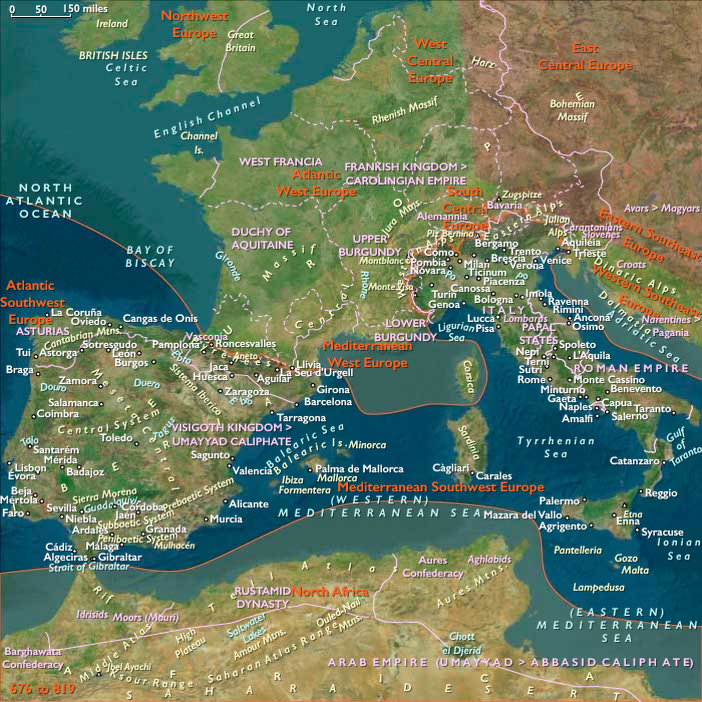
Between 532 and 675 CE, Atlantic Southwest Europe—covering Galicia, northern and central Portugal, Asturias, Cantabria, and northern Spain south of the Franco-Spanish border (43.05548° N, 1.22924° W)—experienced profound religious and political realignments. This age witnessed the definitive transition from Suebic autonomy to Visigothic rule, characterized by gradual centralization from Toledo, intensified ecclesiastical authority, cultural syncretism, and sustained regional autonomy.
Political and Military Developments
Late Suebic Autonomy and Early Chalcedonian Influence (532–567 CE)
Following the stable reign of King Theodemund (508–550 CE), the Suebic kingdom maintained its regional autonomy, cautiously balancing diplomatic relations with the powerful Visigothic kingdom to the south. In the mid-6th century, significant internal transformations began, notably with King Chararic’s legendary conversion (c. 550 CE) to Orthodox (Chalcedonian) Christianity, as reported by Gregory of Tours. This symbolic event initiated a pivotal religious shift away from the region’s earlier embrace of Arianism.
Under King Ariamir, this religious reorientation became formalized at the First Council of Braga in 561 CE, decisively establishing Chalcedonian Christianity in the kingdom. King Miro (570–583 CE) further solidified this alignment, convening the influential Second Council of Braga (572 CE), marking the complete institutionalization of Orthodox Christianity across the Suebic territories.
Visigothic Integration and Consolidation (568–603 CE)
Despite robust internal stability, the Suebic Kingdom’s independence diminished when Visigothic King Leovigild annexed the region by 585 CE, effectively integrating it into the expanding Visigothic realm. King Reccared (586–601 CE), who converted the Visigoths from Arianism to Chalcedonian Christianity at the Third Council of Toledo (589 CE), emphasized religious unity, recognizing the conversion of substantial Suebic populations in Galicia and northern Lusitania.
Centralization and Continued Regional Autonomy (604–675 CE)
Under Visigothic rulers Sisebut (612–621 CE), Suinthila (621–631 CE), Chindasuinth (642–653 CE), Recceswinth (653–672 CE), and Wamba (672–680 CE), royal authority centralized significantly. Visigothic kings implemented legal reforms, notably the Liber Iudiciorum of 654 CE, standardizing governance across Iberia. Yet Atlantic Southwest Europe retained substantial regional autonomy, with local aristocratic families and ecclesiastical leaders continuing to administer local affairs independently from Toledo.
Economic Developments
Continued Stability of Rural Economies
The regional economy remained resilient, anchored in rural villa-based estates producing grain, olives, vineyards, and livestock. Mining activities, especially gold and silver in Galicia and Asturias, persisted robustly, while regional artisanal production (pottery, textiles, metalwork) supported local economies.
Sustained Coastal Trade
Maritime settlements, particularly Bracara Augusta (Braga) and Olissipo (Lisbon), maintained stable commercial networks linking the region to the broader Atlantic and Mediterranean economies. These trading activities, while modest, were essential in preserving regional prosperity and external connections during an era of shifting political alignments.
Cultural and Religious Developments
Shift from Arianism to Orthodox Christianity
The religious landscape underwent profound transformation. After the early dominance of Arian Christianity under the Suebi, the region transitioned decisively toward Chalcedonian orthodoxy during the mid-to-late 6th century. This conversion process, although gradual and often complicated by contradictory historical accounts (involving kings Chararic, Ariamir, and Theodemar, and missionaries like Martin of Dumio), ultimately unified the Suebic and Visigothic populations under a shared orthodox religious identity.
Ecclesiastical Authority and Monastic Expansion
Bishoprics in Braga, Emerita Augusta, and Asturica Augusta significantly expanded their civic and religious influence, directing local governance, social policy, and education. Monastic communities grew markedly, emerging as influential centers of literacy, manuscript preservation, agricultural innovation, and social welfare, deeply embedding Chalcedonian Christianity into regional life.
Cultural Syncretism and Local Traditions
Despite ecclesiastical uniformity, rural and mountainous communities, especially in Galicia, Asturias, and northern Portugal, continued blending orthodox Christianity with indigenous Iberian and Celtic traditions. This cultural syncretism created distinctive regional identities, ensuring the persistence of local customs and practices.
Civic Identity and Local Governance
Preservation of Local Autonomy
Civic identity remained fundamentally local, strongly influenced by ecclesiastical structures and tribal traditions. Despite intensified Visigothic centralization, powerful local aristocratic families, tribal leaders, and bishops continued managing regional governance, preserving considerable autonomy and contributing to resilient community cohesion.
Notable Tribal Groups and Settlements
-
Suebi: Gradually integrated into the Visigothic kingdom, they nonetheless maintained influence through regional aristocracies, contributing significantly to the lasting cultural and political landscape of Galicia and northern Portugal.
-
Lusitanians and Vettones: Continued effective local governance, skillfully balancing autonomy and Visigothic integration.
-
Astures and Cantabri: Maintained robust indigenous governance structures and internal stability, largely insulating themselves from external interference.
-
Vascones: Continued political neutrality, territorial independence, and cultural distinctiveness, remaining insulated from wider Iberian political developments.
Long-Term Significance and Legacy
Between 532 and 675 CE, Atlantic Southwest Europe:
-
Fully integrated politically into Visigothic Iberia, laying the foundations for regional political structures that endured through the medieval period.
-
Experienced a decisive religious realignment, permanently shifting from Arian Christianity to orthodox Chalcedonian Christianity, deeply shaping cultural and religious identities.
-
Maintained resilient economic structures, local autonomy, and cultural distinctiveness, preserving foundational elements of regional identity into the early medieval period.
This era thus represented a pivotal historical phase, establishing enduring political, economic, and cultural characteristics that profoundly influenced the subsequent development of Atlantic Southwest Europe.
Atlantic Southwest Europe (664–675 CE): Height of Visigothic Unity, Ecclesiastical Influence, and Preserved Local Identity
Between 664 and 675 CE, Atlantic Southwest Europe—encompassing Galicia, northern and central Portugal, Asturias, Cantabria, and northern Spain south of the Franco-Spanish border (43.05548° N, 1.22924° W)—experienced the peak of Visigothic central authority under King Recceswinth (653–672 CE) and his successor, Wamba (672–680 CE). Despite stronger royal oversight, the region continued to enjoy stable local governance, resilient economic prosperity, and powerful ecclesiastical institutions, preserving its distinctive cultural identity.
Political and Military Developments
-
Under King Recceswinth, the unified legal code known as the Liber Iudiciorum (654 CE) profoundly shaped regional legal frameworks, promoting uniform administration across the Visigothic kingdom. His rule, lasting until 672 CE, emphasized centralized legal and administrative authority.
-
King Wamba (672–680 CE) maintained political continuity and further stabilized the kingdom, confronting sporadic regional rebellions elsewhere but leaving Atlantic Southwest Europe largely undisturbed, allowing continued local autonomy.
Economic and Social Developments
-
Economic continuity and stability persisted, sustained by established rural villa economies emphasizing agriculture (grain, vineyards, olives), mining operations (particularly gold and silver from Galicia and Asturias), livestock husbandry, and local artisanal manufacturing (pottery, textiles, metalwork).
-
Maritime commerce through coastal centers such as Bracara Augusta (Braga) and Olissipo (Lisbon) remained stable, linking the region to broader Mediterranean and Atlantic trade networks.
Cultural and Religious Developments
Heightened Ecclesiastical Authority
-
Ecclesiastical institutions reached new levels of influence, firmly embedded in daily governance, social welfare, and education. Influential bishoprics, notably Braga, Emerita Augusta, and Asturica Augusta, continued shaping local civic identity and authority.
-
Monastic communities expanded, playing vital roles in preserving literacy, manuscript production, agricultural innovation, and cultural continuity, significantly reinforcing regional ecclesiastical and cultural cohesion.
Continued Cultural Syncretism
-
Rural populations, especially in Galicia, Asturias, and northern Portugal, maintained their traditional blending of orthodox Christianity with indigenous Iberian and Celtic religious customs, solidifying distinct regional identities despite broader ecclesiastical uniformity.
Civic Identity and Local Governance
-
Local governance remained robustly decentralized, effectively managed by influential bishops, tribal leaders, and local aristocratic families. Despite strong royal centralization, significant regional autonomy persisted, strengthening local community identity and cohesion.
Notable Tribal Groups and Settlements
-
Galicians and Lusitanians: Maintained stable local governance and cultural traditions, skillfully balancing autonomy with loyalty to centralized Visigothic rule.
-
Astures and Cantabri: Preserved indigenous governance structures, cultural autonomy, and internal stability, continuing their tradition of minimal interference from external powers.
-
Vascones: Retained political neutrality, cultural distinctiveness, and territorial independence, continuing their longstanding insulation from Iberian political shifts.
Long-Term Significance and Legacy
Between 664 and 675 CE, Atlantic Southwest Europe:
-
Experienced the height of centralized Visigothic governance without losing significant regional autonomy or local governance structures.
-
Further entrenched powerful ecclesiastical and monastic institutions, deeply shaping the region’s medieval religious and cultural identity.
-
Preserved economic stability, resilient cultural distinctiveness, and robust decentralized governance, clearly defining its medieval social, political, and cultural character.
This era capped a decisive phase of regional stability and cultural continuity, positioning Atlantic Southwest Europe to effectively navigate the approaching turbulence and fragmentation of late Visigothic Iberia.
Recceswinth's successor Wamba ascends the Visigothic throne in throne in 672.
At the instigation of the Christian priests, he orders all the unconverted Jews to leave the kingdom.
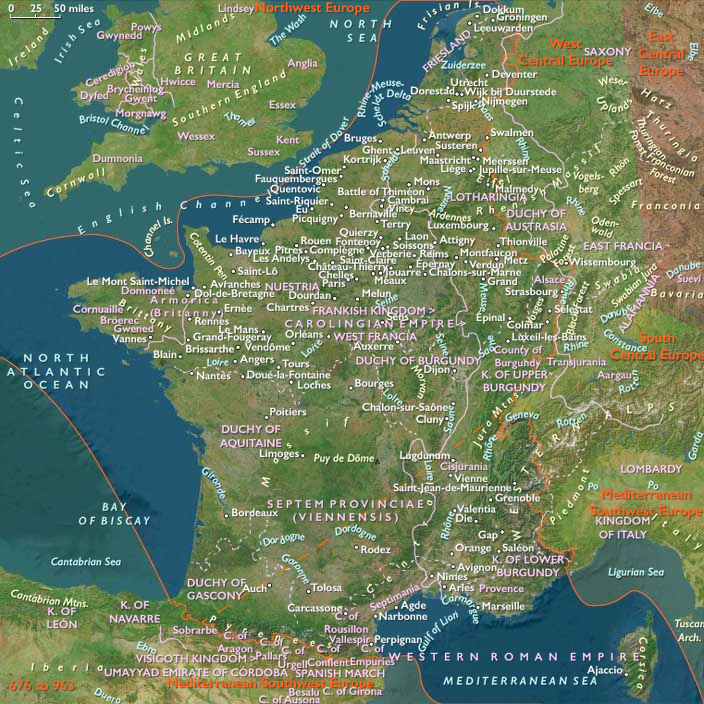
Hilderic, Governor of Nimes, revolts against Wamba, and many Jews join him.
One Duke Paul is sent from Toledo to put down the rebellion, but converts instead to Judaism.
The rebellion fails, however, and …
…the Jews of Narbonne are expelled.
Mediterranean Southwest Europe (676–687 CE): Visigothic Instability, Lombard Consolidation, and Ecclesiastical Influence
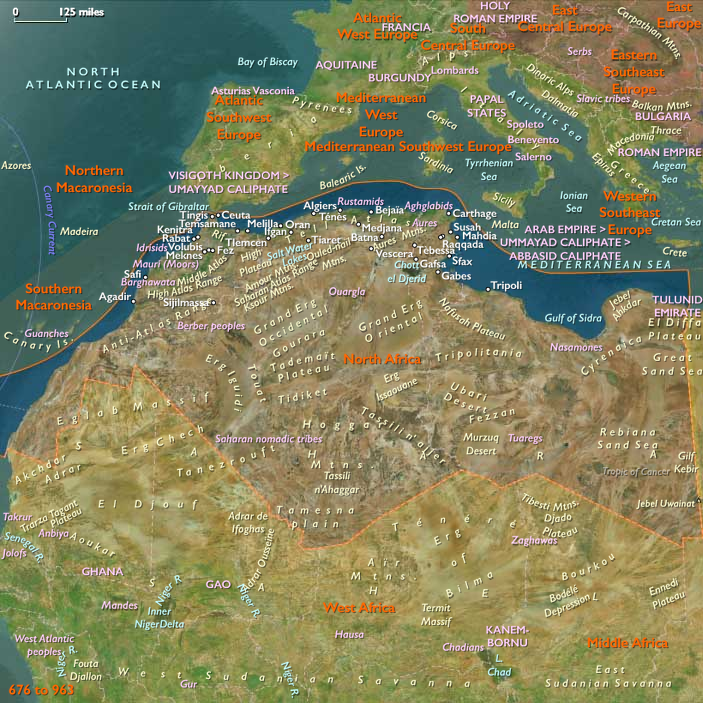
The era 676–687 CE in Mediterranean Southwest Europe is marked by increasing political instability within the Visigothic kingdom, ongoing Lombard territorial consolidation in Italy, and sustained ecclesiastical influence amid persistent regional fragmentation.
Visigothic Succession Crisis and Instability
In Iberia, the Visigothic kingdom remains politically volatile, beset by persistent royal succession disputes and internal rivalries. The death of King Wamba (r. 672–680 CE), who had temporarily stabilized the kingdom, leads to renewed turmoil. His successor, Erwig (r. 680–687 CE), ascends the throne under contested circumstances, intensifying factional tensions. Despite Erwig’s attempts to maintain unity through legislative measures and religious support, internal stability continues to deteriorate.
Lombard Territorial Consolidation
In Italy, the Lombard kingdom under King Perctarit (r. 671–688 CE) experiences a period of consolidation and relative peace, following decades of conflict. Perctarit stabilizes Lombard rule by reinforcing political authority from the capital at Pavia, while the independent Lombard duchies of Benevento and Spoleto continue to solidify their territorial autonomy in the south. This consolidation further entrenches the fragmented political landscape, limiting Byzantine control to coastal enclaves and strategic corridors.
Ecclesiastical Leadership and Cultural Continuity
Throughout this era, ecclesiastical institutions, particularly the papacy, maintain considerable authority and cultural influence. The Church continues to provide critical societal cohesion and continuity, navigating relationships with both Lombard rulers and Byzantine authorities. Papal diplomacy and missionary activities remain vital in reinforcing doctrinal orthodoxy and maintaining regional stability amidst ongoing political fragmentation.
Byzantine Constraints and External Pressures
Byzantine territories in Italy remain constrained by Lombard expansion, yet continue to resist further territorial erosion. The Exarchate of Ravenna, although politically weakened, maintains strategic significance, protecting critical Byzantine interests. Additionally, external pressures, notably emerging Islamic influence across the Mediterranean, begin to indirectly shape regional geopolitical dynamics, increasing the complexity of local politics.
Legacy of the Era
The era 676–687 CE reflects ongoing political volatility within Visigothic Iberia, juxtaposed with a period of relative stabilization in Lombard Italy. Ecclesiastical institutions continue to provide essential cohesion amid persistent fragmentation, significantly shaping the region's evolving historical trajectory into the medieval period.
Atlantic Southwest Europe (676–687 CE): Late Visigothic Stability and Growing Internal Tensions
In the era between 676 and 687 CE, Atlantic Southwest Europe initially enjoyed a brief period of stability under Visigothic rulers based in Toledo. However, beneath this stability, political fractures emerged, driven by succession conflicts, regional rivalries, and increasing tensions between the centralized royal court and local aristocratic powers.
Political and Military Developments
Centralized Authority under King Wamba and Successors
King Wamba (672–680 CE) maintained unified Visigothic authority and political coherence throughout the peninsula. His relatively successful rule preserved internal stability and sustained regional autonomy, especially in distant northwestern regions like Galicia, Asturias, and northern Lusitania. Following Wamba's forced abdication, his successor, King Erwig (680–687 CE), struggled to maintain the same degree of unity. His reign, though politically stable on the surface, masked growing factionalism among nobles, bishops, and regional leaders.
Increasing Aristocratic Autonomy
Local aristocratic families, particularly in Galicia, Asturias, and northern Portugal, solidified their independence from Toledo. The Visigothic kingdom's gradual decentralization allowed regional magnates to expand their local authority and governance structures, setting a foundation for independent political identities that would soon become significant.
Economic Developments
Continuation of Regional Economic Stability
Despite increasing political uncertainties, rural villa-based economies sustained stable production in agriculture (grains, olives, vineyards), livestock husbandry, mining (especially gold and silver in Galicia and Asturias), and artisanal crafts (textiles, pottery, metalwork). Local economies demonstrated resilience, largely insulated from distant political turbulence.
Stable Maritime Trade Networks
Coastal settlements, particularly Bracara Augusta (Braga) and Olissipo (Lisbon), maintained their modest but steady commercial links with broader Atlantic and Mediterranean markets. The continued strength of maritime trade provided essential economic stability despite internal Visigothic tensions.
Cultural and Religious Developments
Ecclesiastical Dominance and Monastic Influence
Ecclesiastical authorities in influential bishoprics—Braga, Emerita Augusta, and Asturica Augusta—remained powerful figures, shaping local governance, community life, and education. Monastic communities continued expanding their role, fostering manuscript production, agricultural innovation, social welfare, and education.
Sustained Cultural Syncretism
The blending of orthodox Christianity with indigenous Iberian and Celtic practices continued unabated, particularly in rural and mountainous areas such as Galicia, Asturias, and northern Portugal. These enduring traditions contributed significantly to the region’s cultural distinctiveness.
Civic Identity and Governance
Persistent Decentralized Governance
Civic identities remained deeply local, governed by powerful regional aristocrats, tribal leaders, and influential bishops. Despite nominally acknowledging Visigothic authority from Toledo, these local leaders effectively governed their territories independently, strengthening regional autonomy and identity.
Notable Tribal Groups and Settlements
-
Galicians and Lusitanians: Continued effectively governing their territories, skillfully balancing local interests with the weakening centralized Visigothic power.
-
Astures and Cantabri: Maintained strong indigenous governance structures and local autonomy, with minimal external interference.
-
Vascones: Persisted in political neutrality and territorial independence, continuing their longstanding cultural and political isolation.
Long-Term Significance and Legacy
Between 676 and 687 CE, Atlantic Southwest Europe:
-
Experienced the final years of relatively unified Visigothic governance, marked increasingly by internal tensions and regional fragmentation.
-
Preserved regional autonomy and local governance structures, positioning itself effectively for future transformations.
-
Reinforced ecclesiastical institutions and cultural syncretism, creating resilient regional identities that would endure beyond Visigothic decline.
This era thus marked a crucial transitional phase, setting the stage for subsequent political fragmentation, Islamic incursions, and the emergence of independent Christian kingdoms that characterized the following age.
A critical time in the history of Visigothic Spain begins toward the end of the seventh century.
A sign of future troubles is the deposition, through deception, of King Wamba, a capable ruler who has tried to reform the military organization.
As agitation continues, his successors make scapegoats of the Jews, compelling them to accept the Christian religion and threatening them with slavery.
Erwig, or Euric, II, who had succeeded Wamba in 680, had begun his reign by enacting twenty-eight anti-Jewish laws, decreeing that all converts must be registered by a parish priest, through whom all travel permits must be obtained.
He had also ruled that all holidays, Christian and Jewish, must be spent in the presence of a priest to ensure piety and to prevent “backsliding”.
The church councils of Toledo have become the main force in the government, and the royal power has been accordingly weakened.
The twelfth Council of Toledo in 681 had burned the Talmud and other Jewish writings.
Erwig presses in 682 for the “utter extirpation of the pest of the Jews” and makes it illegal to practice any Jewish rites.