Hermanfrid, King of the Thuringians, had married Amalaberga, daughter of Amalafrida who was the daughter of Theodemir, king of the Ostrogoths, between 507 and 511.
Amalberga is also the niece of Theodoric the Great, who, up to his death in 526, had been king of the Ostrogoths), ruler of Italy, and regent of the Visigoths.
It is unclear when Hermanfrid became king, but he is called king (rex thoringorum) in a letter by Theodoric dated to 507.
He had first shared the rule with his brothers Baderic and Bertachar, but later killed Bertachar in a battle in 529, leaving the young Radegund an orphan.
According to Gregory of Tours, Amalaberga now stirred up Hermanfrid against his remaining brother.
Once she laid out only half the table for a meal, and when questioned about the reason, she told him "A king who owns only of half of his kingdom deserved to have half of his table bare."
Thus roused, Hermanfrid made a pact with the king of Metz, Theuderic I, to march against Baderic.
Baderic was overcome by the Franks and beheaded, but Hermanfrid refused to fulfill his obligations to Theuderic, which led to enmity between the two kings.
In 531 or 532, Theuderic, his son Theudebert I, and his brother King Clotaire I of Soissons attack the Thuringii.
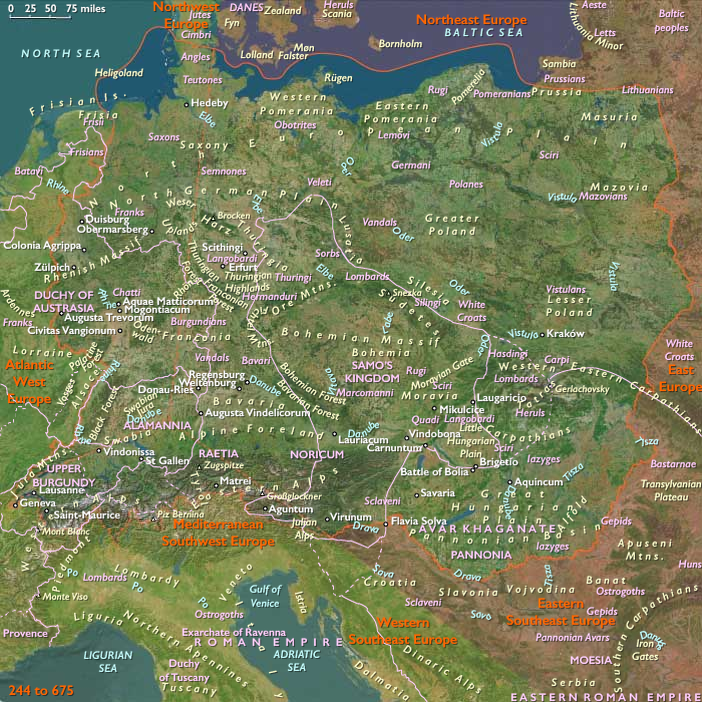
The Franks win a battle near the river Unstrut and take the royal seat at Scithingi (modern Burgscheidungen).
Hermanfrid manages to flee, but the Franks capture his niece Radegund and his nephews.
Theuderic gives Hermanfrid safe conduct, orders him to come to Zülpich, and gives him many gifts.
The Thuringian kingdom will end with Hermanfrid.
The area east of the Saale river will be taken over by Slavic tribes, north Thuringia by the Saxons.
The Thuringian territory is reduced to the Harz mountains and Thuringian Forest region and is to be governed by Frankish dukes.
The Thuringians seem to have retained their system of kingship, however.