Valdemar IV of Denmark
King of Denmark
Years: 1320 - 1375
Valdemar IV Atterdag (the epithet meaning "A New Dawn") or Waldemar (c. 1320 – October 24, 1375) is King of Denmark from 1340 to 1375.
Related Events
Filter results
Showing 10 events out of 23 total
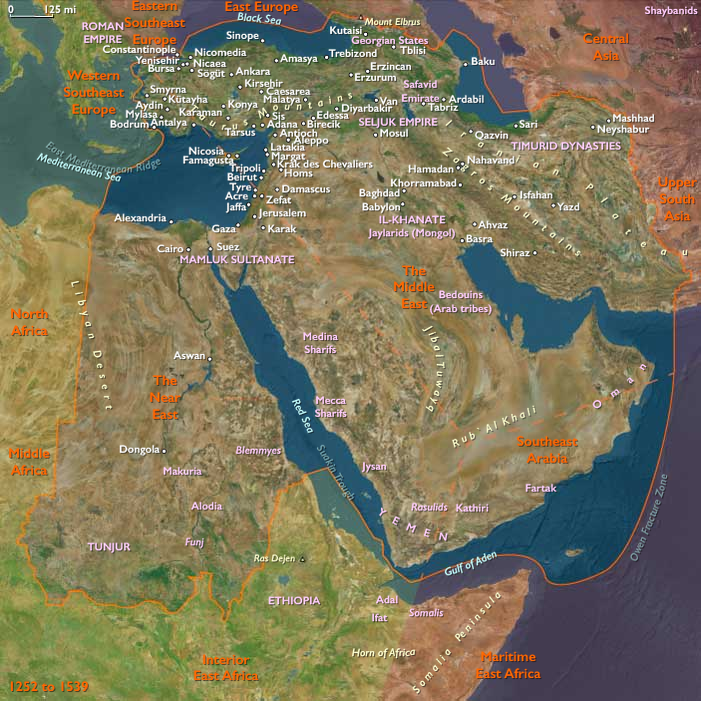
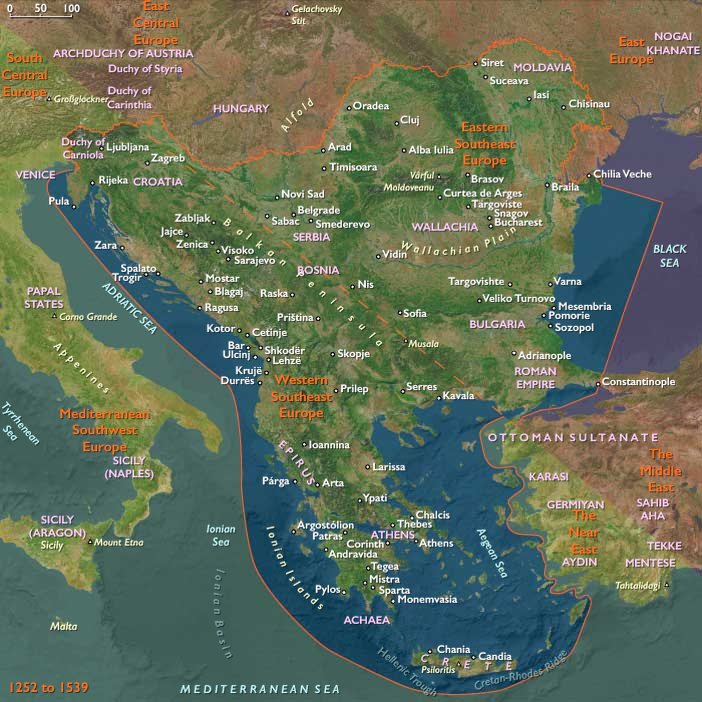
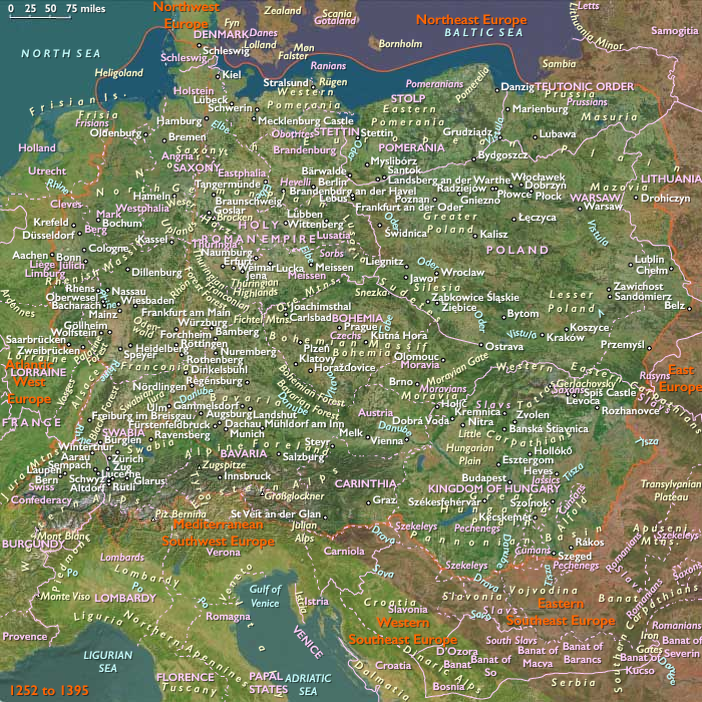
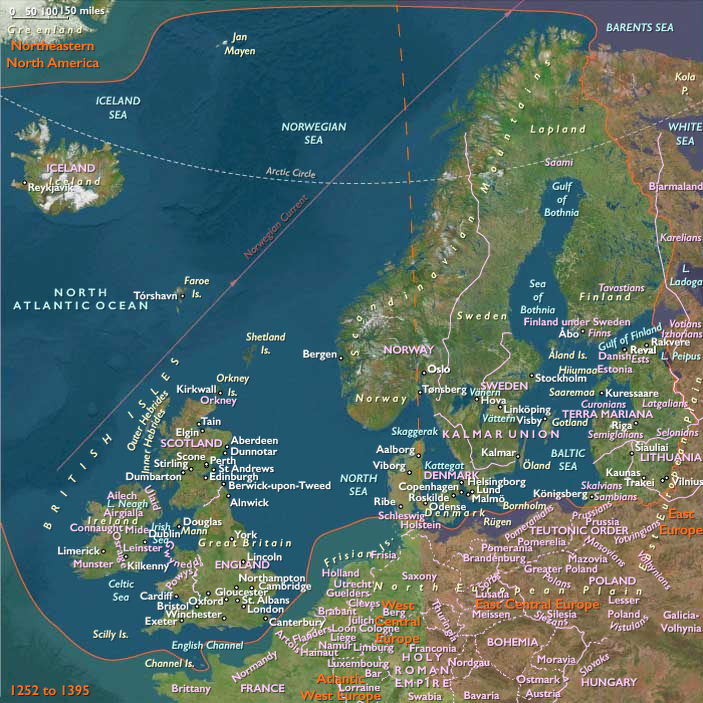
North Europe (1252–1395 CE): Hanseatic Gateways and North Sea Kingdoms
From the ice-bright fjords of Norway to the forested lakes of Finland, from the North Sea harbors of England and Flanders to the timbered ports of Riga and Reval, North Europe in the Lower Late Medieval Age formed a wide arc of coasts and islands bound by ships, winds, and trade. Here, between the Atlantic and the Baltic, urban leagues rose from the cold seas, monarchies forged fragile unions, and frontier societies balanced fishing, farming, and fur in the early chill of the Little Ice Age.
The century after 1250 opened with northern expansion and ended with consolidation. The Baltic world—a mosaic of Scandinavians, Germans, Finnic and Slavic peoples—became Europe’s northern frontier of Christianization, commerce, and state-building. Sweden, extending its reach eastward through the crusades of the mid-13th century, established control over Finland, fortifying Turku and Viipur and planting Latin Christianity along the Gulf of Bothnia. The monarchy strengthened under Magnus Ladulås (r. 1275–1290) but waned amid noble regencies in the 14th century, setting the stage for the Kalmar Union—the later federation of Sweden, Denmark, and Norway that would dominate the north.
Denmark, seated astride the Øresund, rebuilt its Baltic power under Valdemar IV Atterdag (r. 1340–1375). Control of the herring fisheries of Scania and the Sound tolls enriched the crown and the cities of Copenhagen, Malmö, and Helsingør. Across the sea, Norway governed a vast but thinly peopled realm of coasts and islands. The Black Death(1349–1350) cut its population by more than half, reducing royal revenues and leaving the country increasingly dependent on Danish and German merchants. Bergen, however, flourished as a hub of the stockfish trade, exporting dried cod to Lübeck, London, and Bruges, and connecting the Arctic fisheries to the Hanseatic world.
At the same time, Iceland, though under Norwegian rule since 1262, maintained its Althing and sagaliterary traditions, while the Faroe, Shetland, and Orkney islands slipped gradually from Norwegian into Scottish influence. The North Atlantic economy survived on wool, fish, and the resilience of small coastal communities accustomed to harsh climate and long isolation.
Along the southern Baltic, German and Scandinavian merchants transformed the sea into a common highway of trade. The Hanseatic League, led by Lübeck, united more than a hundred cities in a federation of markets and maritime law. Its cogs sailed from Bremen and Hamburg eastward to Visby on Gotland, Riga, Reval (Tallinn), and Novgorod, carrying salt, grain, and cloth north, and returning with timber, furs, tar, and iron. The Livonian Order, a crusading branch of the Teutonic Knights, ruled Estonia and Latvia, founding cathedral towns and fortresses while exacting tribute from the Baltic peoples.
Farther inland, Lithuania expanded westward and southward into Ruthenia, while its Baltic coast remained contested with the Teutonic Knights. The Christianization of Lithuania (1387) and the Union of Krewo (1385) bound it to Poland, drawing the last pagan kingdom of Europe into Latin Christendom. In the far east, the mercantile republic of Novgorod controlled Karelia and the White Sea routes, its boyars growing rich from the fur trade of the Finnic and Sami forests. Tribute flowed from hunters to Novgorod’s markets, then by Hanseatic kontors at Peterhof into the western economy. The Teutonic city of Königsberg (Kaliningrad), founded in 1255, served as a bridge between crusading Prussia and commercial Prussia—half monastery, half market.
The onset of the Little Ice Age after 1300 cooled the Baltic and Atlantic alike. Shorter growing seasons strained grain harvests in Finland and northern Norway, but the sea yielded abundance. The colder waters brought herring and cod in profusion, feeding both local diets and international trade. Mixed economies—small farms, herding, fishing, and trapping—buffered rural societies against famine, while urban ports prospered on maritime redundancy. When one route failed, another port took its place: the resilience of Riga, Reval, and Stockholm mirrored the flexibility of London, Bergen, and Bruges across the North Sea.
In the British Isles, royal wars redefined the landscape. England, unified under the Plantagenets, expanded through the conquest of Wales (1282) but met resistance in Scotland, where William Wallace and Robert the Bruce secured independence after the victory at Bannockburn (1314), later recognized by treaty (1328). The outbreak of the Hundred Years’ War (1337) with France redirected English ambition southward, turning Bordeaux into the principal export port for claret and wool. England’s Model Parliament (1295) and the development of a tax-granting Commons gave its monarchy new fiscal strength, even as plague and war ravaged its towns.
Scotland, emerging from the Wars of Independence, consolidated monarchy under David II and Robert II, fostering Gaelic and Lowland synthesis in court and church. Ireland, fragmented between Anglo-Norman lordships and resurgent Gaelic dynasties, saw the English Pale contract as plague and political crisis reduced royal control. The North Sea economy tied these islands to continental markets through Bristol, Hull, and King’s Lynn, whose fleets traded wool, cloth, wine, and salt fish.
The Hanseatic merchants at London’s Steelyard dominated export finance, while the Calais Staple, established after the English conquest of Calais in 1347, centralized wool trade under royal oversight. Across the channel, Flemish weavers in Bruges and Ghent transformed English wool into Europe’s finest cloth. The same winds that carried wool to Flanders brought herring fleets to Denmark and stockfish convoys to Norway—threads of a single northern economy spun from the sea.
Faith and culture intertwined with commerce. In Uppsala, Turku, and Trondheim, new cathedrals rose from stone quarried from frozen ground; in Westminster and York, Gothic vaults embodied royal piety. Monasteries along the North Sea coast—Lindisfarne, Iona, Bergen, and Nidaros—served as beacons of continuity. In the plague’s aftermath, lay devotion deepened: confraternities tended the sick, while mystics such as Julian of Norwich and Birgitta of Sweden voiced personal revelations of divine mercy amid mortality.
By 1395 CE, North Europe had become a maritime and mercantile sphere of its own. Novgorod still commanded the fur frontier though shadowed by Muscovy’s rise; Sweden and Denmark vied for Baltic supremacy; Livonia and Prussia were knit into the Christian north under the crusading orders; and across the North Sea, England, Scotland, and the Low Countries balanced war with prosperity. Hanseatic fleets and Atlantic merchants together shaped a new northern commonwealth of ports and peoples—resilient, self-confident, and poised to lead Europe’s maritime expansion in the centuries ahead.
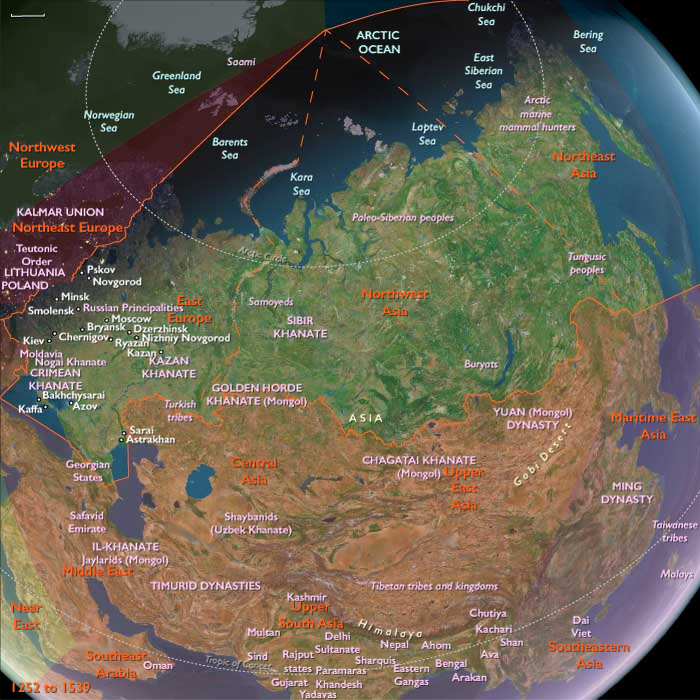
Northeast Europe (1252 – 1395 CE): Hanseatic Gateways, Swedish and Danish Expansion, and Novgorod’s Northern Reach
Geographic and Environmental Context
Northeast Europe includes Sweden, Finland, Denmark’s eastern reaches (including Copenhagen and Zealand), Norway’s southeast (Oslofjord), the Baltic States (Estonia, Latvia, Lithuania’s Baltic coast), and the Russian enclave of Kaliningrad.
-
Anchors: the Baltic Sea and its gulfs (Bothnia, Finland, Riga), forest–lake mosaics inland, and trade hubs like Stockholm, Visby, Riga, Tallinn (Reval), and Novgorod.
-
The region served as a northern crossroads between Scandinavia, Rus’, the Hanseatic League, and the Holy Roman Empire.
Climate and Environmental Shifts
-
The onset of the Little Ice Age (c. 1300) shortened growing seasons, cooled the Baltic, and shifted fishing patterns (notably herring).
-
Finland’s inland farmers and Sami reindeer–fishing communities adapted to longer winters; coastal traders thrived on intensified Hanseatic commerce.
Societies and Political Developments
-
Sweden & Finland:
-
Sweden extended dominion eastward into Finland after the Second Swedish Crusade (c. 1249); castles at Turku and Viipuri anchored control.
-
Swedish monarchy consolidated after the Folkunga dynasty and reforms of Magnus Ladulås (r. 1275–1290); by the 14th c., internal noble conflicts and regencies weakened the crown.
-
In 1397, shortly beyond our range, the Kalmar Union would unite Sweden, Denmark, and Norway.
-
-
Denmark & Norway:
-
Denmark dominated southern Scandinavia and the Sound tolls; under Valdemar IV (r. 1340–1375) it revived Baltic power.
-
Norway’s resources centered on fish and timber; Oslo was a royal seat, but plague (1349–50) devastated population and curtailed royal revenues.
-
-
Baltic States:
-
Livonian Order (branch of Teutonic Knights) ruled Estonia and Latvia after the collapse of native polities; Riga and Reval (Tallinn) prospered as Hanseatic cities.
-
Lithuania’s expansion pressed into coastal Samogitia and Courland; Christianization (1387) integrated Lithuania into Latin Europe.
-
-
Novgorod & Kaliningrad:
-
Novgorod retained control over Karelia and the White Sea, extracting tribute in furs from Finnic and Sami communities; Kaliningrad/Königsberg (founded by the Teutonic Knights in 1255) became a major crusading and Hanseatic hub.
-
Novgorod balanced between Hanseatic trade and Lithuanian–Muscovite frontiers.
-
Economy and Trade
-
Agriculture: rye, barley, oats, and livestock herding; limited by short growing seasons in Finland and Karelia.
-
Fur economy: Sami, Finnic, and Novgorodian hunters supplied sable, squirrel, and marten; exported via Novgorod and Hanseatic kontors.
-
Fishing: herring booms in Scania fueled Danish toll revenues and Hanseatic trade.
-
Timber, tar, hemp, flax, and iron exports from Sweden and Finland supplied European markets.
-
Hanseatic League: Visby (Gotland), Riga, Reval, and Novgorod’s Peterhof kontor became central nodes of the Hanseatic trading system.
-
Imports: salt, cloth, wine, and silver coinage (Lübeck, Prussian mints).
Subsistence and Technology
-
Plough agriculture: heavy ploughs and strip fields in southern Sweden; slash-and-burn (svedjeland) in Finnish forests.
-
Castles & towns: stone fortresses (Turku, Reval, Riga, Stockholm); urban guilds organized artisans and trade.
-
Shipping: cog ships carried bulk trade across the Baltic; local clinker-built vessels continued for fishing and cabotage.
-
Reindeer pastoralism: Sami herding, trapping, and fishing persisted alongside tribute obligations to Novgorod and Sweden.
Movement and Interaction Corridors
-
Baltic Sea routes: Hanseatic cogs linked Lübeck to Riga, Reval, Stockholm, Visby, and Novgorod.
-
Novgorod–White Sea–Karelia: tribute and fur trade routes tied Finnic peoples to Novgorodian merchants.
-
Danish Sound tolls: controlled passage between North Sea and Baltic.
-
Land corridors: overland routes connected Prussia and Livonia to Poland–Lithuania and to Muscovite Rus’.
Belief and Symbolism
-
Christianization:
-
Teutonic–Livonian crusades imposed Latin Christianity on Baltic peoples; monastic houses in Riga, Tallinn, and Königsberg anchored faith.
-
Sweden extended Latin Christianity into Finland with bishoprics at Turku.
-
-
Orthodoxy: remained dominant in Novgorod and Karelia.
-
Syncretism: Sami and Finnic animist practices persisted beneath Christian overlays; sacred drums and offering sites honored animal spirits.
-
Royal ideology: Scandinavian kings patronized cathedral-building (Uppsala, Turku) to legitimate rule.
Adaptation and Resilience
-
Trade redundancy: Hanseatic routes allowed grain, salt, and cloth to flow in when harvests failed.
-
Mixed economies: farming, fishing, and fur-trapping buffered ecological shocks.
-
Frontier tribute: Novgorod extracted furs from forest zones even as plague reduced labor in towns.
-
Political layering: Scandinavian monarchies, crusading orders, and city leagues balanced, ensuring continuity amid Black Death depopulation.
Long-Term Significance
By 1395, Northeast Europe was a Hanseatic–crusading frontier integrated into broader European commerce:
-
Novgorod thrived on the fur trade while under pressure from Muscovy and Lithuania.
-
Sweden and Denmark contested Baltic supremacy, with the Kalmar Union on the horizon.
-
Livonia and Prussia consolidated under the Teutonic and Livonian Orders.
-
Hanseatic merchants dominated Baltic exchange, knitting Scandinavia and Rus’ into Europe’s economic system.
In 1363, Haakon VI marries Margaret, the daughter of King Valdemar IV of Denmark.
Upon the death of Haakon VI, in 1379, his son, Olaf IV, is only ten years old.
Olaf had already been elected to the throne of Denmark, as Olaf II, on May 3, 1376.
Thus, upon Olaf's accession to the throne of Norway, Denmark and Norway enter personal union.
Olaf's mother and Haakon's widow, Queen Margaret, manages the foreign affairs of Denmark and Norway during the minority of Olaf.
For eight years after Christopher's death, Denmark has no king, and is instead controlled by the counts.
After one of them is assassinated in 1340, Christopher's son Valdemar is chosen as king, and gradually begins to recover the pawned territories, which is completed in 1360.
The Black Death, which comes to Denmark during these years, also aids Valdemar's campaign.
His continued efforts to expand the kingdom after 1360 bring him into open conflict with the Hanseatic League.
He conquers Gotland, much to the displeasure of the League, which loses Visby, an important trading town located there.
Luckily for the League, the Jutland nobles revolt against the heavy taxes levied to fight the expansionist war in the Baltic; the two forces work against the king, forcing him into exile in 1370.
For several years, the Hanseatic League controls the fortresses on "the sound" between Skåne and Zealand.
Northeast Europe (1336–1347 CE): Territorial Shifts, Crusader Authority, and Regional Dynamics
Introduction
Between 1336 and 1347 CE, Northeast Europe experienced pivotal territorial realignments, significant crusader influence, and evolving political dynamics. The defining event of this era was the transfer of the Duchy of Estonia from the direct control of the Kingdom of Denmark to the Teutonic Order, reshaping regional geopolitics and influencing future historical trajectories.
Sale of the Duchy of Estonia (1346)
In 1346, the Kingdom of Denmark, under King Valdemar IV, sold its territory of Danish Estonia—also known as the Duchy of Estonia—to the Teutonic Order. This transaction occurred due to Denmark’s pressing financial difficulties and challenges maintaining distant territories. The sale effectively ended Danish dominion (dominium directum) over northern Estonia, which had been held since 1219, transferring authority to the crusader state known as the Ordensstaat.
This territorial shift reinforced the strategic position of the Teutonic Knights, allowing them greater regional consolidation and control. The Teutonic Order integrated the newly acquired lands into their expansive territorial holdings, administratively aligning Estonia closely with other crusader states around the eastern Baltic.
Teutonic Order’s Consolidation of Power
Following this acquisition, the Teutonic Knights strengthened their governance structures in the region, fortifying key locations such as Reval (Tallinn), further developing urban settlements, and promoting economic growth. These administrative and military enhancements solidified the Order’s authority across the Baltic coast, reaffirming their dominance in the face of regional rivalries.
Stability and Governance in the Livonian Confederation
The Livonian Confederation, administered from the important trading city of Riga, maintained internal stability amidst these broader geopolitical changes. The Confederation continued strategic diplomatic engagement, bolstered defensive fortifications, and nurtured commercial networks that linked the region economically with wider European markets.
Swedish Influence and Consolidation in Finland
Concurrently, Sweden reinforced its governance over southern Finland, strengthening ecclesiastical establishments, fortifications, and administrative oversight. These efforts consolidated Finnish territories politically and culturally within the broader Swedish realm, enhancing Sweden’s regional authority despite shifting dynamics elsewhere.
Economic Development and Urban Prosperity
Urban centers such as Reval (Tallinn), now securely under the Teutonic Order, along with Riga, Visby on Gotland, and Königsberg, experienced considerable economic growth. Expanding maritime trade and strengthened economic ties significantly boosted regional prosperity, enhancing stability despite changing territorial controls.
Ecclesiastical Institutions and Cultural Continuity
Ecclesiastical institutions, particularly the influential Teutonic Order and regional bishoprics, played essential roles in governance, education, and cultural cohesion. Latin Christianity continued to exert considerable influence, guiding social policies, education, and administrative practices, reinforcing regional stability and cultural identity.
Rising Geopolitical Complexity
This territorial shift heightened the region’s geopolitical complexity. The expansion of the Teutonic Order’s territorial control contributed to ongoing diplomatic realignments, fostering intensified interactions and rivalries among neighboring states, including Sweden, Lithuania, and other regional powers.
Legacy of the Era
The era from 1336 to 1347 CE significantly reshaped Northeast Europe, marked chiefly by the critical transfer of the Duchy of Estonia to the Teutonic Order. This event, combined with strengthened Swedish influence in Finland and ongoing economic vitality, fundamentally redefined regional political boundaries and alliances, leaving an enduring impact on Northeast Europe's historical landscape.
Valdemar, the youngest son of Christopher II of Denmark and spent most of his childhood and youth in exile at the court of Louis IV, Holy Roman Emperor in Bavaria after the defeats of his father and death and the death and imprisonment, respectively, of his two older brothers Eric and Otto at the hand of the Holsteiners.
Here he had acted as a pretender waiting for a comeback.
Following the assassination of Count Gerhard III by Niels Ebbesen and his brothers, Valdemar had been proclaimed King of Denmark at the Viborg Assembly (landsting) on St Hans Day, June 24, 1340, led by Niels Ebbesen.
By his marriage with Helvig, the daughter of Eric II, Duke of Schleswig, and with what was left to him by his father, he controls about one quarter of the territory of Jutland north of the Kongeå river.
Aalborg's earliest trading privileges date from 1342, when King Valdemar IV receives the town as part of his huge dowry on marrying Helvig of Schleswig.
He is not compelled to sign a charter as his father had done, probably because Denmark had been without a king for years, and no one expects the twenty-year-old king to be any more trouble to the great nobles than his father had been.
But Valdemar is a clever and determined man and realizes that the only way to rule Denmark is to get control of its territory.
Danish king Valdemar IV, in the middle of his campaign to liberate central Jutland from the Holsteiners, in August 1346 goes to Estonia to negotiate with the Teutonic Knights who control the region, where Danes had never migrated in any numbers.
Valdemar gives up restive Danish Estonia, a far-off eastern province that can be controlled only with great difficulty, for nineteen thousand marks,
This allows him to pay off mortgages of parts of Denmark that are more important to him.
The Teutonic Knights give the territory’s administration to their brother order, the Livonian Knights.
Denmark’s Jutland peninsula in 1348 comes under the control of Danish king Valdemar IV, who, as part of his efforts to unite the Danish kingdom, seeks to regain possession of Funen (Fyn) Island, held by the county of Holstein as collateral on a debt.
Under the 1348 Treaty of Nebbegard, Valdemar receives from the Holstein courts half of Funen and a favorable opportunity to gain the other half.
The treaty’s terms come under dispute, however.
Valdemar, with his increased income, is able to pay for a larger army and by treachery comes into possession of Nyborg Castle and eastern Funen Island and the smaller islands.
Resorting to armed conflict, he wins a victory near Gamborg Castle to obtain possession of all of Funen.
Valdemar remains untouched and takes advantage of the deaths of his enemies to add to his growing lands and properties.
He refuses to reduce the taxes in 1350 although fewer peasants farm less land.
Nobles, too, feel their incomes shrink and the tax burdens fall heavier on them as well.
Uprisings will flare up in the following years.