Tiridates III of Armenia
king of Arsacid Armenia
Years: 250 - 330
Tiridates III (250-330) is the king of Arsacid Armenia (287-330), and is also known as Tiridates the Great; some scholars incorrectly refer to him as Tiridates IV as a result of the fact that Tiridates I of Armenia reigned twice).
In 301, Tiridates proclaims Christianity as the state religion of Armenia, making the Armenian kingdom the first state to embrace Christianity officially.




Related Events
Filter results
Showing 10 events out of 11 total
The Middle East: 244–387 CE
Rise of the Sassanid Empire and Persistent Roman Rivalries
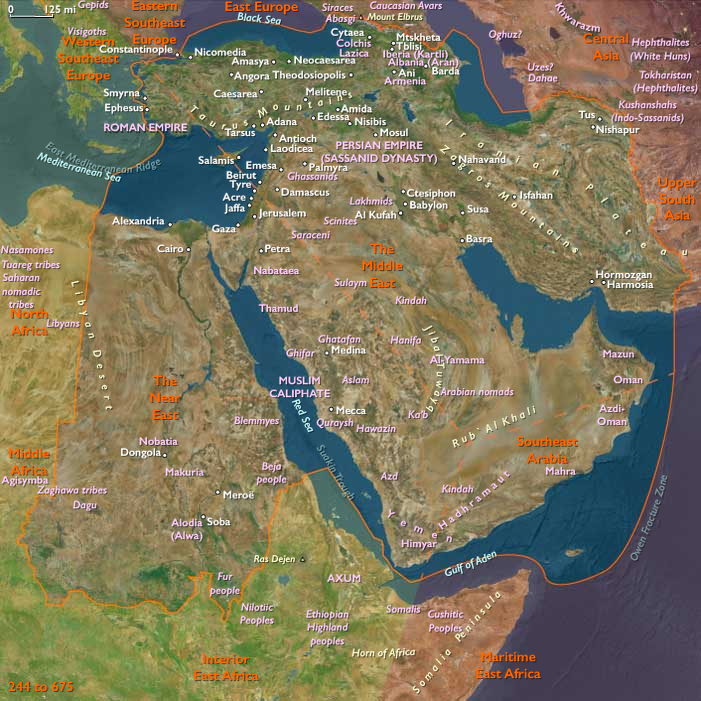
The period from 244 to 387 CE in the Middle East is marked by the decline of the Parthian Empire and the rise of the Sassanid Empire, reshaping the political, cultural, and religious landscape. Ardashir I, son of the priest Papak and claiming descent from the legendary hero Sasan, overthrows the last Parthian king in 224 CE and establishes the Sassanid dynasty, which endures for four centuries. Ardashir and his successors reassert Iranian cultural traditions, deliberately distancing themselves from previous Greek influences by fostering a national Persian renaissance.
Under Sassanid rule, the empire approximates the frontiers of the ancient Achaemenid Empire, with its capital established at Ctesiphon. Sassanian rulers adopt the title shahanshah (king of kings), governing numerous local rulers (shahrdars). Persian society is rigidly structured into four primary classes: priests, warriors, secretaries, and commoners, with powerful priests (led by the mobadan mobad), military leaders (eran spahbod), and bureaucratic officials reinforcing this social stratification.
Military Confrontations with Rome
The Roman Empire remains Persia's principal western adversary, inheriting the rivalry from the Greeks. Emperor Shapur I (241–272) conducts successful military campaigns against Rome, culminating in the capture of Emperor Valerian in 260 CE at the Battle of Edessa, symbolizing a high point of Persian military achievement.
However, the fortunes of war fluctuate significantly over this period. Roman Emperor Carus sacks Ctesiphon in 283, temporarily weakening Persian dominance. Under Emperor Diocletian, Roman forces achieve a decisive victory in 298 at the Battle of Satala, reclaiming extensive territories and exerting renewed control over Armenia. Despite these setbacks, the Sassanians retain substantial power, sustaining intermittent hostilities with Rome, notably under Shapur II (309–379), who captures Armenia and repeatedly confronts Emperor Constantius II.
The drawn-out Roman–Sassanian confrontations, epitomized by engagements at Singara and multiple sieges of the fortress city of Nisibis, underscore the sustained strategic rivalry. A notable truce occurs in 387 CE with the Peace of Acilisene, partitioning Armenia into Roman and Persian spheres of influence, temporarily stabilizing the contested frontier.
Religious Transformations and Christianity’s Spread
Religious and cultural transformations are equally significant during this era. Armenia, influenced by early Christian centers like Antioch and Edessa, officially adopts Christianity as its state religion in approximately 306 CE under King Tiridates III, credited to the miracles performed by Saint Gregory the Illuminator. This conversion precedes Emperor Constantine’s legalization of Christianity within the Roman Empire. Similarly, Georgian King Mirian III converts in 330 CE, aligning Georgia culturally and politically with the Byzantine Empire.
Christianity also thrives in Cyprus, bolstered by the legacy of apostles like Paul and Barnabas. Roman rule brings economic prosperity and infrastructure advancements to the island, despite periodic devastation from earthquakes that continually diminish the grandeur of cities like Salamis.
Sassanian Cultural Influence and Economic Expansion
Sassanian Persia’s influence extends significantly across the Persian Gulf, reaching its apex during this period. Persian authorities establish agricultural colonies in Oman, employing local nomadic tribes as border guards against Roman incursions, promoting Persian agricultural practices, irrigation techniques, and Zoroastrian beliefs. Zoroastrianism, Persia's state religion, reinforces Sassanian rule, elevating the priestly class to a powerful political force.
Urban Prosperity and Cultural Exchange
The people of Greater Syria, notably in cities such as Damascus, Palmyra, and Busra ash Sham, maintain economic vitality, leveraging advanced irrigation, alphabetic writing, and astronomical knowledge predating Roman annexation. Emperor Constantine’s relocation of the Roman capital to Byzantium (Constantinople) in 324 reorients regional administrative structures, dividing Greater Syria into provinces Syria Prima and Syria Secunda, enhancing Roman administrative efficiency and economic integration.
Meanwhile, powerful Arab civilizations like the Nabataeans and the Palmyrenes exert economic influence, with Palmyra flourishing as a vital trade hub along caravan routes.
Thus, from 244 to 387 CE, the Middle East undergoes transformative geopolitical, cultural, and religious shifts. The ascendancy of the Sassanid Empire, sustained Roman–Persian confrontations, and the profound spread of Christianity collectively redefine regional dynamics, laying foundational patterns that endure into subsequent eras.
Armenia, after contact with centers of early Christianity at Antioch and Edessa, accepts Christianity as its state religion in 306 (the traditional date—the actual date may have been as late as 314), following miracles said to have been performed by Saint Gregory the Illuminator, son of a Parthian nobleman.
Thus Armenians claim that Tiridates III (238- 314) was the first ruler to officially Christianize his people, his conversion predating the conventional date (312) of Constantine the Great's legalization of Christianity on behalf of the Roman Empire.
Shapur I soon resumes his attacks against a Roman Empire debilitated by Germanic invasions and a series of short-term emperors.
He reconquers Armenia, and incites Anak the Parthian, an Arsacid Prince and said to be related to the Arsacid Kings of Armenia, to murder the new king of Armenia, Khosrov II, promising to return his own domain as a reward.
Khosrov II is the son of Tiridates II, King of Armenia by an unnamed mother, and follows his father on the Armenian throne.
He is the namesake of his paternal grandfather Khosrov I and the Parthian monarchs: Osroes I and Osroes II.
In Armenian sources, Khosrov II is often confused with his grandfather Khosrov I.
Little is known on his life prior to becoming Armenian King.
From 226 until 238, Tiridates II had been in military conflict with Ardashir I, the first king and founder of the Sassanid Empire.
Ardashir I had wanted to expand his empire, which included conquering Armenia.
Khosrov II’s father had put up a stubborn resistance against Ardashir I.
After twelve years of fighting, although Tiridates II was defeated by Ardashir I, Ardashir I had withdrawn his army and left Armenia.
Khosrov II had participated in his father’s military campaigns against Ardashir I and Ardashir I had been alarmed by the victories of Tiridates II and Khosrov II against him.
Tiridates II dies in 252 and Khosrov II succeeds his father as King of Armenia and makes his capital at Vagharshapat.
From an unknown wife, Khosrov II has known two children: a daughter, called Khosrovidukht and a son called Tiridates III.
Anak, winning Khosrov II’s trust, treacherously murders Khosrov II with his wife in Vagharshapat; in return, the outraged Armenian nobles slay Anak with his entire family.
Shapur then appoints his son Hormizd I as the “Great King of Armenia”.
With Armenia subjugated, Georgia submits to the Sassanian Empire and falls under the supervision of a Sassanian official.
The Sassanians' northern borders are thus secured.
The overthrow of Hormizd has made Bahram secure.
Diocletian signs a peace treaty with him, and …
…installs Tiridates III, a Roman protégé, as king of Armenia, which the Persians have been forced to relinquish.
The Middle East: 292–303 CE
Roman Dominance and Armenia’s Christian Transformation
After a brief period of peace early in Emperor Diocletian's reign, hostilities reignite between the Roman Empire and the Sassanid Persians. Around 296 or 297 CE, the Persians invade Armenia, decisively defeating Roman forces outside Carrhae. This initial success, however, is short-lived. In 298 CE, Roman general Galerius dramatically reverses Persian fortunes at the Battle of Satala, where he utterly crushes the Persian army. Galerius not only captures the Persian royal treasury but also the royal harem, severely humiliating the Persian king.
This victory leads to the Peace of Nisibis, a treaty distinctly favorable to Rome. The settlement grants the Romans extensive territories between the Tigris and the Greater Zab rivers, along with definitive control over Armenia, thus restoring Roman authority over critical border regions. It marks the most decisive Roman triumph against Persian forces in decades, conclusively ending disputes over contested territories.
This era also witnesses profound cultural and religious change within Armenia. In 301 CE, the Armenian king, Tiridates III, owing his throne and power largely to Roman support, adopts Christianity as the state religion. This landmark event positions Armenia as the first Christian nation in history, significantly reshaping its cultural and political landscape and establishing a crucial precedent for Christianity’s role in statecraft throughout the Middle East.
Thus, the period from 292 to 303 CE is defined by significant Roman military success, the stabilization of Rome's eastern frontiers, and a historic shift in Armenia’s religious identity, laying critical foundations for subsequent developments in regional politics and religious culture.
Armenian monarch Tiridates III, who owes his throne to the Roman Empire, adopts Christianity in 301 as his nation’s official religion, making Armenia the first Christian state.
Narseh is heir to Shapur's ambitions, and Persian opposition to the Romans extends from Egypt to Armenia.
Having incited uprisings by both the Blemmyes nomads in southern Egypt and the Arabs of the Syrian desert, and made use of anti-Roman propaganda by the Manichaeans and Jews, Narseh, taking advantage of the disarray in the Roman Empire, precipitates war in 295 or 296, apparently first invading the Roman protectorate of western Armenia, retaking the lands delivered to Tiridates in the peace of 287.
He will occupy the lands there until the following year.
Armenian monarch Tiridates III, who owes his throne to the Roman Empire, adopts Christianity in 301 as his nation’s official religion, making Armenia the first Christian state.
The king appoints Gregory the Illuminator, who had been the instrument of his conversion, as the first Catholicos of the Armenian Apostolic Church.
The Middle East: 304–315 CE
Persecution, Toleration, and Regional Realignments
The period from 304 to 315 CE is marked by significant religious and political upheaval throughout the Middle East, coinciding with the latter years of Roman Emperor Diocletian and the rise of Constantine the Great.
Diocletian’s Persecution and its Aftermath
Diocletian initiates one of the most severe persecutions of Christians—the Great Persecution—beginning in 303 CE and continuing into 305 CE. This persecution profoundly affects Christian communities across the Middle East, including Syria, Palestine, Anatolia, and Egypt, resulting in widespread martyrdom, destruction of scriptures, and dismantling of churches. The persecution leaves deep scars on Christian memory and galvanizes communities toward greater solidarity and resilience.
Constantine and Religious Toleration
The abdication of Diocletian in 305 CE sets the stage for a rapid shift in religious policy. Emperor Constantine, who gains prominence during this era, dramatically alters Roman religious policy toward Christianity following his ascent to power. His vision before the Battle of the Milvian Bridge in 312 CE—interpreted as divine intervention—prompts Constantine to embrace Christianity openly. The issuance of the Edict of Milan in 313 CE, co-authored with Emperor Licinius, officially ends Roman persecution and grants Christianity legal status, paving the way for its eventual dominance throughout the empire, including the Middle Eastern provinces.
Armenia and the Consolidation of Christianity
Armenia, under King Tiridates III, continues to solidify its identity as the world's first officially Christian state. Tiridates III actively promotes Christianity throughout Armenia, strengthening its ecclesiastical structure and developing religious institutions and clergy training centers. The kingdom’s Christian alignment significantly influences its diplomatic and cultural relationships with neighboring Rome and Persia, as both powers vie for influence over this strategically located kingdom.
Continued Roman–Sassanid Tensions
Despite shifts toward religious toleration, Roman–Persian tensions persist. The Sassanid Empire, under Shapur II, who comes to the throne in 309 CE as an infant ruler, begins preparations for renewed conflicts with Rome. Although direct large-scale warfare remains limited during Shapur II's early reign, both empires continually fortify their borders and seek strategic alliances. Armenia remains a contentious buffer, caught between competing Roman and Persian ambitions.
Thus, from 304 to 315 CE, the Middle East experiences a profound transition from persecution to religious toleration, amidst ongoing geopolitical rivalry between Rome and Persia, setting the stage for significant religious, cultural, and political developments in the centuries that follow.