Theudebald
king of Metz, Rheims, or Austrasia
Years: 535 - 555
Theudebald or Theodebald (in modern English, Theobald; in French, Thibaud or Théodebald; in German, Theudowald) (c. 535–555), son of Theudebert I and Deuteria, is the king of Metz, Rheims, or Austrasia—as it is variously called—from 547 or 548 to 555.


Related Events
Filter results
Showing 8 events out of 8 total
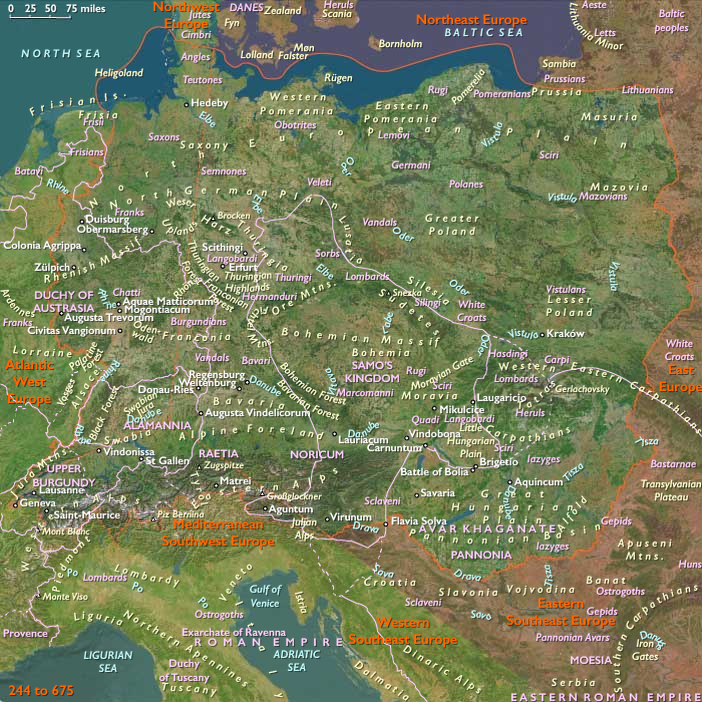
The Lombards, one of the Germanic tribes that formed the Suebi, had by the end of the fifth century moved from their home in northwestern Germany into the area roughly coinciding with modern Austria north of the Danube River.
Their ruler for the past three decades has been Wacho, who had assassinated his uncle Tato and usurped the throne about 510.
Tato's son and grandson had taken refuge with the king of a neighboring Germanic people, the Gepidae, making several fruitless attempts to recover rule over the Lombards.
Shortly after 536, Waccho had made a treaty with Justinian against the Gepids.
Vitiges, King of the Ostrogoths in Italy, hard-pressed by Justinian's general Belisarius, sends ambassadors to Wacho in 539, offering him money in exchange for military aid.
Wacho refuses, preferring to remain on good terms with Constantinople.
Having also good relations with the Franks, Wacho has married off his daughter, Waldrada, to the Frankish prince Theudebald, son of Theudebert of Metz.
Their granddaughter is Theodelinda, who will later become queen of the Lombards.
He his second marriage was to a Gepid princess, Austrigusa, called "Ostrogotha" (perhaps due to her maternal descent from Ostrogothic rulers).
Austrigusa was the mother of two daughters: Wisigarda (who married Theudebert I of Austrasia) and Waldrada (who married firstly Theudebald of Austrasia, secondly Chlothar I, King of the Franks, and thirdly Garibald I of Bavaria).
Wacho's third marriage was to Silinga, a Heruli, and the mother of his son Walhtari.
At the death of Wacho in 539, Walthari rules as an infant king, and his government is administered by Audoin as regent.
Atlantic West Europe (544–555): Consolidation, Dynastic Struggles, and Ecclesiastical Growth
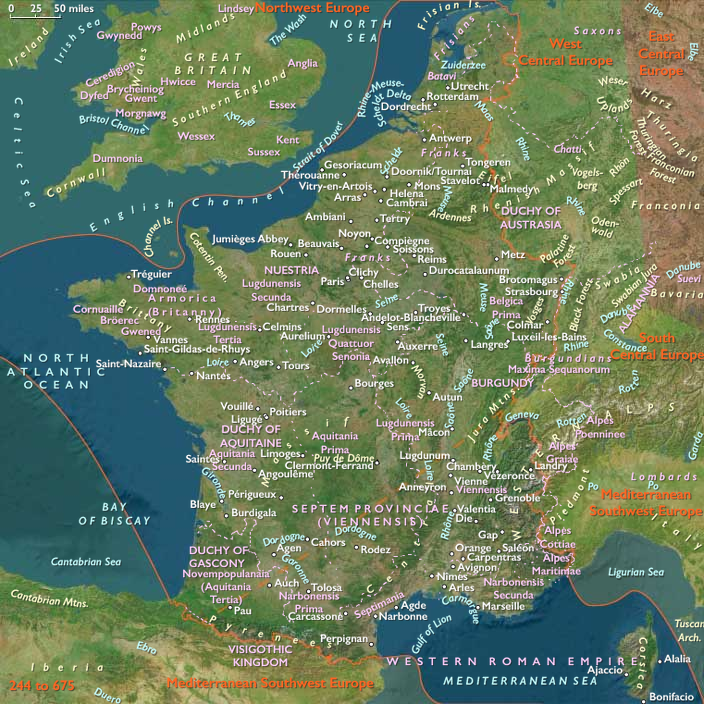
Between 544 and 555, Atlantic West Europe—covering modern-day France (Gaul), Burgundy, and the Low Countries—continued to witness Merovingian dynastic rivalries, territorial consolidation, and expanding ecclesiastical influence. During this era, Frankish kingdoms navigated internal political divisions and solidified their authority, fostering early medieval stability and Christianization.
Political and Military Developments
Merovingian Power Dynamics and Territorial Consolidation
- The Frankish kingdoms, ruled by Childebert I, Chlothar I, and Theudebert I, experienced shifting alliances and rivalries.
- Chlothar I, after consolidating Burgundy with his brother Childebert, gradually increased his influence, particularly in Neustria and Aquitaine, aiming at broader unification.
- Theudebert I (r. 533–548), ruler of Austrasia (northeast Gaul), expanded eastward into Germanic territories, enhancing Austrasian prestige and economic strength.
Conflicts and Dynastic Rivalries
- Following Theudebert I's death in 548, his son, Theudebald (r. 548–555), ascended but struggled to maintain Austrasia's earlier momentum, weakening Austrasian influence relative to Neustria under Chlothar I.
- Tensions between Frankish rulers, including rivalry over succession and territorial control, led to intermittent localized conflicts.
Economic and Social Developments
Stabilization of Rural Estates
- Rural estates (villae) continued to underpin the economy, maintained by aristocratic elites and monastic orders, supporting gradual economic stability after decades of upheaval.
- Increased integration of Burgundy brought valuable agricultural and viticultural lands firmly into Frankish economic systems.
Urban Centers and Local Trade
- Towns like Paris, Tours, Dijon, and Bordeaux retained their ecclesiastical and administrative importance, though urban populations remained modest.
- Local trade persisted along river systems (Loire, Seine, Rhône, Rhine), sustaining regional economic connections despite limited commercial activity.
Religious and Cultural Developments
Growth of Ecclesiastical Power
- Bishops increasingly acted as powerful local administrators and social leaders, influencing governance and societal norms across Gaul.
- The Council of Orléans (549) convened by King Childebert I reinforced church discipline, monastic standards, and ecclesiastical control over local communities.
Expansion of Monasticism
- Monastic communities flourished, notably the monastery of Saint-Germain-des-Prés, founded by Childebert I near Paris in 558, becoming a major cultural and religious hub.
- Monastic foundations, inspired by Benedictine principles, spread steadily, strengthening ecclesiastical networks and cultural continuity.
Cultural Achievements
- Merovingian craftsmanship advanced, as seen in intricate metalwork, jewelry, and manuscript illumination, blending Roman, Germanic, and Christian artistic motifs.
Legacy and Significance
Between 544 and 555, Atlantic West Europe solidified its early medieval identity through Merovingian consolidation, religious development, and cultural synthesis. Despite internal dynastic tensions, this period further entrenched Merovingian rule, established lasting ecclesiastical structures, and deepened Christianization, profoundly shaping the region’s future trajectory.
Theudebert I: A Powerful and Independent Merovingian King (r. 534–547/548 CE)
Theudebert I, king of Austrasia, was one of the most ambitious and politically independent of the early Merovingian rulers. Unlike his predecessors, he actively challenged Byzantine authority, expanded Frankish influence, and sought autonomy from Constantinople. His reign is marked by military successes, political marriages, religious patronage, and a break from imperial traditions.
1. Theudebert’s Challenge to Byzantine Authority
- Since the fall of the Western Roman Empire (476 CE), the Frankish kings had traditionally acknowledged the nominal authority of the Byzantine emperors, often minting gold coins with the emperor’s image as a gesture of deference.
- However, Theudebert breaks from this tradition, issuing gold coins bearing his own likeness, a direct assertion of his sovereignty.
- This act signals his rejection of an inferior status to the Byzantine emperor, claiming Frankish rule as an equal force in European politics.
- His bold assertion of power even leads to rumors in Constantinople, recorded by the Byzantine chronicler Agathias, that Theudebert was considering an invasion of Thrace, a core Byzantine territory.
2. Political Marriages and Personal Scandals
- As heir to his father, Theuderic I, Theudebert had been betrothed to Wisigard, daughter of Wacho, King of the Lombards, a rare diplomatic marriage for a Merovingian ruler.
- However, he abandoned Wisigard in favor of Deuteria, a Gallo-Roman noblewoman he met while on campaign in southern Gaul.
- His supporters were displeased, likely because the Wisigard marriage strengthened Frankish-Lombard relations, while Deuteria had no political value.
- Under pressure, Theudebert eventually took Wisigard back, but she soon died, and he married yet again.
- Like other Merovingian kings, Theudebert was known for taking multiple wives as he pleased, though his political marriages suggest a more calculated approach to dynastic strategy than his predecessors.
3. Military Expansion and Frankish Power
- Theudebert's letters claim a vast array of lands surrounding Austrasia, including imperial lands once controlled by Rome.
- He actively campaigned in southern Gaul, extending Frankish dominance over Visigothic-held territories.
- His aggressive expansion further distanced Austrasia from Byzantine influence, reinforcing the Frankish kingdom’s status as a major power.
4. Patronage of the Gallic Church and Pious Reputation
- Despite his military ambitions and personal scandals, Theudebert is remembered as a pious king and patron of the Church.
- Gregory of Tours praises him for his support of the Gallic clergy, while Fortunatus, a contemporary poet, also acknowledges his Christian devotion.
- His religious patronage strengthens ties between the monarchy and the Church, further legitimizing Merovingian rule.
5. Death and a Smooth Succession
- Theudebert dies in the fourteenth year of his reign, likely in late 547 or early 548 CE.
- Unlike many Merovingian successions, his son Theudebald, by Deuteria, takes the throne without internal strife, suggesting a well-established power structure in Austrasia.
- This peaceful transition contrasts sharply with the violent successions of many Merovingian kings, marking a brief period of stability.
Conclusion: A Bold and Independent Frankish King
Theudebert I was a transformative figure in Merovingian history, known for:
- Asserting Frankish independence from the Byzantine Empire.
- Expanding Austrasia's influence beyond its traditional borders.
- Using strategic marriages to enhance his political standing.
- Gaining a reputation for piety, reinforcing Church support for the Merovingian dynasty.
His reign marks a critical turning point, where the Franks transition from being former Roman allies to an autonomous European power, paving the way for future Merovingian and Carolingian expansion.
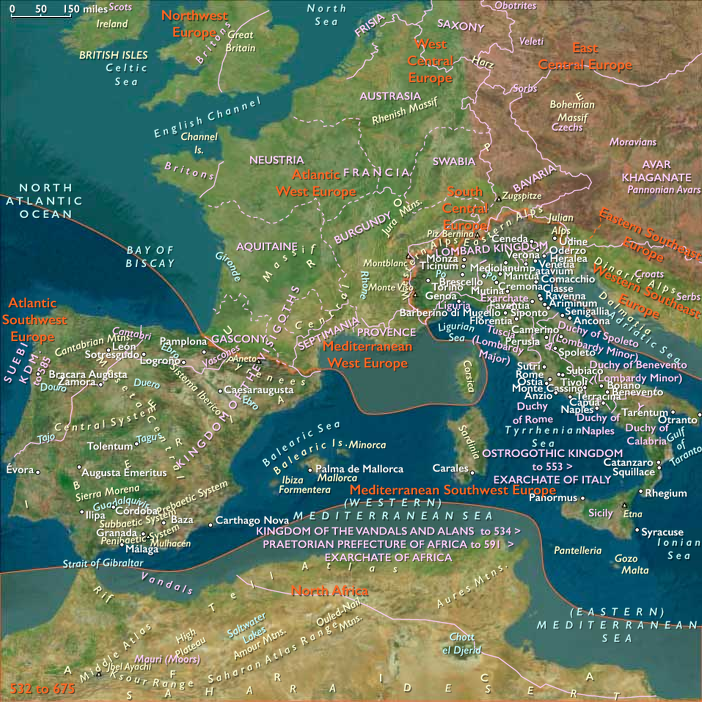
The imperial fleet (fifty warships) destroys the Gothic naval force under Indulf near Sena Gallica (Senigallia), some seventeen miles (twenty-seven kilometers) north of Ancona, in autumn 551.
The battle marks the end of the Gothic supremacy in the Mediterranean Sea.
Narses arrives in Venetia and discovers that a powerful Gothic-Frank army (fifty thousand men), under joint command of the kings Totila and Theudebald, blocks the principal route to the Po Valley.
Not wishing to engage such an formidable force and confident that the Franks would avoid a direct confrontation, Narses skirts the lagoons along the Adriatic shore by using vessels to leapfrog his army from point to point along the coast.
In this way, …
Narses, arriving to the capital, Ravenna, without encountering any opposition, attacks and crushes a small Gothic force at Ariminum (modern Rimini).
Chlothar I Expands His Rule: The Annexation of Metz and Reims (555 CE)
By 555 CE, Chlothar I, already one of the most powerful Merovingian rulers, consolidates even more territory after the death of his great-nephew Theudebald, who had ruled the Frankish kingdom of Austrasia from Metz. Theudebald's prolonged illness and eventual death allow Chlothar to seize Metz and Reims, expanding his dominion over the former Austrasian territories.
1. The Annexation of Austrasia (Metz and Reims)
- Theudebald (r. 548–555 CE), the son of Theudebert I, had ruled over Austrasia, the eastern Frankish kingdom, with its capital at Metz.
- Following his death in 555 CE, Chlothar I quickly moves to annex his lands, ensuring there is no successor to challenge him.
- By claiming Metz and Reims, Chlothar gains control over a key economic and military region, securing dominance over eastern Gaul and the former Roman frontier zones.
2. The Road to Becoming King of All the Franks
- With the acquisition of Theudebald’s lands, Chlothar now controls the majority of the Frankish kingdom.
- His only remaining rival is Childebert I of Paris, his surviving brother.
- Upon Childebert’s death in 558 CE, Chlothar finally reunites all of Frankish Gaul under his sole rule, achieving what his father, Clovis I, had once accomplished before the kingdom was divided among his heirs.
3. The Last Unified Merovingian King
- By 558 CE, Chlothar I becomes the King of All the Franks, ruling from Soissons as his capital.
- His reign marks the final reunification of the Merovingian realm, though this unity will not last long after his death.
- His policies and conquests set the stage for future Frankish rule, shaping the structure of medieval Francia and later Carolingian expansion.
Conclusion: The Final Triumph of Chlothar I
The annexation of Metz and Reims in 555 CE marks Chlothar’s last major territorial acquisition before becoming the sole ruler of the Frankish realm. His ability to outlive and outmaneuver his rivals allows him to restore Frankish unity, cementing his place as one of the most dominant Merovingian kings.