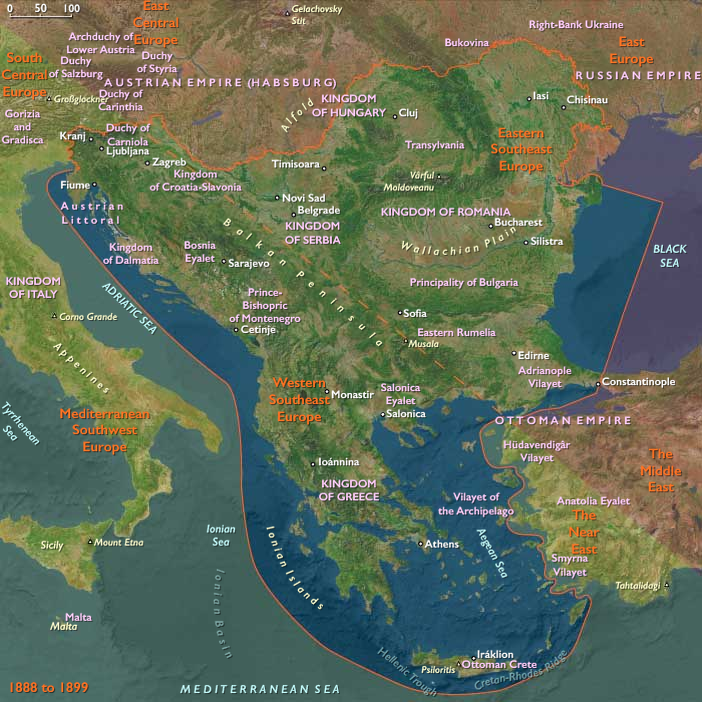
A Greek constituent assembly, convened in 1863 at the urging of Britain and the newly installed King George, adopts a much more democratic constitution in 1864.
The Constitution of 1864 had been drafted following the models of the Constitutions of Belgium of 1831 and of Denmark of 1849, and establishes in clear terms the principle of popular sovereignty, since the only legislative body with reversionary powers is now the Parliament.
Amplifying the democratic freedoms of the 1844 constitution, it vests sovereignty in the Greek people, although the sovereign retains substantial, if vaguely defined, powers in foreign policy.
A single-chamber parliament with full legislative powers is to be elected by direct, secret ballot.
The powers of the King are reduced and the Senate is abolished, and the franchise is extended to all adult males.
Because the king retains substantial powers, however, the choice of a new monarch remains an extremely important issue.
Greek politics remains heavily dynastic, as it has always been.
Family names such as Zaimis, Rallis and Trikoupis will occur repeatedly as Prime Ministers.
Although parties are centered around the individual leaders, often bearing their names, two broad political tendencies exist: the liberals, led first by Charilaos Trikoupis, and the conservatives, led initially by Theodoros Deligiannis.
Trikoupis and Deligiannis will dominate Greek politics in the later 19th century, alternating in office.
Trikoupis favors cooperation with Great Britain in foreign affairs, the creation of infrastructure and an indigenous industry, raising protective tariffs and progressive social legislation, while the more populist Deligiannis depends on the promotion of the irredentist concept of Greek nationalism known as the Megali Idea.