Theodoric Strabo
Ostrogoth chieftain
Years: 425 - 481
Theodoric Strabo (died 481) wai an Ostrogoth chieftain who is involved in the politics of the Byzantine Empire during the reigns of Byzantine Emperors Leo I, Zeno and Basiliscus.
He is a rival for the leadership of the Ostrogoths with his kinsman Theodoric the Great, who will ultimately supplant him.


Related Events
Filter results
Showing 10 events out of 12 total
Theodoric called Strabo, son of Triarius, is a chieftain of the Thracian Goths; he has two brothers.
The wife of the Alan general Aspar is his sister.
Strabo has a wife, Sigilda, and a son called Recitach.
He is a contemporary of the more famous Theodoric the Amal, a Moesian Goth of the royal Amal family, who will become known as Theodoric the Great.
Around 459, he is attested as in friendly relationship with the Empire, possibly one of the foederati, and receiving an annual subsidy from Constantinople.
The Alan commander Aspar, at the time magister militum of Emperor Leo I, had been murdered in 471 by order of the emperor himself.
Strabo, who was at the command of his people in Thrace, had revolted to avenge his relative, but had been defeated by the Roman generals Zeno and Basiliscus (both will later become emperors).
However, Strabo had been able to set three conditions to end his unrest: receiving the properties left as legacy by Aspar, being allowed to settle his Goths in Thrace, and being raised to the rank of magister militum.
Since Leo has rejected the requests, offering the rank of magister militum only in exchange of an oath of loyalty, Strabo starts a military campaign against the cities of Thrace.
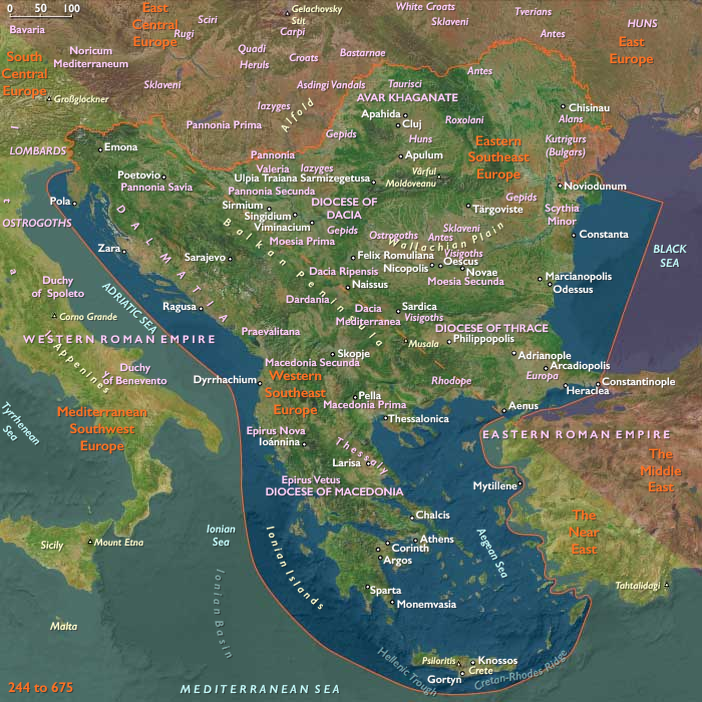
Part of the Gothic army attacks Philippi (or Philippopolis), while …
…Theodoric Strabo leads the remaining men to attack and occupy Arcadiopolis.
Theodoric signs a peace with Leo in 473 when the Goths run out of supplies; according to its terms, Constantinople is to pay an annual tribute of two thousand pounds of gold to the Goths, whose independence is recognized, and Strabo is to obtain the rank of magister militum.
The chief aim of the Ostrogoths after their escape from the Hunnish yoke in the mid-fifth century has been to find new land upon which they can settle and live in peace.
In northern Pannonia, they have fought endlessly against other Germanic peoples, acted for and against the emperors at Constantinople, and sometimes received and sometimes were refused financial subsidies from the imperial government.
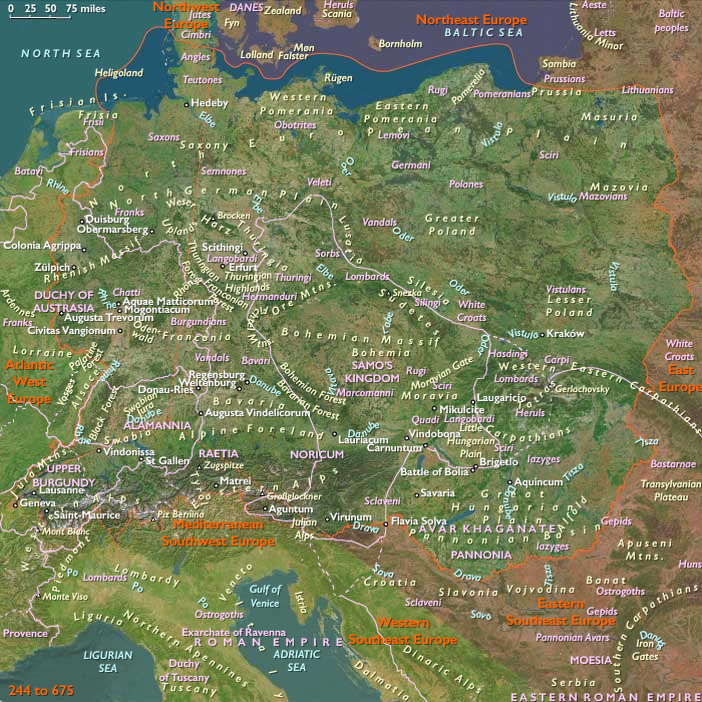
On the death of the Ostrogothic chieftain Theodemir, in 471, his son Theodoric, who had lived as a hostage in Constantinople as a boy, becomes his successor and soon leads his people to new homes in Lower Moesia (in what is now Bulgaria), where they enter into relations, usually hostile, with the group of Ostrogoths led by Theodoric Strabo.
Conditions in the Balkan provinces at this time are chaotic.
A popular revolt against the emperor starts within the capital in 475.
The uprising receives military support by Theodoric Strabo, Illus and Armatus and succeeds in taking control of Constantinople.
Verina persuades her son-in-law to leave the city.
Zeno flees to his native lands, bringing with him some of the Isaurians living in Constantinople, and the imperial treasury.
Basiliscus is now acclaimed as Augustus on January 9, 475, at the Hebdomon palace, by the palace ministers and the Senate.
The mob of Constantinople takes its revenge, killing almost all of the Isaurians left in the city.
Basilicius supports the Monophysites, who gain control of the key sees of Alexandria, Antioch, and Jerusalem.
However Basiliscus soon manages to estrange himself from most of his key collaborators.
Patricius, the magister officiorum and lover of Verina, had been executed to prevent her aspirations to elevate him to the throne.
As a consequence, Verina later intrigues against Basiliscus, because of her lover's execution.
Theodoric and Armatus are promoted to magister millitum and magister militum praesentialis and are vying for authority.
Finally, the support of Illus is most likely wavering, given the massacre of the Isaurians allowed by Basiliscus.
Basiliscus has reigned at Constantinople for twenty months, but his religious beliefs make him highly unpopular.
As emperor, he has stirred up discontent because he favors the Monophysite heresy, which holds that the human and divine elements in Christ's nature were inseparable.
During his reign, a disastrous fire in Constantinople destroys much of the city along with many Greek works of art.
With the help of Illus and Armatus, who change their allegiance, Zeno returns to besiege Constantinople in August 476.
The leader of the Pannonian Goths, Theodoric the Amal (later known as Theodoric the Great) had allied to Zeno, and would have attacked Basiliscus and his Thracian Goth foederati led by Theodoric Strabo, receiving, in exchange, the title of magister militum held by Strabo and the payments previously given to the Thracian Goths.
It has been suggested that Constantinople was defenseless during Zeno's siege because the Magister Militum Strabo had moved north to counter this menace.
The Senate opens the gates of the city to the Isaurian, allowing the deposed emperor to resume the throne.
Ariadne is still his Empress consort.
Basiliscus is exiled to a fortress in Cappadocia, where he will die from starvation.
Verina, mother-in-law of emperor Zeno, attempts to kill Isaurian general Illus for turning against Basiliscus, her brother.
A major revolt is led by her son-in-law Marcian and the Ostrogoth warlord Theodoric Strabo.
Ariadne comes into conflict with her husband in 479 over the fate of her mother.
Verina had attempted to assassinate Illus and had become his prisoner.
She had supported the revolt of her other son-on-law Marcian even during her captivity.
Ariadne endeavors to obtain her release, first from Zeno, and then from Illus, to whom the emperor refers her.
Illus not only refuses her request, but charges her with wishing to place another person on her husband's throne.
This irritates her; and she, like her mother, attempts to assassinate Illus.
Jordanes ascribes her hatred to another cause: he says that Illus had infused jealous suspicions into Zeno's mind which had led Zeno to attempt her life, and that her knowledge of these things stimulated her to revenge.
The assassin whom she has employed fails to kill Illus, but cuts off his ear in the attempt.
The assassin is taken, and Zeno, who appears to have been privy to the affair, is unable to prevent his execution.
The affair does not seem to have had long-term effects in their marriage.
She will remain married to Zeno to his death on April 9, 491.
Illus again proves his loyalty to Zeno by quashing the revolt in 479.
The origin of the early Bulgars (or "Proto-Bulgars") is still unclear.
Their homeland is believed to be situated in Kazakhstan and the North Caucasian steppes.
Interaction with the Hunnic tribes, causing the migration, may have occurred there, but the Pontic–Caspian steppe seems a more likely location.
The first clear mention and evidence of the Bulgars is in the 480s, when they serve as the allies of the Byzantine Emperor Zeno (474–491) against the Ostrogoths.
According D. Dimitrov, the fifth century History of Armenia by Movses Khorenatsi speaks about two migrations of the Bulgars, from Caucasia to Armenia.
The first migration is mentioned in the association with the campaign of Armenian ruler Valarshak (probably Varazdat) to the lands "named Basen by the ancients... and which were afterwards populated by immigrants of the vh' ndur Bulgar Vund, after whose name they (the lands) were named Vanand".
The second migration took place during the time of the ruler Arshak III, when "great disturbances occurred in the range of the great Caucasus mountain, in the land of the Bulgars, many of whom migrated and came to our lands and settled south of Kokh".
Both migrations are dated to the second half of the fourth century.
The "disturbances" that caused them are believed to be the expansion of the Huns in the East-European steppes.
Dimitrov recorded that the toponyms of the Bolha and Vorotan rivers, tributaries of the Aras river, are known as Bolgaru-chaj and Vanand-chaj, and could confirm the Bulgar settlement of Armenia.
The Akatziroi and other tribes that had been part of the Hunnic union were attacked around 463, tby the Šarağurs, one of the first Oğuric Turkic tribes that entered the Ponto-Caspian steppes as the result of migrations set off in Inner Asia.
According to Priscus, in 463 the representatives of Šarağur, Oğur and Onoğur came to the Emperor in Constantinople, and explained they had been driven out of their homeland by the Sabirs, who had been attacked by the Avars.
This tangle of events indicates that the Oğuric tribes are related to the Dingling and Tiele people.
It seems that Kutrigurs and Unigurs arrived with the initial waves of Oğuric peoples entering the Pontic steppes.
The Bulgars were not mentioned in 463.
The eighth-century account by Paul the Deacon in his History of the Lombards says that at the beginning of the fifth century in the northwestern slopes of the Carpathians the Vulgares killed the Lombards’ king Agelmund.
Scholars attribute this account to the Huns; Avars or some Bulgar groups were probably carried away by the Huns to the Central Europe.
When the army of Ostrogoth chieftain Theodoric Strabo grows to thirty-thousand-men strong, it is felt as a menace to Emperor Zeno, who somehow manages to persuade the Bulgars to attack the Thracian Goths.
The Bulgars are in 480/481 defeated, however, by Strabo.