Theodore of Tarsus
Archbishop of Canterbury
Years: 602 - 690
Theodore (602 – 19 September 690; sometimes known as Theodore of Tarsus or Theodore of Canterbury) is the eighth Archbishop of Canterbury, best known for his reform of the English Church and establishment of a school in Canterbury.
Theodore's life can be divided into the time before his arrival in Britain as Archbishop of Canterbury, and his archiepiscopate.

Related Events
Filter results
Showing 10 events out of 12 total
Archbishop Theodore of Canterbury in Liber Poeintentialis, rules in 669 against social interaction between Christians and Jews.
Although this is the first documented reference to Jews in England, the ruling may be of a general nature and is thus not a proof of a seventh-century Jewish presence in England.
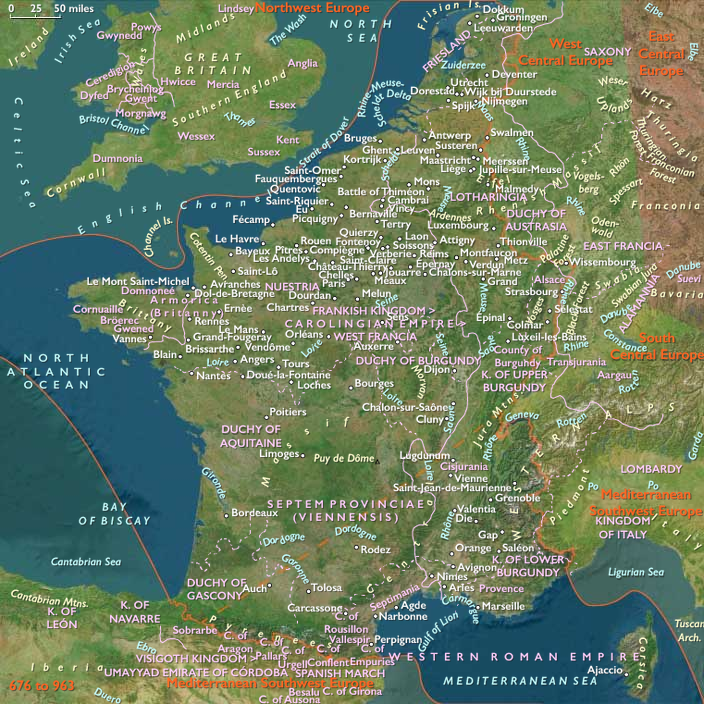
The first recorded act of Æthelred's reign is in 676, when his armies ravage Kent, destroying Rochester, the seat of the bishops of West Kent.
The reason for his attack is not recorded, but he may have wished to prevent King Hlothhere of Kent from regaining control of Surrey, which had been recently brought into the Mercian orbit by Wulfhere.
It may also be that Æthelred wished for revenge for the murder of the sons of Eormenred of Kent; the murders had been instigated by Ecgberht of Kent, Hlothhere's brother, and it is possible that Æthelred was the uncle of the murdered princes.
A third suggestion is that the kings of Essex solicited the invasion, in response to recent Kentish attempts to gain dominance over the East Saxons.
Regardless of the reason, Hlothhere was likely then forced to accept Æthelred's overlordship.
The damage to the see of Rochester is so great that the incumbent bishop, Putta, retires from his diocese; his appointed successor, Cwichelm, also gives up the see "because of its poverty".
Æthelred is the son of Penda of Mercia.
Penda's queen, Cynewise, is named by Bede, who does not mention her children; no other wives of Penda are known and so it is likely but not certain that she was Æthelred's mother.
The Anglo-Saxon Chronicle gives Penda's age as fifty in 626, and credits him with a thirty-year reign, but this would put Penda at eighty years old at the time of his death, which is generally thought unlikely as two of his sons (Wulfhere and Æthelred) were young when he was killed.
At least as likely is that Penda was fifty years old at his death, rather than at his accession.
Æthelred's date of birth is unknown, but Bede describes Wulfhere as a youth at the time of his accession in 658, so it is likely he and Æthelred were in their middle teens at that time.
The early sources do not say whether Æthelred was older or younger than Wulfhere.
Nothing is known of Æthelred's childhood.
He had another brother, Peada, and two sisters, Cyneburh and Cyneswith; it is also possible that Merewalh, king of the Magonsæte, was Æthelred's brother.
Wulfhere in 674 "stirred up all the southern nations against [Northumbria]" according to Stephen of Ripon, but he was defeated by Oswiu's son Ecgfrith who forced him to surrender Lindsey, and to pay tribute.
Wulfhere survived the defeat, but died in 675, possibly of disease, and Æthelred has become king.
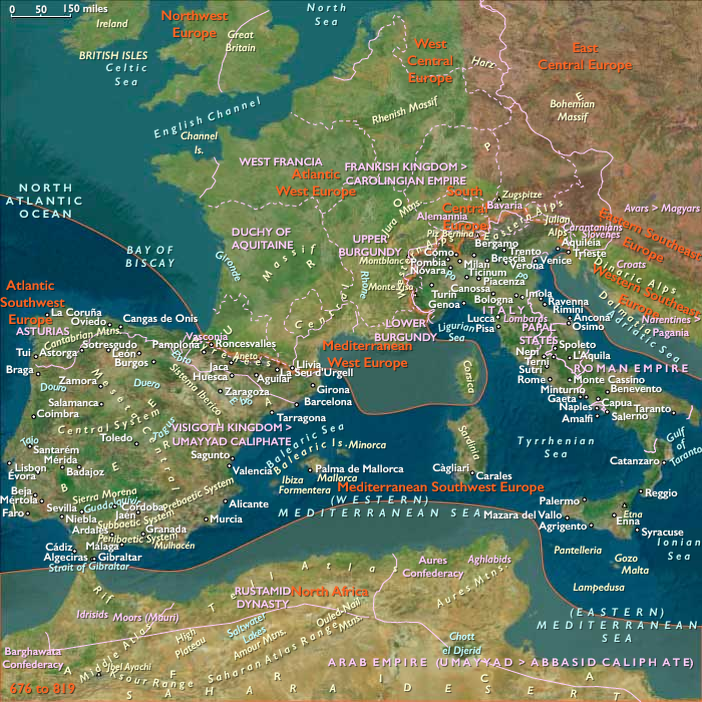
Adeodatus II, having reigned as pope from April 11, 672 to June 17, 676, had been succeeded by Donus, who has paved the enclosed forecourt of St. Peter's Basilica, paved the atrium or quadrangle in front of St. Peter's with great blocks of white marble, and restored other churches of Rome, notably the church of St. Euphemia on the Appian Way, and the basilica of St. Paul Outside the Walls.
During the pontificate of Donus, Reparatus, the Archbishop of Ravenna, returns to the obedience of the Holy See, thus ending the schism created by Archbishop Maurus, who had aimed at making Ravenna autocephalous.
After a colony of Nestorian monks is discovered in a Syrian monastery at Rome—the Monasterium Boetianum—Donus is reported to have dispersed them through the various religious houses of the city and to have given their monastery to Roman monks.
His successor, Agatho, a Greek born in Sicily of wealthy and devout parents, succeeds him to the papal throne in April 678.
Shortly after Agatho’s elevation, Wilfrid, Archbishop of York, arrives at Rome to invoke the authority of the Holy See in his behalf.
Wilfrid had been deposed from his see by Theodore, Archbishop of Canterbury, who had carved up Wilfrid's diocese, appointing three bishops to govern the new sees.
At a synod that Pope Agatho convoked in the Lateran to investigate the affair, it had been decided that Wilfrid's diocese should indeed be divided, but that Wilfrid himself should name the bishops.
Agatho is the first Bishop of Rome to stop paying tribute to the Emperor in Constantinople upon election.
Theodore, the Archbishop of Canterbury, had begun a substantial reorganization of the church in Mercia early in the reign of Æthelred.
He had removed Wilfred from his position as Bishop of Lichfield in 675, and over the past four years has divided the vast Mercian see into the five dioceses of Leicester, Lichfield, Worcester, Dorchester and Hereford.
Æthelred, a devout king, has made several gifts of land to the expanding church, including grants at Tetbury, Long Newton, and Somerford Keynes.
There is also a tradition that Æthelred was associated with the founding of Abingdon Abbey, in southern Oxfordshire.
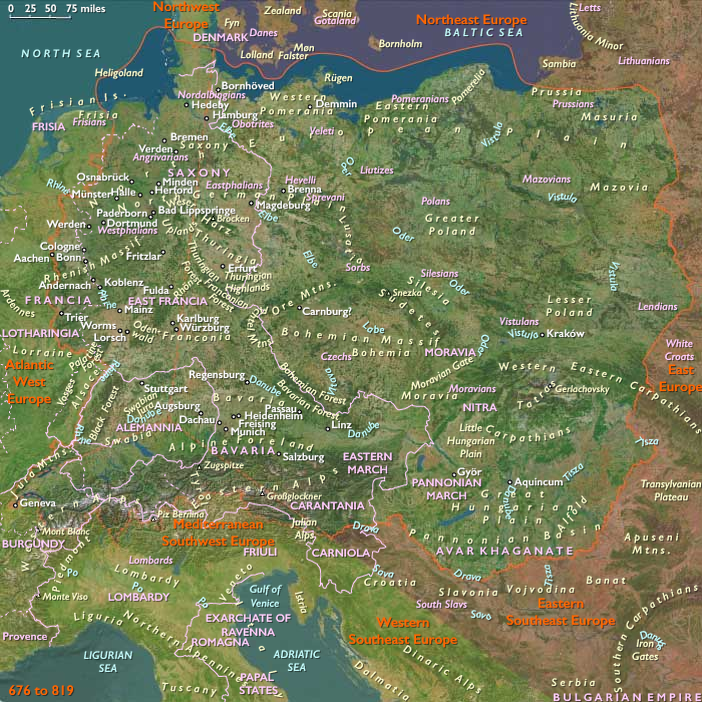
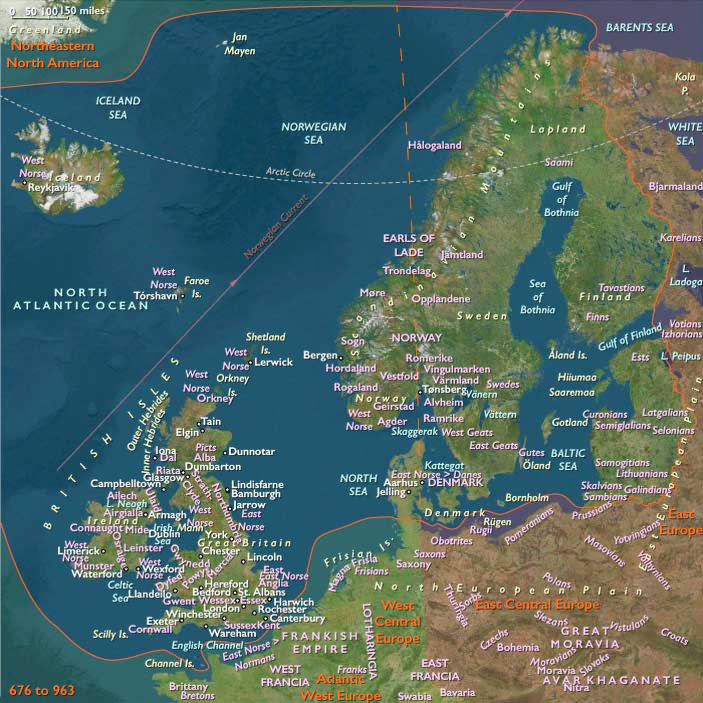
The group of six Anglican kingdoms—Kent, Sussex, Wessex, East Anglia, Essex, Northumbria, and Mercia—is known to historians as the Heptarchy.
Mercia has been in conflict with Northumbria since at least 633, when Penda of Mercia defeated and killed Edwin of Northumbria at the Battle of Hatfield Chase.
However, there have been diplomatic marriages between the two kingdoms: Æthelred's sister Cyneburh had married Alhfrith, a son of Oswiu of Northumbria, and both Æthelred and his brother Peada had married daughters of Oswiu.
Cyneburh's marriage to Alhfrith had taken place in the early 650s, and Peada's marriage, to Ealhflæd, had followed shortly afterwards; Æthelred's marriage, to Osthryth, is of unknown date but must have occurred before 679, since Bede mentions it in describing the Battle of the Trent, which takes place in this year.
Bede does not mention the cause of the battle, simply saying that it occurred in the ninth year of Ecgfrith's reign.
He is more informative on the outcome.
Ælfwine, the young subking of Deira, was killed; Ælfwine was brother to Osthryth and Ecgfrith, and was well liked in both Mercia and Northumbria since Æthelred's marriage to Osthryth.
His death according to Bede threatened to cause further strife between the two kingdoms, but Theodore, the Archbishop of Canterbury, intervened.
Æthelred takes possession of Lindsey again after the battle; the change in control this time will be lasting, and Lindsey will remain part of Mercia until the Viking invasion of the ninth century remakes the map of England.
Cædwalla of Wessex grants land at Farnham for a minster in a charter of 688, so it is evident that Cædwalla controls Surrey.
He had also invaded Kent in 686 and may have founded a monastery at Hoo, northeast of Rochester, between the Medway and the Thames.
He had installed his brother, Mul, as king of Kent, in place of its king Eadric.
Mul had been "burned" along with twelve others in a subsequent Kentish revolt the following year, according to the Anglo-Saxon Chronicle.
Cædwalla had responded with a renewed campaign against Kent, laying waste to its land and leaving it in a state of chaos.
He may have ruled Kent directly after this second invasion.
Cædwalla had been unbaptized when he came to the throne of Wessex, and has remained so throughout his reign, but though he is often referred to as a pagan this is not necessarily the most apt description; it may be that he was already Christian in his beliefs but delayed his baptism to a time of his choice.
He is clearly respectful of the church, with charter evidence showing multiple grants to churches and for religious buildings.
Wilfrid had been at the court of King Æthelwealh when Cædwalla first attacked the South Saxons, and on Æthelwealh's death Wilfrid had attached himself to Cædwalla; the Life of Wilfrid records that Cædwalla sought Wilfrid out as a spiritual father.
Bede states that Cædwalla vowed to give a quarter of the Isle of Wight to the church if he conquered the island, and that Wilfrid was the beneficiary when the vow was fulfilled; Bede also says that Cædwalla agreed to let the heirs of Arwald, the king of the Isle of Wight, be baptized before they were executed.
Two of Cædwalla's charters are grants of land to Wilfrid, and there is also subsequent evidence that Cædwalla worked with Wilfrid and Eorcenwald, a bishop of the East Saxons, to establish an ecclesiastical infrastructure for Sussex.
However, there is no evidence that Wilfrid exerted any influence over Cædwalla's secular activities or his campaigns.
Wilfrid's association with Cædwalla may have benefited him in other ways: the Life of Wilfrid asserts that the Archbishop of Canterbury, Theodore, expressed a wish that Wilfrid succeed him in that role, and if this is true it may be a reflection of Wilfrid's association with Cædwalla's southern overlordship.
Cædwalla abdicates in 688 and goes on a pilgrimage to Rome, possibly because he is dying of the wounds he had suffered while fighting on the Isle of Wight.
Cædwalla has never been baptized, and Bede states that he wished to "obtain the particular privilege of receiving the cleansing of baptism at the shrine of the blessed Apostles".
The throne of Wessex passes in 688 to Ine, …
...Cædwalla's departure in 688 appears to have led to instability in the south of England.
Ine, Cædwalla's successor, will abdicate in 726, and the West Saxon Genealogical Regnal List says that he reigned for thirty-seven years, implying his reign began in 689 instead of 688.
This could indicate an unsettled period between Cædwalla's abdication and Ine's accession.
The kingship had also changed in Kent in 688, with Oswine, who was apparently a Mercian client, taking the throne; and there is evidence of East Saxon influence in Kent in the years immediately following Cædwalla's abdication.
Northumbria and …
…Mercia conclude a truce in 689.