Theobald I
1st count of Blois
Years: 913 - 975
Theobald I (913–975), called the Trickster (le Tricheur, meaning cheater), is the first count of Blois, Chartres, and Châteaudun as well as count of Tours.

Related Events
Filter results
Showing 6 events out of 6 total
The Rise of Hugh Capet and the Fragmented Kingdom of the Franks (941–956)
Born in 941, Hugh Capet was the son of Hugh the Great, Duke of the Franks, and Hedwige of Saxony, daughter of Henry the Fowler, King of East Francia. His paternal family, the Robertians, were powerful landowners in the Île-de-France, and his lineage was deeply tied to both the Carolingians and the Ottonian rulers of the Holy Roman Empire.
Hugh Capet’s Royal and Noble Connections
- Grandson of King Robert I of West Francia.
- Great-great-great-great-grandson of Charlemagne, descended from Pepin of Italy through his grandmother Beatrice of Vermandois.
- Grandnephew of King Odo of West Francia.
- Related to the Ottonian emperors, being first cousin to Otto II of Germany.
- Son of Hugh the Great, the most powerful noble in West Francia, though he never took the crown.
Hugh the Great’s Role in the Return of Louis IV (936)
- When King Rudolph (Raoul) of Burgundy died in 936, Hugh the Great orchestrated the return of Louis IV ("d’Outremer"), son of the deposed Charles the Simple, from exile in England.
- Motives remain unclear, but possible reasons include:
- Preventing Rudolph’s brother, Hugh the Black, from claiming the throne.
- Blocking Herbert II of Vermandois or Richard the Fearless, Duke of Normandy, from taking power.
- Though he restored the Carolingian dynasty, Hugh the Great ensured his own dominance, keeping Louis IV as a weak, dependent king.
Hugh Capet Inherits Power (956)
- Hugh the Great dies in 956, leaving his vast estates to his young son, Hugh Capet.
- At the time, Hugh Capet is still a minor, so his mother, Hedwige of Saxony, acts as his guardian.
- Despite his father’s immense influence, Hugh immediately faces challenges from ambitious neighbors.
Loss of Land to Former Vassals
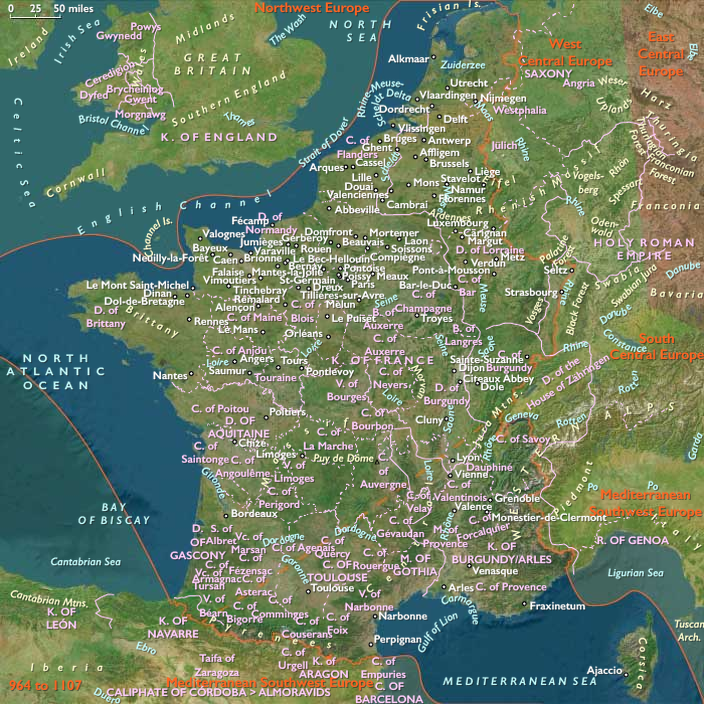
- Theobald I of Blois, a former vassal of Hugh the Great, seizes Chartres and Châteaudun, weakening Hugh’s control in the Loire Valley.
- Fulk II of Anjou, another former client of Hugh the Great, carves out a principality at Hugh’s expense, gaining control over key territories along the Breton border.
The Fragmentation of West Francia
Hugh Capet grows up in a much-reduced West Frankish kingdom, which looks nothing like modern France:
- The king is known as Rex Francorum ("King of the Franks"), not "King of France," a title that will only emerge under Philip II Augustus (1180–1223).
- West Francia is a weak and fragmented realm, with the king controlling only a small portion of the former Carolingian Empire.
- The Holy Roman Empire, ruled by Hugh’s first cousin Otto II and later Otto III, dominates the eastern Frankish lands.
- South of the Loire, the king’s influence is nearly nonexistent, as local rulers act independently.
- Normandy and Burgundy are virtually autonomous, with Hugh’s brothers Otto and Henry ruling Burgundy from 956.
- Brittany is entirely independent, resisting West Frankish authority.
Conclusion: The Future King of a Feudal Kingdom
As Hugh Capet comes of age, he inherits a divided and decentralized realm, where noble power surpasses royal authority. His eventual rise to the throne in 987 will mark the end of Carolingian rule and the beginning of the Capetian dynasty, setting the foundation for the Kingdom of France. However, for now, he remains a young duke in a fractured kingdom, struggling to reclaim lost lands and secure his position.
Bruno the Great: Archbishop, Duke, and Regent of West Francia (956)
Bruno the Great, the younger brother of Otto I of Germany, was not only Archbishop of Cologne (since 953) but also Duke of Lotharingia, making him one of the most powerful figures in 10th-century Europe. His dual authority as both a spiritual and secular ruler earned him the title of "Archduke," as recorded by his biographer Ruotger.
Following the deaths of King Louis IV of West Francia in 954 and Hugh the Great, Duke of the Franks, in 956, Bruno steps in as regent of West Francia, acting on behalf of his nephews:
- Lothair (b. 941), now King of West Francia, the son of Louis IV and Gerberga of Saxony (Bruno’s sister).
- Hugh Capet (b. 941), Duke of the Franks, son of Hugh the Great and Hedwige of Saxony (also Bruno’s sister).
Bruno’s Role as Regent of West Francia (956–965)
-
Maintaining Stability in West Francia
- With Lothair still a minor, Bruno serves as his regent, guiding the young Carolingian king through a period of political instability.
- He also ensures that Hugh Capet, the heir to Hugh the Great, remains a powerful noble but does not threaten the monarchy.
-
Strengthening Ottonian Influence in France
- As maternal uncle to both Lothair and Hugh Capet, Bruno’s regency extends Ottonian influence into West Francia.
- This helps Otto I’s empire maintain a balance of power over its western neighbor, preventing West Francia from falling into complete chaos.
-
Defending Lotharingia and West Francia
- As Duke of Lotharingia, Bruno ensures the stability of this contested region, preventing further West Frankish interference.
- His control over Lotharingia and West Francia places him in a unique position of influence across both realms.
Conclusion: The Most Powerful Man After Otto I
Bruno the Great’s position as both archbishop and duke made him the most powerful man after Otto I in the Holy Roman Empire and beyond. His role as regent of West Francia ensured that Ottonian control extended into France, stabilizing the Carolingian monarchy under King Lothair and managing the rising power of Hugh Capet, setting the stage for the eventual Capetian takeover of France in 987.
The Division of Lotharingia: The End of a Unified Duchy (959)
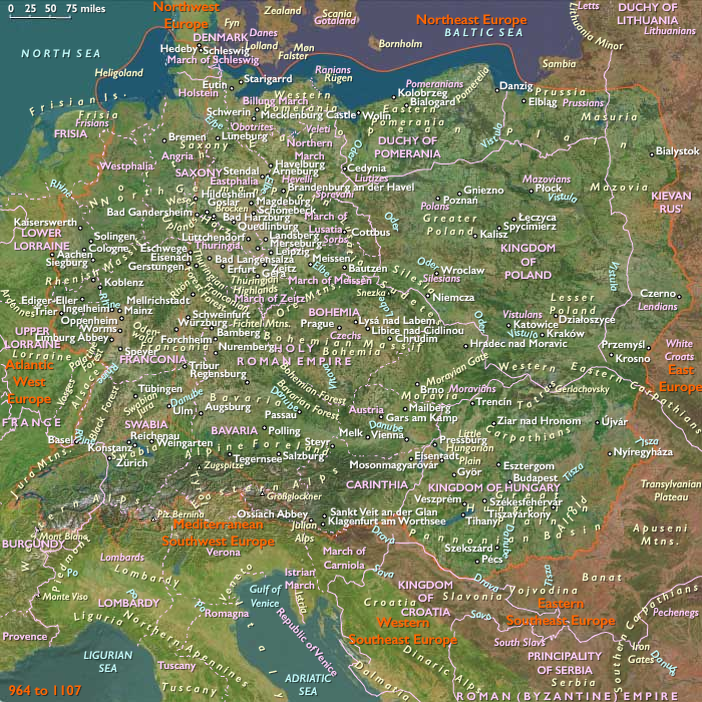
By 959, Bruno the Great, the Duke of Lotharingia and Archbishop of Cologne, makes a critical administrative decision that permanently ends the unity of Lotharingia. As one of the last dukes of the whole region, Bruno appoints two local nobles, Frederick and Godfrey, as margraves, effectively splitting the duchy into Upper and Lower Lotharingia.
Background: Lotharingia’s Shifting Allegiances
- Originally part of Middle Francia, Lotharingia had long been contested between East and West Francia since the Treaty of Meerssen (870) and the Treaty of Ribemont (880).
- It had shifted from East Francia (Germany) to West Francia (France) and back again, remaining a hotly disputed territory.
- Under Bruno’s rule, Lotharingia was stabilized as part of the Holy Roman Empire, but its vast size and strategic importance made it difficult to govern as a single duchy.
The Division of Lotharingia (959)
To ensure more effective rule, Bruno appoints:
- Frederick I as Margrave of Upper Lotharingia, later recognized as Duke of Upper Lorraine.
- Godfrey I as Margrave of Lower Lotharingia, later known as Duke of Lower Lorraine.
This administrative division is meant to improve governance and military defense but ultimately results in:
- The permanent split of Lotharingia into two distinct duchies.
- A further weakening of centralized control, as regional lords gain more autonomy.
- Continued fragmentation, making Lotharingia a battleground for German, French, and local noble interestsin the following centuries.
Legacy: The Last Duke of a United Lotharingia
- Bruno is one of the last rulers to control all of Lotharingia as a single entity.
- His decision in 959 shapes the future of the region, ensuring that Upper and Lower Lorraine evolve as separate feudal entities.
- This fragmentation reinforces feudal decentralization, marking another step toward the eventual dissolution of the Carolingian world and the rise of independent regional powers.
With Bruno’s death in 965, the once-mighty Lotharingia is permanently divided, reflecting the broader breakdown of centralized authority in medieval Europe.
The Division of Hugh the Great’s Lands and Lothair’s Regency (956–960)
Following the death of Hugh the Great in 956, King Lothair of West Francia is forced to mediate between Hugh’s sons—the powerful Hugh Capet and his younger brothers Otto and Henry—to prevent internal conflict among the most influential noble family in France. This period sees:
- The division of Hugh the Great’s vast territories between his sons.
- Lothair coming under the guardianship of his maternal uncle, Bruno of Cologne, reinforcing Ottonian influence over West Francia.
The Division of Hugh the Great’s Domains (956–960)
To maintain stability and avoid a civil war, Lothair makes the following decisions:
-
Hugh Capet, the eldest son, receives:
- The County of Paris
- The Duchy of the Franks (dux Francorum), the highest noble title in West Francia
- Control over much of Neustria and the Loire Valley
-
Otto of Burgundy (younger brother of Hugh Capet) is invested in 960 as Duke of Burgundy, controlling:
- The Duchy of Burgundy, ensuring its autonomy from Neustria.
-
Henry, the youngest brother, does not receive an immediate duchy but is a key member of the family’s growing influence.
This division ensures that the powerful Robertian family remains dominant, though Hugh Capet emerges as the most powerful of the brothers.
Lothair’s Guardianship Under Bruno of Cologne (956–965)
- With Hugh Capet still consolidating power, Lothair, who had ascended the throne in 954 at age 13, falls under the influence of his maternal uncle, Bruno, Archbishop of Cologne and Duke of Lotharingia.
- Bruno serves as regent, reinforcing Ottonian control over West Francia, as he is also the younger brother of Otto I, Holy Roman Emperor.
- This allows the Holy Roman Empire to maintain a strong presence in Frankish affairs, ensuring Lothair remains politically weak while the Robertians grow stronger.
Consequences of This Power Shift
-
Hugh Capet Establishes the Foundation of the Capetian Dynasty
- Now controlling Paris and Neustria, Hugh Capet emerges as the dominant noble in West Francia, a position he will hold until his eventual rise to the throne in 987.
-
Burgundy Becomes Semi-Independent
- The duchy is now separate from Neustria, meaning West Francia’s royal power is further decentralized.
-
Ottonian Influence Over West Francia
- With Bruno of Cologne as Lothair’s guardian, the Holy Roman Empire has a strong political grip over West Francia.
- This prevents Lothair from acting independently until Bruno’s death in 965.
Conclusion: A Step Toward the Capetian Takeover
While Lothair technically remains king, the division of Hugh the Great’s lands strengthens the Robertians, particularly Hugh Capet, who emerges as the most powerful noble in France. Meanwhile, Ottonian influence over West Francia grows through Bruno of Cologne’s regency, ensuring that Lothair’s rule remains weak and dependent on external forces. This balance of power will eventually lead to the downfall of the Carolingian dynasty and the rise of the Capetians in 987.
Richard I of Normandy’s Alliance with the Capetians and the Battle of Rouen (962)
By 962, Richard I of Normandy had strengthened his political position through his marriage to Emma, the daughter of Hugh the Great and Hedwig of Saxony, connecting him to the rising Capetian dynasty. This dynastic alliance reinforced Norman ties to West Francia’s most powerful noble family, further securing Normandy’s integration into Frankish politics.
Theobald of Blois Attacks Rouen (962)
- Theobald I, Count of Blois, launches an assault on Rouen, Richard’s capital and the heart of Norman power.
- The attack is likely motivated by Theobald’s rivalry with Normandy and his desire to weaken Richard’s influence.
- However, the Normans successfully repel Theobald’s forces, preventing them from crossing the Seine and dealing a humiliating defeat to Blois’ army.
King Lothair Intervenes to Prevent Further War
- Following Theobald’s failed attack, King Lothair of West Francia steps in to prevent a prolonged conflictbetween Normandy and Blois.
- Lothair’s intervention suggests that he:
- Seeks to maintain stability in northern France, avoiding a protracted noble war.
- Recognizes Richard’s growing power, as Normandy’s alliance with the Capetians strengthens his political legitimacy.
- Prefers to mediate between rival nobles, preventing either Blois or Normandy from gaining too much influence.
Consequences of the Battle of Rouen (962)
-
Normandy Emerges Victorious and Strengthens Its Position
- Richard I’s defeat of Theobald reinforces Norman military strength and political autonomy.
- Normandy remains a key power in northern France, expanding its influence within West Francia.
-
Theobald of Blois Suffers a Major Setback
- Having failed to take Rouen, Theobald’s ambitions in Normandy are permanently thwarted.
- His defeat ensures that Normandy remains independent of Blois’ influence.
-
Strengthening Norman-Capetian Ties
- Richard’s marriage to Emma of Capet ties him directly to Hugh Capet’s family, foreshadowing the growing alliance between Normandy and the future Capetian monarchy.
Conclusion: Normandy Holds Its Ground
The Battle of Rouen in 962 marks a critical moment in Norman history, as Richard I successfully defends his domain against Theobald of Blois. With King Lothair stepping in to prevent further conflict, Normandy’s political stability is ensured, allowing Richard to further strengthen Norman autonomy and his ties to the Capetian dynasty—an alliance that will shape the future of French and English history.
The Troubled History of the Duchy of Burgundy Begins (c. 952–1002)
The Duchy of Burgundy, which will experience centuries of contested rule, begins its long and complex history under Hugh the Black (d. 952). His rule and succession shape the duchy’s political trajectory, particularly in relation to the Robertians and the Capetians, who seek to assert dominance over Burgundy but ultimately fail to incorporate it into their domains.
Hugh the Black and the Succession of Gilbert of Chalon (c. 952)
- Hugh the Black, brother of King Rudolph of West Francia, ruled Burgundy until his death in 952.
- It is uncertain whether Hugh ever married or had children, as he was succeeded by Gilbert of Chalon, who ruled Burgundy jure uxoris (by right of his wife, Ermengard).
- Ermengard was the daughter of Richard of Autun and the sister of Hugh the Black, ensuring that the ducal title remained within the Burgundian noble family.
Robertian Ambitions and the Struggle for Burgundy
- The Robertian family, rulers of Neustria and Francia, seek to bring Burgundy under their control to strengthen their position against the Carolingians.
- However, their efforts to subject Burgundy to their suzerainty fail, as the duchy remains an autonomous political entity.
- The Robertians are forced to abandon the direct annexation of Burgundy, instead maintaining it as a separate duchy, while ensuring that it remains under Capetian influence.
Capetian Dukes of Burgundy: Otto and Henry the Venerable
- As the Capetian dynasty rises to power in France, two brothers of Hugh Capet, the first Capetian king, take control of Burgundy:
- Otto (Duke of Burgundy, 956–965) → Maintains Burgundian independence while remaining loyal to his brother Hugh Capet.
- Henry the Venerable (Duke of Burgundy, 965–1002) → His reign continues Burgundy’s semi-independent status, balancing Capetian influence with local Burgundian autonomy.
- Both Otto and Henry ensure that Burgundy remains a distinct political unit, rather than being absorbed directly into the Capetian royal domain.
The Defining Moment: The Death of Henry the Venerable (1002)
- The death of Henry the Venerable without children in 1002 marks a major turning point in Burgundian history.
- His lack of an heir creates a succession crisis, leading to contested claims over the duchy.
- This event sets the stage for a long struggle over Burgundian independence, shaping its role in medieval French and European politics.
Conclusion: Burgundy’s Complex Relationship with the Capetians
Though the Robertians and later the Capetians sought to incorporate Burgundy into their domain, the duchy remains independent under local rulers. The death of Henry the Venerable in 1002 will spark a defining moment in Burgundian history, leading to rival claims and further struggles for control. Burgundy’s distinct identityensures that it remains a powerful feudal state, playing a key role in the political conflicts of medieval France.