Æthelberht of Kent
king of Kent
Years: 560 - 616
Æthelberht (also Æthelbert, Aethelberht, Aethelbert, or Ethelbert) (c. 560 – 24 February 616) is King of Kent from about 580 or 590 until his death.
In his Ecclesiastical History of the English People, the eighth-century monk Bede lists Aethelberht as the third king to hold imperium over other Anglo-Saxon kingdoms.
In the late ninth century Anglo-Saxon Chronicle, Æthelberht is referred to as a bretwalda, or "Britain-ruler".
He is the first English king to convert to Christianity.
He was the son of Eormenric, succeeding him as king, according to the Chronicle.
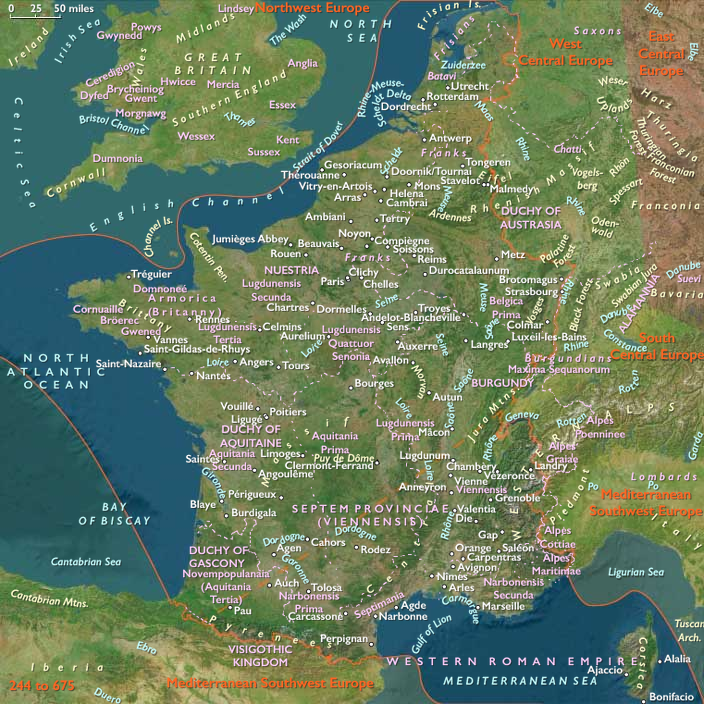
He marries Bertha, the Christian daughter of Charibert, king of the Franks, thus building an alliance with the most powerful state in contemporary Western Europe; the marriage probably took place before Æthelberht came to the throne.
The influence of Bertha may have led to the decision by Pope Gregory I to send Augustine as a missionary from Rome.
Augustine lands on the Isle of Thanet in east Kent in 597.
Shortly thereafter, Æthelberht is converted to Christianity, churches are established, and wider-scale conversion to Christianity begins in the kingdom.
Æthelberht provides the new church with land in Canterbury, at what comes to be known as St Augustine's Abbey.
Æthelberht’s law for Kent, the earliest written code in any Germanic language, institutes a complex system of fines.
These can be found in the Textus Roffensis (circa 1120).
Kent is rich, with strong trade ties to the continent and, it may be that Æthelberht instituted royal control of trade.
For the first time following the Anglo-Saxon invasion, coins begin circulating in Kent during his reign.
Æthelberht later was canonized for his role in establishing Christianity among the Anglo-Saxons, as were his wife and daughter.
His feast day originally was 24 February, but was changed to 25 February.