Sverre of Norway
King of Norway
Years: 1145 - 1202
Sverre Sigurdsson (c. 1145/1151 – 9 March 1202) is King of Norway from 1177 to 1202.
He marries Margareta Eriksdotter, the daughter of the Swedish king Eric IX, by whom he has the daughter Kristina Sverresdotter.
Many consider him one of the most important rulers in Norwegian history.
He assumes power as the leader of the rebel group, the Birkebeiners, during their struggle against King Magnus Erlingsson.
After Magnus falsl at the Battle of Fimreite in 1184, Sverre rules as sole king of Norway.
Differences with the Church, however, lead to his excommunication in 1194.
Another civil war begins against the church-supported Baglers, which lasts beyond Sverre's death in 1202.
The most important historical source on Sverre’s life is his biography, Sverris saga, in part written while Sverre was alive.
This saga is likely biased, since the foreword states that part was written under Sverre’s direct sponsorship.
Correspondence between the Pope and the Norwegian bishops can be used as an alternate source when it comes to church affairs.
The saga and the letters mostly agree about the hard facts.
Supposedly, King Sverre was short, so he usually directed his troops from horseback during battles.
The contrast is great to the traditional Norse warrior ideals where the king was expected to lead his men from the front of the battle line.
Sverre was a talented improviser, both in political and military life.
His innovative tactics often helped the Birkebeiners against more tradition-bound opponents.
During battle he had his men operate in smaller groups, while previously tactics similar to the shield wall had been preferred.
This made the Birkebeiners more mobile and adaptable.
Related Events
Filter results
Showing 10 events out of 10 total
Magnus Erlingsson, probably born in Etne in Hordaland, is the son of Erling Skakke, a Norwegian nobleman who earned his reputation crusading with Rögnvald Kali Kolsson, the Earl of Orkney.
His mother was Kristin Sigurdsdatter, daughter of king Sigurd Jorsalfare, who was king of Norway from 1103 to 1130.
Magnus Erlingsson, named king in 1161 at the age of eight, is the first Norwegian king to be crowned.
Since Magnus was a minor, his father Erling took the title of earl and held the real power and continues to be the country’s real ruler even after Magnus has come of age.
Sigurd Agnhatt and his foster son Olav Ugjæva had raised a force in Oppland in 1166 and had Olav proclaimed king, while earl Erling Skakke was away in Denmark.
Olav is the son of Maria Øysteinsdotter, the daughter of former king Øystein Magnusson.
After Erling returned to Norway to fight this uprising, Olav and his men had attacked Erling in an ambush at Rydjokul in Sørum.
Erling was wounded and barely escaped.
Olav and his men venture south in 1168 to the Oslofjord area, but are there defeated in battle at Stanger in Våler.
Sigurd is killed in the battle, but Olav escapes and goes to Denmark.
Sverre, an illegitimate son of Norway’s King Sigurd born in mid-century in a time of civil war, is raised as a commoner and educated for the priesthood.
When told of his true heritage, he goes to Norway in 1174 and fights for the throne, with the support of a populist faction called the Birkebeiners.
Sverre in June 1177 first leads his men to Trøndelag, where he is proclaimed as king.
Earl Erling Skakke's position is compromised and he falls at the Battle of Kalvskinnet outside Nidaros in 1179.
The battle changes the tide of the civil wars.
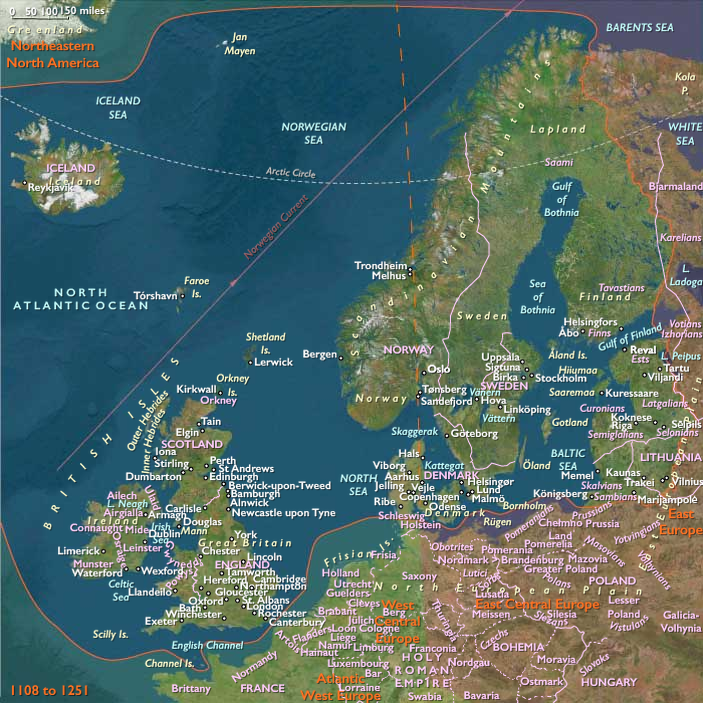
Northwest Europe (1180–1191 CE): Power Struggles and Territorial Consolidation
England: The Later Years of Henry II
The later reign of Henry II (1154–1189) continued to be marked by family conflict and administrative advancement. His sons, notably Richard I (the Lionheart) and John, remained contentious figures, frequently challenging their father's authority. Despite internal family strife, Henry further developed England’s administrative structures, reinforcing the legal foundations established earlier. His death in 1189 paved the way for Richard I, renowned for his military prowess and engagement in the Third Crusade, which began immediately upon his accession.
Scotland: Reaffirmation of Sovereignty under William the Lion
William the Lion (r. 1165–1214), following his humiliation under the Treaty of Falaise, gradually re-established Scottish autonomy. The period saw William negotiating carefully to regain castles and lands lost to English control. The relationship with England improved after Richard I ascended to the English throne, resulting in the Quitclaim of Canterbury (1189), in which Richard formally relinquished the overlordship claims established by the Treaty of Falaise, significantly restoring Scottish independence.
Ireland: Anglo-Norman Consolidation and Expansion
Anglo-Norman presence in Ireland expanded steadily, consolidating power in regions such as Leinster and establishing significant settlements. Prince John, appointed Lord of Ireland by his father Henry II in 1185, launched a largely unsuccessful initial campaign characterized by poor leadership and strained relations with both Normans and native Irish rulers. Nevertheless, the period entrenched the Anglo-Norman presence, laying a complex foundation for subsequent centuries of English governance and cultural fusion.
Denmark: Stability under King Canute VI
Following the death of Valdemar I in 1182, his son Canute VI (r. 1182–1202) ascended to the Danish throne. Canute VI’s reign marked a period of stability and expansion, notably continuing successful military campaigns initiated by his father, significantly reinforcing Danish dominance in the Baltic region. His reign strengthened the kingdom internally, maintaining strong alliances with the Church and nobility.
Norway: Ongoing Civil Wars
Norway remained turbulent, with continued civil wars and rivalry among claimants to the throne. Sverre Sigurdsson emerged prominently, claiming descent from King Sigurd II and attracting widespread support. After a decisive victory in 1184, Sverre effectively solidified his position, becoming king. Despite this, tensions remained high, with ongoing conflicts against various noble and ecclesiastical factions.
Iceland and the North Atlantic: Cultural Continuity
Iceland continued its cultural flourishing during this period, maintaining independence and societal stability. The Althing, the island's democratic assembly, remained active in managing disputes and governance. Icelandic literature thrived, preserving traditions, law, and oral histories in sagas and chronicles, reinforcing the island’s distinct cultural identity.
Religious and Cultural Developments
Monastic institutions across Northwest Europe continued to thrive, contributing significantly to agriculture, learning, and culture. The Cistercian Order, in particular, expanded rapidly, establishing numerous influential monasteries. The commencement of the Third Crusade in 1189, prominently involving Richard I of England, reflected the era's intense religious and martial fervor, significantly influencing European politics and society.
Legacy of the Era
By 1191 CE, Northwest Europe was shaped by significant territorial realignments and evolving political structures. Richard I’s accession transformed England's international role through crusading zeal, Scotland regained substantial independence under William the Lion, and Anglo-Norman influence firmly rooted itself in Ireland. Denmark experienced sustained stability under Canute VI, and Norway transitioned toward relative stability under Sverre Sigurdsson. Iceland continued its role as a cultural bastion, preserving traditions amidst broader geopolitical shifts.

The forces of Sverre attack the fleet of King Magnus on June 15, 1184, off the coast near the hamlet of Fimreite in the long and narrow Sognefjord in today's Sogndal municipality, Sogn og Fjordane county.
Magnus has several large ships, but none as huge as the Mariasuda, which Sverre has built.
Because of its great size, the seaworthiness of the Mariasuda is rather poor and it will only be useful within the narrow fjords.
The ships in the fleet of King Magnus are lashed together, creating the appearance of one big fleet.
While the Mariasuda holds up half of the enemy fleet, the rest attack the outlying enemy ships.
Sverre Sigurdsson sends his ships into battle in squadrons, to charge and overwhelm on one ship at a time, forcing Magnus's men to jump over to the next.
As the battle proceeds, the remaining ships become extremely crammed, then start to sink from the added weight.
King Magnus V is reported to have gone down with one of the last of them.
After Magnus' death, Sverre becomes the sole sovereign of Norway.
The civil war era in Norway does not end with this victory, however.
Sigurd Magnusson, Inge Magnusson and Erling Steinvegg will come forth eventually, all stating to be sons of Magnus and claiming the Norwegian throne.
Sverre, successful in his decade-long struggle for the Norwegian throne, is in 1184 acknowledged as sole king.
He creates a new nobility and replaces an aristocratic administration with royal officials.
Several more years of civil warfare in Norway end with Magnus' defeat and death in the Battle of Fimreite on June 15, 1184.
Sverre attacks Magnus' fleet, sending his ships into battle in squadrons, to charge and overwhelm on one ship at a time, forcing Magnus' men to jump over to the next.
As the battle proceeds, the remaining ships become extremely crammed, and then start to go down because of the weight.
King Magnus is reported to have gone down on one of the last of them.
After Magnus' death, Sverre becomes the sole sovereign of Norway.
However, the civil war era in Norway does not end with this victory.
After the death of Magnus, Sigurd Magnusson, Inge Magnusson and Erling Steinvegg come forward, all stating themselves to be sons of Magnus and claiming the Norwegian throne.
Northwest Europe (1192–1203 CE): Crusades, Intrigue, and Political Shifts
England: The Absentee Reign of Richard I
Richard I (the Lionheart) (r. 1189–1199), though crowned King of England, spent much of his reign abroad, primarily engaged in the Third Crusade and military campaigns in France. His prolonged absence led to the strengthening of royal administration and the rise of capable administrators, notably Hubert Walter, Archbishop of Canterbury. Richard’s captivity in 1192–1194 by the Holy Roman Emperor Henry VI strained the kingdom financially due to the heavy ransom required for his release. Upon Richard’s death in 1199, his brother John ascended the throne, beginning a turbulent reign marked by internal dissent and territorial losses.
Scotland: Strengthened Sovereignty
William the Lion (r. 1165–1214) continued to solidify Scottish independence through effective administration and strategic diplomacy. Following the restoration of sovereignty from the Quitclaim of Canterbury, William invested in strengthening royal authority and reorganizing legal and administrative structures, laying lasting foundations for Scottish statehood.
Ireland: Intensified Anglo-Norman Expansion
Under the rule of Prince John (r. as Lord of Ireland from 1177, as King of England from 1199), Anglo-Norman expansion and consolidation intensified. Though initially unpopular due to harsh taxation and military failures, John’s reign saw the further entrenchment of Norman power, particularly in the regions surrounding Dublin, Munster, and Leinster. The era was marked by the construction of significant fortifications and towns, further embedding Norman influence.
Denmark: Expansion under Valdemar II
Following Canute VI's stable reign, his brother Valdemar II (r. 1202–1241) succeeded to the Danish throne. Known as Valdemar the Victorious, he aggressively expanded Danish control into northern Germany and the Baltic region. His early reign marked Denmark's peak as a regional power, with strengthened centralized authority and extensive territorial expansion.
Norway: Sverre's Consolidation of Power
King Sverre Sigurdsson (r. 1184–1202) continued to consolidate his reign over Norway, overcoming significant opposition from ecclesiastical and noble factions. His rule was characterized by strengthening royal power, reorganizing the military, and resisting Church dominance. Sverre’s death in 1202 left Norway more unified yet still vulnerable to internal factionalism.
Iceland: Flourishing Commonwealth
Iceland maintained its cultural vibrancy, continuing as a center of learning and literature. The period saw the development of significant literary works, including sagas that preserved Norse heritage. Political stability remained under the Althing’s governance, sustaining Icelandic independence and autonomy.
Religious and Cultural Movements
The end of the Third Crusade (1189–1192) significantly impacted religious sentiments across Northwest Europe. Though the crusade had mixed results, the period inspired a wave of religious enthusiasm, pilgrimage, and increased clerical influence. Monastic institutions, particularly the Cistercians, flourished further, contributing significantly to agricultural and economic advancements.
Legacy of the Era
By 1203 CE, Northwest Europe had experienced significant political and territorial shifts. England transitioned to the controversial reign of King John following Richard’s turbulent absentee rule. Scotland further solidified its independence under William the Lion. Anglo-Norman power expanded and embedded deeply into Irish society. Denmark experienced its height as a Baltic power under Valdemar II, and Norway stabilized under Sverre’s authoritative rule. Iceland continued its role as a significant cultural and literary center, maintaining autonomy amidst shifting regional dynamics.
Norway’s King Sverre’s strong hand in ruling the church leads Pope Innocent III to excommunicate him and lay Norway under interdict.
Northwest Europe (1204–1215 CE): Struggles for Power and Territorial Reconfigurations
England: Magna Carta and Rebellion
The reign of King John (r. 1199–1216) was marked by political turmoil, territorial losses, and clashes with the nobility. John's failed campaigns to reclaim territories in France, notably Normandy in 1204, weakened his authority and led to heavy taxation at home. His strained relationship with the barons culminated in rebellion, forcing him to seal the Magna Carta in 1215, a pivotal document limiting royal authority and establishing fundamental legal protections.
Scotland: Continued Stability and Expansion
Under William the Lion (r. 1165–1214), Scotland maintained its internal stability and territorial integrity. William effectively managed alliances with English nobles and skillfully navigated tensions with King John, preserving Scotland's sovereignty. His death in 1214 transitioned power smoothly to his son, Alexander II, ensuring continued stability and laying groundwork for further consolidation of Scottish royal power.
Ireland: Anglo-Norman Integration and Resistance
In Ireland, Anglo-Norman lords expanded their territories and strengthened control through the building of fortresses and establishment of towns. Yet, resistance persisted from Gaelic Irish clans. The period witnessed ongoing conflict, with alliances forming and dissolving between Norman settlers and native rulers, creating a complex landscape of power dynamics throughout the island.
Denmark: Dominance and Expansion under Valdemar II
Valdemar II (the Victorious) (r. 1202–1241) consolidated Danish supremacy in the Baltic region through military conquests and diplomatic alliances. His capture of key strategic locations such as Estonia in 1219 further elevated Denmark’s regional power. Domestically, Valdemar's reign was characterized by administrative reforms and strengthened royal authority.
Norway: Succession and Civil Strife
After Sverre Sigurdsson's death in 1202, Norway faced renewed internal conflict and civil strife. Sverre's successors struggled to maintain his centralized authority, as disputes erupted between rival factions, notably the Baglers and Birkebeiner. King Inge Bårdsson (r. 1204–1217) sought to stabilize the kingdom but faced continual challenges and periodic violence, undermining Norway’s unity.
Iceland: Continued Cultural Achievement
Iceland continued to flourish culturally during this era, maintaining its unique political system governed by the Althing. Literary achievements, including the recording and preservation of Norse sagas, underscored the island’s cultural vibrancy. Icelandic autonomy and relative peace allowed cultural and scholarly pursuits to thrive.
Economic and Cultural Exchanges
Crusaders returning from the Holy Land introduced new commodities, notably sugar, which supplemented honey as Europe's primary sweetener. Venetian sugar estates near Tyre exported sugar to Europe, praised by chroniclers like William of Tyre for its health benefits. Almonds, cinnamon, ginger, and nutmeg were also imported, becoming valued additions to royal banquets and shaping the tastes of Europe's elite.
Religious and Cultural Developments
Throughout Northwest Europe, monastic orders, especially the Cistercians and the newly founded Franciscan order, expanded their influence. These groups emphasized poverty, preaching, and direct engagement with local populations, significantly influencing religious life and education throughout the region.
Legacy of the Era
By 1215 CE, Northwest Europe had witnessed transformative shifts. England’s Magna Carta became a cornerstone of constitutional governance. Scotland retained internal stability and independence, while Ireland experienced deepening Anglo-Norman settlement alongside resilient native resistance. Denmark reached new heights under Valdemar II, consolidating Baltic dominance. Norway, however, grappled with succession struggles, compromising national stability. Iceland sustained its cultural golden age, contributing lasting literary and historical legacies.