Sverker I of Sweden
King of Sweden
Years: 1100 - 1156
Sverker I or Sverker the Elder (murdered 25 December 1156) is King of Sweden from about 1130 till his death.
Related Events
Filter results
Showing 7 events out of 7 total
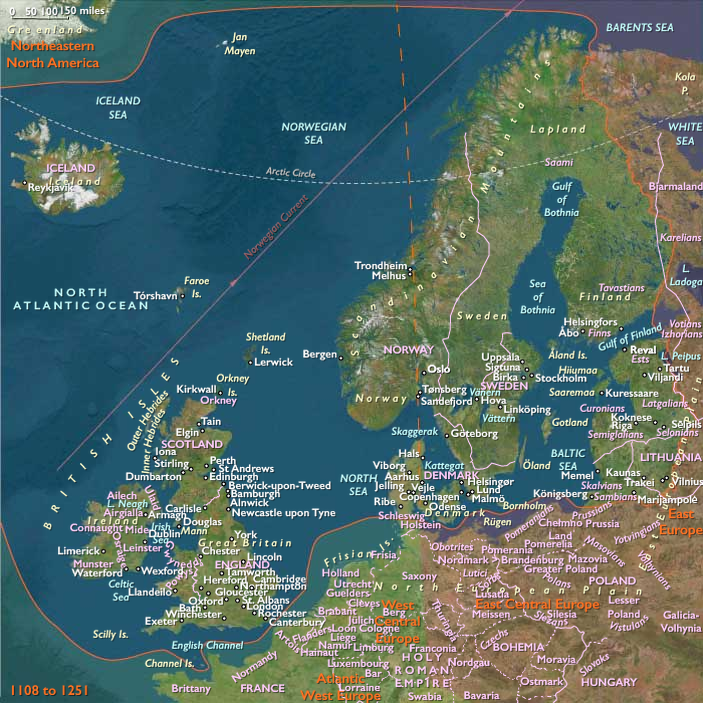
Northeast Europe (1132–1143 CE): Internal Struggles and Expansion of Christian Influence
Introduction
From 1132 to 1143 CE, Northeast Europe experienced significant internal political strife, further expansion of Christian missionary influence, and incremental urban growth. The period was marked by heightened dynastic rivalry, notably within Denmark and Sweden, alongside growing interactions—often conflictual—with neighboring Baltic populations.
Dynastic Struggles and Monarchical Consolidation
In Denmark, King Niels faced escalating internal opposition from rival claimants to the throne, particularly from his nephew, Erik Emune. The rivalry culminated in a destructive civil conflict, weakening central authority and contributing to internal instability that persisted throughout the era.
In Sweden, dynastic disputes intensified between the Sverker and Erik families. King Sverker I (ascended ca. 1130) sought to strengthen royal authority amid considerable internal tensions. His reign was characterized by efforts to unify disparate territories, thus laying foundations for subsequent stable rule.
Early Baltic Crusades and Christianization Efforts
Danish and Swedish missionary efforts intensified along the Baltic coasts during this period, serving as precursors to the later, full-scale crusades of the late twelfth and early thirteenth centuries. These missions primarily targeted pagan populations, notably in areas that would become Estonia and Finland. Initial contacts, though often hostile, gradually increased Scandinavian presence and cultural influence along Baltic shores.
Urban and Economic Development
The era witnessed further growth of emerging urban centers. Visby on Gotland continued to solidify its status as a pivotal Baltic trade hub, facilitating commerce between Scandinavia, the Baltic peoples, and the broader European continent. Similarly, towns such as Roskilde and early iterations of Stockholm and Lund saw modest but steady development, influenced by expanding regional trade networks and local artisan guilds.
Resistance and Fortification among the Baltic Tribes
Baltic tribes intensified defensive efforts against expanding Scandinavian incursions. Ancestors of the Estonians, Latvians, and Lithuanians fortified settlements and increasingly organized resistance. Early Scandinavian attempts to penetrate these regions, though limited in scope, fostered a tradition of fierce resistance among local populations, laying the groundwork for more structured resistance in subsequent decades.
Ecclesiastical Expansion and Cultural Influence
The growth of ecclesiastical institutions continued, particularly through monastic foundations such as Benedictine and early Cistercian monasteries. These institutions played central roles in local education, Latin literacy, and ecclesiastical governance. Christianity gradually permeated deeper into social life, influencing legal practices, cultural norms, and regional governance.
Legacy of the Era
The era from 1132 to 1143 CE significantly shaped Northeast Europe's future through intensified dynastic conflicts, preliminary missionary activities, and growing urban centers. It marked the gradual extension of Christian influence and set foundational precedents for intensified regional interactions, conflicts, and crusading efforts that would decisively shape the historical trajectory of the Baltic and Scandinavian lands.
Eric, born around 1090 to king Eric I of Denmark and an unknown concubine, had been given some Danish isles by his half-brother Canute Lavard, and was jarl of Møn, Lolland, and Falster.
When Lavard was murdered in 1131, Eric had joined his half-brother Harald Kesja in a rebellion against the responsible king Niels of Denmark.
Eric had been elected Danish Antiking in Scania in April 1131, prompting Kesja to support Niels in jealousy.
Eric's army had lost several battles against Niels and his son Magnus the Strong, including Jelling in Jutland in 1131 and Værbro on Zealand, and he had fled to Scania.
His retreat had earned him the nickname Harefoot.
Eric had unsuccessfully tried to convince Lothair III, Holy Roman Emperor, to support his bid for kingship, and had had no luck asking Magnus IV of Norway for help.
He returns to Scania in 1134, where Archbishop Asser of Lund joins his cause, and Lothair eventually supports him as well.
Magnus, Margaret Fredulka’s son by King Niels of Denmark, had in 1125 claimed the Swedish throne as the eldest grandson of Inge the Elder at the death of Margaret's first cousin King Inge the Younger.
Magnus had been recognized by the Geats (Göterna) of Gothenland, but according to the Westrogothic law, had to be accepted also by the Swea, another tribe to the north of the Geats.
The Swea, however, had selected Ragnvald Knaphövde.
According to Saxo Grammaticus, Ragnvald had shown disrespect towards the Geats by not taking a Geat hostage.
As retaliation, Ragnvald had been murdered by Magnus's supporters not long after.
Magnus in around 1127 had married Richeza, daughter of Boleslaw III of Poland.
Magnus had in 1130 backed Boleslaw III in conquering Rügen.
The Polish forces, together with a Danish fleet, had compelled the Rani to recognize Polish rule over the island.
Magnus is not mentioned as King in the law of Västergötland and was probably ousted from Sweden by his successor Sverker I of Sweden around 1130.
Magnus had in 1131 arranged the murder of his cousin and potential rival for the Danish throne, Canute Lavard, in order to position himself as heir presumptive to his father King Niels.
Although Magnus is eventually backed by Niels, he finds himself in a civil war against Lavard's half-brother Eric Emune.
King Niels has his strongest base of support in Jutland, and the church also supports him.
Moreover, he has secured support from the Holy Roman Empire by agreeing to subordinate the Danish Archdiocese of Lund in Scania to the German Archdiocese of Hamburg-Bremen, which had prompted Archbishop Asser of Lund to support Eric.
Eric, proclaimed king at Scania's landsting assembly at St Liber's Hill, makes Lund his capital city.
With the resounding victory at Fotevik, Eric is given the nickname the Memorable to replace Harefoot.
Northeast Europe (1144–1155 CE): Royal Power, Early Northern Crusades, and Emerging Conflict
Introduction
Between 1144 and 1155 CE, Northeast Europe was shaped by intensified crusading zeal, consolidation of royal power, and growing conflict between Christian kingdoms and neighboring pagan tribes. This era witnessed the formal beginnings of the Northern Crusades, aimed at forcibly converting Baltic peoples to Christianity, significantly influencing future regional dynamics.
Strengthening of Royal Authority
In Denmark, following the turbulent reign and death of King Erik Emune (r. 1134–1137), his successor King Sweyn III Grathe (r. 1146–1157) struggled to maintain central authority amid persistent dynastic rivalry. Noble factions competed fiercely, weakening Denmark internally and diverting resources toward political conflict rather than external expansion.
In Sweden, King Sverker I (r. ca. 1130–1156) strengthened royal governance by consolidating control over previously fragmented territories. Sverker's reign stabilized internal politics, providing conditions conducive to early crusading missions and territorial consolidation.
Commencement of the Northern Crusades
This era marked the formal onset of the Northern Crusades, beginning around 1147, driven primarily by German crusaders and Scandinavian monarchs. These crusades targeted the forcibly conversion of pagan tribes including the Slavs, Balts, Estonians, and Finns to Christianity. The military and religious campaigns initiated in this era continued for centuries, profoundly shaping the political and cultural landscape of the Baltic region.
Notably, the legendary First Swedish Crusade around 1155, led by King Erik IX ("Saint Erik") and Bishop Henry of Uppsala, focused on Finland. Although historical specifics are limited and steeped in later tradition, this expedition symbolized Sweden's burgeoning ambitions for territorial and religious expansion eastward.
Economic Expansion and Urban Growth
Urbanization advanced notably during this period. The strategic trading center of Visby on Gotland enhanced its prominence as a key node in Baltic commerce. Additionally, Danish cities such as Roskilde and Lund saw incremental growth driven by thriving trade networks and merchant activities, foreshadowing their later centrality in regional economic life.
Baltic Resistance and Fortifications
Baltic tribes—including ancestors of modern Estonians, Latvians, and Lithuanians—resisted fiercely against incursions from crusaders. Fortified settlements expanded considerably, and local populations demonstrated a readiness to repel external threats. This active resistance laid the foundations for enduring regional conflicts, as Baltic tribes sought to preserve their autonomy and traditional beliefs against mounting external pressures.
Ecclesiastical Influence and Cultural Expansion
Ecclesiastical institutions, particularly monastic foundations such as the Cistercians, gained further prominence, fostering education, literacy, and religious reforms. The Church significantly shaped regional cultural norms, legal systems, and political institutions, reinforcing Christian influence in local governance.
Legacy of the Era
The era 1144–1155 CE critically impacted Northeast Europe's historical trajectory through intensified royal ambitions, the onset of the Northern Crusades, and persistent Baltic resistance. These developments initiated enduring patterns of religious conflict, territorial expansion, and cultural interaction that profoundly influenced Northeast Europe for generations to follow.
Sverker I, before becoming King of Sweden, had been a powerful landowner from Östergötland.
According to the Westrogothic law (1240), his father's name was Cornube, but according to Skáldatal, his father's name was Kol.
He was acknowledged as king at the beginning of 1130s, and conquered Västergötland from its ruler Magnus the Strong.
Sverker rules for about 26 years, but in spite of the long reign not much is known about him, other than that the convents and monasteries of Alvastra, Nydala and Varnhem are founded during this time.
According to a Russian chronicle, the newly founded Republic of Novgorod had its first confrontation with Sweden during Sverker's reign in 1142, thus breaking a centurylong peace that had been guaranteed by marriages between the earlier ruling families.
Sverker is murdered near his own coach at the Alebäck bridge near Alvastra priory, going to the early service on Christmas day, in 1156.
This is considered a shocking crime, even by medieval standards.
The pretender Magnus Henriksson is suspected of the crime.
Eric, a rival king, is subsequently recognized in most or all provinces.
Eric is murdered as he leaves the church in Uppsala on May 18, 1160.
He is said to have been murdered by Emund Ulvbane, an assassin who was hired by people working for the Sverker dynasty, in order for them to regain the control of the kingdom, or alternatively by Magnus Henriksson, another claimant, who is said in some sources to have succeeded him briefly as king.
Swedes believe a miracle occurred at Eric's death: a fountain is said to have sprung from the earth where the king's head fell after being chopped off.
Eric is soon worshiped as a saint, becoming known as Eric the Saint or Eric the Holy.
Though never formally canonized by the pope, he will eventually become the patron saint of Sweden.