Svatopluk I
ruler of Great Moravia
Years: 830 - 894
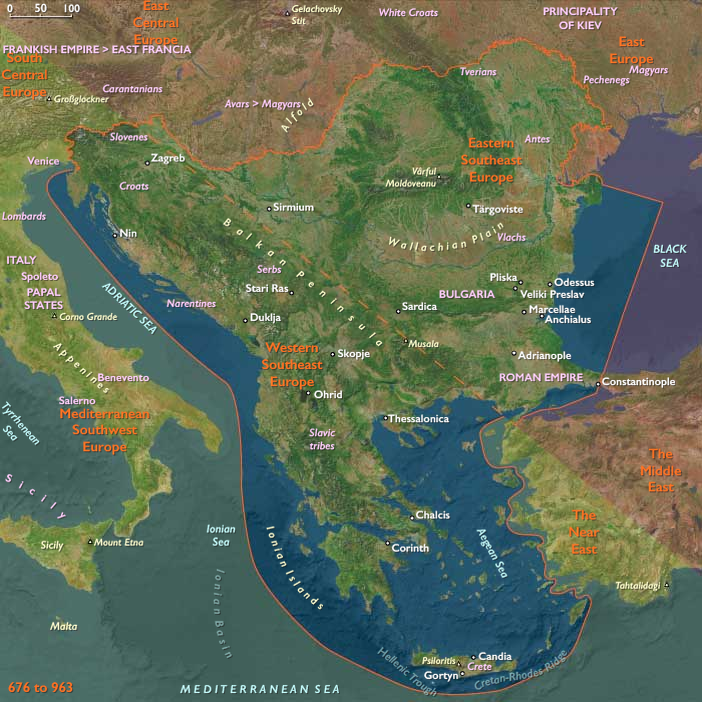
Svatopluk I or Zwentibald I is the ruler of Great Moravia, which attains its maximum territorial expansion in his reign (869 or 870–871, 871–894).
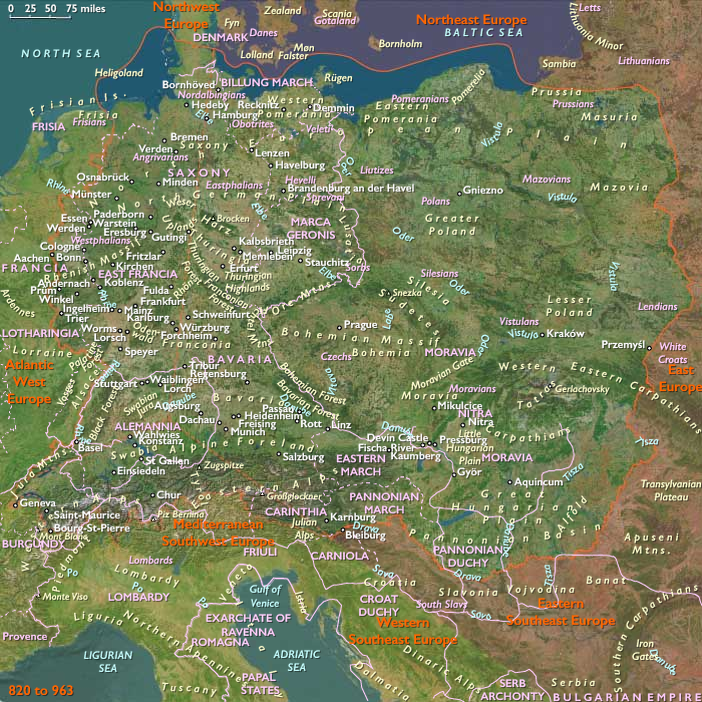
His career had already started in the 860s, when he governed a principality, the location of which is still a matter of debate among historians, within Moravia under the suzerainty of his uncle, Rastislav.
Svatopluk dethrones Rastislav, who is a vassal of Louis the German, and betrays him to the Franks in 869 or 870, but within a year he is also imprisoned by them.
Having been released due to the Moravians' rebellion against the Franks, Svatopluk joins the rebels and defeates the invaders.
Although he is obliged to pay tribute to East Francia according to the peace treaty concluded at Forchheim (Germany) in 874, he is able to expand in territories outside the Franks' sphere of interest in the following years.
His forces even invade the March of Pannonia within East Francia in 882.
Svatopluk establishes good relationship with the popes, thus he and his people are taken under the protection of the Holy See in 880.
[ Pope Stephen V even addresses him "king" in a letter written in 885.
In matters of religion, Svatopluk wants to appease the German clergy who oppose the liturgy officiated in Old Church Slavonic; therefore, Methodius's disciples are expelled from Moravia in 886, after their teacher's death.
Svatopluk's state is a loose structure of principalities and also includes conquered territories.Not long after his death, Svatopluk's "Great Moravia", as the Byzantine Emperor Constantine VII Porphyrogenetos will refer to it around 950, collapses due to the power struggle between his sons and the intensifying Hungarian raids.
Svatopluk, whose empire encompassed the whole or parts of the territory of modern Slovakia, has time to time been presented as a "Slovak king" in literary works since the eighteenth century, the period of the Slovak national awakening.