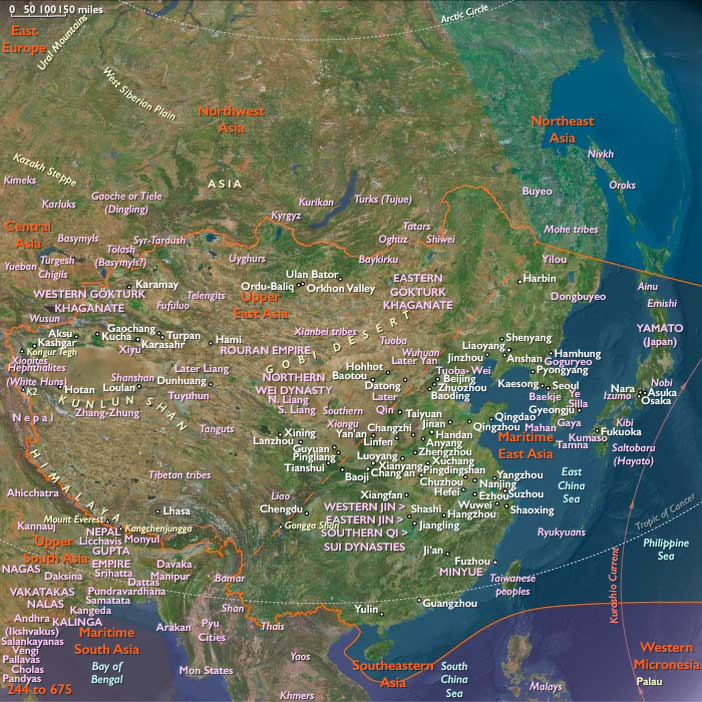
The region of Wu, in the south of the Yangtze River surrounding Nanjing, had during the decline of the Han dynasty been under the control of the warlord Sun Quan, who had succeeded his brother Sun Ce as the lord over the Wu region paying nominal allegiance to Emperor Xian of Han (who was, at that point, under the control of the warlord Cao Cao).
Sun Quan, unlike his competitors, lacked sufficient ambition ambition to be Emperor of China, and had ruled from 200 to 222 as Wu Wang (King/Prince of Wu).
After Cao Pi of the Kingdom of Wei and Liu Bei of the Kingdom of Shu each declared themselves to be the Emperor, Sun Quan had decided to follow suit in 229, claiming to have founded the Wu Dynasty.
Formally Emperor Da of the Wu Dynasty, one of the Three Kingdoms competing for control of China after the fall of the Han Dynasty, he dies in 252 and is succeeded by Sun Liang, his youngest son.
Southern China, regarded in early history as a barbaric "jungle", has developed under the rule of Eastern Wu into one of the commercial, cultural, and political centers of China.
The development of Southern China will surpass that of the north within five centuries, during the Five Dynasties and Ten States period.
The achievements of Wu mark the beginning of the cultural and political division between Northern and Southern China that will repeatedly appear in Chinese history well into modernity.