Stephen of Blois
King of England
Years: 1092 - 1154
Stephen (c. 1092/6 – 25 October 1154), often referred to as Stephen of Blois, is a grandson of William the Conqueror.
He is King of England from 1135 to his death, and also the Count of Boulogne in right of his wife.
Stephen's reign is marked by the Anarchy, a civil war with his cousin and rival, the Empress Matilda.
He is succeeded by Matilda's son, Henry II, the first of the Angevin kings.
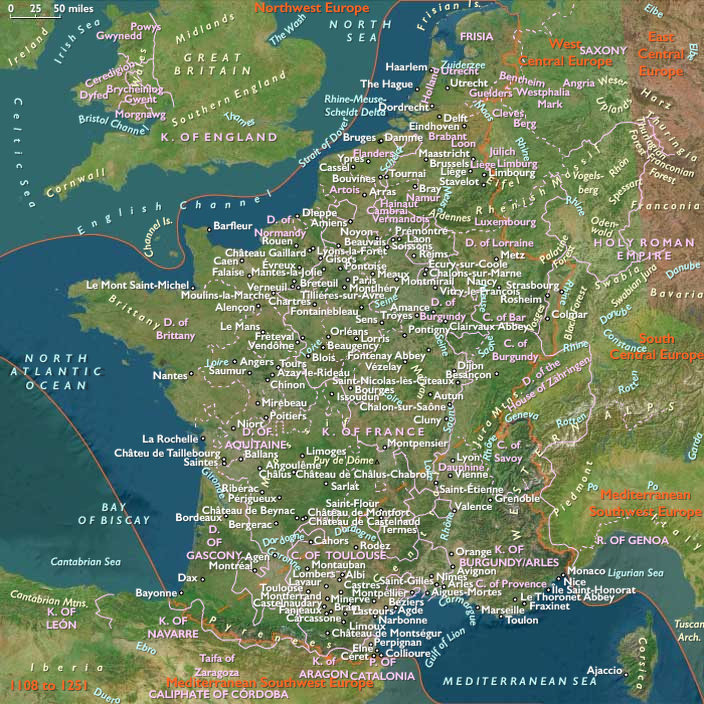
Stephen was born in the County of Blois in middle France; his father, Count Stephen-Henry, died while Stephen was still young, and he was brought up by his mother, Adela.
Placed into the court of his uncle, Henry I, Stephen rises in prominence and is granted extensive lands.
Stephen marries Matilda of Boulogne, inheriting additional estates in Kent and Boulogne that make the couple one of the wealthiest in England.
Stephen narrowly escapes drowning with Henry I's son, William Adelin, in the sinking of the White Ship in 1120; William's death leaves the succession of the English throne open to challenge.
When Henry I dies in 1135, Stephen quickly crosses the English Channel and with the help of his brother Henry of Blois, a powerful ecclesiastic, takes the throne, arguing that the preservation of order across the kingdom takes priority over his earlier oaths to support the claim of Henry I's daughter, the Empress Matilda.
The early years of Stephen's reign are largely successful, despite a series of attacks on his possessions in England and Normandy from David I of Scotland, Welsh rebels and the Empress Matilda's husband, Geoffrey of Anjou.
In 1138, the Empress's half-brother Robert of Gloucester rebels against Stephen, threatening civil war.
Together with his close advisor, Waleron de Beaumont, Stephen takes firm steps to defend England, including arresting a powerful family of bishops.
When the Empress and Robert invade in 1139, however, Stephen is unable to rapidly crush the revolt, which takes hold in the southwest of England.
Captured at the battle of Lincoln in 1141, Stephen is abandoned by many of his followers and loses control of Normandy.
Stephen is only freed after his wife and William of Ypres, one of his military commanders, capture Robert at the Rout of Winchester, but the war drags on for many years with neither side able to win an advantage.
Stephen becomes increasingly concerned with ensuring that his son, Eustace, will inherit his throne after him.
The king attempts to convince the church to agree to crown Eustace to reinforce his claim: Pope Eugene III refuses and Stephen finds himself in a sequence of increasingly bitter arguments with his senior clergy.
In 1153, the Empress's son, Henry FitzEmpress, invades England and builds an alliance of powerful regional barons to support his claim for the throne.
The two armies meet at Wallingford but neither side's barons are keen to fight another pitched battle.
Stephen begins to examine a negotiated peace, a process hastened by the sudden death of Eustace.
Stephen and Henry agree to the Treaty of Winchester later in the year, in which Stephen recognizes Henry as his heir in exchange for peace, passing over William, Stephen's second son.
Stephen dies the following year.
Modern historians have extensively debated the extent to which Stephen's personality, external events, or the weaknesses in the Norman state contributed to this prolonged period of civil war.