Stephen III of Moldavia
Voivode (Prince) of Moldavia
Years: 1433 - 1504
Stephen III of Moldavia, commonly known as Stephen the Great, (1433 – July 2, 1504) is Prince of Principality of Moldavia between 1457 and 1504, and the most prominent representative of the House of Mușat.
During his reign, he strengthens Moldavia and maintains its independence against the ambitions of Hungary, Poland, and the Ottoman Empire, which all seek to subdue the land.
Stephen achieves fame in Europe for his long resistance against the Ottomans.
He is victorious in forty-six of his forty-eight battles, and is one of the first to gain a decisive victory over the Ottomans at the Battle of Vaslui, after which Pope Sixtus IV deems him verus christianae fidei athleta (true Champion of Christian Faith).
He is a man of religion and displays his piety when he pays the debt of Mount Athos to the Porte, ensuring the continuity of Athos as an autonomous monastical community.
Related Events
Filter results
Showing 10 events out of 56 total
Southeast Europe (1396–1539 CE)
Ottoman Ascendancy, Balkan Frontiers, and the Fault Line of Christendom
Geography & Environmental Context
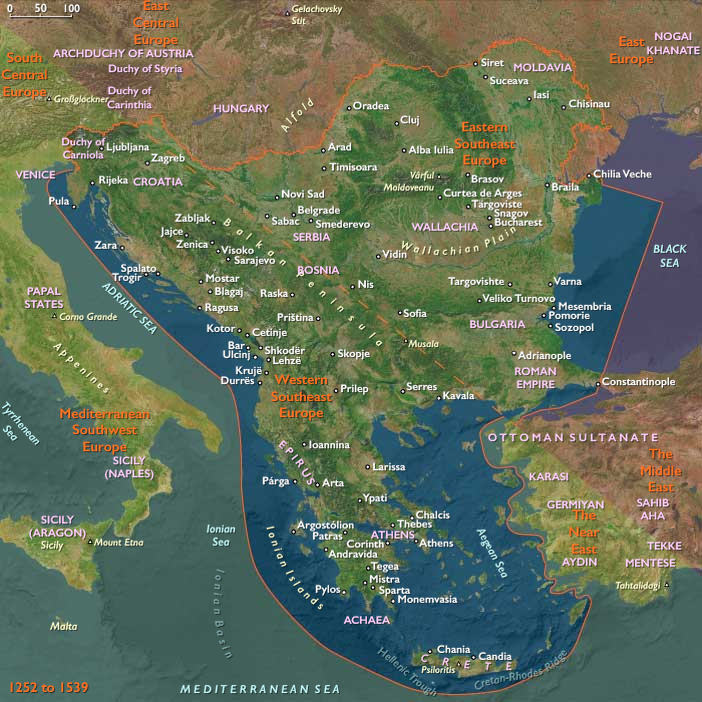
Southeast Europe in this era was a land of rivers, mountains, and fortified cities dividing Christian and Islamic worlds.
Eastern Southeast Europe stretched from Turkey-in-Europe and Thrace through Bulgaria, Moldova, and Romania to the Danube Delta—a landscape of river valleys, forest plains, and mountain ramparts feeding into the Bosporus and the Black Sea.
Western Southeast Europe encompassed Greece, Albania, Montenegro, North Macedonia, Kosovo, Bosnia, Croatia, and Slovenia, where the Dinaric Alps, Pindus, and Adriatic coasts met the mountain hinterlands of the Balkans.
This region formed the great hinge between Central Europe and the eastern Mediterranean, a crossroads of empires and faiths.
Climate & Environmental Shifts
The Little Ice Age cooled the region, tightening agricultural margins:
-
Danube Basin: Floods alternated with droughts, reshaping floodplain farming.
-
Carpathian & Balkan uplands: Heavy snow prolonged transhumance cycles; spring torrents enriched meadows.
-
Thrace & Aegean coasts: Frosts damaged olives and vines; Mediterranean crops retreated upslope.
-
Adriatic & Ionian Seas: Stormier seasons and colder currents complicated navigation and coastal trade.
Subsistence & Settlement
-
Plains & river valleys: Wheat, barley, rye, and millet formed staples; vineyards in Bulgaria and Thrace produced wine for local and export trade.
-
Uplands: Sheep, goats, and cattle moved along seasonal routes between the Carpathians, Balkans, and Dinaric Alps.
-
Coasts & islands: Olive oil, figs, salt, and fisheries supported maritime towns from Dubrovnik to Thessaloniki.
-
Mining zones: Bosnia and Serbia exported silver and lead via Dalmatian ports.
-
Urban nodes: Constantinople/Istanbul, Sofia, Iași, Belgrade, and Dubrovnik were vital centers of administration, craft, and exchange.
Technology & Material Culture
-
Agriculture: Iron-tipped plows and watermills improved productivity; Ottoman timar tenure reorganized rural estates.
-
Military: Gunpowder artillery transformed sieges; the Ottomans perfected field logistics and fortress artillery; local principalities deployed cavalry and wagon defenses.
-
Architecture: Frescoed Orthodox monasteries such as Voroneț and Humor adorned Moldavia; Ottoman mosques, baths, and bridges reshaped Balkan towns; Venetian Gothic façades persisted on the Adriatic.
-
Crafts: Balkan goldsmithing, woodcarving, and textile production continued under mixed Ottoman and local patronage.
Movement & Interaction Corridors
-
The Danube Corridor: Lifeline for armies, grain, and trade; fortresses like Belgrade and Vidin guarded crossings.
-
Via Egnatia & Balkan passes: Connected Adriatic ports with Thrace and Constantinople, sustaining overland caravans.
-
Black Sea–steppe routes: Linked Moldavia, Dobruja, and the Crimea, feeding Ottoman supply lines.
-
Adriatic and Aegean sea lanes: Carried Venetian, Ragusan, and Ottoman fleets, merchants, and pilgrims between Italy, Greece, and Anatolia.
-
Mountain and forest roads: Enabled transhumance and the smuggling of goods and people across imperial frontiers.
Cultural & Symbolic Expressions
-
Orthodox Christianity: Monasteries in Moldavia, Wallachia, Serbia, and Athos preserved liturgy, manuscript illumination, and identity under Ottoman rule.
-
Islamic urban culture: Mosques, caravanserais, and vakıf foundations spread through conquered towns, introducing Ottoman civic life.
-
Catholic & Humanist enclaves: Dalmatian cities like Zadar, Split, and Dubrovnik maintained Latin schools and libraries; émigré scholars from Constantinople brought Greek manuscripts to Italy, fueling the Renaissance.
-
Folk traditions: Heroic songs of Hunyadi, Skanderbeg, and Stephen the Great celebrated resistance; South Slavic and Albanian epics sustained oral memory.
-
Civic artistry: Icon painting, manuscript copying, and folk embroidery bridged church and household devotion.
Environmental Adaptation & Resilience
-
Agrarian diversity: Mixed grain, vine, and pastoral systems buffered risk; maize was still unknown but cereals diversified diets.
-
Transhumant mobility: Pastoralists followed snowmelt, shifting herds between alpine meadows and Danubian plains.
-
Forest refuge: Villages rebuilt after raids amid forest cover; woodlands supplied construction and fuel.
-
Maritime exchange: Salt, fish, and ship timber stabilized economies when inland fields failed.
-
Ottoman provisioning networks: Redirected Balkan surpluses toward Istanbul and garrisons, maintaining trade under imperial integration.
Technology & Power Shifts (Conflict Dynamics)
-
Ottoman victories:
-
Nicopolis (1396) and Varna (1444) shattered crusader resistance.
-
Constantinople fell in 1453, transforming it into Istanbul.
-
Belgrade (1521) and Mohács (1526) opened Hungary to Ottoman partition.
-
-
Danubian principalities: Wallachia and Moldavia maintained tributary autonomy; leaders like Mircea the Elderand Stephen the Great resisted Ottoman and Tatar incursions.
-
Crimean Tatars: Allied with the Ottomans, raided Moldavia, Poland, and Ukraine, feeding the Black Sea slave trade.
-
Western frontiers: Venice clashed with Ottoman fleets; Dubrovnik navigated neutrality and profit as intermediary; Skanderbeg’s Albanian revolt (1443–1468) became emblematic of mountain resistance.
-
Naval dominance: The Battle of Preveza (1538) secured Ottoman mastery of the Ionian and Aegean seas.
Transition (to 1539 CE)
By 1539, Southeast Europe had become the principal marchland of empire.
The Ottoman crescent stretched from the Danube to the Aegean and Adriatic, with Istanbul at its center.
Bulgaria, Thrace, Greece, and Bosnia were integrated into Ottoman administration; Wallachia and Moldavia paid tribute; Transylvania balanced between Habsburg and Ottoman influence.
The Adriatic remained contested—Venice held coastal enclaves, while Dubrovnik thrived as a neutral broker.
Amid conquest, Balkan peoples preserved faith, language, and tradition through monastery, market, and mountain refuge.
The age closed with the Battle of Preveza (1538) and Ottoman control of the eastern Mediterranean, confirming Southeast Europe as the heart of the empire’s European frontier—a landscape of faith, resistance, and imperial transformation.
Eastern Southeast Europe (1396–1539 CE): Ottoman Ascendancy, Danubian Principalities, and Balkan Crossroads
Geographic & Environmental Context
The subregion of Eastern Southeast Europe includes Turkey-in-Europe, Thrace-in-Greece, Bulgaria (except the southwest), Moldova, Romania, northeastern Serbia, northeastern Croatia, and extreme northeastern Bosnia and Herzegovina. Anchors included the Danube from the Iron Gates to its delta, the Wallachian and Moldavian plains, the Transylvanian and Carpathian margins, the Balkan and Rhodope ranges, and the Thracian plain leading to Constantinople/Istanbul. This was a meeting ground of steppe and forest, mountain fortresses and river valleys, bound by the Danube corridor and the Bosporus straits.
Climate & Environmental Shifts
The Little Ice Age cooled winters and shortened growing seasons.
-
Danube basin: spring floods inundated floodplains; summer droughts alternated with wet years, affecting grain surpluses.
-
Carpathian foothills & Balkan uplands: heavy snowpack fed torrents; pastoralists shifted grazing with snowmelt.
-
Thrace & Marmara lowlands: Mediterranean crops of vines and olives endured but suffered frost in severe winters.
Subsistence & Settlement
-
Rural farming: Wheat, barley, millet, and rye across Wallachia, Moldavia, and Thrace; vineyards in Bulgaria and Thrace; maize only arrived later.
-
Pastoralism: Sheep, cattle, and horses grazed on plains and upland meadows; transhumance between Carpathians and lowlands.
-
Towns & trade nodes: Constantinople/Istanbul, Sofia, Târgu Jiu, Bucharest (emerging), Iași, and Brașov; fortified citadels guarded Danube crossings.
-
Fishing & forests: Danube, Prut, and Dniester supplied sturgeon and carp; forests yielded honey, wax, and timber.
Technology & Material Culture
-
Agriculture: Wooden plows, iron-tipped tools, watermills; peasant strips and manorial estates persisted under Ottoman timar and local boyar systems.
-
Military: Cavalry and fortresses dominated warfare; Ottomans refined siege artillery; Moldavian and Wallachian hosts combined light cavalry with war wagons.
-
Crafts & architecture: Orthodox monasteries in Moldavia and Wallachia (Voroneț, Humor) painted with vivid frescoes; Ottoman mosques and baths began reshaping Balkan towns.
Movement & Interaction Corridors
-
Danube corridor: Lifeline for grain, salt, and armies; Brașov and Belgrade were major crossings.
-
Black Sea–steppe routes: Moldavia and Dobruja linked to Genoese colonies (until Ottoman conquest in 1475) and later Ottoman trade.
-
Balkan passes: Shipka and Iron Gates moved caravans between plains and coastal zones.
-
Ottoman expansion: After Battle of Nicopolis (1396) and Varna (1444), Ottomans pressed north; 1453 capture of Constantinople secured the Bosporus; Belgrade resisted until 1521.
Cultural & Symbolic Expressions
-
Orthodoxy: Wallachia, Moldavia, and Bulgaria maintained Orthodox liturgy, monasteries, and saints’ cults as centers of identity under Ottoman suzerainty.
-
Ottoman Islam: Spread in towns via mosques, markets, and administrative complexes; janissary garrisons became cultural nodes.
-
Humanism: Latin and Greek scholars fled Constantinople (1453), carrying manuscripts to Italy; Balkan literacy endured in monasteries.
-
Epic & folklore: Songs of resistance (Hunyadi, Skanderbeg) circulated; Moldavian chronicles preserved local memory.
Environmental Adaptation & Resilience
-
Farmers: Diversified between cereals, vineyards, and pastoralism; stored grain in earth cellars.
-
Pastoralists: Practiced flexible transhumance, moving flocks between Carpathian pastures and Danubian lowlands.
-
Villages: Rebuilt after raids with timber palisades; forests offered refuge.
-
Markets: Redistributed surpluses; Ottoman provisioning drew resources toward Istanbul and military roads.
Technology & Power Shifts (Conflict Dynamics)
-
Ottoman victories: Nicopolis (1396), Varna (1444), Kosovo (1448), Constantinople (1453), Belgrade (1521), Mohács (1526).
-
Danubian principalities: Wallachia and Moldavia maintained tributary autonomy, resisting at times (Mircea the Elder, Stephen the Great of Moldavia defeated Ottomans at Vaslui, 1475).
-
Hungary & Habsburgs: Held the northern frontier until Mohács (1526), after which Ottomans partitioned Hungary and pressed into the Carpathian basin.
-
Crimean Tatars: Allied to Ottomans, raided Moldavia, Poland, and Ukraine through Black Sea steppes.
Transition
By 1539 CE, Eastern Southeast Europe had become an Ottoman marchland. Constantinople was the Ottoman capital, Bulgaria and Thrace integrated into the timar system, and Belgrade secured. Wallachia and Moldavia remained tributary but strategically vital; Transylvania, now semi-independent, stood between Ottoman and Habsburg spheres. The Danube and Carpathian arc had become Europe’s central fault line between Christendom and the expanding Ottoman world.
Moldavia has from 1451 been racked by civil war between Petru Aron, who had murdered his half-brother Bogdan II to usurp the throne, and Alexăndrel—a nephew of Alexandru cel Bun (Alexander the Good), Voivode (Prince) of Moldavia between 1400 and 1432.
Following the outbreak of the conflict, Bogdan’s son Stephen had taken refuge in Transylvania, seeking the protection of military commander John Hunyadi.
After Hunyadi’s death, he had moved to the court of Vlad III Dracula and, in 1457, manages to receive six thousand horsemen as military assistance, putting them to use in a victorious battle against Petru Aron at Doljeşti.
Following another lost battle at Orbic, Aron flees to Poland, while Stephen is crowned Prince.
The most prominent representative of the House of Muşat, Stephen cel Mare (Stephen the Great) is to retain the throne of Moldavia for the next forty-seven years.
Stephen leads an incursion into Poland in 1459 in the search for Aron, but is met with resistance.
Instead, a treaty is signed between Moldavia and Poland, through which Stephen recognizes King Casimir IV Jagiellon as his suzerain, while Aron is barred from entering Moldavia.
He is forced to seek asylum in Transylvania.
Stephen’s objective is to regain the region of Budjak with the castles of Chilia and Cetatea Albă.
The region had previously belonged to Wallachia, but had been incorporated into Moldavia in the late fourteenth century.
Due to the decline of Moldavia during the civil war, the region had reverted to Wallachia, with Chilia being co-ruled by Hungary and Wallachia.
Ţepeş writes in a letter to Corvinus, dated February 2, 1462, that Hamza Pasha had been captured close to the former Wallachian fortress of Giurgiu.
He then disguises himself as a Turk and advances with his cavalry towards the fortress where he orders the guards in Turkish to have the gates open.
This they do and Ţepeş attacks and destroys the fortress.
Ţepes’ next move is a campaign to slaughter enemy soldiers and populations that might have sympathized with the Turks; first in southern Wallachia, then, in Bulgaria by crossing the frozen Danube.
While in Bulgaria, he divides his army into several smaller groups, which in the space of two weeks kill over twenty-three thousand Turks and Muslim Bulgarians.
In a letter to Corvinus, dated February 11, 1462, he states: I have killed men and women, old and young, who lived at Oblucitza and Novoselo, where the Danube flows into the sea, up to Rahova, which is located near Chilia, from the lower Danube up to such places as Samovit and Ghighen.
We killed 23,884 Turks and Bulgars without counting those whom we burned in homes or whose heads were not cut by our soldiers....Thus your highness must know that I have broken the peace with him [the sultan].
Because of his sadistic cruelty toward subjects and Turkish prisoners alike, the Wallachian monarch becomes known as Vlad the Impaler (and, as Dracula—or son of the Devil—will become the source of the Dracula legend).
The Christian Bulgarians are spared, however, and many of them are settled in Wallachia.
When hearing about the devastation, Mehmed—who is busy besieging a fortress in Corinth—sends his grand vizier, Mahmud, with an army of eighteen thousand to destroy the Wallachian port of Brăila.
Ţepeş turns back and defeats the army, and according to the Italian chronicle de Lezze, only eight thousand Turks survive.
Ţepeş's campaign is celebrated among the Saxon cities of Transylvania, the Italian states and the Pope.
A Venetian envoy, upon hearing about the news at the court of Corvinus on March 4, expresses great joy and says that the whole of Christianity should celebrate Ţepeş's successful campaign.
An English pilgrim to the Holy Land, William of Wey, passing through the island of Rhodes while on his way home, writes that "the military men of Rhodes, upon hearing of Ţepeş's campaign, had Te Deum sung in praise and honour of God who had granted such victories....The lord mayor of Rhodes convened his brother soldiers and the whole citizenry feasted on fruit and wine."
The Genoese from Caffa thank Ţepeş, for his campaign had saved them from an attack of some three hundred ships that the sultan had planned to send against them.
Many Turks, now frightened of Ţepeş, leave the European side of their empire and move into Anatolia.
Mehmed, when hearing about the events, abandons his siege at Corinth and decides to go against Vlad Ţepeş himself.
Mehmed has sent messengers in all directions to assemble an army.
The sultan moves with his army from Constantinople on April 26 or May 17, 1462 with the objective of conquering Wallachia and annexing the land to his empire.
The Sultan himself writes in a letter addressed to one of his grand viziers, that he took one hundred and fifty thousand men with him.
The Greek historian Laonikos Chalkokondyles wrote of Mehmed's army as "huge, second in size only to the one that this sultan had led against Constantinople."
He estimated the force at two hundred and fifty thousand, while the Turkish historian Tursun Bey mentioned three hundred thousand.
The same numbers were put by an anonymous Italian chronicle found in Verona, believed to have been written by a certain merchant named Cristoforo Schiappa.
A letter of a Leonardo Tocco to Francesco I Sforza, duke of Milan, wrote that Mehmed had recruited four hundred thousand men from Rumelia and Anatolia, with forty thousand being constructers of bridges armed with axes.
These numbers are deemed exaggerations.
A more realistic number is the one given by Venetian envoy at Buda, Tommasi, who mentioned a regular force of sixty thousand and some thirty thousand irregulars.
These consistsof the janissaries (the elite troops); infantry soldiers; sipâhis (the feudal cavalry); saiales (the sacrificial units composed of enslaved men who would win their freedom if they survived); acings (the archers); silahdârs (the custodians of the sultan's weapons who also protect the flanks); azabs (the pikemen); beshlis (who handle the firearms); and the praetorian guard that serves as the sultan's personal bodyguards.
Vlad's half-brother, Radu the Handsome, who willingly serves the sultan, commands four thousand horsemen.
In addition to this, the Turks bring with them one hundred and twenty cannon, engineers and workers that will build roads and bridges, priests of Islam (ulema) and muezzin, who call the troops to prayer, astrologers who consult Mehmed and help im make military decisions; and women "reserved for the night pleasures of the men."
Chalcocondyles reports that the Danube shipowners were paid three hundred thousand gold pieces to transport the army.
In addition to this, the Ottomans use their own fleet, which consists of twenty-five triremes and one hundred and fifty smaller vessels.
Ţepeş asks the Hungarian king for assistance—even offering to convert from Orthodoxy to Catholicism in order to gain support from Corvinus.
He receives no support despite promises made by Corvinus and instead calls for a mobilization.
Various sources mention the strength of his army to be between twenty-two thousand and thirty thousand nine hundred, with the most popular accepted number set at thirty thousand.The letter of Leonardo Tocco, which puts the numbers of the Turkish army at an exaggerated strength of four hundred thousand, exaggerated also the Wallachian strength, which is estimated at two hundred thousand.
The majority of the army consists of peasants and shepherds, while the boyars on horseback—who are few in numbers—are armed with lances, swords, and daggers and wear chain mail armor.
Vlad's personal guard consists of mercenaries from many countries and some Gypsies.
The Turks first try to disembark at Vidin, but are pushed back by arrows.