Sten Sture the Elder
Swedish statesman and regent of Sweden
Years: 1440 - 1503
Sten Sture the Elder (Sten Sture den äldre; 1440 – 14 December 1503) is a Swedish statesman and regent of Sweden from (1470–1497 and 1501–1503).
Related Events
Filter results
Showing 10 events out of 12 total
North Europe (1396–1539 CE)
Kalmar Union, Hanseatic Hubs, and Tudor Beginnings
Geography & Environmental Context
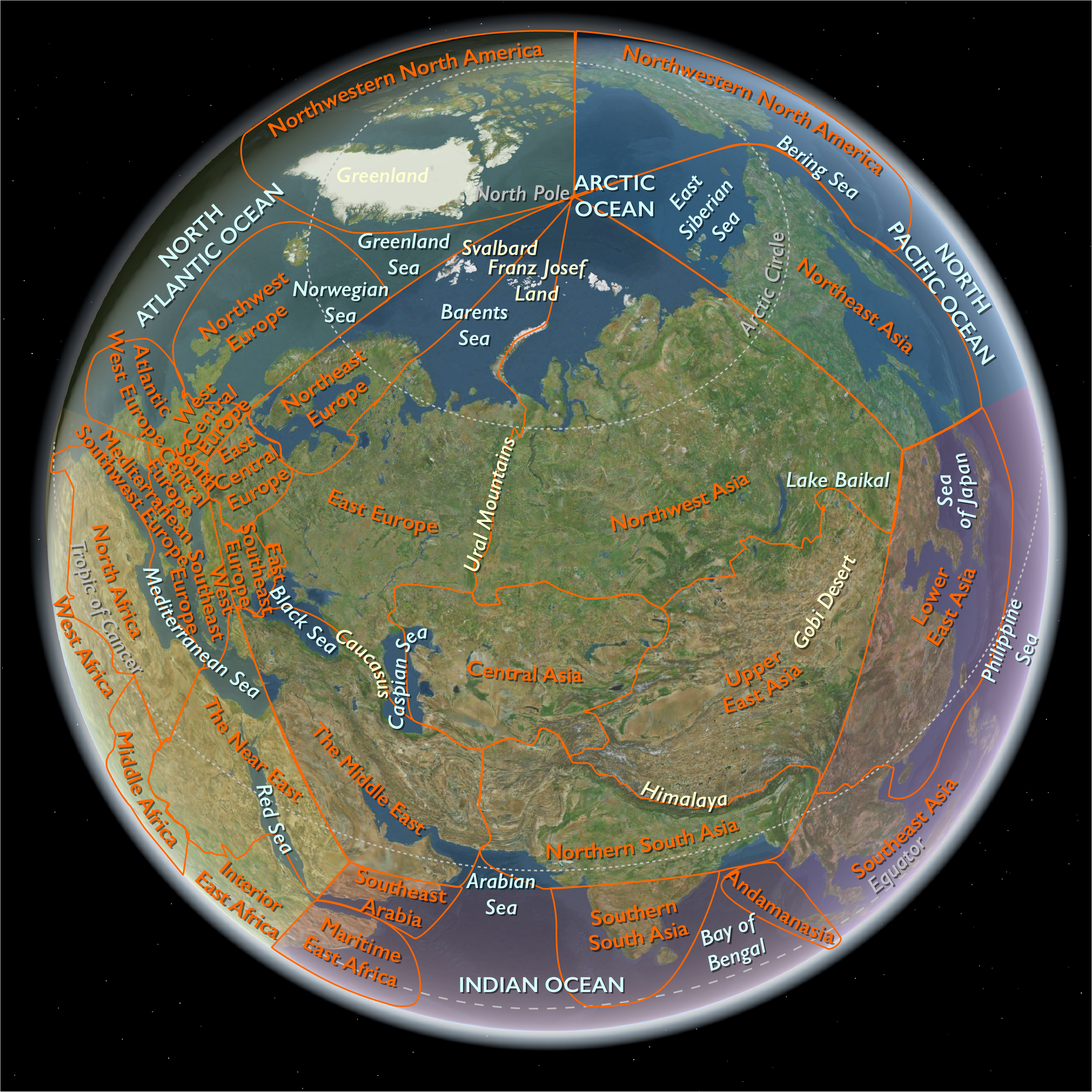
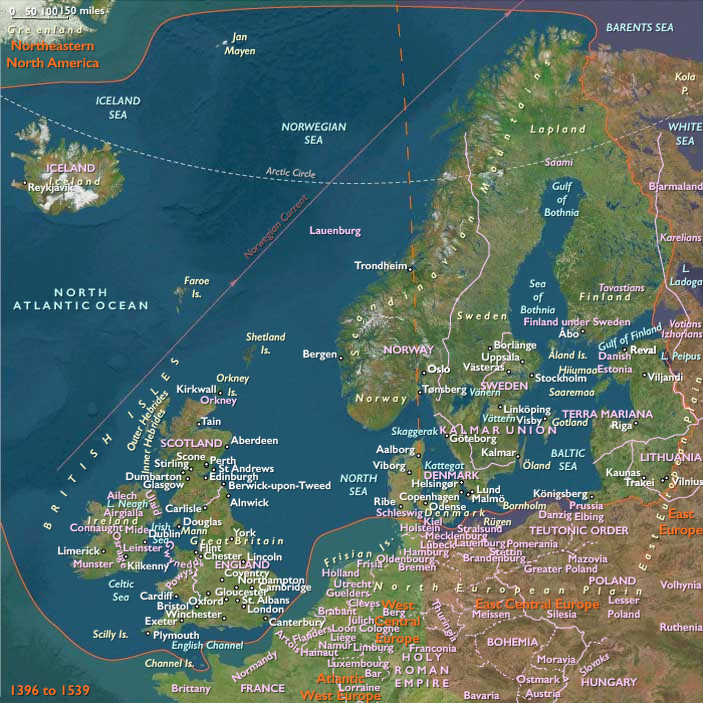
North Europe stretched from the Baltic to the North Atlantic, encompassing the forested and maritime worlds of Scandinavia, the Baltic states, and the British–Irish archipelago.
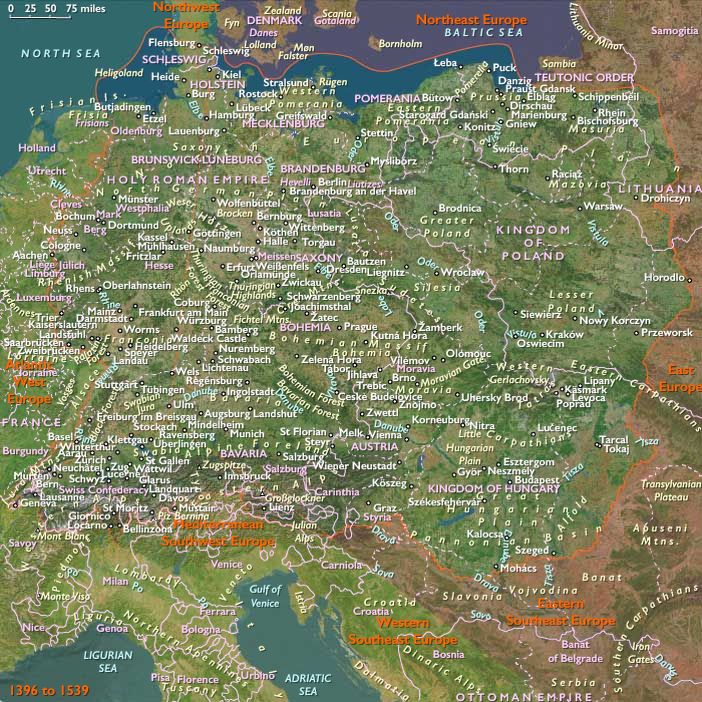
Northeast Europe—Sweden, Finland, Lithuania, Latvia, Estonia, eastern Denmark, and eastern Norway—formed the heart of the Baltic world, where forests, lakes, and grain plains fed into Hanseatic trade.
Northwest Europe—England, Scotland, Ireland, Wales, Iceland, the Faroes, and the Atlantic coasts of Norway and Denmark—looked westward toward fisheries and emerging Atlantic routes. Together, they linked the inland forests and plains to the open seas that defined early modern northern power.
Climate & Environmental Shifts
The Little Ice Age deepened winter severity and shortened growing seasons.
-
Baltic region: Long freezes closed harbors; floods and late thaws alternated with droughts in interior plains.
-
Scandinavia & Finland: Harvests shrank; forests and fisheries provided crucial fallback resources.
-
North Atlantic fringe: Harsher storms and sea-ice reached further south, disrupting cod and herring cycles but enriching fisheries in better years.
-
Britain & Ireland: Cooler, wetter decades challenged crops but spared maritime trade, as fisheries and livestock compensated for shortfalls.
Subsistence & Settlement
-
Baltic lands: Rye, barley, and oats dominated; forests yielded furs, timber, tar, and honey; iron mining in Bergslagen (Sweden) expanded.
-
Scandinavia & Denmark: Mixed grain and stock herding supported towns like Stockholm, Oslo, and Copenhagen.
-
British Isles: England’s open fields produced wheat, rye, and barley; uplands in Scotland, Wales, and Ireland focused on oats, grazing, and dairying; peat and woodland provided vital fuel.
-
Iceland & Faroes: Dependent on sheep, fish, and seabirds, exporting dried cod and wool to Bergen and Hanseatic merchants.
Urban growth centered on London, Stockholm, Copenhagen, Riga, and Tallinn—ports uniting inland grain and iron with sea commerce.
Technology & Material Culture
-
Agriculture: Wooden plows, iron blades, and watermills; three-field rotations in Baltic plains and open-field farming in England.
-
Maritime: Cogs, hulks, and evolving caravels carried timber, grain, and fish; clinker-built vessels remained common in fjords and islands.
-
Industry: Swedish ironworks, English cloth finishing, and Hanseatic shipyards drove regional exchange.
-
Architecture: Brick Gothic churches and fortresses in the Baltic; Perpendicular Gothic cathedrals in England; stave-church legacies in Norway; fortified tower houses in Ireland and Scotland.
-
Print & craft: Printing spread to London, Paris, Copenhagen, and Stockholm after 1476, fostering literacy and trade in books.
Movement & Interaction Corridors
-
Hanseatic League: From Lübeck to Riga and Tallinn, Baltic trade moved furs, tar, wax, and grain outward, bringing textiles, salt, and wine inward.
-
Kalmar Union (1397): United Denmark, Norway, and Sweden under one monarch; internal rebellion and civil wars foreshadowed its collapse.
-
Lithuania & Poland: The Polish–Lithuanian union (1386) extended from the Baltic to the steppe, linking Europe to Muscovy’s frontier.
-
British & Irish seas: Wool, cloth, and salt fish moved between London, Dublin, Bristol, Edinburgh, and continental ports.
-
Atlantic ventures: Bristol merchants probed western seas; John Cabot’s voyage (1497) revealed the cod-rich coasts of Newfoundland.
-
Scandinavian routes: Bergen’s Hanse convoys and Jutland’s cattle exports tied the Atlantic rim to the Baltic core.
Cultural & Symbolic Expressions
-
Faith & reform: Catholic orthodoxy prevailed, though reformist ideas spread via universities and trade. The Lutheran Reformation took root first in Sweden (under Gustav Vasa, 1520s) and Denmark–Norway (after 1536).
-
Literature & learning: Swedish and Danish chronicles, Gaelic bardic poetry, Icelandic sagas, and English and Scots verse (e.g., Dunbar, Henryson) flourished.
-
Urban culture: Baltic guilds sponsored altarpieces and public art; English confraternities built hospitals and chapels; Hanseatic merchants endowed churches across ports.
-
Law & monarchy: English common law matured; Scottish and Danish kings strengthened bureaucracies; Gaelic Brehon law persisted in Ireland.
Environmental Adaptation & Resilience
-
Diversified subsistence: Grain shortages offset by fishing, forestry, and livestock.
-
Storage & trade: Hanseatic and English granaries redistributed food in famine years.
-
Construction: Log and turf houses insulated against cold; seawalls and dikes secured coasts.
-
Mobility: Transhumance, timber floating, and coastal shipping ensured resource flow across fragmented geographies.
Technology & Power Shifts (Conflict Dynamics)
-
Scandinavia:
-
Kalmar Union revolts (1430s–1520s) led to Sweden’s independence under Gustav Vasa (1523) and the start of Lutheran reform.
-
Denmark–Norway retained the Atlantic isles; the Count’s Feud (1534–1536) ended with royal consolidation and Protestant victory.
-
-
Baltic & Steppe:
-
The Livonian Order ruled Estonia and Latvia under Hanseatic influence, declining under pressure from Muscovy.
-
Lithuania fought Moscow’s expansion, maintaining autonomy in the Polish–Lithuanian commonwealth.
-
Teutonic Prussia weakened after Tannenberg (1410), becoming a Polish fief.
-
-
British Isles:
-
The Hundred Years’ War’s close (1453) redirected England inward.
-
Wars of the Roses (1455–1487) culminated in Tudor rule under Henry VII.
-
Flodden (1513) crushed Scottish arms; Ireland remained divided between the English Pale and Gaelic lordships.
-
-
Maritime shifts: Naval gunnery, enclosed shipyards, and state fleets emerged, notably under the Tudors and Danes, signaling northern Europe’s coming naval ascendancy.
Transition (to 1539 CE)
By 1539, North Europe stood divided yet ascendant:
The Hanseatic League waned but its maritime legacy endured; Sweden and Denmark–Norway entered the Protestant era; Lithuania faced the growing might of Muscovy; and the British Isles, stabilized under the Tudors, turned toward the Atlantic.
Iceland and the Faroes remained fishing outposts; the Baltic still pulsed with trade in grain, tar, and timber. Across forests, fjords, and sea-lanes, resilience under cold skies forged the region’s next transformation—from medieval borderlands to early modern maritime powers.
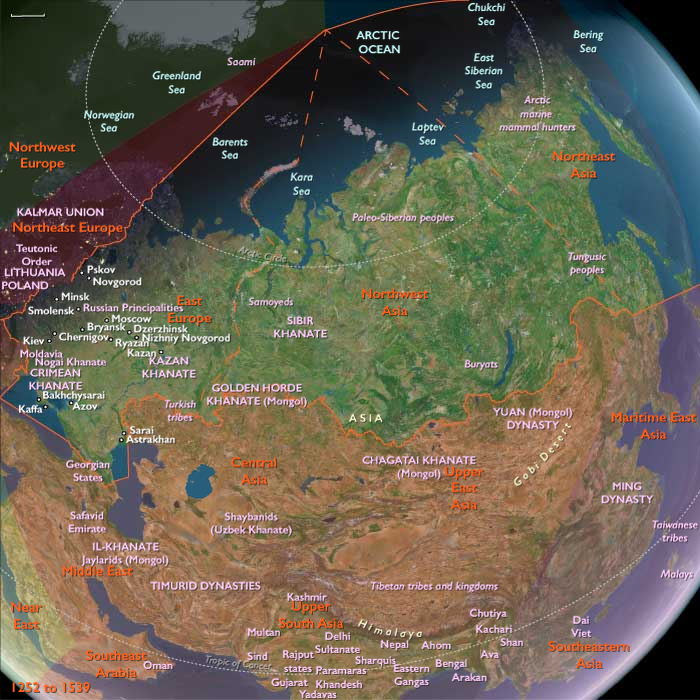
Northeast Europe (1396–1539 CE): Kalmar Union, Hanseatic Hubs, and Baltic Frontiers
Geographic & Environmental Context
The subregion of Northeast Europe includes Sweden, Finland, Lithuania, Latvia, Estonia, eastern Denmark (with Copenhagen), eastern Norway (with Oslo), and the Kaliningrad enclave. Anchors spanned the Baltic Sea and Gulf of Finland, the Bothnian Gulf, the Scandinavian lake–forest interior, and the Lithuanian–Livonian plains. Forests, lakes, and rivers fed into the Baltic maritime corridor, while upland pastures, iron-bearing districts, and fishing zones shaped inland economies.
Climate & Environmental Shifts
The Little Ice Age deepened seasonal extremes.
-
Winters: longer freezes locked harbors and rivers, delaying trade;
-
Summers: shorter, sometimes wet, affecting grain harvests in Sweden, Finland, and Livonia;
-
Forests & lakes: supplied furs, timber, and fish to buffer poor grain years.
Sea ice spread widely in severe winters, but milder decades allowed sustained shipping across the Baltic.
Subsistence & Settlement
-
Scandinavia (Sweden, Finland, Norway east): Rye, barley, oats, and peas were staples; fishing and stock herding were critical supplements; iron mining grew in Bergslagen (Sweden).
-
Denmark (eastern provinces): Grain, dairy, and fishing supported Copenhagen, an emerging royal hub.
-
Baltic states (Lithuania, Latvia, Estonia): Cereal farming (rye, barley), cattle herding, flax, and honey; coastal towns drew supplies from inland peasants.
-
Kaliningrad (Prussian coast): Mixed farming with rye and livestock; amber collecting continued.
Technology & Material Culture
-
Agriculture: wooden plows, iron-tipped tools, watermills; three-field rotations in Baltic plains.
-
Mining & craft: Swedish ironworks expanded, producing bars for Hanseatic trade.
-
Maritime: cogs and hulks carried timber, tar, grain, and iron; Danish and Swedish shipwrights innovated in response to naval rivalries.
-
Architecture & art: Brick Gothic churches, Hanseatic warehouses, and castle fortresses (Tallinn, Riga, Stockholm, Vilnius); altarpieces and icon painting reflected Catholic and Orthodox patronage.
Movement & Interaction Corridors
-
Hanseatic League: Lübeck, Tallinn, Riga, and Stockholm tied the region into North Sea–Baltic trade; furs, timber, wax, and grain moved outward, textiles and salt inward.
-
Kalmar Union (1397): Linked Denmark, Norway, and Sweden under one crown; tensions between Danish monarchs and Swedish nobility fueled civil wars.
-
Lithuania: Stretched from Baltic to Black Sea; in union with Poland (from 1386) but retained distinct identity; trade routes through Vilnius connected to Muscovy.
-
Livonian Order: German knights ruled Estonia and Latvia, defending ports while exploiting peasantry.
-
Novgorod & Muscovy: Baltic trade drew in Russian fur and wax via Novgorod until its annexation by Moscow in 1478.
Cultural & Symbolic Expressions
-
Catholicism: Dominant in Denmark, Sweden, Norway, and Baltic towns; monasteries, cathedrals, and feast calendars organized social life.
-
Orthodoxy: Endured in eastern Lithuania and among Russian enclaves; Pskov and Novgorod influenced nearby Baltic cultures.
-
Local traditions: Folk epics, runo-songs, and sagas persisted in Finland and Karelia; seasonal rites tied to agriculture and fishing.
-
Art & letters: Lithuania fostered chronicles; Swedish and Danish courts commissioned sagas and chronicles; German-language urban culture dominated Hanseatic towns.
Environmental Adaptation & Resilience
-
Grain storage: Granaries and trade surpluses in Lübeck and Riga redistributed food in famine.
-
Diversification: Fishing, forestry, hunting, and livestock offset poor harvests.
-
Architecture: Log houses and turf-roofed structures insulated against cold; fortified towns stored supplies.
-
Mobility: Seasonal herding, timber floating, and coastal shipping buffered communities against local scarcity.
Technology & Power Shifts (Conflict Dynamics)
-
Kalmar Union: Swedish nobles resisted Danish dominance; Engelbrekt rebellion (1430s) and wars in the late 15th century destabilized the union.
-
Sweden: Broke definitively from Denmark in 1523 under Gustav Vasa, founding a hereditary monarchy and initiating the Lutheran Reformation.
-
Norway: Remained bound to Denmark until the 19th century, with Oslo as an eastern hub.
-
Lithuania: Fought Muscovy on its eastern frontier; preserved autonomy in the Polish–Lithuanian union.
-
Livonian Order: Contested with Russians and Lithuanians; relied on Hanseatic allies for survival.
-
Kaliningrad coast (Prussia): Under Teutonic Knights, weakened after defeat at Tannenberg/Grunwald (1410), shifting toward Polish suzerainty.
Transition
By 1539 CE, Northeast Europe was fractured but dynamic: the Kalmar Union was collapsing, Sweden independent under Gustav Vasa and entering Lutheran reform; Lithuania remained powerful but pressured by Muscovy; Livonia survived precariously between neighbors; Hanseatic ports still dominated Baltic trade, though in decline. Orthodox, Catholic, and Protestant frontiers overlapped across the region, foreshadowing wars of confession and imperial competition.
Contemporary Scandinavian sources refer to Sten Sture as Sten Gustavsson or Herr Sten (Sir Sten); the practice of using noble family names as part of a personal name is not yet in use in Sweden at this time.
He was born around 1440, the son of Gustav Anundsson of the Sture family and Birgitta Stensdotter Bielke, half-sister of the future Charles VIII.
The Sture family is one of the high-ranking noble families of the time, though only distantly related to the royal house; his closest royal ancestor is King Sverker II of Sweden (both through family of Vinga and through family of Aspenäs).
Sture's father, Gustav Anundsson, had been Castellan of Kalmar Castle and a Privy Councilor, but died when Sten was four.
Birgitta Stensdotter remarried Gustav Karlsson of the Gumsehuvud family, and Sten had most likely been raised in their home, first at Kalmar Castle and later at Ekholmen Castle.
The fifteenth century in Sweden is largely defined by the political struggles and civil wars between the unionists of the Kalmar Union, seeking to unite Sweden with Denmark and Norway under the rule of the Danish monarchs, with Danish support, and the separatists seeking to reestablish Sweden as an independent kingdom under a rival Swedish monarch.
Due to his close family ties to the Swedish King Charles, the young Sten Sture had become part of the Swedish separatist political movement from an early age, and had visited Charles during his exile in Danzig.
He is mentioned as a knight in 1462 and as a privy councilor in 1466, and has taken up residence on the family estate at Räfsnäs north of Mariefred.
Sture had fought with Bishop and Regent Kettil Karlsson Vasa during the uprising against the Danish King Christian I in 1464, taking part in the decisive victory at Haraker.
He served as a military commander under King Charles VIII, defeating Erik Karlsson Vasa's uprising at Uppbo in 1470 and later in the same year successfully beating back Christian I's forces at Öresten.
He had married Ingeborg Tott, niece by marriage of Magdalen of Sweden, in 1467; she is a renaissance personality interested in theology and science and seems to have had some importance in the intellectual development during his reign.
The marriage is childless.
Sture's uncle, King Charles VIII, has named Sture heir to Charles' personal domains, and has left Sture in charge of the crown lands, including the city of Stockholm and Stockholm Castle.
On the death of Charles on May 15, 1470, Sture immediately becomes the most powerful noble and political force in the country.
Sten Sture had been elected as Lord Protector of Sweden by the Riksmöte in Arboga in May 1471.
Advocating Swedish secession from the Kalmar Union, Herr Sten as he is known, has garnered large support.
In particular his followers are to be found among the peasantry, in Stockholm and in the Bergslagen mining region.
The latter region's trade with German cities such as Lübeck had often placed its residents in conflict with Union's Danish foreign policy.
In response to the election of Sture, Christian I sails to Sweden with a military force, intending to unseat him as Lord Protector.
Mooring his ships off Skeppsholmen in Stockholm, he sets up camp on Brunkebergsåsen, a ridge a short distance north of Stockholm (at the time Stockholm is restricted to the island containing the Old Town).
On Thursday, October 10, Sten Sture and Nils Bossom Sture lead their troops north to the area which is Hötorget in Stockholm today, near Brunkeberg.
Sten Sture's battle plan is to catch Christian's troops in a vice; Sten attacks from the west, Nils from the east, and Knut Posse strike south from the city itself.
In the ensuing battle, Christian is hit in the face by musket fire.
Losing several teeth, he is forced to retire from battle.
The decisive turn of battle in favor of Sture's side occurs when Nils' troops break out of the forest north of the ridge, as Posse's troops attack from the city.
This cuts off a contingent of Danish troops at the Klara monastery north of the town.
Christian retires with his troops towards the island of Käpplingen (today the Blasieholmen peninsula); however, Sten's troops destroy the makeshift bridge Christian's troops had built, causing many to drown.
The battle ends in a victory for Sten Sture, whose power as regent of Sweden is thus secured and will remain so for the rest of his life.
According to legend, Sture had prayed to Saint George before the battle.
He later paid tribute to Saint George by commissioning a statue of Saint George and the Dragon carved by the Lübeck sculptor Bernt Notke for the Storkyrkan church in Stockholm, as an obvious allegory of Sture's battle against Christian.
An altar dedicated to Saint George was also built in the church.
The Kalmar Union’s King John, titular elected monarch of Denmark, Norway, and Sweden for the past sixteen years, grows impatient with the vacillations of Sweden’s long-ruling regent, Sten Sture the Elder, who has continued to deny John the rulership of Sweden.
In 1497, John and his forces seize Kalmar, the union’s political center, in southeastern Sweden.
Sweden’s regent, Sten Sture the Elder, retaliates for the Danish seizure of Kalmar by laying siege to the Swedish coronation center of Uppsala, and intercepts John’s forces as they advance on the main Swedish commercial center of Stockholm.
The Danes, however, defeat Sture’s Dalecarlian (Darlarnan) reinforcements before they can link with the main Swedish forces.
Sture accepts defeat.
The defeated Swedish regent Sten Sture the Elder receives control of Finland and the lands around the Gulf of Bothnia under the terms that end the Danish-Swedish War of 1497-1500.
Kalmar Union monarch John, crowned King John II of Sweden, makes Sture the kingdom’s grand master.
Christian, the son of the Kalmar Union’s King John, leads others in fomenting rumors that Sten Sture the Elder, newly created Grand Master, plans to seize John’s throne.
Summoned by John to explain himself, Sture appears at Stockholm with a large retinue of heavily armed troops.
A fearful John flees to his citadel, then departs for Denmark, leaving his queen to hold the citadel with a thousand-man garrison.
Sture, aided by troops from Lübeck and other Hanseatic ports, leads Swedish troops to capture Orebro and lay siege to Stockholm, forcing the surrender of John’s queen.
Norway allies with Sweden in 1502 in the escalating Danish-Swedish War, but the cruel treatment of captured Norwegian rebels by King John’s son Christian frightens the country into submission.
Leading the Danes into Sweden, Christian seizes two fortresses in Västergötland and slaughters their defenders.