Stefan Stambolov
Tsar of Bulgaria
Years: 1854 - 1895
Stefan Nikolov Stambolov (31 January 1854 – 6 July 1895) is a Bulgarian politician, who serves as Prime Minister and regent.
Related Events
Filter results
Showing 10 events out of 17 total
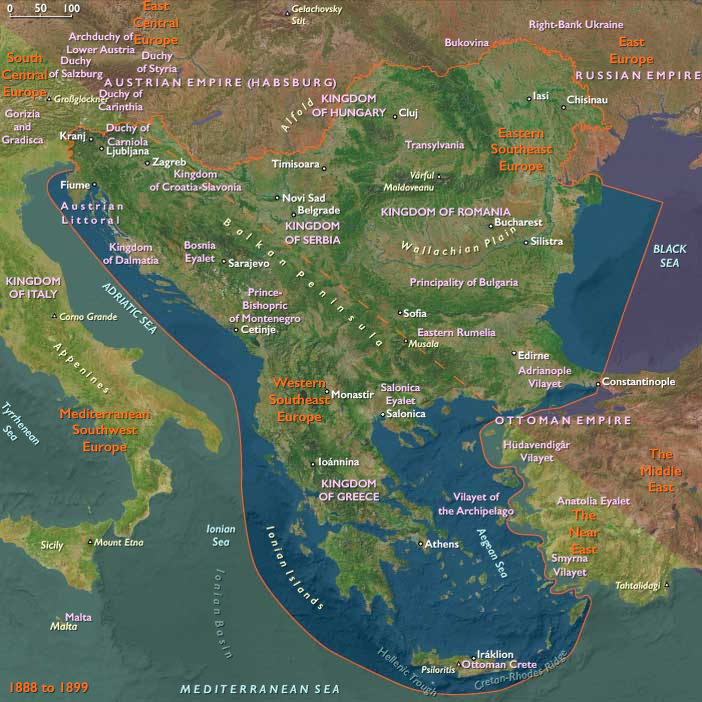
Eastern Southeast Europe (1876–1887 CE): Independence, National Consolidation, and International Rivalries
Settlement and Migration Patterns
Bulgarian Independence and Territorial Changes
The Principality of Bulgaria was established following the Russo-Turkish War (1877–1878), dramatically altering settlement and administrative patterns in the region. However, the Congress of Berlin (1878) significantly reduced Bulgaria’s territory compared to initial Russian plans, leaving large Bulgarian populations in Macedonia, Eastern Rumelia, and Thrace outside its borders, which triggered significant migration and refugee movements.
Romanian Territorial Adjustments
Following its support for Russia during the war, Romania ceded southern Bessarabia to Russia but gained Dobruja from the Ottoman Empire. These territorial adjustments fostered demographic shifts, as Dobruja was inhabited by diverse groups, including Turks, Bulgarians, and Roma populations.
Economic and Social Developments
Ottoman Economic Crisis
The Ottoman Empire’s finances reached a crisis point by 1881, compelling the government to surrender administration of its public debt to a commission of European creditors. This arrangement significantly limited Ottoman economic sovereignty, reflecting the empire’s broader decline and vulnerability to European financial influence.
Romanian Economic Progress
In Romania, rapid economic development occurred, including infrastructure improvements such as oil wells in Wallachia, the construction of the Danube bridge at Cernavodă, and expansion of the port at Constanța. Despite these advances, heavy borrowing and uneven wealth distribution meant that most Romanians continued to live in poverty.
Cultural and Artistic Developments
Bulgarian Cultural Revival
The Bulgarian cultural revival reached new heights following independence. The establishment of cultural institutions like the chitalishte continued to foster education and national consciousness, while the adoption of the liberal Turnovo Constitution (1879) symbolized the intellectual aspirations of a newly independent Bulgaria.
Serbian Cultural Nationalism
Serbian national culture flourished during this period, significantly influenced by scholars like Vuk Karadžić and Dositej Obradović. These figures revitalized the Serbian literary language, promoted the publication of folk songs, and cultivated a national pride based on linguistic and historical identity.
Intellectual and Religious Developments
Bulgarian Ecclesiastical Independence
The Bulgarian Orthodox Church gained further autonomy, reducing Greek influence significantly. This ecclesiastical independence solidified national identity and underscored the political and cultural separation from Ottoman and Greek dominance.
Political Dynamics and Regional Rivalries
Russo-Turkish War and the Congress of Berlin
The Russo-Turkish War (1877–1878) ended with significant territorial adjustments at the Congress of Berlin (1878). While the congress limited Russian gains, it formally recognized the independence of Romania, Serbia, and Montenegro and created a smaller, autonomous Bulgaria under nominal Ottoman suzerainty, altering the political landscape profoundly.
Bulgarian Political Instability
Political instability marked early independent Bulgaria. Conflicts over constitutional authority between Prince Alexander of Battenberg and liberal factions led to tensions and Russian interference. Alexander’s forced abdication in 1886 led to further turmoil until the strong-handed rule of Stefan Stambolov restored a measure of stability.
Serbian National Consolidation
Serbia’s autonomy evolved into full independence in 1878, and the principality became a kingdom in 1882 under Milan Obrenović. Despite initial enthusiasm, Milan’s pro-Austrian orientation alienated many Serbs and created enduring political rifts.
Romanian National Consolidation
Romania’s full independence was internationally recognized in 1880 after initially tense diplomatic negotiations. The parliament proclaimed the nation a kingdom in 1881, crowning King Carol I in Bucharest, ushering in three decades of relative peace, economic growth, and national consolidation.
Key Historical Events and Developments
-
Russo-Turkish War (1877–1878) leading to Bulgarian and Serbian independence.
-
Congress of Berlin (1878) significantly reshaping Balkan national boundaries.
-
International recognition of Romanian independence and the establishment of the Romanian Kingdom (1881).
-
Political turmoil in Bulgaria and subsequent stabilization under Stefan Stambolov.
Long-Term Consequences and Historical Significance
This period marked a critical juncture in Eastern Southeast Europe, establishing the modern political landscape. The creation and recognition of independent nation-states significantly reduced Ottoman influence, intensified national rivalries, and set the stage for the region's complex geopolitical dynamics leading into the twentieth century.
The Bulgarian government is as unstable as it had been in its first year, Alexander having left behind a three-man regency headed by Stefan Stambolov.
A Russian-educated liberal, Stambolov becomes prime minister in 1887 and ceases tailoring Bulgarian policy to Russian requirements.
The tsar's special representative in Bulgaria returns to Russia after failing to block a subranie called to nominate a new prince.
Russo-Bulgarian relations will remain chilly for the next ten years, and this break will further destabilize Bulgarian politics and society.
Stambolov brutally suppresses an army uprising in 1887 and begins seven years of iron control that often bypass the country's democratic institutions but bring unprecedented stability to Bulgaria.
Meanwhile, Ferdinand of Saxe-Coburg-Gotha, a Catholic German prince, accepts the Bulgarian throne in August 1887.
The Bulgarian conspiracy is countered, however, by Stefan Nikolov Stambolov, president of the National Assembly, and by Lieutenant Colonel Sava Mutkurov, commander of the Plovdiv garrison, who takes control of Sofia and recalls Alexander.
The Russians do not detain the prince, but he refuses to remain in Bulgaria without Russian approval.
When the tsar refuses to give it, Alexander abdicates on September 7, appointing a regency composed of Stambolov, Mutkurov, and Petko Karavelov.
The Bulgarian government is now as unstable as it was in its first year.
Stefan Stambolov, a Russian-educated liberal, becomes Bulgaria’s prime minister in 1887 and ceases tailoring Bulgarian policy to Russian requirements.
The tsar's special representative in Bulgaria returns to Russia after failing to block a subranie called to nominate a new prince.
Stambolov brutally suppresses an army uprising in 1887.
The regency is thus successful in preserving order but has great difficulty finding a new prince, for few candidates wish to assume the throne in the face of Russian hostility.
A willing candidate is at last found in the person of twenty-six-year-old Catholic German prince, Ferdinand Maximilan Karl Leopold Maria of Saxe-Coburg and Gotha, a ducal family that has contrived to occupy, either by marriage or by direct election, several European thrones in the course of the nineteenth century.
Ferdinand, who is currently serving as an officer in the Austrian army, is the son of Prince Augustus of Saxe-Coburg-Gotha (1818-81) and his wife Clémentine of Orléans (1817-1907), daughter of king Louis Philippe I of the French.
Ferdinand is a grand-nephew of Ernst I, Duke of Saxe-Coburg-Gotha and of Leopold I, first king of the Belgians.
His father Augustus is a brother of the Prince Consort of Portugal, and also a first cousin of both Queen Victoria and her husband Prince Albert.
He also descends from medieval rulers of Bulgaria from both his mother's and father's side.
Elected prince in July 1887 by the Grand National Assembly, he accepts the throne in August.
Eastern Southeast Europe (1888–1889 CE): Nationalism, Reform, and Regional Tensions
Political Developments and Regional Realignments
Serbia: Turmoil and Autocratic Rule
A regency governed Serbia until 1893, following the abdication of King Milan Obrenović. His teenage son, Aleksandar Obrenović (1889–1903), then assumed authority, swiftly nullifying the existing constitution. Aleksandar's authoritarian style, scandals, and his pronounced alignment with Austria-Hungary significantly undermined his popularity and fostered political instability.
Romania: Secret Alliances and Diplomatic Tensions
In a climate of heightened distrust towards Russia, Romania’s King Carol I secretly aligned with the Central Powers—Austria-Hungary, Germany, and Italy—by signing a clandestine treaty in 1883, details of which only emerged publicly years later. This pact deeply influenced Romania's diplomatic posture, prompting the fortification of defenses along the Russian border, while strategically neglecting the vulnerable mountain passes into Hungarian-held Transylvania.
Bulgarian Autonomy and Governance Challenges
In Bulgaria, Prince Ferdinand of Saxe-Coburg-Gotha struggled for international recognition, achieving acceptance by Russia and other Great Powers only in 1896. The government's authoritarian stance under Prime Minister Stefan Stambolov included widespread voter intimidation and political patronage, aimed at suppressing extreme nationalism and stabilizing the nation’s political landscape. Stambolov's policies significantly enhanced Bulgaria's economic infrastructure, exemplified by the completion of the Vienna-to-Constantinople Railway through Bulgaria in 1888 and the Burgas-Yambol Railway in the early 1890s.
Social and Economic Dynamics
Land Reform and Social Unrest in Romania
Romania continued grappling with inequitable land distribution, which led to persistent rural unrest. By 1888, peasant discontent had escalated, culminating in agrarian disturbances and eventually forcing the government into limited land reforms. Despite these attempts, substantial inequalities persisted, maintaining tensions and widespread poverty among the rural populace.
Jewish Communities and Economic Frictions
The Jewish population in Romania, which had grown significantly due to immigration after the Treaty of Adrianople (1829), faced increased discrimination and exclusion from citizenship. Economic rivalry frequently escalated into violence and anti-Semitic attacks, severely restricting social integration and economic advancement opportunities for the Jewish communities, especially concentrated in urban areas such as Iași.
Industrialization and Socialism in Bulgaria
Bulgaria experienced rapid industrialization, which significantly reshaped its economic and social fabric. Numerous factories had opened since the nation's independence in 1878, creating a new urban working class. The harsh realities of industrial employment spurred the establishment of the Social Democratic Party in 1891, marking the beginnings of organized labor movements and socialist politics in Bulgaria.
Cultural and National Identity Movements
Bulgarian Nationalism and Macedonian Question
The issue of Macedonia continued to fuel Bulgarian nationalism, as revolutionary and secret liberation movements persisted in advocating for the unification of Macedonian territories with Bulgaria. Diplomatic maneuvers by Stambolov in 1890 successfully obtained Ottoman concessions, granting three major Macedonian dioceses to the Bulgarian Exarchate and thus reinforcing Bulgarian national sentiment and church authority.
Transylvanian Romanians and Magyarization
In Transylvania, Romanian nationalism intensified against Hungary's aggressive Magyarization policies. Calls from Bucharest for unification with Romanians in Transylvania, Bukovina, and Bessarabia became increasingly vocal, reflecting deepening ethnic tensions within the Austro-Hungarian Empire.
Key Historical Developments (1888–1889)
-
Secret treaty between Romania and the Central Powers (Austria-Hungary, Germany, Italy).
-
Limited land reform efforts in Romania after agrarian disturbances.
-
Completion of major railways (Vienna-Constantinople Railway, Burgas-Yambol Railway) in Bulgaria, significantly enhancing its economic infrastructure.
-
Continued political instability in Serbia under Aleksandar Obrenović's autocratic rule.
Long-Term Consequences and Historical Significance
The period marked critical developments in nationalistic fervor, political alliances, and economic transformations across Eastern Southeast Europe. Rising nationalism and ethnic tensions sowed seeds of future conflicts, while economic modernization introduced significant social changes, laying foundations for subsequent historical shifts in the region.
Bulgaria's independence from the Ottoman Empire brings drastic economic and social changes to the country at the end of the nineteenth century.
Industrialization proceeds rapidly (thirty-six major factories had opened between 1878 and 1887), and a new class of industrial labor forms from displaced artisans and agricultural workers.
Harsh working conditions lead the urban poor to the cause of socialism, and in 1891 the Social Democratic Party is formed. (Later transformation of one of its factions into the Bulgarian Communist Party will make this organization the oldest communist party in the world.)
Town-centered trade and the guild structure are swept away by an influx of West European commerce to which Bulgaria had been opened by the terms of the Treaty of Berlin.
Bulgaria remains primarily an agricultural country despite industrialization.
Liberation had eliminated the Ottoman feudal landholding system.
Bulgarian peasants were able to buy land cheaply or simply occupy it after Turkish landlords left, and a system of village-based small landholding had begun.
Agricultural production rises in spite of heavy government land taxes.
Many peasants are forced into the urban work force by taxes or high interest on borrowings for land purchase.
Until the end of the nineteenth century, the vast majority of the Bulgarian population are small landholders or independent small tradesmen.
Russia and the other great powers will not recognize Ferdinand as rightful prince of Bulgaria until 1896.
Supporters of Prince Alexander who remain in power use this failure as a weapon against the policies of Ferdinand and Stambolov.
In 1890 a widespread plot against the government is discovered.
As before, the basis of the plot is dissatisfaction with Stambolov's refusal to intercede with the Turks on behalf of Macedonian independence.
In a masterful diplomatic stroke, Stambolov represents the insurrection to the Turks as an example of potential chaos that could be avoided by minor concessions.
Fearing the Balkan instability that would follow an overthrow of Ferdinand, the Turks now cede three major Macedonian dioceses to the Bulgarian exarchate.
Stambolov thus gains solid church support and an overwhelming victory in the 1890 election, which legitimizes his government among all Bulgarian factions and reduces the threat of radical plots.
Stefan Stambolov and the People's Liberal Party he had founded in 1886 exert virtually dictatorial power to suppress extreme nationalism and opposing parties and create conditions for economic growth in Bulgaria.
After the 1886 coup, the army has been strictly controlled.
Voters are intimidated to ensure the reelection of incumbent officials, and political patronage grows rampant.
Using his own and Prince Ferdinand's ties with Germany and Austria-Hungary, Stambolov builds a capitalist Bulgarian economic system on foreign loans, protectionism, an expanded industrial and transport infrastructure, and a strict tax system for capital accumulation.
Especially important to the Bulgarian economy is completion of the Vienna-to-Constantinople Railway through Bulgaria in 1888 and the Burgas-Yambol Railway in the early 1890s.
Stambolov derives strong political support from the entrepreneurs who benefit from his industrial policy.
The Stambolov era marks the victory of executive over legislative power in the Bulgarian political system.
The legitimacy of the Bulgarian throne remains an important symbolic issue in the early 1890s, and the threat of assassination or overthrow of the prince remains after Stambolov consolidates his power.
Therefore, Stambolov finds a Catholic wife for Ferdinand and maneuvers past Orthodox Church objections in 1893 to ensure Ferdinand an heir that will stabilize the throne.
This heir, Boris, is born the next year.
Meanwhile, Stambolov's autocratic maneuvering and tough policies win him many enemies, especially after the stabilization of the early 1890s appears to make such tactics unnecessary.
In 1894 Ferdinand dismissed his prime minister because the prince seekst more power for himself and believes that Stambolov has become a political liability.
The next year, Macedonian radicals assassinate Stambolov.