Sir William Penn
English admiral
Years: 1621 - 1670
Sir William Penn (23 April 1621 – 16 September 1670) is an English admiral, and the father of William Penn, founder of the Province of Pennsylvania.
Penn was born in St. Thomas Parish, Bristol to Giles Penn and Joan Gilbert.
On 6 June 1643 he marries Margaret Jasper, a daughter of a wealthy Dutch merchant.
They have three children: Margaret, Richard and William.
Related Events
Filter results
Showing 10 events out of 10 total
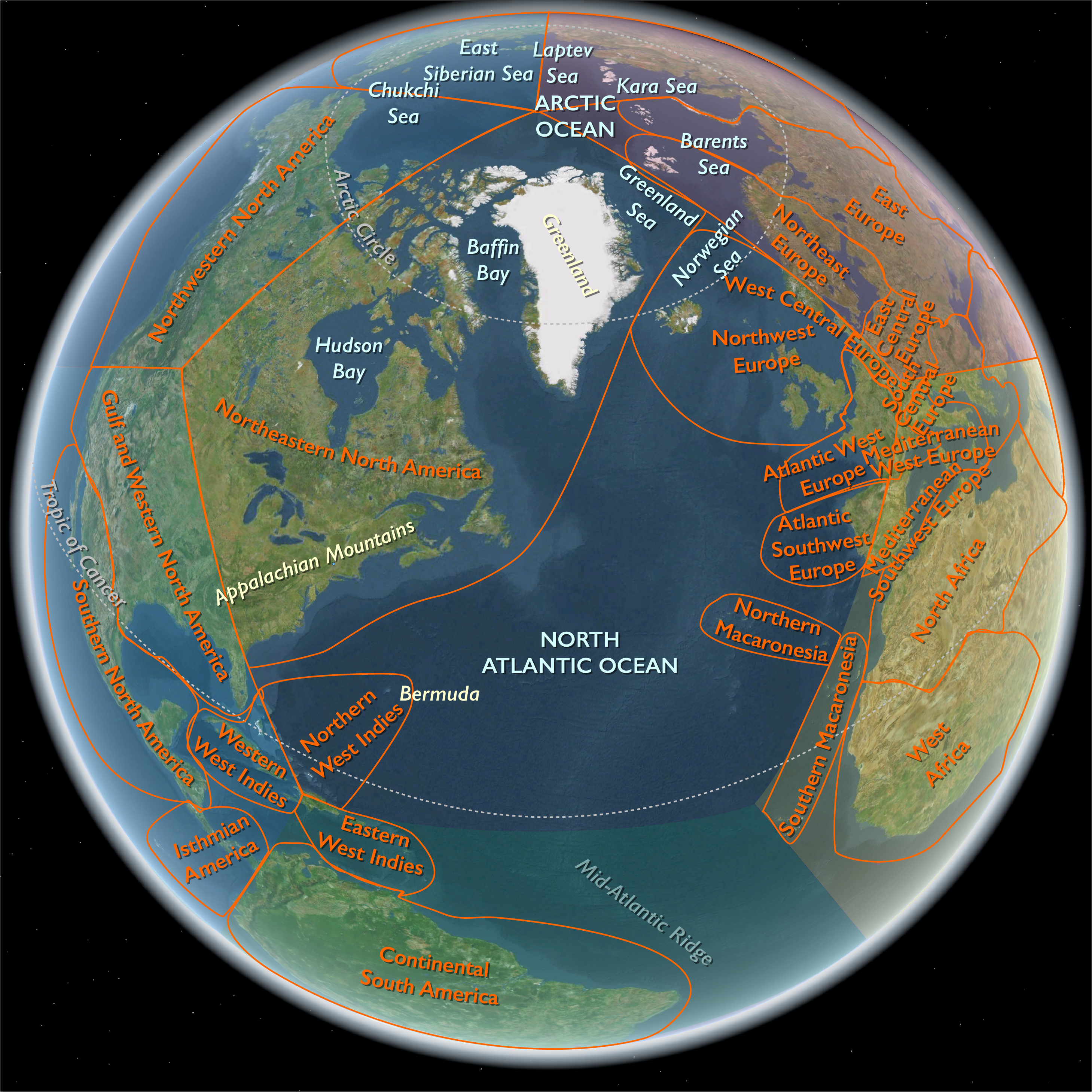
Eastern West Indies (1540–1683 CE): Consolidation, Resistance, and Maritime Corridors
Geographic & Environmental Context
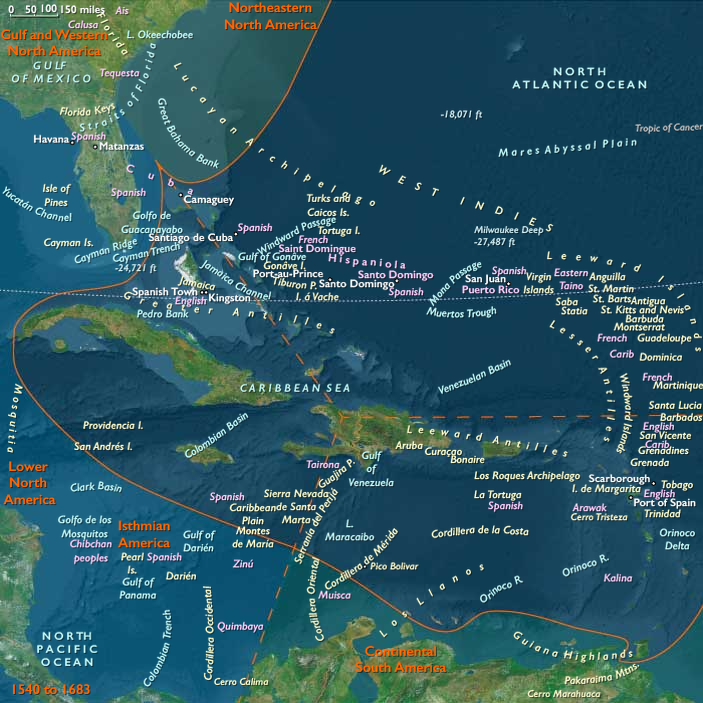
The subregion of Eastern West Indies includes Trinidad, Saint Lucia, Barbados, most of Haiti, most of the Dominican Republic, Puerto Rico, and the Virgin Islands. Anchors included the Orinoco–Trinidad seaway, the Cordillera Central of Hispaniola, the karst valleys of Puerto Rico, and the volcanic arc from Saint Lucia through the northern Lesser Antilles. Coral reefs, fertile valleys, and hurricane-exposed coasts structured settlement and strategy.
Climate & Environmental Shifts
The Little Ice Age persisted with cooler decades and heightened hurricane frequency (notably mid-1600s). Drought cycles struck leeward islands; windward slopes on volcanic islands retained higher rainfall. Floods alternated with dry spells on Hispaniola’s north, shaping ranching and smallholder agriculture.
Subsistence & Settlement
-
Spanish Hispaniola and Puerto Rico: After demographic collapse, Spanish society reorganized around cattle hatós (ranches), small farms, and coastal towns. Enslaved Africans and their descendants worked ranches, mines (declining), and ports; free Afro-descended communities grew in rural zones.
-
Trinidad & the Lesser Antilles: Kalinago (Carib) communities maintained shifting cultivation, fishing, and canoe raiding/trading networks; Spanish footholds remained tenuous outside main towns.
-
Barbados (from 1627, English): Rapid plantation shift to sugar with enslaved African labor; small farms gave way to estates, and the island became a key English sugar hub.
-
Virgin Islands & northern Lesser Antilles: Intermittent Spanish presence met rising French and English settlements (mid-17th century), while Kalinago resistance persisted from strongholds on mountainous isles.
Technology & Material Culture
Spanish towns displayed masonry churches, plazas, and coastal forts; ranching technologies (lasso, corral, brand) dominated Hispaniola’s interior. English Barbados installed wind-powered sugar mills, boiling houses, and curing facilities; plantation house forms and stone/brick windmills dotted ridges. Afro-Caribbean craft, music, and cuisine expanded—ironwork, basketry, drum traditions—blending with European and surviving Taíno elements. Kalinago weaponry (bow, lance) and seaworthy canoes underpinned mobility and defense.
Movement & Interaction Corridors
-
Treasure-fleet and convoy routes funneled through the Windward Passage and past Puerto Rico; Havana remained the principal rally point, but Hispaniola’s north and Puerto Rico supplied cattle, hides, and timber.
-
Barbados–England–North America circuits exported sugar and imported provisions, enslaved people, and equipment.
-
Kalinago canoe corridors linked Saint Lucia, Dominica, Guadeloupe, and the Virgin Islands for trade/raids, intercepting colonial shipping.
-
Smuggling networks connected Hispaniola’s north with Tortuga and Saint-Domingue (French) for hides, tobacco, and textiles.
Cultural & Symbolic Expressions
Spanish Catholicism structured public ritual on Hispaniola and Puerto Rico, while Afro-descended confraternities and cabildos nurtured mutual aid and syncretic devotion. On Barbados, Anglican worship anchored planters’ identity; African ritual life persisted covertly in quarters and nighttime gatherings. Kalinago spirituality—ancestor veneration, warrior rites, and healing—remained central to island autonomy. Music, drum/dance, and festival cycles expressed memory and power across all societies.
Environmental Adaptation & Resilience
Hurricane rebuilding fostered stone foundations, buttressed churches, and wind-smart siting. On Hispaniola, mixed herding–cropping buffered drought; free and enslaved Afro-descended farmers sustained provision grounds (cassava, plantains, yams). Barbados shifted soils under cane; provision plots and inter-island provisioning mitigated food shortfalls. Kalinago mobility and upland refuges enabled long resistance amid encroaching colonies.
Transition
By 1683 CE, the Eastern West Indies had polarized: Spanish Hispaniola and Puerto Rico stabilized as provisioning and ranching nodes; Barbados rose as England’s sugar powerhouse; Kalinago strongholds still contested the Lesser Antilles even as French and English settlements multiplied. The subregion’s future would pivot on sugar-driven slavery, imperial rivalry, and the endurance of Afro-Caribbean and Indigenous lifeways.
The stagnation that will prevail in Santo Domingo until the end of the nineteenth century is interrupted on several occasions by armed engagements, as the French and British attempt to weaken Spain's economic and political dominance in the New World.
The British admiral, Sir Francis Drake, captures the city of Santo Domingo in 1586 and collects a ransom for its return to Spanish control.
Oliver Cromwell dispatches a British fleet commanded by Sir William Penn to take Santo Domingo in 1655.
After meeting heavy resistance, the British sail farther west and take Jamaica instead.
Jamaica at this time as a population of about three thousand, equally divided between Spaniards and their slaves—the native population having been eliminated.
Although Jamaica is a disappointing consolation for the failure to capture either of the major colonies of Hispaniola or Cuba, the island is retained in the Treaty of Madrid in 1670, thereby more than doubling the land area for potential English colonization in the Caribbean.
Jamaica will be the most important of Britain's Caribbean colonies by 1750, having eclipsed Barbados in economic significance.
French Protestant theologian and metaphysician Moses Amyraut, also known as Amyraldus, is perhaps most noted for his modifications to Calvinist theology regarding the nature of Christ's atonement, which is referred to as Amyraldism or Amyraldianism.
He publishes his Traité des religions in 1631, and from this year onward he is to be a foremost man in the French church.
Chosen to represent the provincial synod of Anjou, Touraine and Maine at the national synod held in 1631 at Charenton, he is appointed as orator to present to the king The Copy of their Complaints and Grievances for the Infractions and Violations of the Edict of Nantes.
The university of Saumur is to become the university of French Protestantism.
Amyraut has as many as a hundred students in attendance at his lectures.
One of these is William Penn, who will later go on to found the Pennsylvania Colony in America based in part on Amyraut's notions of religious freedom.
Oliver Cromwell’s Western Design against Spanish colonies in the West Indies, aimed at securing sugar-producing islands, had involved the dispatch of a fleet from Portsmouth in late December 1654 that arrives in the West Indies in January.
Under General-at-Sea William Penn, it is one of the strongest ever to sail from England, with some three thousand marines under the command of General Robert Venables, further reinforced in Barbados, ...
...Montserrat, ...
...St. Kitts and ...
...Nevis.
Cromwell had previously been interested in the possible acquisition of Hispaniola, but the expedition's commanders have been given the freedom to determine their own priorities in the circumstances they faced on arrival.
Several options are considered, including a landing on the coast of Guatemala or on Cuba.
Both are discounted, as Penn and Venables decide to attempt to repeat Drake's attack on Santo Domingo on Hispaniola.
However, the assault fails because the Spanish have improved their defenses in the face of Dutch attacks earlier in the century.
General-at-Sea William Penn and General Robert Venables had seized Jamaica in 1655 without orders in the name of Britain's Lord Protector Oliver Cromwell, seeking to make up for the disastrous failure of the mission Cromwell had assigned them: to seize Hispaniola.
Spanish resistance has continued for some years, in some cases with the help of the maroons, but Spain will ever succeed in retaking the island.
Under English rule Jamaica has become a haven of privateers, buccaneers, and occasionally outright pirates: Christopher Myngs, Edward Mansvelt, and most famously, Henry Morgan.
Myngs had earned a reputation for unnecessary cruelty during his actions as a commerce raider during the Anglo-Spanish War of 1654, sacking and massacring entire towns in command of whole fleets of buccaneers.
The Spanish government considers Myngs a common pirate and mass murderer, protesting to no avail to the Cromwell government about his conduct.
Because he had shared half of the bounty of his 1659 raid on Venezuela, about a quarter of a million pounds, with the buccaneers against the explicit orders of Edward D'Oyley, the English Commander of Jamaica, he had been arrested for embezzlement and sent back to England on the Marston Moor in 1660.
The later governor described him in an accompanying letter as "unhinged and out of tune".
The Restoration government has retained Myngs in his command however, and in August 1662 he is sent to Jamaica commanding the Centurion in order to resume his activities, despite the fact the war with Spain had ended.
This is part of a covert English policy to undermine the Spanish dominion of the area, by destroying as much as possible of the infrastructure.
Myngs decides that the best way to accomplish this is to employ the full potential of the buccaneers by promising them the opportunity for unbridled plunder and rapine.
He has the complete support of the new governor, Lord Windsor, who fires a large contingent of soldiers to fill Myngs's ranks with disgruntled men.
This year, ...