Sir Harry Smith, 1st Baronet
British soldier and military commander
Years: 1787 - 1860
Lieutenant General Sir Henry George Wakelyn Smith, 1st Baronet of Aliwal GCB (28 June 1787 – 12 October 1860), known as Sir Harry Smith, is a notable English soldier and military commander in the British Army of the early 19th century.
A veteran of the Napoleonic Wars, he is also particularly remembered for his role in the Battle of Aliwal (India) in 1846, and as the husband of Lady Smith.

Related Events
Filter results
Showing 10 events out of 12 total
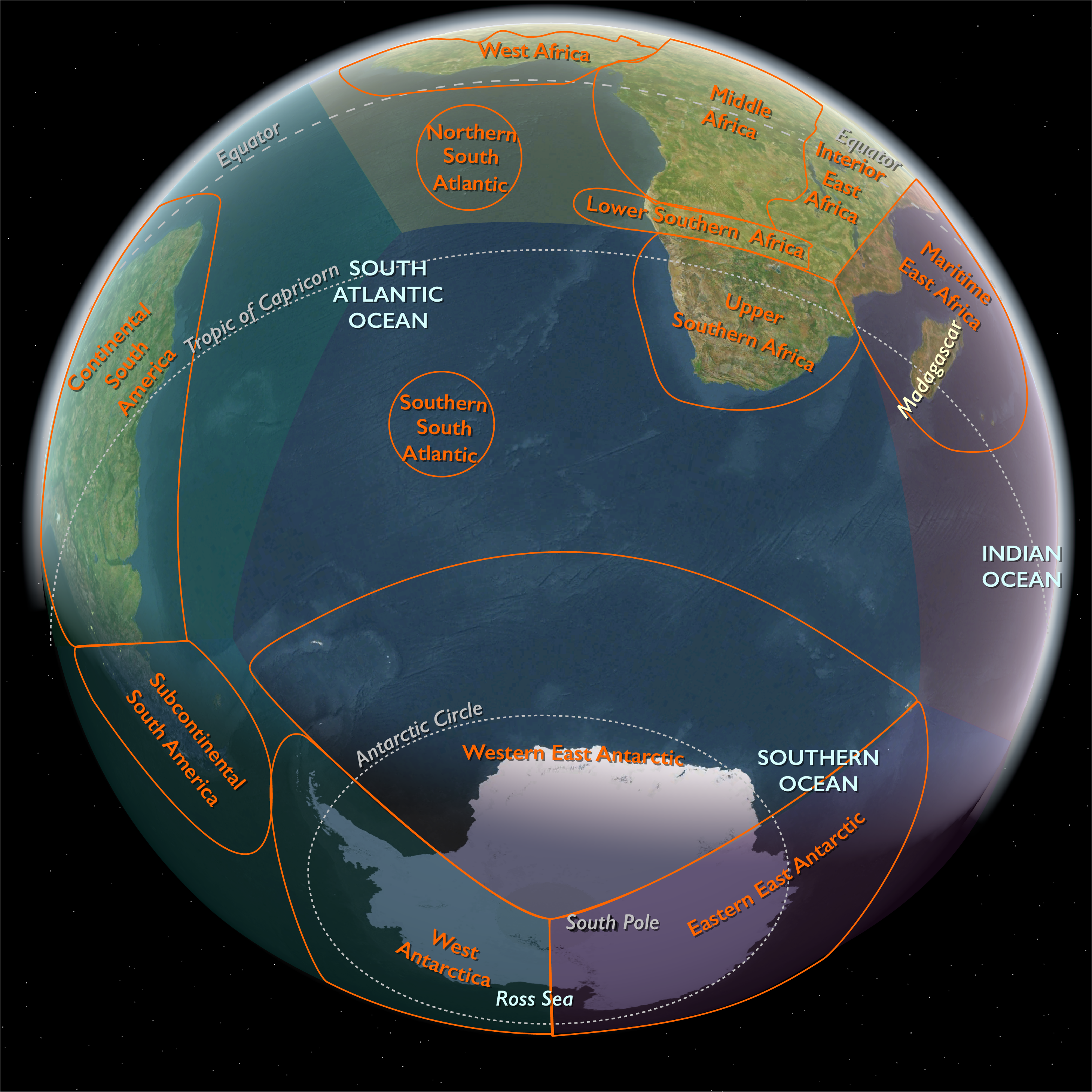
Further trouble on the Cape Colony’s eastern border arises between the government and the Xhosa, towards whom the policy of the Cape government has been marked by much vacillation as Dutch-speaking settlers colonize the area north of Orange River.
On December 11, 1834, a government commando party kills a chief of high rank, incensing the Xhosa: an army of ten thousand men, led by Macomo, a brother of the chief who had been killed, sweeps across the frontier, pillages and burns the homesteads and kill all who resist.
Among the worst sufferers in this Sixth Xhosa War is a colony of freed Khoikhoi who, in 1829, had been settled in the Kat River valley by the British authorities.
Inhabitants of the farms and villages take to the safety of Graham's Town, where women and children find refuge in the church.
There are few available soldiers in the colony, but the governor, Sir Benjamin d'Urban, acts quickly and all available forces are mustered under Colonel Sir Harry Smith, a Peninsula War veteran.
Colonel Smith reaches Graham’s Town on January 6, 1835, six days after news of the uprising had reached Cape Town.
Retaliatory attacks against the amaXhosa are launched from the town, and hostilities will continue for nine months.
Forty farmers (Boers) have been killed in the Sixth Xhosa War and four hundred and sixteen farmhouses burnt down.
In addition, amaXhosa people have plundered fifty-seven hundred horses, one hundred and fifteen thousand head of cattle and one hundred and sixty-two thousand sheep.
In retaliation, sixty thousand amaXhosa cattle have been taken or retaken by colonists.
On September 17, 1836, with the signing of a new peace treaty, all the country as far as the River Kei is acknowledged by the Xhosa to be British, and its inhabitants declared British subjects.
A site for the seat of government is selected and named King William’s Town.
The end of the war leaves seven thousand people of all races homeless.
Having restored confidence among the whites by his energetic measures, Harry Smith has been appointed governor of the newly created Province of Queen Adelaide, where he has gained unbounded influence over the native tribes, whom he has vigorously set himself to civilize and benefit.
Cape governor Benjamin d'Urban takes far-reaching steps to prevent similar conflict in the future.
These are however not to the liking of the British minister of colonies, Lord Glenelg, who revokes all the measures and accuses the Boers of instigating the conflict.
As a result, the members of the Boer community loses faith in the British justice system, often taking the law into their own hands when cattle rustlers are caught.
Having reversed d’Urban’s policy, over the protests of land-hungry British and Afrikaner settlers, the ministry in London, to quote Smith's own words, directs the Province of Queen Adelaide to be restored to barbarism.
Smith himself is removed from his command, his departure being deplored alike by the Bantu and the Dutch; and numbers of the latter, largely in consequence of this policy of Lord Glenelg, begin the migration to the interior known as the Great Trek.
A Sikh detachment crosses the Sutlej near Aliwal when hostilities resume, threatening Gough's lines of supply and communications.
A division under Sir Harry Smith is sent to deal with them.
Sikh cavalry attack Smith continually on his march and capture his baggage, but at the Battle of Aliwal on January 28, 1846, Smith wins a model victory, eliminating the Sikh bridgehead.
Gough's main army had now been reinforced, and rejoined by Smith's division, they attack the main Sikh bridgehead at Sobraon on February 10.
Tej Singh is said to have deserted the Sikh army early in the battle.
Although the Sikh army resists as stubbornly as at Ferozeshah, Gough's troops eventually break into their position.
The bridges behind the Sikhs break under British artillery fire, or are ordered to be destroyed behind him by Tej Singh (ostensibly to prevent British pursuit).
The Sikh army is trapped.
None of them surrender, and the British troops show little mercy.
This victory effectively breaks the Sikh army.
General Harry Smith, fresh from fighting the Sikhs in India the previous year, becomes Cape Colony governor in 1847.
British policies, however, bring about enormous destruction for the Xhosa on the eastern Cape frontier.
Smith is recalled by the British government in 1852 for instigating conflict with the Xhosa, but the Colonial Office decides to pursue the war to victory nonetheless in 1853.
Large areas of Xhosa land are annexed, and thousands of head of cattle are confiscated.
Drought and disease further reduce the Xhosa's remaining herds.
Defeated in war, their lands greatly reduced and food supplies in decline, the Xhosa turn for salvation to a young girl, Nongqawuse, who prophesies that if the people purify themselves through sacrifice—by destroying their cattle and their grain, and by not planting new crops—then their ancestors will return to aid them, the herds will reappear, and all the whites will be driven into the sea.
Although not all Xhosa believe the prophecies, by 1857 more than four hundred thousand head of cattle have been killed and vast quantities of grain have been destroyed.
As a result, forty thousand Xhosa die from starvation, and an equal number seek refuge in the Cape Colony, where most become impoverished farm laborers.
The British in South Africa had initially attempted to strengthen their own position by extending colonial control beyond the Cape Colony's boundaries.
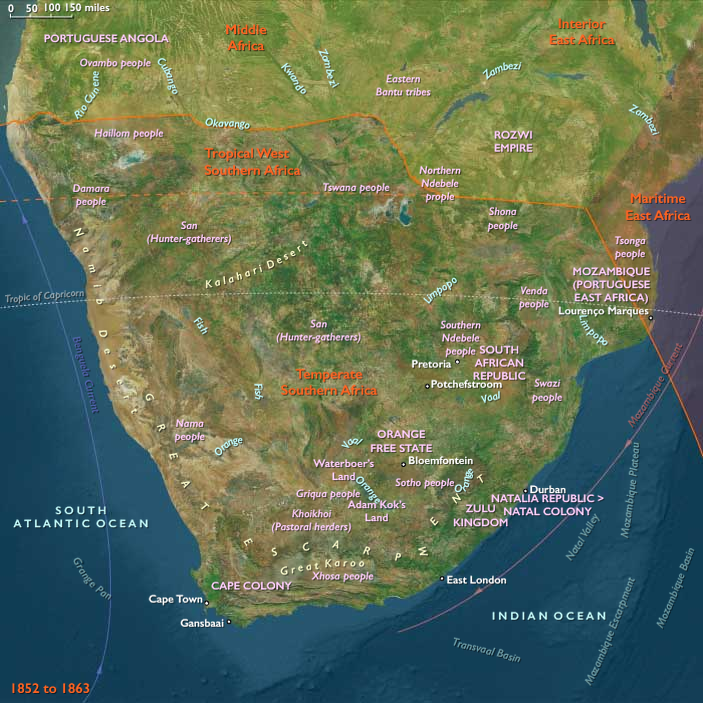
In 1848, after the northern frontier was threatened by fighting between Voortrekkers and Griqua on the Orange River and by continued competition for resources among settlers and Africans, the governor of the Cape Colony, Sir Harry Smith, had annexed all the land between the Orange and the Vaal rivers.
This area, which the British called the Orange River Sovereignty, comprised large numbers of Voortrekker communities and practically all of the Sotho state, Lesotho.
Smith, urged on by land-hungry white settlers, also annexed the Xhosa lands between the Keiskama and the Great Kei rivers that the British had first taken and then returned in 1835 and 1836.
Moreover, he sought to win a decisive military victory over the Xhosa and to break forever the power of their chiefs by pursuing a ruthless war against them from 1850 to 1852.
The British have mixed success.
Their attempts to tax the Orange River Voortrekkers produce almost no revenue.
Claims to Sotho lands are met with opposition from Moshoeshoe, who in 1851 and 1852 successfully defeata British attempts to extend their authority into his lands.
As a result of the Sotho resistance, the British decide to withdraw from the Highveld, but in so doing they recognize the primacy of European rather than African claims to the land.
The Sand River Convention of 1852 and the Bloemfontein Convention of 1854 recognize the independence of the South African Republic and the Orange Free State, respectively, as Voortrekker republics so long as their residents agree to acknowledge the ultimate sovereignty of the British government, agree not to allow slavery in their territories, and agree not to sell ammunition to Africans.
Not until 1868 will the British again attempt to extend their power onto the Highveld, and this is only when Lesotho's defeat by the Orange Free State is so complete that the total destruction of the Sotho people seems likely.
Native insurgents led by Maqoma have established themselves in the forested Waterkloof (today a suburb of the city of Pretoria) in the course of the 8th Xhosa War that began in 1850.
From this base, they have managed to plunder surrounding Afrikaner farms and torch the homesteads.
Maqoma's stronghold is situated on Mount Misery, a natural fortress on a narrow neck wedged between the Waterkloof and Harry's Kloof.
The Waterkloof conflicts have lasted two years.
Maqoma has also led an attack on Fort Fordyce and inflicted heavy losses on the forces of Sir Harry Smith.