Near East (717–706 BCE): Religious and Political Transformations
Syncretism and the Rise of Samaritan Identity
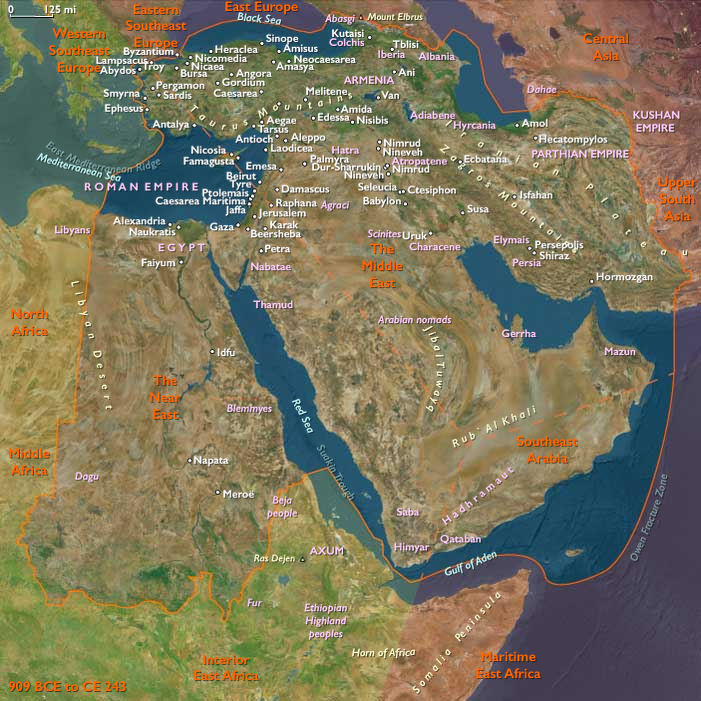
After the fall of Samaria, its new inhabitants—colonists from diverse parts of the Assyrian Empire—initially worship their own deities. According to later Jewish tradition, when dangerous wild animals infest the region, these colonists appeal to the Assyrian king for priests from Israel to instruct them on how to worship the local god, Yahweh. This leads to the emergence of a syncretistic form of religion, blending the worship of Yahweh with their original gods. Today's Samaritans, who regard themselves as descendants of the tribes of Ephraim and Manasseh, continue to honor the Pentateuch as their sacred scripture and worship at Mount Gerizim. Modern genetic studies confirm Samaritan claims of Israelite lineage through male ancestors, with maternal lines indicating Assyrian and other foreign origins.
Nubian Religious Revival: The Shabaka Stone
During the reign of Pharaoh Shabaka of Egypt’s Nubian Twenty-fifth Dynasty, a significant religious artifact known as the Shabaka Stone is produced. Discovered by Shabaka himself at the temple of Ptah in Memphis, this slab records the deteriorating text of an ancient papyrus. The Shabaka Stone preserves the Memphite Theology, a sophisticated religious doctrine elevating Ptah, god of craftsmen, as the creator of all existence. According to this theology, Ptah conceives all things mentally and brings them into existence by speech—a concept reflecting a high level of abstraction and philosophical sophistication in Egyptian religious thought.
Moab Under Assyrian Influence
Moab, despite linguistic and cultural affinities with its Israelite neighbors, faces religious and political marginalization from Judahite society. This isolation is underscored by scriptural prohibitions (Deuteronomy 23:3-6) and prophetic denunciations (Isaiah 25:10). By the late eighth century BCE, Moab becomes a tributary of Assyria, signaling its integration into the expanding Assyrian sphere of influence.
Religious and Political Reforms in Judah
The fall of the northern kingdom deeply influences the southern kingdom of Judah, prompting religious introspection and political caution. Under King Hezekiah, who succeeds Ahaz in 715 BCE, Judah initiates significant religious reforms aimed at eradicating Canaanite religious practices and reaffirming the worship of Yahweh. These reforms contrast sharply with Ahaz's earlier policies, which had subjected Judah to Assyrian dominance. The prophet Isaiah resumes his activity during this period, addressing Hezekiah’s political efforts to extricate Judah from Assyrian suzerainty, notably during a failed rebellion involving Tyre and Sidon against Sargon II in 710 BCE.
Cyprus and the Assyrian Hegemony
In 709 BCE, Cyprus submits to Assyrian King Sargon II, who consolidates his regional authority by erecting a stela at Citium. Seven Cypriot city-kings—Curium, Paphos, Marion, Soli, Lapithos, Salamis, and Amathus—formally acknowledge his dominance. Subsequent Assyrian records add four more kingdoms—Citium, Kyrenia, Tamassos, and Idalium—to the list of tributary states. Although nominal, this acknowledgment underscores the broad reach of Assyrian imperial power, which extends over Cyprus until approximately 663 BCE.
Legacy of the Era
The period from 717 to 706 BCE is marked by profound transformations in religion and politics across the Near East. The emergence of Samaritan identity, theological innovation in Nubian-controlled Egypt, and Judah’s religious reforms under Hezekiah significantly shape the cultural and political landscape. Meanwhile, Assyria’s expanding influence, exemplified by its dominance over Moab and Cyprus, sets the stage for further imperial entanglements and cultural exchanges in the region.